Manitoba Passenger Limits by Design
It's easy to get excited about heading out on Manitoba's trails with friends or family, but a common pitfall many off-road vehicle (ORV) enthusiasts face is misunderstanding exactly how many people their machine can legally and safely carry. This guide will walk you through the essential rules and practical considerations regarding passenger limits for ATVs and UTVs in Manitoba, focusing on the crucial concept of a machine's "design capacity."
Understanding Manitoba's ORV Passenger Rules
The trails, ditches, and backcountry of Manitoba offer incredible adventures, but they also come with a clear set of rules designed to keep everyone safe. One of the most often misunderstood regulations revolves around how many passengers your off-road vehicle can actually hold. It’s not just about fitting people on; it's about what your machine was designed for, right from the factory.
Why 'By Design' Matters
When we talk about "passenger limits by design," we're diving into the fundamental engineering of your ATV or UTV. Manufacturers don't just arbitrarily decide how many seats to put on a machine; every aspect, from the chassis and suspension to the braking system and even the engine's power, is calibrated for a specific load and number of occupants. A single-rider ATV, for instance, is engineered for one person's weight distribution, braking force, and center of gravity. Adding a second passenger, even a small one, completely throws off this delicate balance. The machine becomes unstable, harder to steer, and its braking distance significantly increases. It's not just uncomfortable; it's genuinely dangerous.
Think of it this way: when you're navigating a tight turn on a rocky trail, or trying to stop quickly to avoid a deer, your machine needs to respond predictably. If it's overloaded or the weight isn't distributed as intended, that predictability goes right out the window. This is why Manitoba's regulations, much like those in many other jurisdictions, focus so heavily on the manufacturer's original design. It's a critical safety measure, preventing riders from inadvertently turning a nimble, capable machine into an unpredictable and hazardous one. Failing to respect these design limits can lead to serious accidents and put everyone on board, and even other trail users, at risk.
Single vs. Multi-Passenger Machines
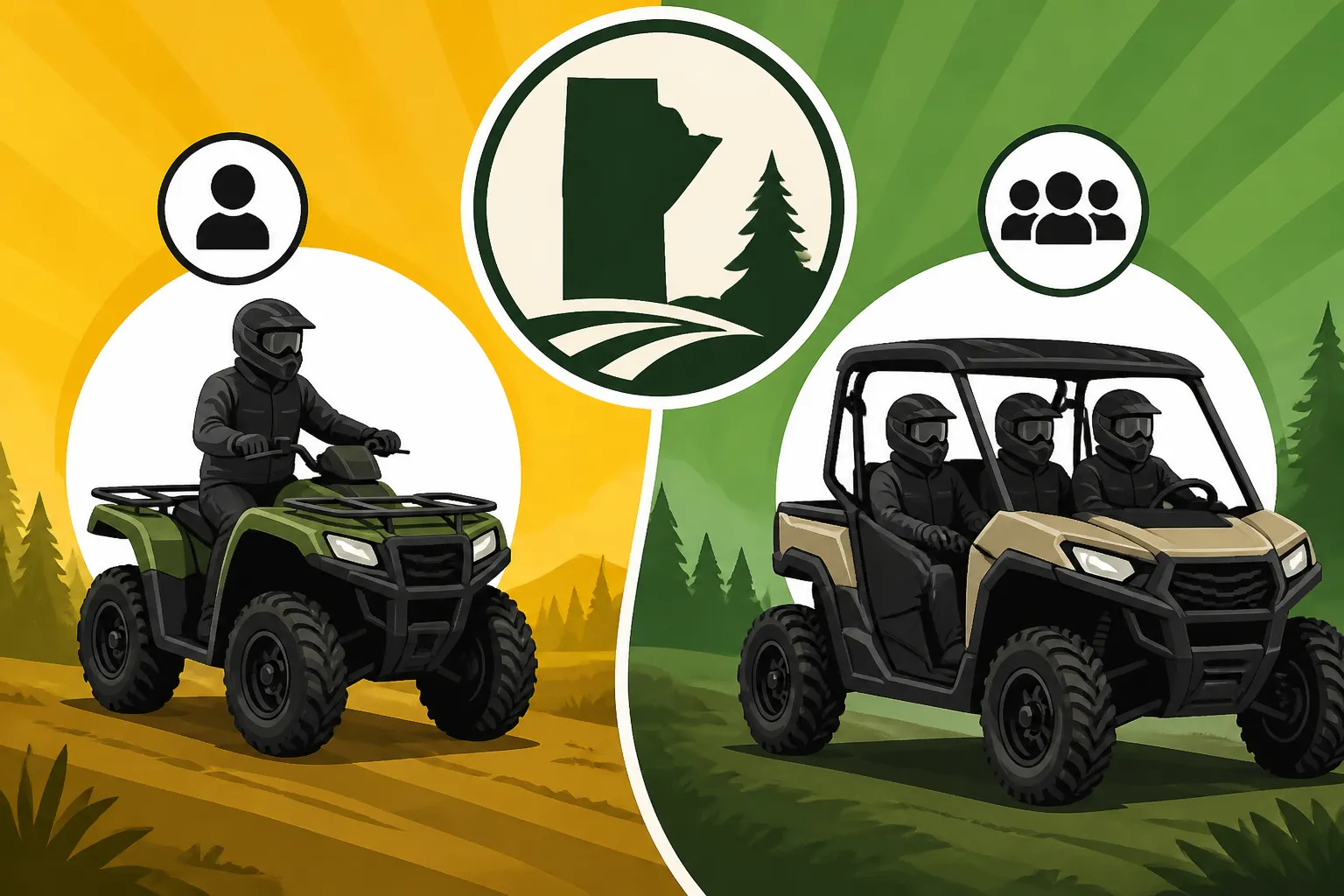
The world of ORVs is diverse, and so are their passenger capacities. Generally, ATVs are either designed for a single operator or for an operator plus one passenger. You'll often hear these referred to as "single-rider ATVs" or "two-up ATVs." A single-rider ATV typically has a long, narrow seat meant for one person. There are no additional footrests or handholds for a second rider, and the seat might even slope upwards at the rear, signaling it's not meant for another person. Trying to squeeze a passenger onto a single-rider ATV is not only illegal in Manitoba but also incredibly unsafe, as it compromises the machine's stability and handling.
On the other hand, a "two-up" ATV is specifically built with a longer, often stepped seat, dedicated footrests for a passenger, and sometimes even grab handles. Its suspension and frame are reinforced to handle the added weight, and the overall design accounts for the different center of gravity with two people aboard. UTVs, or side-by-sides, are a different beast entirely. These machines are purpose-built with multiple seats, often resembling miniature cars with roll cages and seatbelts. They come in configurations for two, three, four, or even six passengers, and their design clearly dictates the number of people they can safely carry. Brands like SuperATV offer a wide range of accessories and parts for UTVs, but regardless of what you add, always adhere to the machine's original seating design. Understanding these distinctions is your first step towards safe and legal riding in Manitoba. [Manitoba Passenger Limits by Design] are a key part of responsible operation.
Practical Implications for Riders
Knowing the rules is one thing, but truly understanding their practical implications for your everyday riding experience is another. It's not just about avoiding a ticket; it's about ensuring every ride is enjoyable and, most importantly, safe for everyone involved.
The Dangers of Overloading
The temptation to bring an extra person along, especially on a scenic ride, can be strong. However, overloading an ORV beyond its design capacity is an incredibly dangerous gamble. First and foremost, stability is severely compromised. A machine designed for one person will handle very differently with two, especially on uneven terrain or during turns. The added weight, particularly if it's high up or poorly distributed, can dramatically increase the risk of a rollover. Imagine navigating a steep incline or a sharp corner with twice the intended weight – the machine becomes top-heavy and much harder to control.
Braking is another critical area affected by overloading. More weight means more momentum, and that requires a longer distance to stop. In an emergency situation, those extra feet could be the difference between a close call and a serious collision. Suspension components also take a beating, potentially leading to premature wear, reduced shock absorption, and a much rougher ride. Beyond the physical dangers, there are legal consequences. An officer spotting an overloaded machine isn't just seeing a rule infraction; they're seeing a significant safety hazard. You could face a ticket, and in the event of an accident, your insurance coverage could be jeopardized if it's determined you were operating outside of the manufacturer's specifications. Always keep in mind [Manitoba Accident Reporting Rules] if the worst should happen, but it's far better to prevent it.
Checking Your Machine's Specifications
So, how do you know your machine's official passenger limit? It's simpler than you might think, but often overlooked. The first place to check is your owner's manual. This invaluable resource contains all the manufacturer's specifications, including the exact number of passengers your ATV or UTV is designed to carry. It will also outline weight limits and any specific instructions for carrying passengers. If you bought your machine used and don't have the manual, don't despair. Most manufacturers have digital versions available for download on their websites. You'll usually need your machine's VIN (Vehicle Identification Number) or model number to find the correct manual.
Another key indicator is the machine itself. Look for labels or decals affixed by the manufacturer, often near the driver's seat, on the frame, or under the hood. These labels typically provide crucial safety information, including seating capacity. For UTVs, the number of actual seats with seatbelts is usually a dead giveaway. If you have any doubt, visiting your local authorized dealer is a great idea. They can look up your machine's specifications and give you definitive guidance. It’s always better to confirm than to guess when it comes to safety and legality. When considering additions to your machine, like a utility box or a new winch, remember that even products from reputable brands like SuperATV should be installed with your machine's overall weight and design limits in mind. Understanding [Manitoba Equipment Checks by Officers] means being prepared for these details to be scrutinized.
Legal Ramifications and Enforcement
It's one thing to know the safety risks of overloading your ORV, but it's equally important to understand the legal consequences that can follow if you're caught breaking the rules in Manitoba. Law enforcement takes these regulations seriously because they are directly tied to public safety.
Penalties for Exceeding Passenger Limits
Operating an ORV with more passengers than it was designed to carry is a violation of Manitoba's Off-Road Vehicles Act. The penalties for such an infraction can vary but typically involve fines. While I can't give you specific dollar amounts as they change over time, rest assured that these tickets are not trivial. They are meant to be a deterrent and a clear signal that unsafe operation will not be tolerated. Beyond the immediate financial hit, there could be other, more severe ramifications. For instance, if you're involved in an accident while exceeding your machine's passenger limit, your insurance company might deny coverage for damages or injuries, arguing that you were operating the vehicle outside of its intended and insured parameters. This could leave you personally liable for significant medical bills, property damage, or legal costs.
It's also worth noting that operating carelessly, which could be argued if you're knowingly overloading a machine, carries its own set of substantial penalties. [Manitoba Careless Operation Penalties] can be far more severe than a simple ticket for too many passengers. The consequences highlight why adhering to these design limits isn't just about following the law; it's about protecting your wallet, your future, and everyone's well-being.
Officer Discretion and Spot Checks
Manitoba Conservation Officers, RCMP, and local police officers are all authorized to enforce the Off-Road Vehicles Act. This means that whether you're deep in the Whiteshell Provincial Park, crossing a field near Brandon, or simply riding in a ditch permitted for ORV use, you could be subject to a spot check. Officers are trained to quickly identify machines that appear overloaded or operated unsafely. They'll look for tell-tale signs: a sag in the suspension, riders crammed together, or a passenger clinging precariously to a spot not designed for seating.
During a stop, an officer will likely ask for your [Manitoba Registration Cards Carried at All Times] and possibly your proof of insurance. They'll also observe how your machine is being operated and how many individuals are on board. It's not uncommon for officers to carry information about common ORV models, allowing them to verify a machine's design capacity on the spot. If they determine you're exceeding the passenger limit, they have the discretion to issue a warning or, more likely, a citation. Remember, their primary goal is safety on the trails and in communities. Being polite and cooperative is always best, but compliance with the law, particularly regarding passenger limits, is non-negotiable.
Common ORV Passenger Design Capacities
To help clarify the differences, here's a quick look at typical passenger capacities based on machine design. Always verify with your specific model's manual!
| Machine Type | Typical Passenger Design | Features to Look For | Legal Limit in Manitoba (By Design) |
|---|---|---|---|
| Single-Rider ATV | 1 Operator | Long, narrow seat for one, no passenger footrests/handholds | 1 |
| Two-Up ATV | 1 Operator, 1 Passenger | Longer, stepped seat, dedicated passenger footrests/handholds | 2 |
| 2-Seat UTV | 1 Operator, 1 Passenger | Two bucket seats, seatbelts, roll cage | 2 |
| 3-Seat UTV | 1 Operator, 2 Passengers | Bench seat or three bucket seats, seatbelts, roll cage | 3 |
| 4-Seat UTV | 1 Operator, 3 Passengers | Two rows of bucket/bench seats, seatbelts, roll cage | 4 |
| 6-Seat UTV | 1 Operator, 5 Passengers | Three rows of bucket/bench seats, seatbelts, roll cage | 6 |
This table provides a general overview, but your specific machine's design is the ultimate authority. Always check your owner's manual! [Manitoba Rules for a Child Passenger] also apply, regardless of the machine's capacity, and typically mean a child counts as a passenger just like an adult. You'll also want to review [Manitoba Seat Belt Rules] for UTVs.
Understanding and adhering to your ORV's passenger limits by design isn't just about following a rule; it's about embracing responsible riding. It ensures the safety of everyone on your machine and helps preserve the integrity of the trails we all share. Before you head out, take a moment to confirm your machine's capacity and make sure you're geared up for a safe and legal adventure in Manitoba. This goes for all riders, whether you’re learning to ride at [Registering Your First Quad at Age 16] or are a seasoned veteran.
Disclaimer
This article is for general informational purposes only and does not constitute professional advice. Laws, prices and regulations vary by location and change over time. Consult a qualified professional for guidance on your specific situation.