40 km/h at Most
It's a common scenario for many of us who love hitting the trails or using our quads for work on the farm: you need to get from Point A to Point B, and a short stretch of roadway or shoulder seems like the only sensible option. But then you hear whispers about speed limits, specifically that "40 km/h at most" rule, and suddenly you're wondering if you're going to get a ticket just for trying to get home. This guide is here to untangle the specifics of Manitoba's 40 km/h speed limit for off-road vehicles, helping you understand where and when it applies, and how to stay safe and legal on those necessary road segments.
The Rationale Behind Manitoba's 40 km/h Off-Road Vehicle Speed Limit
When you’re out on your ATV or UTV, whether it's for recreation or agricultural purposes, there are times you might find yourself needing to use the shoulder of a public roadway. It’s not always about tearing down a trail; sometimes it’s about practical access. Manitoba's 40 km/h shoulder limit for off-road vehicles isn't an arbitrary number; it's a carefully considered regulation designed to balance the needs of ORV users with the safety of all road users. It acknowledges that while ORVs can be essential tools and fantastic recreational machines, they operate differently than cars and trucks on paved or gravel road surfaces.
Balancing Safety with Practicality on Shared Roadways
The primary goal of the 40 km/h speed limit is safety, pure and simple. Off-road vehicles, by their very design, are not built to perform like highway vehicles. Their suspension, tires, and steering are optimized for rough terrain, not high-speed travel on hard surfaces. When you introduce an ORV onto a road shoulder, even for a short distance, you're placing a slower, less predictable vehicle into an environment where cars and trucks are moving at much higher speeds. A significant speed differential increases the risk of serious accidents.
Think about it: a car cruising at 90 km/h comes upon an ORV moving at 40 km/h. That 50 km/h difference means the closing speed is considerable, leaving less time for either driver to react if something unexpected happens. This rule helps to minimize that speed differential, giving everyone more time to anticipate and respond to changing conditions. It’s a practical compromise that allows ORV operators necessary access while attempting to mitigate the inherent risks of mixing different types of traffic. It’s about ensuring that riders can get where they need to go without becoming a major hazard to themselves or others.
Who the "40 km/h at Most" Rule Primarily Affects
This specific speed limit isn't a blanket rule for all ORV use. It's targeted directly at situations where off-road vehicles are permitted to use the shoulder of a highway, primarily under the [Manitoba's Agricultural Shoulder Exception]. This means if you're using your ATV or UTV for farming purposes – maybe moving between fields, heading to a neighbouring property to help out, or transporting equipment – and you need to use the shoulder of a provincial road, this 40 km/h limit applies to you.
It's important to understand that this isn't about recreational riding on roadways. [Manitoba Bans Riding on Roadways] for the most part. This exception is quite specific. It recognizes the agricultural needs of rural communities where ORVs are often integral to daily operations. However, it comes with the caveat of a reduced speed to ensure that this practical necessity doesn't compromise public safety. If you're using your machine for commercial fishing or trapping and need to use a shoulder, similar considerations apply. The rule is designed for those instances where an ORV is a working vehicle needing to transition temporarily on a public right-of-way.
Understanding the Agricultural Shoulder Exception
The "agricultural shoulder exception" is a lifeline for many farmers in Manitoba, allowing them to legally operate their ORVs on highway shoulders to access their fields or other farm properties. However, it's not a free pass. Beyond the 40 km/h speed limit, there are other conditions you must meet. For instance, your ORV must be equipped with a [Manitoba Slow-Moving Vehicle Sign] displayed prominently on the rear. This sign serves as a clear warning to other motorists that you're moving at a reduced speed.
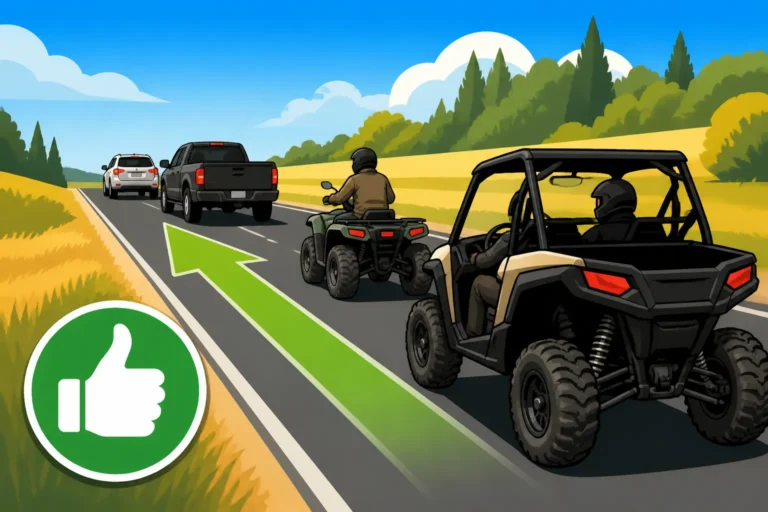
Furthermore, this exception typically applies only to machines with more than two wheels, meaning your quad or side-by-side (UTV) might qualify, but a dirt bike generally would not for shoulder use. The idea is to permit larger, more stable machines that are often used in agricultural settings to operate on these segments of road. You also need to be riding in the same direction as traffic, and only on the right-hand shoulder. This isn't about crisscrossing the highway or riding against the flow of vehicles; it's about predictable, controlled movement along a designated path. Failing to meet any of these conditions could negate the exception and potentially lead to a ticket, even if you are going 40 km/h at Most.
Specific Scenarios Where the 40 km/h Limit Applies to ORVs
Navigating the rules for off-road vehicles in Manitoba can sometimes feel like trying to solve a puzzle with missing pieces. The 40 km/h limit isn't universal for all ORV use; it's specific to certain situations. Understanding these scenarios is key to staying compliant and avoiding unnecessary run-ins with enforcement. It’s about knowing when you can even be on a shoulder, and then how fast you’re permitted to travel.
Navigating Provincial Road Shoulders
The most common situation where you’ll encounter the 40 km/h limit is when operating an ORV on the shoulder of a provincial highway. As we've discussed, this is primarily under the agricultural exception. Imagine you're a farmer needing to move your UTV loaded with tools from one field to another, perhaps a kilometre down the road, and the only practical route involves a short stretch of provincial highway shoulder. This is exactly the scenario where you must adhere to the 40 km/h maximum.
It's crucial to remember that "shoulder" means just that – the paved or gravel area immediately adjacent to the main driving lanes, to the right of the white line. It does not mean the ditch, which has its own distinct set of regulations under [Manitoba Ditch Riding Rules]. The shoulder is considered part of the highway right-of-way, and thus, rules for its use are stringent. This specific provision aims to enable necessary agricultural movement without creating undue risk for faster-moving highway traffic. Always make sure your machine is clearly visible, especially if it's got aftermarket accessories like robust SuperATV skid plates or lift kits that might make it stand out – though these are for trail performance, on the road, visibility through proper lighting and signage is paramount.
Municipal Roadways and Local By-Laws
While provincial highways have clear rules, what about municipal roads or local streets within towns and rural municipalities? This is where things can get a little more complex. The province sets the overarching framework, but [Manitoba Municipal By-Law Powers] allow local governments to create their own specific rules regarding ORV use on roads, ditches, or shoulders within their boundaries. Some municipalities might have by-laws that open certain roads or shoulders to ORVs, sometimes with their own speed restrictions or specific hours of operation.
It's entirely possible that a rural municipality might have a by-law permitting ORVs on certain gravel roads or shoulders at speeds different from the provincial 40 km/h limit, or they might prohibit it entirely. Before you even think about hitting a municipal road or shoulder with your ORV, it is absolutely essential to check the local by-laws for that specific area. What's legal in one rural municipality might be strictly forbidden in the next. A quick call to the local municipal office or a check of their website can save you a lot of hassle and potential fines. Don't assume that just because you can ride the shoulder of a provincial highway under the agricultural exception, you can do the same on a local road.
Distinguishing Ditch Riding from Shoulder Riding Speed Limits
It’s easy to confuse shoulder riding with ditch riding, but in Manitoba, they are two distinct activities governed by different rules. As outlined in [Manitoba Ditch Riding Rules], ORVs are generally allowed to operate in ditches of provincial roads, but not necessarily on the shoulder itself, unless under specific exceptions like the agricultural one. The 40 km/h limit we’re discussing applies strictly to the shoulder. Ditch riding, while often slower by nature due to terrain, doesn't carry the same explicit 40 km/h speed cap from the province, though prudent speed is always advised.
The ditch is considered a separate area from the paved or gravel shoulder. When you are in the ditch, you are expected to operate safely, but you're typically not subject to the same strict speed limitation as you would be on the shoulder, mainly because you are further removed from high-speed traffic. However, this doesn't mean you can tear through a ditch at unlimited speed. Officers can still cite you for careless operation if you're riding too fast for the conditions, even if no explicit speed limit is posted. The key takeaway is: if you're on the shoulder of a provincial highway for an allowed purpose (like farming), the 40 km/h rule is firm. If you're in the ditch, general safe operating principles apply, and you should always be aware of your surroundings and potential hazards, including private property.
Essential Equipment and Practices for Safe, Legal Road Use at 40 km/h
Operating your off-road vehicle on public road shoulders, even at a controlled speed, requires more than just knowing the speed limit. It demands adherence to specific equipment requirements and responsible riding practices to ensure your safety and the safety of others. It’s about making your machine as visible and predictable as possible in an environment where it’s an outlier.
The Mandate for Slow-Moving Vehicle Signs
One of the most critical, yet often overlooked, requirements for ORVs operating on highway shoulders under the agricultural exception is the display of a [Manitoba Slow-Moving Vehicle Sign]. This triangular, fluorescent orange sign with a red reflective border isn't just a suggestion; it's a legal necessity. Its purpose is unequivocal: to alert faster-moving traffic from behind that your vehicle is traveling at a significantly reduced speed.
Imagine driving a car down a highway at 100 km/h. If you come up on an ORV at 40 km/h without that bright orange triangle, it might take you precious extra seconds to register the speed difference, which could be the difference between a safe pass and a dangerous situation. The SMV sign provides an immediate visual cue, giving drivers ample warning and time to adjust their speed or prepare to pass safely. Ensure your sign is clean, properly mounted on the rear of your machine, and not obscured by cargo or mud. A sign that can't be seen is as good as no sign at all, and an officer doing [Manitoba Equipment Checks by Officers] will certainly notice if it's missing or unreadable.
Ensuring Your Machine is Road-Ready
Even though you’re only permitted to travel at 40 km/h, your ORV still needs to be in good working order to handle even this limited road exposure safely. This means checking your tires, brakes, lights, and general mechanical condition before you head out onto any shoulder. Are your tires appropriate for road use, or are they aggressive mud tires that might handle poorly on pavement or gravel? While SuperATV offers a fantastic range of aftermarket parts that enhance off-road performance, like their heavy-duty control arms or axle upgrades, when you're on the shoulder, reliability and road-specific considerations become paramount.
Your brakes must be fully functional and able to stop your machine predictably. Lights – headlamps and taillights – are absolutely essential, especially if you're operating near dawn, dusk, or in inclement weather. Even in broad daylight, fully functioning lights improve your visibility to other motorists. Remember, road surfaces can be unforgiving. A loose steering component or worn-out brakes that might be manageable on a slow trail could lead to serious trouble at 40 km/h on a busy shoulder. Treat these short road sections with the same mechanical respect you would a long trail ride; preventive maintenance is key.
Visibility: Lights, Reflectors, and Rider Responsibility
Beyond the slow-moving vehicle sign, your personal responsibility for visibility cannot be overstated. Wearing bright, contrasting colours, especially reflective gear, can significantly increase your profile to other drivers. While your ORV should have functional lights from the manufacturer, consider adding auxiliary lights or additional reflectors if your machine will be frequently used on shoulders, even briefly. The more visible you are, the safer everyone is.
Think about the conditions. A dusty gravel shoulder can reduce visibility for everyone. Rain, fog, or even just the low angle of the sun can make a 40 km/h ORV blend into the background. As the operator, it's your job to take every reasonable precaution to make yourself seen. Don't assume that because you can see an oncoming vehicle, they can see you just as clearly. Make eye contact if possible, and always ride defensively. This proactive approach to visibility is a cornerstone of safe riding on shared roadways, regardless of the specific speed limit.
Understanding the Penalties and Risks of Exceeding 40 km/h
It's tempting to think that an extra 10 or 20 km/h on a short stretch of road won't hurt anyone, especially when you're in a hurry. However, breaking the 40 km/h speed limit for ORVs on a road shoulder in Manitoba carries real consequences, both legally and in terms of safety. These rules are in place for a reason, and ignoring them can lead to a host of problems that far outweigh any perceived time savings.
Financial Fines and Legal Consequences
Exceeding the posted 40 km/h limit on a provincial road shoulder, or failing to meet other requirements like displaying a [Manitoba Slow-Moving Vehicle Sign], can result in a traffic citation. Just like with cars, speeding on an ORV can incur significant [Manitoba Ticket Costs for Riders]. These fines are not trivial and can quickly add up, especially if you receive multiple tickets. Moreover, a conviction for a traffic offense can impact your driving record, potentially affecting your insurance premiums for your other vehicles.
Law enforcement officers are well aware of the rules governing ORV use on roads and shoulders. They are specifically trained to identify violations, and they take these rules seriously because they are directly tied to public safety. Getting pulled over and ticketed is not just an inconvenience; it can be a costly lesson. Beyond the fine itself, you might also face court costs or have to spend time dealing with the legal system. It's a much smoother experience to simply adhere to the limit and avoid the hassle altogether.
Increased Accident Risk and Liability
The most severe consequence of exceeding the 40 km/h limit is the dramatically increased risk of an accident. At higher speeds, even a minor steering correction or an unexpected bump on the shoulder can lead to a loss of control. As mentioned earlier, ORVs are not designed for high-speed road travel, and their handling characteristics change significantly on pavement or hard gravel compared to off-road terrain. A tire blowout, a sudden swerve, or an encounter with road debris at higher speeds can quickly escalate into a dangerous situation.
If an accident does occur, especially if you were exceeding the speed limit, your liability can be substantial. While basic ORV registration in Manitoba includes some third-party liability coverage, intentionally violating traffic laws could complicate any insurance claims or legal defense. Imagine the devastating impact if your actions lead to an accident involving another vehicle or pedestrian. The financial and emotional toll could be immense. Sticking to the 40 km/h limit isn't just about avoiding a ticket; it's about making a conscious choice to minimize a very real and severe risk to yourself and others.
Impact on Public Perception and Future Access
Every time an ORV operator disregards the rules, it chips away at the positive public perception of off-road enthusiasts. When motorists see ORVs speeding on shoulders or operating recklessly, it reinforces negative stereotypes and can lead to calls for stricter regulations or outright bans. The privilege of using shoulders for specific purposes, such as agriculture, is hard-won and can be easily lost if a pattern of non-compliance emerges.
Consider the ongoing efforts by ATV clubs and associations to expand trail networks and secure responsible access for riders. These groups work tirelessly to build relationships with landowners, municipalities, and government bodies. Incidents of rule-breaking undermine their work and make it harder to gain acceptance for future ORV initiatives. Adhering to the [Manitoba Rules for Riding a Shoulder], including the 40 km/h speed limit, is a small but significant way to demonstrate responsible riding and help preserve the limited access that off-road vehicles currently have to certain public roadways. It’s about being a good ambassador for the sport and ensuring that future generations can continue to enjoy their machines.
| Scenario | Legal Speed Limit | Key Conditions & Notes |
|---|
| Feature | Primary Use Case | Key Distinction |
|---|---|---|
| Primary Function: | To enable an individual to drive an ORV on roads | This is the official document from Manitoba Public Insurance (MPI) verifying an ORV has met all requirements for legal operation. It includes the identification of the ORV, the owner's information, and the validity period. Without it, your machine isn't considered properly registered for any use beyond specific exemptions. |
| Why You Need It: | Legal requirement for operation on public land/roadways | If you plan to ride your ORV anywhere off your own private property, or any property where you have specific consent from the landowner, then registration is mandatory. This includes designated trails, Crown land where ORVs are allowed, and those specific situations where you might use a road shoulder or cross a roadway. |
| Issued By: | Manitoba Public Insurance (MPI) | MPI is the provincial body responsible for vehicle registration and insurance, including off-road vehicles. You'll interact with them or their authorized Autopac agents to complete the registration process. |
| Contents: | ORV details (VIN, make, model), owner's name/address, plate number, expiry date | This card acts as proof that your ORV meets the provincial standards for identification and ownership. It links your machine to you, and verifies that its registration is current. |
| Mandatory: | Yes, must be carried when operating ORV | It's not enough to just have your ORV registered; you must carry the registration card with you every time you operate the machine. This ensures that if you're stopped by an enforcement officer, you can immediately provide proof of legal registration. |
Disclaimer
This article is for general informational purposes only and does not constitute professional advice. Laws, prices and regulations vary by location and change over time. Consult a qualified professional for guidance on your specific situation.