Who Has the Final Say on a Crossing
An ATV crossing that looks open from the trail can still be off-limits, and permission from the wrong person may not count. In Manitoba, the answer depends on the road, the crossing location and the rules set by the authority responsible for that road. This guide explains who to ask, what to check and how to avoid mistaking a safe-looking gap for a legal crossing.
Who has authority over an ATV crossing in Manitoba
There is not one person who can approve every off-road vehicle crossing in Manitoba. Responsibility depends on who controls the road and what the provincial rules allow. A landowner, trail club or nearby resident may be able to answer questions about access to their land, but that does not automatically give them authority over a public road.
Start by identifying the road and the precise crossing point. A route shown on a club map, or a track you have ridden before, does not necessarily mean the road authority has approved ATV traffic there. If you are unsure which government is responsible, ask the municipality or local government district where the crossing is located.
The road authority sets the local answer
A municipal council or local government district may have rules affecting off-road vehicle use on roads under its jurisdiction. Those rules can differ from one community to another. A crossing that is allowed or designated in one municipality may not be allowed in a neighbouring area.
Provincial highways require particular care. Do not assume a town’s permission applies to a provincial highway, or that a permission for one road applies to every road in the area. Ask the relevant road authority whether that specific crossing is allowed, and whether its answer applies to the type of road and machine you plan to use.
When you call, describe the crossing rather than asking only, “Can I ride here?” Give the road name or number, nearby intersection or landmark, direction of travel, and whether you mean to cross or ride along the road. Those are different activities and may have different rules.
A landowner or trail club cannot overrule road rules
A landowner can grant permission to travel across private property, but that permission does not convert a public roadway into a legal ATV route. Likewise, a trail club can provide useful local guidance about its trails and crossings, but it cannot replace a municipal bylaw or other applicable road rule.
This distinction can be easy to miss. Imagine a private trail leading to a gravel road, with tire tracks continuing on the other side. The landowner may have authorized the trail, and riders may have crossed there in the past, but neither fact proves the road crossing is currently permitted. Confirm the crossing itself with the authority responsible for the road.
The same principle applies to aftermarket equipment. A mirror or light from SuperATV may help with awareness or visibility, but accessories do not grant legal permission to cross a road. Treat equipment, permission and operating rules as separate checks.
The rider remains responsible for checking
A trail sign, online route, map app or another rider’s advice can be a useful starting point, not a guarantee. Signs may be missing or outdated, and a route may cross property or roads with different rules along the way.
Before heading out, confirm the applicable [Manitoba ORV Road Rules Explained] and ask the authority responsible for the crossing if anything is unclear. If you are riding near a town or community boundary, check both sides of the boundary rather than assuming the rules continue unchanged.
What the rules mean for the crossing itself
Permission from a road authority does not mean you can cross in any manner or at any point. Manitoba’s operating rules include requirements that affect where and how a crossing may be made. A crossing can be unlawful or unsafe even when a rider has a legitimate reason to reach the trail on the other side.
Keep these questions separate: Is crossing allowed at this location? Does the operator meet the requirements? Can the crossing be made safely under the conditions at that moment? A “yes” to one does not answer the others.
Check the location and distance to intersections
Crossing rules can depend on the road layout and the distance to an intersection. Pay attention to the requirements concerning [Crossing Within 5 Metres of an Intersection] and [Crossing at Least 3 Kilometres From an Intersection]. Do not estimate casually while approaching a road. A bend, side road or obstructed view can make a location less straightforward than it appears on a map.
If you cannot confidently identify the relevant intersection or determine whether the location meets the applicable rule, do not cross there on the assumption that it is acceptable. Ask the road authority about the exact spot, or find a crossing whose legal status is clear.
The terms can also be confusing because an intersection, a trail entrance and a road crossing are not necessarily the same thing. When requesting guidance, name the nearest road junction and describe where the trail meets the road. That helps the authority assess the actual location instead of answering a general question that may not fit your route.
Follow operator requirements and crossing procedure
The operator may need to meet specific requirements before crossing. Review [Manitoba Crossings Need a Driver's Licence] rather than assuming that a learner’s permit or an ordinary ability to operate the machine is enough. If a young rider is in the group, check the rules for that rider’s age and licence status before you leave.
At the road, approach cautiously, stop as required, yield to traffic and cross only when the route is clear. Follow the applicable rules for crossing one machine at a time and maintaining a clear view. Never let a group’s momentum push a rider into a gap that is not safe. Each operator should make their own crossing decision.
Visibility accessories can help a rider notice hazards, but they do not remove the need for a clear view or a safe opening in traffic. A SuperATV mirror, for example, is not a substitute for stopping, looking carefully and following the crossing rules. If brush, a hill, parked equipment or weather blocks your view, choose another location.
Crossing is different from riding along a road
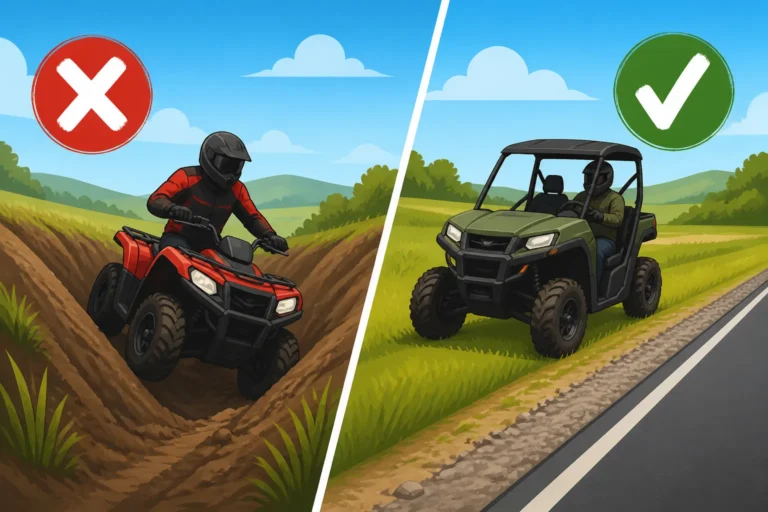
A permitted crossing does not mean the roadway is open for ATV travel. Manitoba generally restricts off-road vehicles from roadways, subject to limited exceptions and applicable local rules. Do not turn a short crossing into a shortcut along the road because the trail seems to continue farther ahead.
Be especially cautious where a trail appears to run beside a road or where a ditch seems to provide an easy route. Rules can differ for a crossing, a ditch, a shoulder and the roadway itself. Review [Manitoba Ditch Riding Rules] and [Manitoba Rules for Crossing a Highway] for the distinctions that may affect your route.
A common mistake is to see another rider travelling along a road and conclude that the route is allowed. That rider may have permission, may be in a different jurisdiction, or may simply be breaking the rules. Follow the requirements that apply to your machine and location, not the behaviour you happen to observe.
How to get a clear answer before you ride
When road responsibility is unclear, a few minutes of preparation can prevent a frustrating turn-around—or a dangerous mistake. The key is to ask a specific question and get the answer from someone with authority over that road.
Identify the road and the exact spot
Write down the road name or number, the nearest intersection and the community or municipality. If you are using a trail map, note where the trail reaches the road and where it resumes. A broad question such as “Can ATVs cross in this area?” may not give you a useful answer if several roads or jurisdictions are involved.
Then contact the municipality, local government district or provincial road authority responsible for that location. Ask whether an ATV or UTV may cross at that exact point, whether there are location restrictions and whether any local bylaw applies. If you are directed to another office, ask which authority has responsibility for the road.
A local club can also be a practical source of route knowledge. Club volunteers may know about seasonal conditions, trail closures or confusing junctions. Use that information to plan, then confirm legal questions with the responsible authority. This is particularly useful if a route crosses several municipalities or includes both local roads and provincial highways.
Ask questions that separate permission from safety
Use a short checklist when speaking with an official:
- Is this road under your authority?
- Is an ATV or UTV crossing allowed at this exact location?
- Does the answer change because of the road type or a nearby intersection?
- Are there local bylaws, signs or seasonal restrictions I should know about?
- Is crossing allowed only, or is any travel along the road permitted?
- Where can I confirm the applicable operating and crossing requirements?
If you receive verbal guidance, record the office you contacted, the date and the location discussed. That note is not a substitute for a bylaw or a formal designation, but it helps you remember what was explained and follow up if the answer was unclear.
For route planning, also review [Manitoba Municipalities With ORV By-Laws] and [Asking a Local Government District About a Road]. If you are still uncertain after calling, choose a route with a clearly permitted crossing rather than relying on an assumption.
Recheck when conditions or routes change
A familiar crossing may become unsuitable because of construction, poor visibility, flooding, snowbanks, fallen branches or changes to local access. Legal permission does not make a crossing safe in every condition. If you cannot see far enough to judge traffic, wait or use another route.
Maps and club information can also change. Before a longer ride, check the route and any relevant notices, especially if you are travelling through unfamiliar communities. SuperATV accessories may support visibility or comfort on a ride, but they cannot make a closed crossing legal or compensate for blocked sightlines.
If a sign or road closure conflicts with what you were told earlier, do not treat the older information as permission to proceed. Stop and verify the current situation with the responsible authority. A safe plan includes a detour, enough fuel and time to turn back, and agreement among the group about what to do if a crossing is unavailable.
A quick decision guide for riders
Use this table as a planning aid, not as a replacement for checking the rules that apply to the exact road and location.
| Situation | Who to ask or what to check | Practical next step |
|---|---|---|
| A municipal road crossing | The municipality or local government district responsible for the road | Ask whether crossing is allowed at the precise location |
| A provincial highway crossing | The provincial road authority and applicable Manitoba operating rules | Confirm that the location and crossing method are permitted |
| A trail crosses private property before reaching a road | The landowner for property access, then the road authority for the crossing | Confirm both permissions separately |
| A club map shows a crossing | The trail club for route information and the road authority for legal status | Treat the map as guidance until the crossing is confirmed |
| A rider says the crossing is usually used | The authority responsible for the road | Do not rely on custom or another rider’s experience |
| The view is blocked or traffic is heavy | No one can make an unsafe opening safe | Wait or use a different crossing |
| You are unsure whether crossing rules apply to a young operator | The relevant Manitoba age and licence requirements | Confirm the operator qualifies before the ride |
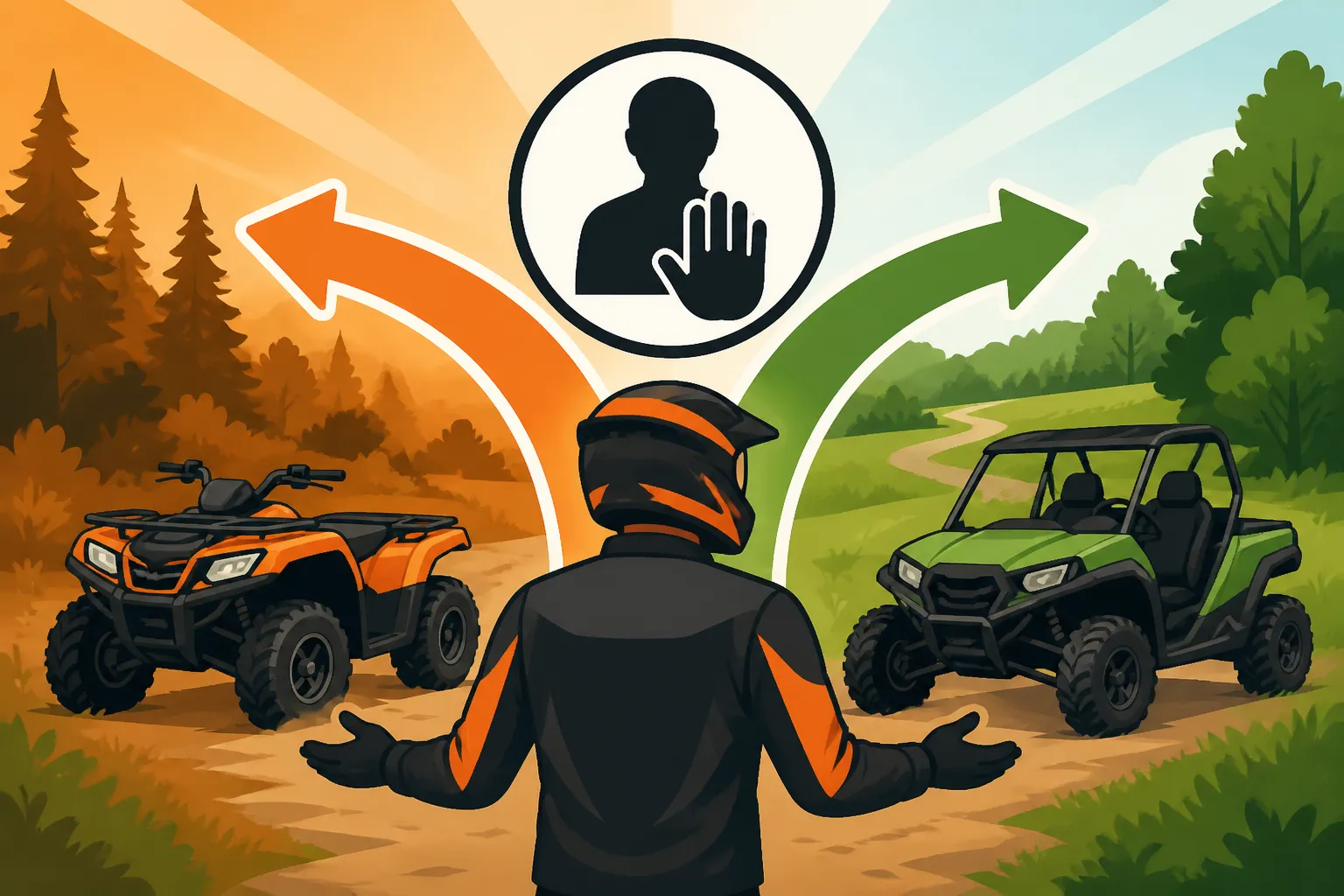
The simplest rule of thumb is this: the authority responsible for the road answers whether the crossing is allowed there; the rider must still meet Manitoba’s operating requirements and decide whether it is safe to cross at that moment. A landowner, club volunteer, map or accessory cannot replace either part of that check.
For extra preparation, review [Manitoba Equipment Checks by Officers] and [What an Officer Can Ask to See in Manitoba]. Carrying the right documents and understanding the rules can make a roadside conversation much less stressful, but the best outcome is avoiding an uncertain crossing in the first place.
Disclaimer
This article is for general informational purposes only and does not constitute professional advice. Laws, prices and regulations vary by location and change over time. Consult a qualified professional for guidance on your specific situation.