Why a Jeep May Not Ride a Ditch
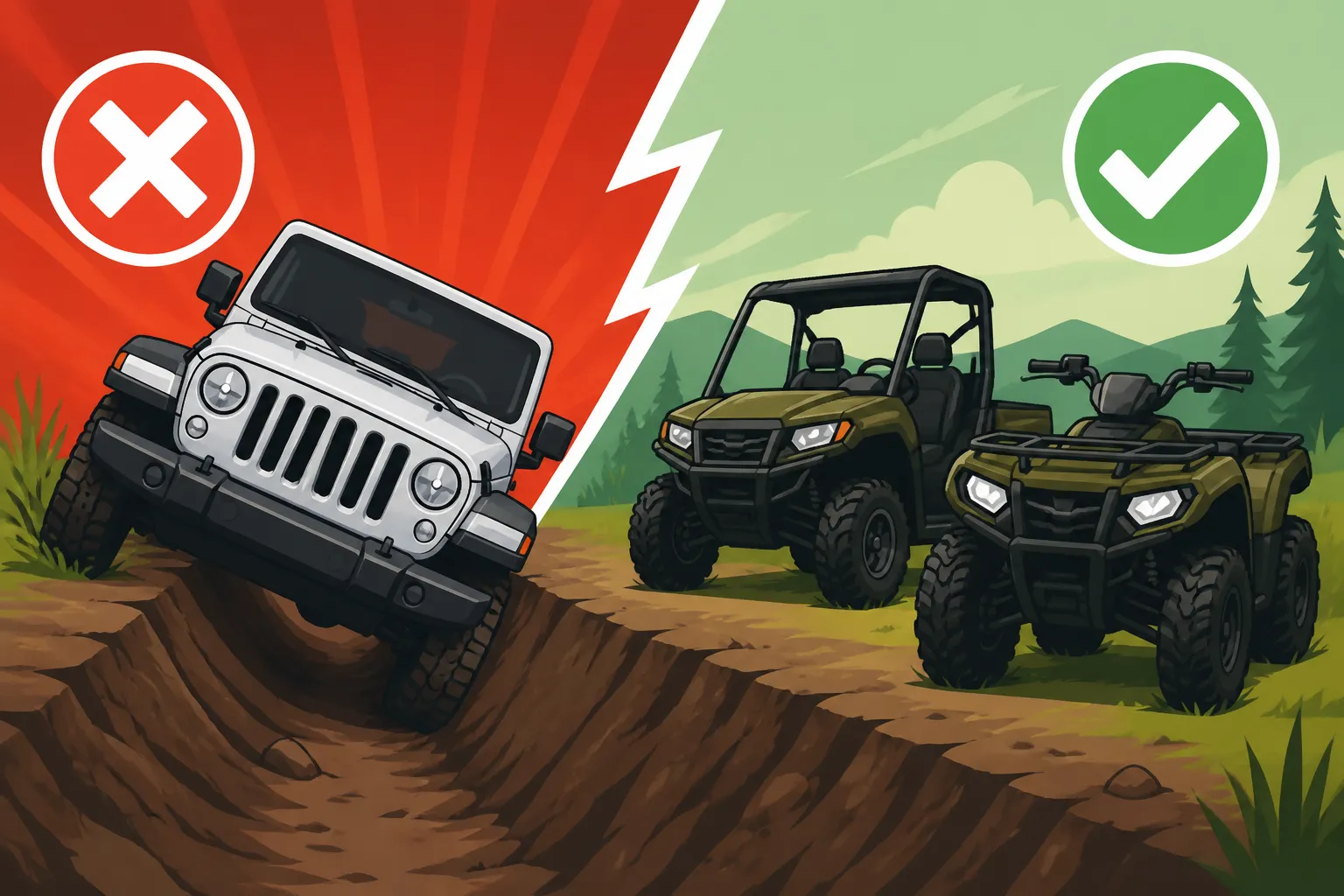
It's a common sight across Manitoba: ATVs and side-by-sides legally cruising along the shoulder or within the ditch beside a provincial road. This often leads to a natural question from owners of other capable off-road vehicles, particularly Jeeps: "If my rig can handle it, why can't I ride my Jeep in the ditch too?" This guide will clear up the confusion, diving into Manitoba's specific laws that differentiate off-road vehicles (ORVs) from conventional motor vehicles when it comes to ditch riding.
Understanding "Off-Road Vehicle" in Manitoba Law
The first step to understanding why a Jeep generally can't legally ride in a ditch in Manitoba is to grasp how the law defines an "off-road vehicle" in the first place. It's not as simple as asking if a machine can go off the pavement; it's about its official classification.
The Legal Definition of an ORV
Many riders mistakenly assume that "off-road" simply means "not on the paved road," and anything with big tires and four-wheel drive should qualify. However, in Manitoba, the Off-Road Vehicles Act has a very specific definition for what constitutes an ORV, and it's this definition that grants certain privileges, like ditch riding, to these machines. This legal classification is the foundation upon which all other rules are built.
The Act typically defines an ORV as a self-propelled vehicle designed primarily for travel on unprepared surfaces, like snow, ice, or natural terrain. This includes common ATVs, UTVs (side-by-sides), and snowmobiles. The design, weight, and general construction of these vehicles are geared towards navigating challenging landscapes, often with low-pressure tires and no requirement for traditional road safety features like crumple zones.
Crucially, it's not about whether a vehicle possesses the capability to go off-road, but rather whether it was manufactured, designed, and classified as an ORV under the provincial statutes. This might seem like a small distinction, but it's the pivotal point that separates an ATV from a Jeep in the eyes of the law. If a vehicle doesn't fit this specific legal definition, the rules for ORVs simply don't apply.
Why a Jeep Isn't an ORV in the Eyes of the Law
Despite their incredible off-road prowess, a Jeep, whether it's a stock Wrangler or a highly modified Rubicon, is fundamentally different from an ORV when it comes to legal classification in Manitoba. This is where the core of the ditch riding restriction lies.
A Jeep is manufactured and registered as a passenger vehicle, primarily designed and intended for operation on public highways. It comes equipped with standard road safety features – seatbelts, airbags, turn signals, headlights – all designed to meet the Highway Traffic Act requirements for on-road use. Its registration through MPI is as a conventional motor vehicle, not under the specific ORV registration system.
This primary designation as a motor vehicle for public roads means a Jeep is governed by the Highway Traffic Act, not the Off-Road Vehicles Act when it comes to where it can operate in relation to roadways. While the Off-Road Vehicles Act provides specific exemptions and permissions for actual ORVs to use ditches, these do not extend to vehicles primarily designed and registered for highway travel.
Therefore, the critical difference is not the vehicle's capability, but its legal classification. Even if your Jeep has been kitted out with robust SuperATV aftermarket suspension and rock sliders, it doesn't transform it into an ORV in the legal sense. It remains a motor vehicle, subject to the distinct rules of the road.
Manitoba's Ditch Riding Rules for ORVs
To further understand why a Jeep isn't permitted in a ditch, it helps to examine the rules that do apply to actual ORVs when they operate in these areas. This highlights the specific nature of the ORV allowance.
The Specifics of Legal Ditch Riding for ORVs
Manitoba law does indeed provide specific allowances for registered off-road vehicles (ATVs, UTVs, snowmobiles) to operate within the ditch alongside public roadways. However, this isn't a blanket permission and comes with clear conditions. The intent behind these rules is generally to facilitate access to trails or allow safe crossings, rather than unrestricted travel.
When an ORV is riding in a ditch, it must adhere to several key requirements. First and foremost, the ORV must be operated in the ditch to the right-hand side of the roadway, travelling in the same direction as traffic. This mirrors the flow of traffic on the adjacent highway, minimizing potential conflicts. Furthermore, riders must always be aware of local municipal by-laws, as some communities may have stricter rules or even prohibit ditch riding in certain areas. Understanding these rules is critical for any ORV operator. You can find more detail in [Manitoba Ditch Riding Rules].
The allowance for ORVs in ditches is often a practical solution for riders needing to get from one trail segment to another, or to simply move safely around congested areas or private property. It allows for critical connectivity without requiring ORVs to operate on the paved roadway itself, where they are typically not permitted. However, it's a privilege, not a right, and comes with the expectation of responsible operation.
Restrictions and Limitations for ORV Ditch Use
Even for legitimate ORVs, ditch riding in Manitoba comes with a comprehensive list of restrictions and limitations designed to ensure safety for both riders and other road users. These are not areas for high-speed travel or reckless operation.
For instance, there are strict speed limits when operating in a ditch, often significantly lower than the speed limit on the adjacent roadway. This ensures that ORVs can react quickly to unforeseen obstacles or changes in terrain. Additionally, specific rules govern how ORVs must approach and execute highway crossings, often requiring them to stop, yield to all traffic, and cross at designated points, either within 5 metres of an intersection or at least 3 kilometres away from one. [Manitoba Crossing Rules at 5 Metres and 3 Kilometres]
To cross a provincial highway, an ORV operator must hold a valid driver's licence. This ensures a certain level of road awareness and driving skill. [Manitoba Crossings Need a Driver's Licence] The intention here is clear: ditch use and road crossings are managed meticulously to minimize any potential hazards with faster-moving highway traffic. These rules highlight that even for legally designated ORVs, ditch riding is a highly regulated activity. The presence of these detailed rules underscores that ditches are not simply extensions of off-road trails.
Why Highway Traffic Act Rules Govern Jeeps
Given the specific legal framework for ORVs, it becomes much clearer why a Jeep, despite its capabilities, cannot use ditches in the same way. The rules governing Jeeps fall under an entirely different piece of legislation.
Jeeps as "Motor Vehicles" Under the Highway Traffic Act
A Jeep, like any other car, truck, or SUV, is categorized as a "motor vehicle" under Manitoba's Highway Traffic Act. This is the fundamental piece of legislation that dictates how vehicles operate on all public roads, including the paved surfaces, shoulders, and, by extension, the ditches that are part of the public road allowance.
The Highway Traffic Act generally restricts motor vehicles to the designated paved roadway. There are very few exceptions that permit a conventional motor vehicle to operate off the paved surface, and these are typically for emergencies, maintenance, or very specific agricultural purposes on the shoulder (not the ditch). In fact, [Manitoba Bans Riding on Roadways] for off-road vehicles, and for conventional vehicles, that generally extends to operating in areas off the roadway as well.
This means that while an ORV might have a special provision in the Off-Road Vehicles Act to use a ditch, a Jeep does not. It is expected to adhere to the much more stringent rules of the Highway Traffic Act, which do not grant permission for motor vehicles to travel in ditches. This is a crucial legal distinction that separates a highway-registered vehicle from a dedicated off-road machine.
Implications of Operating a Jeep in a Ditch
Operating a street-legal vehicle like a Jeep in a ditch, even if it feels natural given its design, can lead to serious legal and financial consequences. This is not just a theoretical concern; it's a real risk for those who misunderstand the rules.
If you are caught operating a Jeep in a ditch by law enforcement, you could face charges under the Highway Traffic Act. This could range from fines for improper operation of a motor vehicle off the roadway to more serious charges like careless driving, depending on the circumstances and how the officer interprets your actions. These penalties can include demerit points on your driver's licence, which can impact your insurance rates.
Furthermore, consider the insurance implications. Your standard Autopac insurance policy for a motor vehicle is designed to cover you for incidents that occur when operating legally on public roads or private property. If you're involved in an accident while operating your Jeep in an area where it's legally not permitted, such as a ditch, your insurance provider could potentially deny coverage for damages or injuries, leaving you with a massive financial burden. While your Jeep might be equipped with robust SuperATV components to handle rough terrain, these upgrades do not grant you legal immunity from traffic laws. The bottom line is that operating a Jeep in a ditch for recreational purposes puts you at significant legal and financial risk.
Common Misconceptions and Exceptions
The rules around ditch riding can be confusing, and several common misconceptions often lead Jeep owners astray. It's important to address these directly.
The "It's 4×4, So It's an ORV" Myth
This is perhaps the most prevalent misunderstanding among enthusiasts: the belief that simply because a vehicle has four-wheel drive, high ground clearance, and rugged construction, it automatically qualifies as an "off-road vehicle" under Manitoba law. This couldn't be further from the truth, and it's a distinction that can have real consequences for drivers.
Many trucks and SUVs sold today come with impressive off-road capabilities. They can navigate rough trails, climb steep inclines, and power through muddy sections with ease. However, they are still primarily designed, marketed, and registered as conventional motor vehicles for highway use. Think about the fundamental difference: a pickup truck can easily drive through a farmer's field, but it's not legally considered an ORV in the same vein as an ATV. Its purpose and regulatory framework are distinct.
This common misstep arises when a Jeep owner, seeing a side-by-side legally traverse a ditch, assumes their equally capable, or even more capable, vehicle should have the same rights. But the law doesn't look at capability; it looks at classification. Your tricked-out Jeep with its SuperATV lift kit and tires is still a "motor vehicle" under the Highway Traffic Act, and thus, the specific ORV ditch riding allowances do not apply. The legal framework is designed to regulate vehicle types based on their primary design and safety standards, not their potential for off-pavement performance.
Agricultural and Remote Community Exceptions (And Why They Don't Apply to Jeeps in Ditches)
While there are specific situations where certain vehicles might be allowed to operate off the main roadway, these are very narrow exceptions that do not extend to recreational ditch riding for Jeeps. It's easy to hear about an exception and assume it applies broadly, but context is everything.
For instance, the Off-Road Vehicles Act does include provisions for certain agricultural uses. A farmer might be allowed to operate an ORV on the shoulder of a provincial highway for the most direct route between fields, or to access farm property, under specific conditions. This is outlined in [Manitoba's Agricultural Shoulder Exception]. Similarly, there are exemptions for ORV use within specific remote communities where access by conventional roads is limited. [Manitoba Machines Used Only in a Remote Community]
However, these exemptions are highly specific and almost exclusively apply to actual ORVs (ATVs, UTVs, snowmobiles) or dedicated farm machinery. They are granted to facilitate essential work or provide transport in areas without developed road networks. These exceptions do not, for example, allow a farmer to take his personal Jeep for a joyride in the ditch, nor do they permit a non-resident of a remote community to operate their Jeep off-road outside of the paved road. They are not loopholes for recreational ditch use by conventional motor vehicles. The general rule remains: [The Only Legal Ditch Is on Your Right] for ORVs, not for Jeeps.
Where Jeeps Can Legally Go Off-Road in Manitoba
So, if you can't ride your Jeep in a ditch, where can you legally enjoy its off-road capabilities in Manitoba without breaking the law or risking your insurance? Thankfully, there are plenty of fantastic options.
Private Land and Designated Off-Road Parks
The most straightforward and widely accepted way to enjoy your Jeep off-road in Manitoba is on private property, provided you have explicit permission from the landowner. This offers unparalleled freedom to explore challenging terrain without worrying about public road laws.
Many farmers and private landowners are often open to allowing responsible off-roaders to use their land, especially if you establish a good relationship and respect their property. Always ask first, and make sure you understand any specific rules or restrictions they might have. This is where you can truly test your vehicle, whether it's stock or loaded with high-performance SuperATV components, without the constraints of public road regulations.
Beyond individual private properties, Manitoba also has areas or groups that cater to dedicated 4×4 enthusiasts with private off-road parks or designated zones. These parks are specifically designed for vehicles like Jeeps and often feature various obstacles, trails, and challenges that you wouldn't find (or shouldn't attempt) anywhere else. Researching local 4×4 clubs or off-road associations can often lead you to these fantastic resources.
Managed Trails and Events
Another excellent avenue for legal off-roading in your Jeep is through organized clubs, events, or on Crown land where specific allowances are made for 4×4 vehicles. This offers a structured and often safer way to explore.
Joining a local 4×4 club can be incredibly beneficial. These clubs often maintain relationships with landowners, have permits for specific Crown land access, or organize events on dedicated trails. They provide a community of like-minded individuals, offer valuable training, and ensure that your off-roading adventures are conducted legally and responsibly. These groups are often deeply involved in trail maintenance and advocating for responsible access. [Manitoba ATV Trails: Club Ground and Crown Land]
While many Crown land trails are primarily designed for ATVs and UTVs, some may be suitable for or specifically designated to allow larger 4×4 vehicles like Jeeps. It's absolutely crucial to do your homework before heading out onto Crown land. Always check with Manitoba's conservation offices or relevant government departments for current rules, maps, and any specific access restrictions for 4x4s in the area you plan to visit. Understanding [Manitoba Rules for Riding Crown Land] is paramount to avoiding fines and protecting sensitive ecosystems. Always confirm vehicle allowances for any trail or event to ensure your Jeep, even with its full suite of SuperATV gear, is welcome and compliant.
Here's a quick comparison of the legal differences:
| Feature | Off-Road Vehicle (ATV/SxS) | Jeep (Motor Vehicle) |
|---|---|---|
| Legal Classification | Off-Road Vehicle (The Off-Road Vehicles Act) | Motor Vehicle (The Highway Traffic Act) |
| Ditch Riding Status | Permitted under specific conditions and restrictions | Generally not permitted |
| Primary Design | For off-highway use, unpaved terrain | For highway use, paved roads (with off-road capability) |
| Registration | MPI ORV Registration, specific ORV plate | MPI Autopac (standard vehicle registration, regular plate) |
| Governing Act | The Off-Road Vehicles Act (primarily) | The Highway Traffic Act (primarily) |
| Permissible Off-Road Use | Dedicated trails, private land, some Crown land, ditches (under conditions) | Private land, designated 4×4 parks, some specific Crown land trails (with permission) |
| Insurance Coverage | Basic ORV coverage through MPI, optional add-ons | Standard Autopac for road use, may be voided off-road illegally |
Disclaimer
This article is for general informational purposes only and does not constitute professional advice. Laws, prices and regulations vary by location and change over time. Consult a qualified professional for guidance on your specific situation.