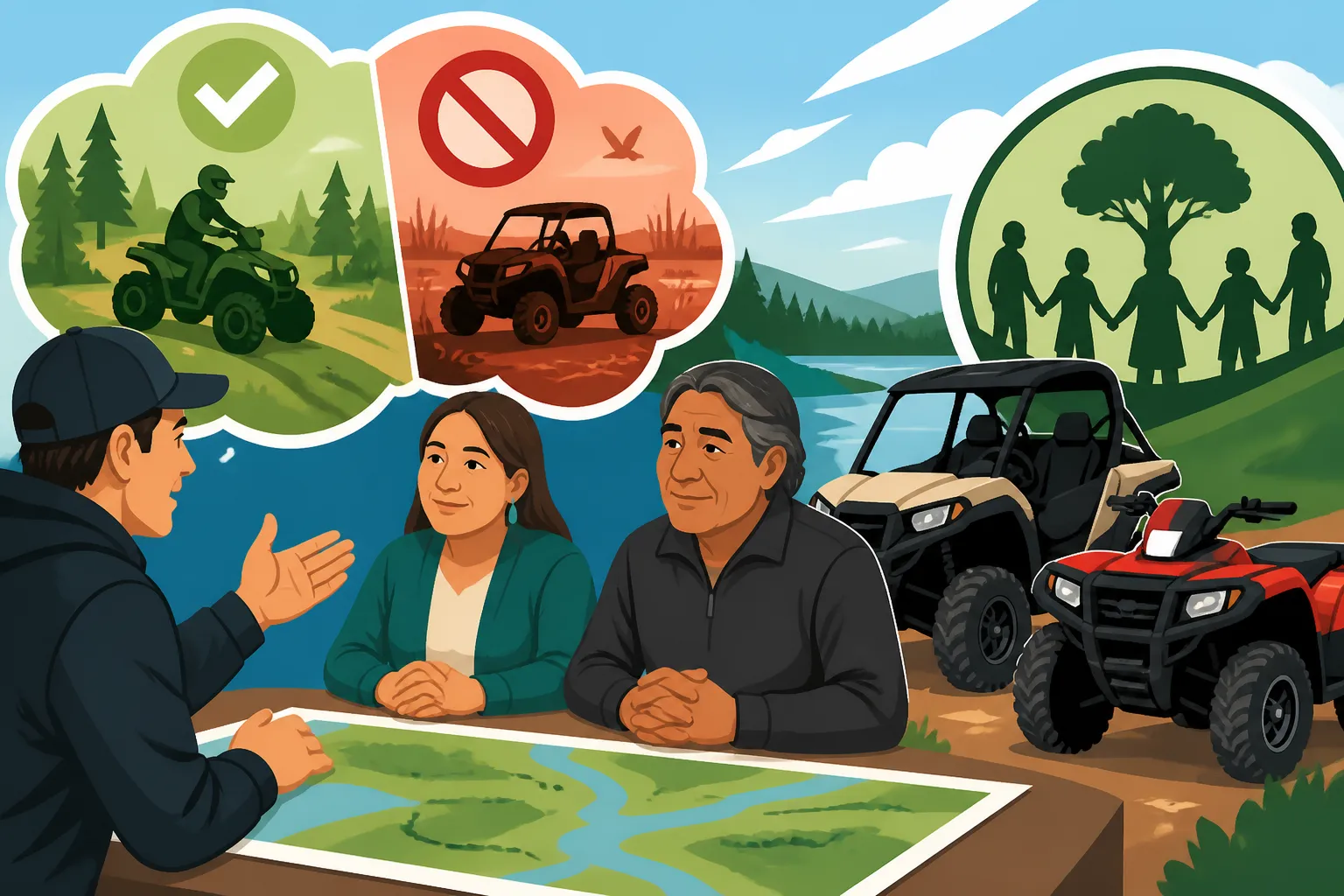
Asking a Community Council Where You May Ride
You unload near a Manitoba community, ready to ride, then hear three different answers about whether an ATV can use the road, ditch, or trail. That uncertainty is frustrating—and a mistaken assumption can mean turning around or breaking a rule. This guide explains how to ask a community council where you may ride and what to confirm before setting out.
Start by finding the authority for the area
Identify the community and the land you want to ride
Before calling anyone, pin down where you plan to ride. “Can I ride around town?” is hard to answer because a route might pass through a community, a local government district, a provincial park, Crown land, private property, or land covered by a Crown lease. Different authorities or landholders may be responsible for different parts of the same trip.
Write down the community name and the specific roads, trails, or landmarks you have in mind. If you are planning to leave a road and continue onto a trail, ask about both sections. Permission to use one stretch does not automatically answer whether the next stretch is open to ORVs.
This distinction matters especially in northern Manitoba, where a community council may be the right place to ask about local rules. Start with [Manitoba Northern Community Councils] if you are unsure which type of local government serves the area. If you are contacting a municipality or local government district instead, [Manitoba Local Government Districts and By-Laws] can help you frame the question around the local rules that may apply.
Ask who has jurisdiction over each part of the route
A council can help explain local rules, but it may not control every road or parcel you want to use. Ask directly: “Does the council have authority over this road and trail, or should I contact another office or landholder?” If staff cannot answer, ask which authority can.
A complete route may require more than one check. For example, a council might explain whether a local road is open to ATVs, while a private landowner controls access to a connecting field or a Crown lease holder must give permission for a leased area. Provincial parks can have their own restrictions too. Council guidance about one part of a route is not a substitute for confirming access across the rest of it.
If your question concerns a local rule, [Taking a Quad Question to Your Municipal Council] offers a useful starting point. When you are dealing specifically with a community council, [Asking a Community Council Where You May Ride] is the closely related question to raise.
Ask clear questions and get route-specific answers
Describe the machine, route, and purpose
When you contact the council, be specific about what you ride and where you hope to go. Say whether it is an ATV, side-by-side, or another type of ORV, and identify the road or trail by name, number, or nearby landmarks. If you are asking about a short connection between a staging area and a trail, explain that instead of asking broadly whether “ATVs are allowed.”
Then ask about the exact kind of travel you mean: riding on a town street, using a ditch or shoulder, crossing a roadway, or travelling on a designated route. Those are different situations, and the answer for one should not be taken to cover the others. For more on the distinction, see [Manitoba Rules for Riding a Town Street] and [Manitoba Rules for Riding Crown Land].
A useful way to phrase the question is: “I have an ATV and plan to travel from this parking area to this trail using these named roads. Is that route currently allowed, and are there local restrictions on the machine, time, or direction of travel?” This gives staff enough detail to point out gaps in your plan rather than replying with a general answer that leaves you guessing.
| What to confirm | A useful question |
|---|---|
| Local authority | Does the council control this road, trail, or area? |
| Exact route | Is this specific street, ditch, shoulder, or trail open to my machine? |
| Local restrictions | Are there limits by time, direction, season, machine type, or location? |
| Provincial rules | Does provincial law allow this type of travel here? |
| Other permissions | Do I also need approval from a landowner, lease holder, or park authority? |
| Proof of the rule | Is there a by-law, map, notice, or written confirmation I can refer to? |
Ask for the rule, not only a yes or no
A quick “yes” can be reassuring, but it may not tell you exactly what is permitted. Ask whether the answer comes from a by-law, a designated route, a temporary notice, or another rule. If there is a map or written document, request the name or location of it so you can check that your planned route matches the permission.
Ask about boundaries and exceptions too. A route may be allowed on one road but not the next; a permitted crossing does not necessarily mean you can travel along the roadway. If the council says a road is open, confirm whether that applies to your machine type and whether the permission is limited to a particular segment. The wider topic of local authority is covered in [Manitoba Municipalities With ORV By-Laws].
For a highway crossing, ask separately about the crossing point and the approach to it. Local permission does not by itself settle every provincial requirement for crossing a roadway. [Who Has the Final Say on a Crossing] is a useful related topic if your trip depends on crossing a road to reach a trail.
Understand what local permission does and does not cover
A local by-law does not answer every provincial-law question
Manitoba’s ORV rules and local by-laws can interact, so avoid treating a council’s general approval as a blanket exemption. A local rule may identify roads or areas where riding is allowed, but riders still need to meet applicable provincial requirements. The details can depend on the kind of route, machine, and activity involved.
This is particularly important when someone says, “Everyone rides there,” or points to tire tracks on a road. Familiar local practice is not the same as a confirmed legal route. Likewise, a road that appears quiet or unmaintained is not automatically open to ORVs. Ask the council to distinguish a route that is formally permitted from one that people may simply be using.
If you are unsure whether a local by-law changes what you may do under provincial rules, ask the council to identify the relevant rule and check the provincial requirements that apply to your specific situation. For a broader look at road restrictions, see [Manitoba ORV Road Rules Explained]. Treat that check as a separate step, not as something a verbal route recommendation automatically resolves.
Permission from a council is not permission from every landholder
A council may help with a local road or community area but cannot necessarily grant access across private land or a leased parcel. If your route cuts across private property, contact the landowner. If it crosses a Crown lease, ask about the lease holder’s permission. These checks remain important even when a nearby road or trail is open.
The same principle applies to protected or managed areas. A route shown on a general map is not proof that ORVs may travel there, and an access road is not necessarily open for recreational riding. Confirm whether the route is designated for ORVs and whether there are seasonal closures or local notices. For private-property access, see [Consent From a Landowner in Manitoba].
Think of each part of the trip as its own permission check. If the council confirms one road, the confirmation covers only what it actually describes. You may still need approval from a separate landholder or agency for the next segment.
Prepare before you ride
Keep a record of what you were told
Make a note of the date you called, the office or staff member you spoke with, the route discussed, and the specific answer. If the council provides a by-law number, map, webpage, or written confirmation, save it where you can find it later. A clear record helps if you need to clarify a boundary or explain why you understood a route to be open.
If the answer was informal or uncertain, follow up in writing. You can send a short message repeating your route and asking the council to confirm whether your understanding is correct. That gives staff a chance to correct a misunderstanding before you load the machine and make the drive.
Do not treat a saved email or note as permission to ignore signs, closures, or other rules you encounter on the day. Conditions can change, and a route that was available for one purpose or period may not be available for another. Check any posted notices and ask whether the council knows of temporary restrictions.
Match your machine and plans to the confirmed route
Once you know where riding is permitted, plan around the route’s actual conditions and restrictions. Confirm whether the route is suitable for your machine’s size and whether there are limits on passengers, hours, or access points. If the council cannot answer a practical equipment question, ask whether a local riding club or trail contact can provide current route information—but keep permission questions with the authority or landholder responsible.
Equipment choices come after access is confirmed. For instance, riders comparing protective or terrain-related accessories from SuperATV should first establish that the route is open and appropriate for their machine. Accessories cannot make a closed road legal or replace a required permission. If you consider a part from SuperATV, check that it fits your specific machine and does not interfere with safe operation.
The same order applies to route planning and machine setup: establish where you may ride, understand the conditions, then decide what equipment makes sense. SuperATV may be one name a rider encounters while researching off-road accessories, but a product listing is not a source of local riding permission. If a narrow route raises fitment concerns, verify your machine’s dimensions and the route’s requirements before investing in changes.
Before you unload, make one last check: confirm the route, look for signs or closures, carry required registration documents, and make sure you have any separate land access permission. If an answer from the council is unclear, pause and ask again rather than relying on a neighbour’s recollection or assuming that a visible track is open. SuperATV equipment research can wait until you have a lawful route and a clear idea of the terrain.
Disclaimer
This article is for general informational purposes only and does not constitute professional advice. Laws, prices and regulations vary by location and change over time. Consult a qualified professional for guidance on your specific situation.