Manitoba Bans Riding an Interchange
It's incredibly frustrating when you're out enjoying your ATV or UTV in Manitoba, trying to get from one great riding spot to another, and you hit a confusing patch of road infrastructure that just screams "stay away!" Highway interchanges, with their complex ramps, merges, and high-speed traffic, are precisely one of those areas that can leave many riders feeling bewildered and even tempted to take a shortcut. This guide is here to clear up that confusion, explain exactly why riding an interchange in Manitoba is a strict no-go for off-road vehicles, shed light on the very real dangers involved, and offer practical advice on how to navigate these areas safely and legally, ensuring your adventures stay on the right side of the law.
Understanding the Firm Prohibition on Interchanges
Let's get straight to it: the Province of Manitoba is very clear on this. Off-road vehicles (ORVs) like ATVs and UTVs are simply not allowed on highway interchanges. This isn't just a suggestion; it's a hard and fast rule enforced by law. Many riders, especially those new to the province or to the sport, might look at a wide-open ramp or a grassy median and think, "What's the harm?" But the law sees it very differently, and for good reason. It's about safety, not just for you, but for every other driver on the road.
The Legal Framework and the ORV Act
The primary legislation governing ORV operation in Manitoba is the Off-Road Vehicles Act. This act lays out precisely where and how ORVs can be operated, and more importantly, where they absolutely cannot. When it comes to roadways and related infrastructure, the Act is quite specific. It designates certain areas as off-limits to ensure that ORVs, which are designed for different terrains and speeds, don't create hazards for conventional motor vehicle traffic. The ban on interchanges falls squarely within these provisions. It's a preventative measure designed to keep everyone safe and to maintain the orderly flow of traffic on high-speed routes. Many riders often miss this crucial detail, assuming that if a paved surface is wide enough, it's fair game. However, the Act makes no such allowance for interchanges, placing them in the same category as other prohibited areas like active [Manitoba Bans Riding on Roadways].
It's not just about what the ORV Act explicitly bans; it's also about what it doesn't permit. Unlike some other jurisdictions that might have specific exceptions for certain parts of highway infrastructure, Manitoba’s Act does not provide any allowances for ORVs on interchanges. This means that if it's not explicitly permitted, it's prohibited, especially when it comes to high-risk areas like highways and their associated structures. This often comes as a surprise to riders from other provinces where rules might be more lenient, highlighting the importance of understanding Manitoba's specific regulations before heading out.
Why Interchanges Are Singled Out for the Ban
Interchanges are complex, high-traffic zones designed for vehicles travelling at high speeds, typically connecting major highways or facilitating rapid transitions between routes. This design inherently makes them incompatible with ORV operation. Think about it: ORVs, while capable of decent speeds off-road, are not engineered for sustained highway speeds. Their tires, suspension, and braking systems are optimized for dirt, mud, and rocks, not asphalt. Moreover, their acceleration and deceleration profiles are different from cars and trucks, making them unpredictable in fast-moving traffic.
The ban isn't arbitrary; it's a reflection of practical safety concerns. Interchanges involve multiple lanes, merging traffic, and often blind spots, all of which pose extreme risks to a smaller, slower-moving ORV. Imagine a side-by-side trying to merge onto a highway ramp where cars are accelerating to 100 km/h. The speed differential alone is a recipe for disaster. This is why the province has drawn a clear line, ensuring that these areas remain exclusively for the vehicles they were designed for. It’s a measure to prevent collisions and save lives, even if it feels restrictive to an enthusiastic rider. You might feel like you can handle it, but the law isn't built on individual confidence; it's built on collective safety statistics and engineering realities.
The Definition of an Interchange for ORV Riders
So, what exactly is an interchange in the eyes of the law, and how does it apply to ORV riders? An interchange is a grade-separated junction that allows for the movement of traffic between two or more roads without crossing streams of traffic at the same level. This typically involves a system of ramps, bridges, and underpasses that facilitate turns, merges, and exits from one highway to another, or from a highway to a major arterial road. Think of the elaborate cloverleafs or diamond interchanges you see connecting the Trans-Canada Highway to other major routes.
For ORV riders, this means not just the main lanes of the highway within the interchange area, but also all the connecting ramps – entrance ramps, exit ramps, loop ramps, and even the median areas within the confines of the interchange structure. These are all part of the prohibited zone. It's a comprehensive ban that doesn't allow for partial use. Many riders mistakenly believe they can use a grassy shoulder or a non-paved section of an interchange area. However, the Act considers the entire infrastructure, from ramp to ramp, as part of the prohibited interchange, just as it prohibits [The Median of a Divided Highway Is Closed]. Understanding this broad definition is crucial to avoiding accidental infractions. If you're on a multi-level road system designed for high-speed vehicle transitions, assume it's an interchange and stay off it with your ORV.
The Inherent Dangers of ORVs on Interchanges
Even if the law wasn't clear, common sense should tell us that off-road vehicles and highway interchanges don't mix. The design of these road features, combined with the characteristics of ORVs, creates a perfect storm of hazards that are simply too risky to ignore. It’s not about being overly cautious; it’s about acknowledging the fundamental incompatibility between these two elements.
Speed Differentials and Collision Risk
One of the most immediate and significant dangers is the vast difference in speed capabilities and operational characteristics between ORVs and the cars and trucks using interchanges. As mentioned, highway traffic moves at high speeds – 90, 100, or even 110 km/h in some zones. While some high-performance UTVs can reach impressive speeds, they are not designed to maintain these speeds for extended periods or to accelerate and decelerate with the same responsiveness as a highway-legal vehicle.
Imagine an ATV attempting to merge onto a busy highway ramp where other vehicles are moving much faster. The ORV would be a slow-moving obstacle, forcing other drivers to suddenly brake or swerve, which dramatically increases the risk of a multi-vehicle collision. The smaller profile of an ATV or UTV also makes it less visible to drivers in larger vehicles, especially trucks, further exacerbating this risk. This speed differential isn't just an inconvenience; it's a critical safety flaw that can have catastrophic consequences, which is why the law is so strict. It’s a situation where even the most skilled ORV operator is at a severe disadvantage, as the environment is simply not built for their machine.
Limited Visibility and Lane Changing Hazards
Interchanges are notorious for their complex visual environments. Drivers are constantly looking for signs, checking mirrors for merging traffic, and anticipating lane changes. For an ORV, these challenges are amplified. An ATV or UTV sits much lower than a truck and often lower than many cars, making it incredibly difficult for other drivers to spot, particularly in blind spots or during quick lane changes. This is especially true on curved ramps or in areas with multiple lanes converging or diverging.
Furthermore, ORVs typically lack the extensive mirror systems and robust lighting found on highway vehicles, reducing the operator's ability to monitor surrounding traffic effectively. While you might equip your machine with aftermarket lights for off-road visibility, like some of the robust LED bars you find from companies such as SuperATV, these are primarily designed to illuminate trails, not to make you more conspicuous in high-speed, multi-lane highway traffic during the day. The primary purpose of such lighting is to enhance your view of obstacles on a dark trail, not to compete with the visual noise of an interchange. The risk of being overlooked, leading to a side-swipe or rear-end collision, is unacceptably high on an interchange, making it a place to avoid at all costs.
Incompatible Infrastructure and Design
Beyond speed and visibility, the physical design of an interchange itself is fundamentally incompatible with ORV use. Highway surfaces are engineered for the specific demands of cars, trucks, and their associated tire compounds. An ORV's knobby tires, while excellent for grip on loose terrain, can behave unpredictably on smooth, high-speed pavement, especially when wet or during emergency braking. The braking distances can be longer, and the handling less precise than a road vehicle.
Moreover, the tight turning radii on some ramps, combined with the banking of the curves, can pose challenges for ORVs, which have different stability characteristics compared to cars. Attempting to navigate these features at highway speeds could lead to a loss of control. The very structure, from the concrete barriers to the drainage grates, is not designed with ORVs in mind, presenting obstacles and hazards that might not be immediately apparent to an off-road rider. It's an environment that simply doesn't accommodate the unique operational characteristics of an ATV or UTV, making it an unsafe place for any off-road adventure.
Navigating Around Interchanges Safely and Legally
Given the strict prohibition and inherent dangers, it's clear that staying off interchanges with your ORV is paramount. But how do you get where you need to go if an interchange is in your path? The key lies in careful planning, understanding legal alternatives, and embracing the true spirit of off-road riding.
Planning Your Route to Avoid Prohibited Areas
The best defence against accidentally riding on an interchange is proactive route planning. Before you even load your machine, take some time to study your intended riding area and the routes between different trails or destinations. Utilize detailed maps, especially those that highlight ORV-legal trails and designated crossing points. Many local ATV clubs and provincial organizations offer excellent resources, including [Manitoba ATV Trail Map Downloads], that can help you plan.
When looking at a map, identify any major highways or expressways that feature interchanges. If your route seems to take you directly through one, it’s time to find an alternative. This might mean rerouting significantly, finding a designated ORV underpass or overpass further down the road, or seeking out local roads that allow for ORV use (within municipal bylaws, of course). Sometimes, the shortest path on a road map is the most illegal one for an ORV. Always prioritize legal, safe routes, even if they add a few extra kilometres to your journey. Using apps that show ORV trails can be incredibly helpful here, allowing you to visually plan around these forbidden zones.
Utilizing Legal Crossing Points for Highways
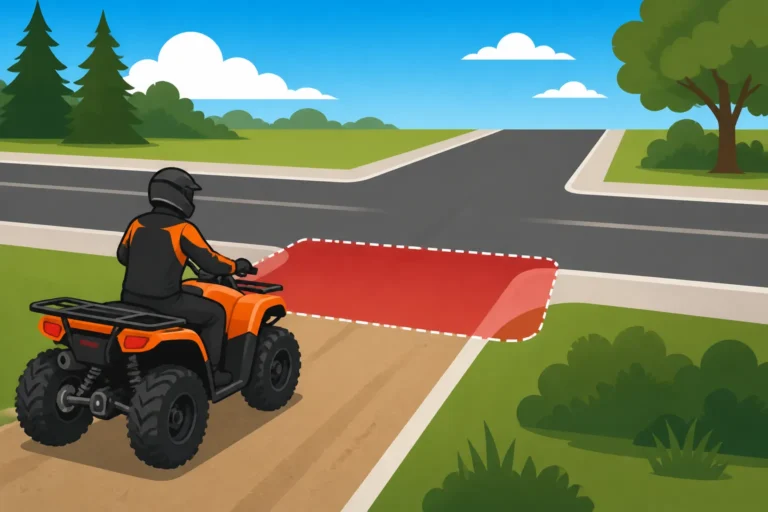
While interchanges are off-limits, the Off-Road Vehicles Act does provide specific rules for how ORVs can legally cross certain roadways, including highways. These rules are very precise and must be followed to the letter to avoid fines and ensure safety. Generally, ORVs are permitted to cross a highway at specific locations, such as intersections with other public roads, or where the ORV Act specifically permits. [Manitoba Crossing Rules at 5 Metres and 3 Kilometres] outlines these specific distances and conditions. You'll need to approach the crossing point, stop, yield to all traffic, and cross directly and as quickly as possible, usually at a 90-degree angle to the roadway.
Crucially, you must have a valid driver's licence to cross a highway, and only one machine is permitted to cross at a time. This is a far cry from the complex, multi-lane environment of an interchange. These legal crossing points are often marked or can be identified on detailed maps. They represent the only sanctioned way for ORVs to traverse major roads, completely bypassing the need to ever set a tire on an interchange. Always use these designated points and never assume you can create your own crossing point or use an undesignated area of an interchange.
Exploring Alternative Off-Road Routes and Trails
Manitoba boasts a fantastic network of trails and vast expanses of Crown land that are perfect for ORV riding. Instead of trying to find a dubious way through or around a highway interchange, focus your energy on exploring these legitimate off-road opportunities. Many club trails, like those managed by the Eastman ATV Association or the Westman ATV Association, are specifically designed for safe and enjoyable ORV use. Check out options like [Manitoba Crown Land Riding Explained] to understand where you can legally ride.
These trails offer the authentic off-road experience that ORVs are built for, without the dangers and legal risks of interacting with high-speed highway traffic. Plan your rides to connect these trails, making your journey an adventure in itself, rather than just a means to an end. It's also a great opportunity to utilize the full capabilities of your machine, perhaps showcasing performance upgrades like heavy-duty axles or robust skid plates from manufacturers like SuperATV, designed to handle challenging off-road conditions, not asphalt interchanges. Investing in quality parts that enhance your machine's durability and performance on trails means you can confidently tackle the terrain where your ORV belongs, keeping you far away from the pavement.
Enforcement, Penalties, and What to Expect
Ignoring the rules about riding on interchanges isn't just a minor infraction; it can lead to serious consequences. Law enforcement in Manitoba takes the Off-Road Vehicles Act seriously, especially when it pertains to safety on and near public roadways. It's vital for every rider to understand what happens if you're caught breaking these rules.
Officer Discretion and Mandatory Fines
When a law enforcement officer observes an ORV operating on a prohibited area like a highway interchange, they have a clear duty to intervene. There's usually little room for discretion here, as the risk to public safety is considered high. You can expect to be pulled over, and depending on the specific circumstances, you'll likely face a significant fine. [Manitoba Ticket Costs for Riders] can give you a general idea of the financial implications for various infractions under the ORV Act.
Beyond the initial fine, there can be additional charges if your operation of the ORV is deemed careless or reckless. If you’re seen operating erratically, at excessive speeds, or creating a clear danger to other road users, you could face more severe penalties for [Manitoba Careless Operation Penalties]. Officers aren't looking to ruin anyone's day, but they are absolutely committed to preventing serious accidents, and operating an ORV on an interchange is seen as a direct challenge to that commitment. The best way to avoid these penalties is simply not to put yourself in that situation.
Machine Seizure and Other Serious Consequences
In more severe cases, especially if there's a history of infractions, extreme danger posed, or other contributing factors like impaired driving, an officer has the authority to seize your off-road vehicle. Imagine having your prized ATV or UTV impounded, facing not only the initial fines but also towing and storage fees to get it back, if you can get it back at all. This can be an incredibly costly and disruptive experience. Being cited for operating an ORV on a prohibited roadway can also impact your driving record, potentially leading to increased insurance premiums for your highway vehicles or even licence suspension, especially if you're deemed to be operating carelessly or dangerously.
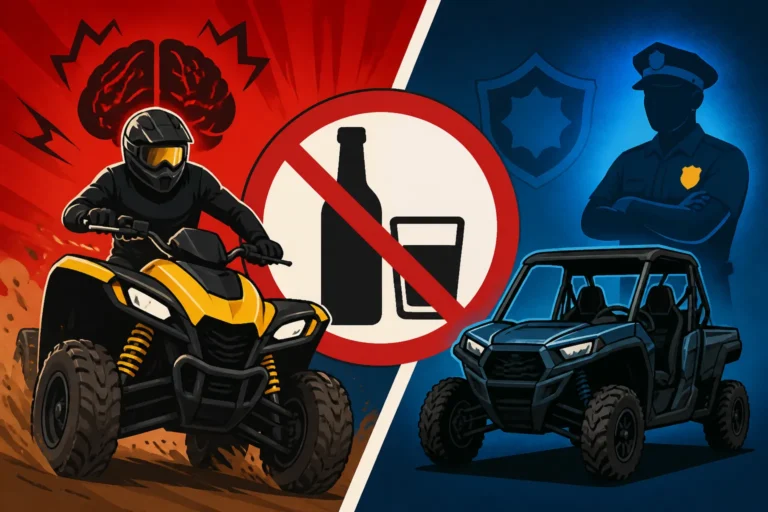
Furthermore, if your actions result in an accident or injury to another person or property damage, the legal and financial ramifications can escalate dramatically. Basic ORV insurance in Manitoba often doesn't cover incidents occurring in prohibited areas. This means you could be personally liable for extensive damages, medical costs, and legal fees. It's a stark reminder that the consequences extend far beyond a simple ticket when you venture onto prohibited highway infrastructure. [Manitoba Impaired Riding Penalties] also highlight how much worse these situations can get if alcohol or cannabis is involved.
Understanding Your Rights and Responsibilities
As an ORV operator in Manitoba, you have rights, but you also have significant responsibilities. Your primary responsibility is to know and follow the law. This means being familiar with the Off-Road Vehicles Act, understanding where you can and cannot ride, and operating your machine safely and respectfully. If you are stopped by an officer, you have the right to remain silent (except to provide identification), and you have the right to legal counsel. However, you are legally required to provide identification and your [Carrying Your Registration Card on Every Ride] for the machine if requested.
It’s your responsibility to ensure your ORV is properly registered and insured, and that you are wearing appropriate safety gear, such as an approved helmet. Ignorance of the law is not a valid defence. If you're unsure about a specific rule or a particular area, it's always best to err on the side of caution or seek clarification from an Autopac agent or local law enforcement before you ride. A quick phone call or a review of the official provincial resources can save you a world of trouble and ensure your riding remains a pleasure, not a legal headache.
General Roadway Rules for ORVs in Manitoba
The ban on interchanges is just one piece of the larger puzzle regarding ORV interaction with public roadways in Manitoba. To truly ride safely and legally, it's essential to understand the broader context of where your machine can and cannot go on or near conventional road infrastructure. It’s not just about interchanges; it’s about a comprehensive approach to safety and regulation.
Distinguishing Between Roadways, Shoulders, and Ditches
One of the most common areas of confusion for ORV riders is distinguishing between the roadway itself, the shoulder, and the ditch. The Off-Road Vehicles Act has specific definitions and rules for each:
- Roadway: This is the paved or improved surface specifically designed for motor vehicle traffic. With very few exceptions (like specific agricultural operations under strict conditions), ORVs are generally prohibited from riding on the actual roadway. This means no driving in the driving lanes, turning lanes, or on medians. [Roadways Are Closed to Every Off-Road Machine].
- Shoulder: The shoulder is the portion of the highway immediately adjacent to the roadway, typically unpaved or with a different surface, designed to allow vehicles to pull over. While ORVs are generally also prohibited from shoulders, there are specific, limited exceptions for farming and related agricultural activities where special permits or signage may apply. These are very narrow exceptions and do not apply to recreational riding.
- Ditch: The ditch is the area alongside the road, beyond the shoulder, usually lower than the road surface, designed for drainage. Manitoba does permit ORV riding in certain ditches, but there are strict conditions. [Manitoba Ditch Riding Rules] specify that you must ride in the right-hand ditch, in the same direction as traffic, and maintain a safe speed. Not all ditches are legal to ride in, and there are restrictions regarding proximity to dwellings, playgrounds, and crossing points.
It’s not a free-for-all; each area has its own set of detailed rules, and understanding these distinctions is key to avoiding tickets and ensuring safety.
Specific Prohibitions Beyond Interchanges
The ban on interchanges is part of a broader set of prohibitions designed to keep ORVs off high-speed, high-traffic road infrastructure. Besides interchanges, ORVs are also generally prohibited from:
- Medians of divided highways: [The Median of a Divided Highway Is Closed] because these areas are designed for highway aesthetics or emergency crossovers, not ORV traffic.
- Sidewalks: [Manitoba Bans Riding a Sidewalk] as sidewalks are reserved for pedestrians and pose a significant safety risk to walkers if ORVs are present.
- Bridge decks (unless specifically designated): While you might use a bridge that's part of an ORV trail system, using highway bridges as a means to cross a river or valley with your ORV is typically prohibited if it's part of a general highway.
- Controlled access highways: Many highways are "controlled access," meaning vehicles can only enter or exit at specific interchanges or ramps, which are themselves prohibited for ORVs.
These prohibitions are in place to ensure ORVs operate in environments compatible with their design and where they don't pose undue risk to themselves or the general public. Always assume a major road structure is off-limits unless you have explicit confirmation that it's part of a designated ORV route.
Equipment for Safe and Legal Off-Road Operations
To ride safely and adhere to the law, especially when navigating areas near prohibited road infrastructure (like preparing for a legal highway crossing or riding in a legal ditch), your ORV needs to be properly equipped. This includes:
- Proper Lighting: Even if you're only riding off-road, if you plan to cross any roadways, your machine needs functional headlights, taillights, and brake lights that meet [Manitoba Lighting Requirements on a Machine]. This ensures you're visible to other drivers during legal crossings, particularly during dawn, dusk, or adverse weather conditions. Good quality lights are essential, and many riders opt for robust aftermarket options from companies like SuperATV to ensure maximum visibility and durability for both trail riding and legal road interactions.
- Braking System: Ensure your brakes are in excellent working order. This is critical for controlling your machine, especially when coming to a complete stop before a highway crossing or when navigating varied terrain.
- Spark Arrester: Many areas, particularly Crown land, require your ORV to be equipped with a [Manitoba Spark Arrester Requirements] to prevent wildfires. This is a year-round requirement and helps maintain access to riding areas.
- Reflectors: Additional reflectors can enhance your visibility to others, especially on the sides of your machine.
- Safety Gear: Don't forget your personal safety gear! An approved helmet is mandatory, and proper eye protection, gloves, and sturdy footwear are highly recommended.
Ensuring your machine is well-maintained and properly equipped is not just about legal compliance; it's about making sure you're as safe as possible when you're out on the trails and when you have to interact with road infrastructure, however briefly and legally. By understanding and respecting these rules, you can enjoy the vast beauty of Manitoba's off-road landscape without unnecessary risks or legal troubles.
| Prohibited ORV Riding Areas in Manitoba | Description & Specifics |
|---|---|
| Highway Interchanges | All ramps, bridges, underpasses, and main lanes within the junction designed for grade-separated traffic flow. |
| Roadways (Paved/Main Driving Lanes) | The primary surface for conventional motor vehicle traffic. General prohibition with very limited agricultural exceptions. |
| Medians of Divided Highways | The strip separating opposing traffic lanes on a divided highway. |
| Sidewalks | Areas designated for pedestrian use. |
| Shoulders (General Prohibition) | The area immediately next to the roadway; very limited exceptions (e.g., farming with proper signage). |
| Private Land (Without Consent) | Any privately owned land without explicit permission from the landowner. |
| Designated Protected/Sensitive Areas | Environmental protection zones, wildlife refuges, specific provincial park areas not designated as ORV trails. |
Disclaimer
This article is for general informational purposes only and does not constitute professional advice. Laws, prices and regulations vary by location and change over time. Consult a qualified professional for guidance on your specific situation.