Yielding on a Narrow Manitoba Trail
A narrow Manitoba trail can turn a relaxed ride into an awkward standoff: two quads meet in the bush, a side-by-side cannot squeeze past, or a horse appears around a blind corner. This guide explains how to slow down, choose a safe place to pass, and communicate clearly—without treating common trail courtesy as a substitute for posted rules or permission to ride.
Start With the Safest Default
Slow down before the trail gets tight
On a narrow trail, the best time to prepare for a meeting is before you can see the other rider. Ease off the throttle when the route narrows, bends out of sight, crosses a hill, or runs between trees and brush. Keep enough space to stop without skidding into the person or machine ahead of you.
This matters especially on Manitoba trails where sand, roots, wet ground, and uneven ruts can make a quick stop less predictable than it looks. A rider who is travelling slowly has more time to steer to a wider spot, signal, and avoid damaging the trail edge. If you cannot see around a bend, assume someone may be coming the other way.
Keep your speed low enough to stop within the visible part of the trail. That is a useful everyday rule, not just a response to a posted speed limit. It also gives your group time to react if a rider ahead stops suddenly or wildlife steps onto the route.
Stop somewhere both riders can pass safely
When two machines meet, do not assume the trail edge is firm. A shallow-looking shoulder can hide muskeg, a ditch, a steep drop, or soft ground that will bog down a quad. Look for a broad, durable spot where one machine can pull aside without crushing vegetation or widening the trail.
If there is no safe passing area nearby, one rider may need to back up slowly to a wider section. Do this only when the route behind is clear and the rider can maintain control. On a steep, slippery, or blind section, it may be safer to wait and let the other rider move first rather than trying to reverse in a hurry.
For more practical expectations about sharing a route, see Manitoba Trail Etiquette Locals Expect. Yielding is part of that etiquette, but protecting the trail matters too: avoid creating a new bypass around a muddy or narrow section just to get around another machine.
Treat uphill priority as a courtesy, not a guarantee
Many riders use a simple courtesy convention on hills: the downhill rider yields to the rider climbing uphill, because restarting on a slope can be difficult. That can be a sensible way to avoid a scramble, but it should not be treated as a province-wide legal rule or as permission to keep climbing when the other rider has already found a safe place to stop.
Use judgment. If the downhill rider has an obvious, stable pull-off and the uphill rider is struggling for traction, stopping downhill may be the safer choice. If neither rider can safely move, communicate before either machine changes position. On a steep or loose slope, avoid sudden throttle, sharp turns, and reversing without checking what is below.
How to Pass Without Making a Bad Situation Worse
Make your intentions obvious
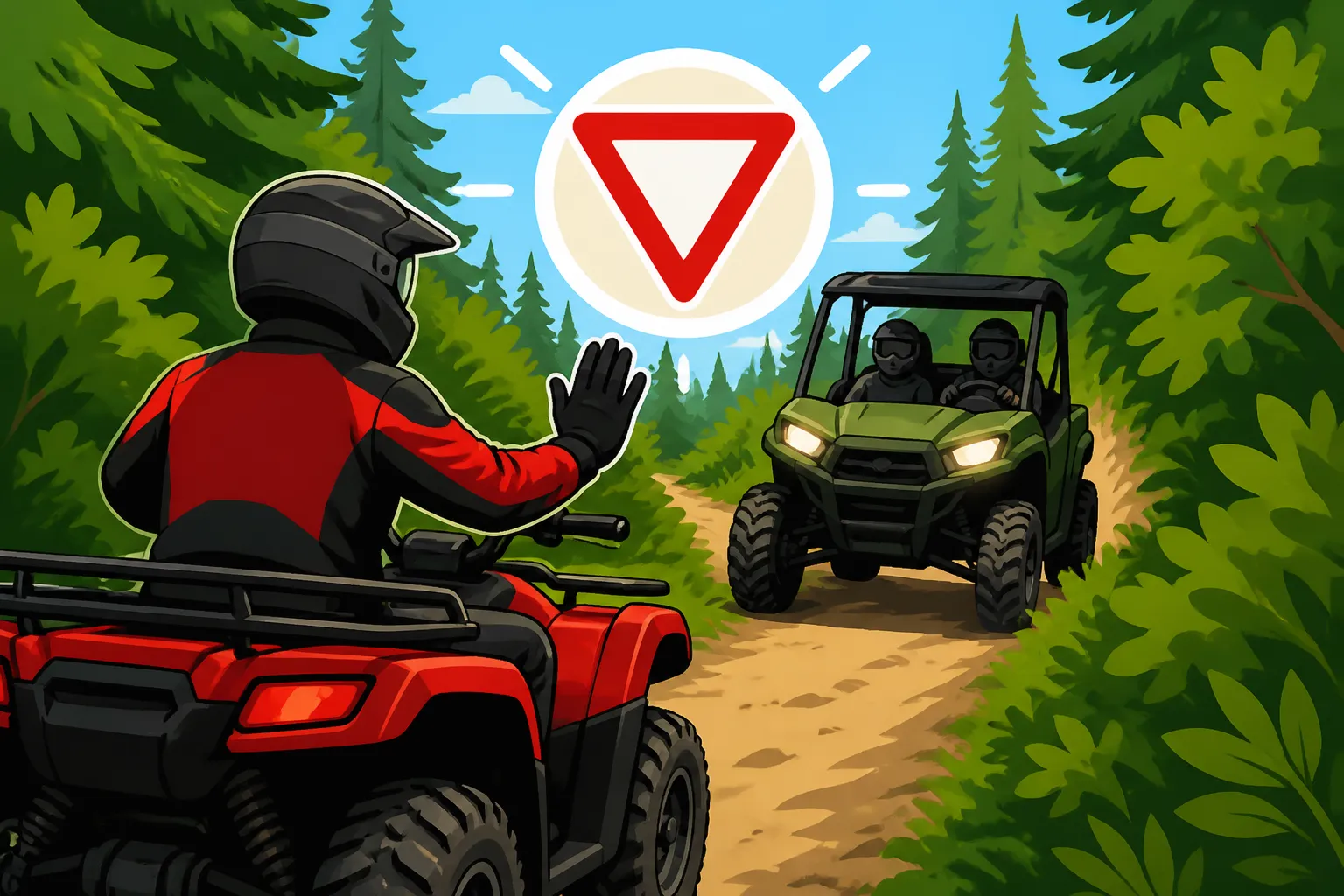
A calm, predictable exchange is usually safer than trying to wave someone through while both machines are moving. Stop with room between the machines, make eye contact if practical, and use a clear hand signal or a brief verbal exchange. If one rider is guiding another into a wider spot, keep the directions simple.
Do not assume a wave means the full group has passed. A rider may be signalling only for the first machine, or may not have seen a passenger or another quad behind you. Wait until you can see that the trail is clear and the other rider is ready before moving.
In a larger group, let the lead rider manage the exchange and pass the message back. Riders behind should not bunch up at the pinch point. A line of machines can block the trail, reduce visibility, and leave the last rider with no room to manoeuvre.
Give people, horses, and other trail users extra room
When you meet hikers or cyclists, slow well in advance and leave enough room for them to choose where to stand or pass. Do not crowd someone against brush or an unstable edge. If the trail is too narrow, stop and ask which direction gives them the safest space.
Horses need particular care. Stop at a distance, keep the machine quiet, and ask the rider what they would like you to do. Avoid revving, rushing past, or assuming the horse is comfortable with an ATV or UTV. A rider may prefer that you wait while they guide the horse through the tight spot. Do not restart or approach until they indicate it is safe.
Shared-use conditions can differ by location, and a trail being visible on a map does not prove that every kind of motorized use is allowed. Check the posted signs and local access rules before setting out. Manitoba ATV Trails: Club Ground and Crown Land offers useful context for why knowing who manages or maintains a route matters.
Make room for the machine you are meeting
A compact quad and a wide UTV do not need the same passing space. If you are on a narrow route and meet a side-by-side, a trailer, or a group of machines, do not try to force a pass through brush or onto soft ground. Find a stable pull-off or agree on which rider will move to a wider section.
The same caution applies when you are in the larger machine. Do not assume the smaller rider can safely squeeze past you. Leave room for them to stop, and be willing to reverse carefully if that is the safest option. If backing up, move slowly, keep the route behind you in view, and use a spotter when one is available.
| Trail situation | Safer response | Avoid |
|---|---|---|
| Blind bend or narrow approach | Slow down early and stay alert for oncoming traffic | Accelerating because the trail looks empty |
| Two machines meet on a tight section | Stop and find a firm, wide passing place | Forcing a pass through brush or soft ground |
| Rider is climbing a hill | Treat uphill priority as a courtesy and assess who can stop safely | Treating the convention as an absolute rule |
| Horse or hiker approaches | Stop at a distance and follow their directions | Revving, crowding, or passing too closely |
| UTV meets a quad | Communicate and use a wider pull-off if needed | Expecting the smaller machine to squeeze by |
| Group ride reaches a pinch point | Let riders pass in a controlled order | Bunching machines together at the narrow spot |
Plan Ahead for Manitoba Trail Conditions
Expect the trail to change during the ride
A route that was easy to pass on during a dry morning may become tight or slippery after rain. Ruts deepen, soft shoulders become harder to judge, and a trail edge that looked firm can give way under a heavy machine. After a storm, fallen branches or washouts may also leave less usable width than the map suggests.
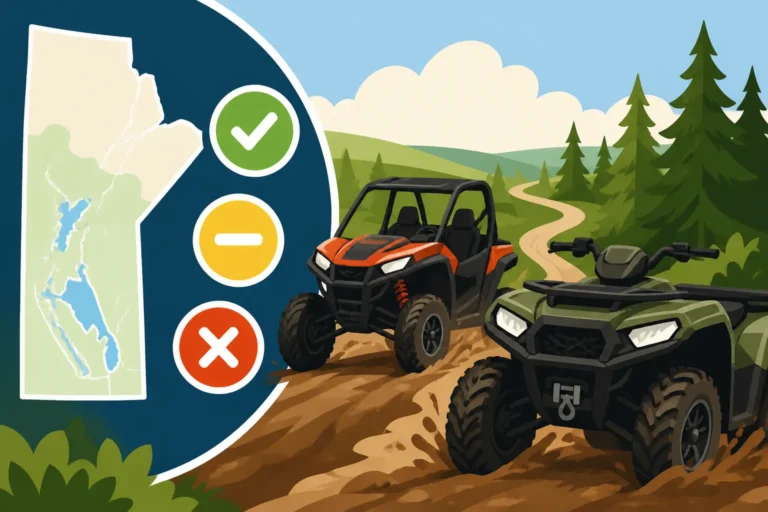
Before hauling to a trailhead, check local updates and consider whether your machine and experience suit the conditions. Trail difficulty can affect more than whether you can complete the route: it also affects how easily you can stop, turn around, or make room for someone coming the other way. Manitoba Trail Conditions Before You Haul and Manitoba Trail Difficulty Ratings can help you think through those decisions.
If a route becomes unsafe, turn back when you can do so without damaging the trail or putting another rider at risk. Do not create a new track around a blockage. Use marked routes and respect closures; Manitoba Trail Closures After a Storm is relevant when weather has changed access or conditions.
Use mapping tools as planning aids, not permission
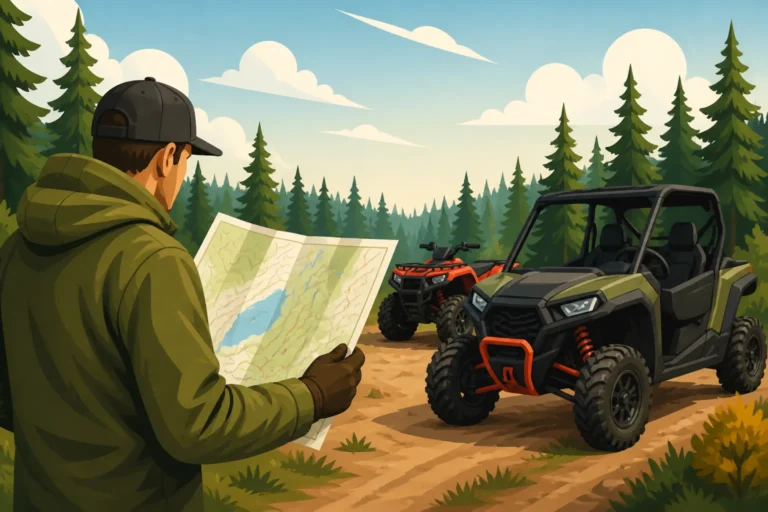
A mapping app can help you follow a route, understand where a trail connects, and keep your group oriented when a junction is easy to miss. Some riders use onX Offroad to plan and navigate rides, but any digital map should be treated as one tool rather than proof that a route is open or legal to ride.
Before departure, compare your planned route with current signs, local club information, land-access requirements, and any closure notices. Keep a paper map or another backup if you expect to ride where cell coverage may be limited. A phone battery can run down, a route line may not reflect a temporary closure, and a map cannot tell you that a narrow section has become unsafe since the last update.
If your group uses onX Offroad, check the route before you leave and agree on a meeting point in case riders get separated. Tell the group who is leading and who is riding at the back. For more on route-planning options, see Manitoba Trail Apps and Maps.
Set group rules before the first tight section
A short conversation at the trailhead can prevent confusion later. Agree on who leads, what signals the group will use, and how riders will handle a stop or a separation. Keep enough distance between machines for each rider to react, but avoid leaving such a large gap that the group loses track of one another at junctions.
Ask less experienced riders to speak up if they are uncomfortable with a hill, rut, or narrow passage. Nobody should feel pressured to squeeze past another machine just to keep the group moving. A patient pause is usually better than a rushed manoeuvre that risks a rollover, collision, or trail damage. Manitoba Group Ride Planning has more guidance for organizing a ride with several machines.
If your group includes different machine sizes, discuss that too. A wide UTV may need more room to turn around, while a smaller quad may be easier to reposition. Plan to stop at wider trail sections when checking on the group, rather than gathering everyone at a blind corner or pinch point.
Common Yielding Mistakes to Avoid
Do not assume the other rider sees you
Brush, hills, engine noise, and helmets can make it hard to notice an approaching machine. Slow down and be prepared to stop even if you have not heard anyone. A horn or a brief signal may help where appropriate, but it does not replace careful speed and visibility.
Avoid racing toward a narrow section to claim the space first. That turns a simple meeting into a contest and leaves both riders less time to respond. If the other machine does not appear to understand your signal, stay put until you can communicate clearly.
Do not pull off onto fragile ground
A rider may instinctively move off the trail to make room, only to sink into wet soil or damage plants along the edge. Before leaving the packed route, check whether the ground looks firm and whether the machine can get back onto the trail safely. If it cannot, wait for the other rider to move or coordinate a careful approach to a wider spot.
Avoid riding around a blockage or passing on an unmarked trail edge. Repeated detours can widen a route and harm sensitive ground. When a safe passage is not obvious, stop and reassess rather than turning a small inconvenience into a damaged trail or stuck machine.
Do not let courtesy override posted rules
Signs, closures, access restrictions, and local requirements take precedence over informal riding conventions. A rider waving you through does not make a closed route open, and a familiar trail does not automatically allow every machine type. If you are unsure, pause and check with the relevant land manager or local trail organization before continuing.
The practical rule is simple: slow down, communicate, and make room in the safest durable place available. Whether you are meeting another quad, a UTV, a hiker, or a horse, patience protects people and helps keep Manitoba’s shared trails in better shape.
Disclaimer
This article is for general informational purposes only and does not constitute professional advice. Laws, prices and regulations vary by location and change over time. Consult a qualified professional for guidance on your specific situation.