Manitoba Riding With a Group of Ten
A ride with ten people can turn into a headache before anyone reaches the trail: one vehicle gets separated, the parking area fills up, or the group discovers it needed a permit. This guide explains what to check before organizing a Manitoba ATV or UTV ride for ten, how to plan a route and meeting point, and how to keep the group moving safely.
Start with the permit and the route
Check whether your group needs a special event permit
In Manitoba, an organized group ride of ten or more may require a special event permit. Treat that as an early planning task, not a detail to sort out at the trailhead. A group ride arranged through a club, business, or social group can look different from several friends who happen to meet up, so describe your actual plans when you ask about the permit.
Before settling on a date, contact the appropriate permit office or land manager and explain where you intend to ride, whether the route crosses public or private land, how many machines you expect, and whether the ride is organized or open to additional participants. Ask how the group size is counted and what information the application needs. The permit authority and requirements can depend on the location and type of event.
Do not assume that a club membership, a trail map, or permission to use one section of trail covers the whole ride. A permit for an event and permission to access land are separate questions. Start with [Manitoba Special Event Permit Steps] and confirm which office handles your proposed location before you advertise the ride or collect commitments.
Confirm every part of the route is open to your group
A route that looks continuous on a map may cross land with different access rules. Club trails, provincial parks, Crown land, private land, and municipal areas may each have different permissions or restrictions. A route used by a friend last season is not proof it is open today, and a visible trail does not automatically mean you have permission to ride it.
Make a route list before the planning call. Include the trailhead, planned riding area, any road crossings, overnight stops, and the route back. For each section, note who manages it and what you need to check: event permission, access consent, park rules, seasonal closures, or local by-laws. If you cannot establish that a segment is open to your group, make a backup route rather than hoping to sort it out on the day.
This is especially important when a route crosses a club trail or a provincial park. Use [Manitoba Group Size on a Club Trail] to think through the club-trail side of a larger ride, and review [Manitoba Park Trail Conditions Pages] when your plan enters a park. Permission for one section does not carry over to the next.
| Planning question | What to confirm before the ride |
|---|---|
| Is the ride organized and does the group meet the permit threshold? | Ask the appropriate permit office about the event and how group size is counted |
| Who manages the route? | Identify club, park, municipal, private, or other land managers along the way |
| Is each segment open on the planned date? | Check closures, seasonal restrictions, and local rules |
| Can the whole group use the trail? | Confirm machine types, route suitability, and any group-size limits |
| Where will everyone meet and park? | Check trailer space, staging rules, and whether the area can handle the group |
| What should riders carry? | Confirm registration, insurance, identification, and any event paperwork required |
Build a route that works for a large group
Keep the day realistic for the slowest rider
A route that feels easy with two machines can become tiring and slow with ten. Every stop takes longer: riders need time to regroup, someone may need to adjust gear, and a machine issue can hold up everyone behind it. Plan the day around the pace of the least experienced rider and the least capable machine, not the quickest rider’s estimate.
For example, a group may plan to ride from a trailhead near Lac du Bonnet to a familiar destination and back. If several riders are new to bush trails, that plan should allow for slower travel, navigation pauses, and a longer lunch stop. Choose a route with clear places to turn around or shorten the day. A shorter ride completed together is usually better than an ambitious route that leaves half the group racing to catch up.
Check [Manitoba Trail Difficulty Ratings] while choosing a route, and look at [Manitoba Trail Conditions Before You Haul] before towing machines to the trailhead. Recent rain, rough ground, washouts, or other changing conditions can affect how long a route takes and whether it suits every machine in your group.
Use maps, markers, and a simple group structure
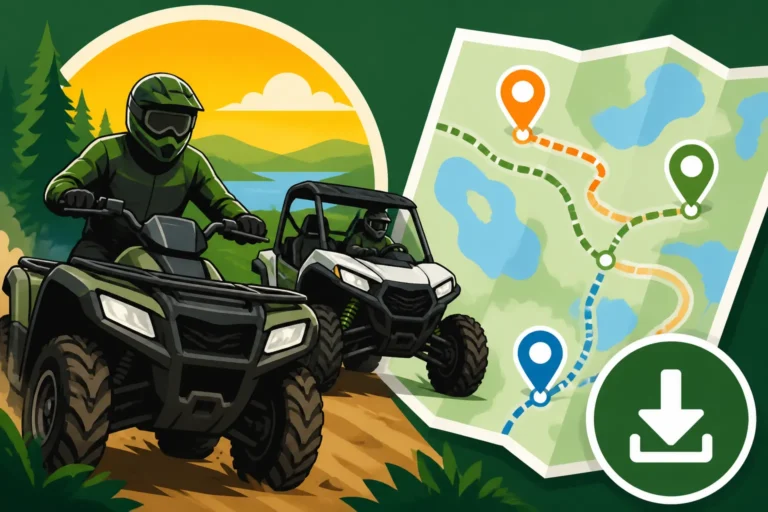
A large ride needs a navigation plan that does not depend on one person’s memory. Give every rider the meeting location, route outline, planned stops, and a clear instruction for what to do if they become separated. Share a map before the ride, then ask riders to download or save what they need in case mobile reception is poor. [Manitoba ATV Trail Map Downloads] can help with the map-planning step.
Tools such as onX Offroad can help a group compare route ideas and keep a shared navigation reference. Use it as one part of the plan, not as proof that a route is open or that access is permitted. Confirm the route with the relevant land manager and carry an offline map or other backup. In a northern riding area, a phone that loses service can turn a simple wrong turn into a long detour.
Give the group a lead rider and a sweep rider who stays behind the last machine. The lead should know the planned route and stop points; the sweep should know who is riding and notice if someone falls behind. Ask riders not to pass the lead or leave the trail without telling the group. At each junction, wait until the sweep arrives before moving on. That small habit prevents the familiar problem where the front half assumes everyone is behind them while the last riders are trying to guess which fork to take.
Organize people, machines, and the meeting point
Set expectations before anyone loads a trailer
Send practical ride details in advance: meeting time, exact staging location, route length, expected terrain, fuel plan, food and water needs, and what to do if someone is late. Tell riders to arrive with machines ready to unload, rather than expecting the whole group to wait while one person searches for paperwork or fixes a loose strap.
Ask each participant to confirm their machine is suitable for the planned route and that required registration and insurance are in order. Riders should know what documents they need to carry, and the organizer should check what the permit or land manager requires for the event. A group leader is not a substitute for each rider meeting their own obligations. For a refresher on shared-trail behaviour, [Manitoba Trail Etiquette Locals Expect] is useful reading to circulate before the ride.
It also helps to collect a few basic details from participants in advance: a mobile number, an emergency contact, machine type, and whether the rider is comfortable with the route. Keep the information accessible during the ride. If a machine breaks down, knowing who has a winch, basic tools, or the ability to tow can make the response calmer and more organized.
Choose a trailhead that can handle ten machines
A convenient meeting point is not always a suitable staging area. Ten machines may mean several trailers, tow vehicles, and riders arriving at the same time. Check whether the lot allows trailer parking, whether there is room to turn around, and whether your group could block other users or nearby roads. [Manitoba Trailheads With Trailer Parking] can help focus your search on practical staging options.
Contact the site or trail manager if the parking arrangement is unclear. Ask about overflow space, unloading, overnight parking, and whether a large group needs to coordinate arrival. If the trailhead is small, stagger arrival times or choose a different meeting point. A crowded unload area creates stress before the ride even begins and can make it difficult for other trail users to get through.
Plan a backup meeting location too. A full lot, a closure, or a sudden change in conditions can disrupt the original plan. Share both locations with the group and explain when the backup plan applies. Check [Manitoba Trail Closures After a Storm] before departure if weather has been rough, and do not treat a previous ride report as confirmation that the route remains open.
Keep the group safe and together on the ride
Agree on a pace, spacing, and regrouping routine
Before starting, explain the ride’s basic rhythm. The lead sets a pace that keeps the group together, riders leave enough room to stop safely, and the sweep stays behind the last machine. At a junction, the group pauses until everyone is accounted for. If someone needs to stop, they tell the nearest rider and the message travels forward or back rather than leaving one person alone without explanation.
Avoid splitting into faster and slower groups unless you have enough experienced leaders, a clear route plan for both groups, and an agreed meeting point. Otherwise, a rider who takes the wrong turn may not know which group to follow. If the group must separate because of ability or machine limitations, make that decision before leaving the trailhead and ensure each group has a responsible leader and its own navigation plan.
These routines are not about making a recreational ride feel formal. They reduce confusion when engines are loud, visibility is limited, and riders are spread along a wooded trail. The group can still be relaxed; it just needs to know how it will handle the ordinary moments that tend to cause trouble.
Prepare for a delay, breakdown, or sudden closure
A larger group is more likely to encounter a small problem during the day simply because there are more machines and people involved. Carry basic tools, water, suitable clothing, and a first-aid kit. Consider how the group will respond if a machine cannot continue, a rider is injured, or a trail becomes impassable. Decide whether the group waits together, sends a pair for help, or turns back, and make sure everyone knows the plan.
Check current trail and area information before loading up, then check again before you leave the staging area. If a closure or access concern appears, follow the posted direction and use the backup route only if it is confirmed open. Do not create a new trail around a barrier or assume that a nearby route is an acceptable detour. For help planning the overall itinerary and communications, see [Manitoba Group Ride Planning].
If the group is riding in a remote area, do not count on every rider having reliable mobile service. Share the route and expected return time with someone who is not on the ride. Keep the lead and sweep in communication where possible, and agree on a check-in point. A simple plan made before departure can prevent a minor delay from becoming a worrying search for the group.
Disclaimer
This article is for general informational purposes only and does not constitute professional advice. Laws, prices and regulations vary by location and change over time. Consult a qualified professional for guidance on your specific situation.