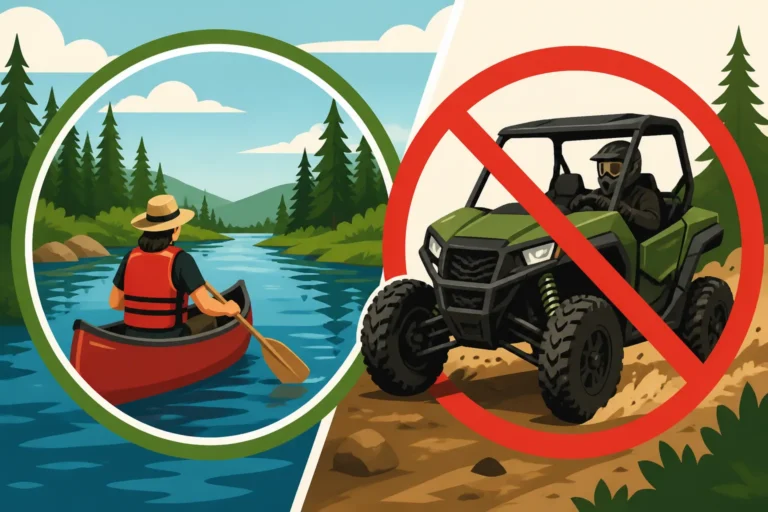
Riding Quietly Past Manitoba Cottages
A quiet ride can turn into a neighbour dispute faster than you expect: a quad climbs a hill, the throttle opens, and the sound carries straight across a Manitoba lake. This guide explains how to pass cottages considerately, what to check before riding near homes, and how to plan a route that respects residents without guessing at local rules.
Understand the rules before riding near cottages
Know the nighttime restriction
Manitoba has a provincial restriction on operating an off-road vehicle within 30 metres of a dwelling between midnight and 7 a.m. The rule is an important baseline for riders, but it is not a general “quiet hours” permission slip: being outside that distance, or riding before midnight, does not automatically mean every route or noise level is acceptable.
The practical difficulty is that distance can be hard to judge from a machine. A cottage may sit back from the visible shoreline, be partly hidden by trees, or have a deck and sleeping area facing a trail. If you are unsure how close you are, take the conservative option: slow down, avoid unnecessary throttle, and use another route if one is available. For the details and limits of the provincial restriction, see Manitoba’s 30-Metre Dwelling Rule and The 30-Metre Rule Runs Midnight to 7 a.m..
Local rules may add restrictions, including limits on where ORVs may travel or when they may be used. Municipalities, local government districts, and northern community councils can have different by-laws, so a route that is permitted in one area may be restricted in another. Check the rules for the place you are actually riding—not just the rules where you live. Manitoba Municipalities With ORV By-Laws is a useful place to explore why local details matter.
Separate legal access from considerate riding
A trail’s presence on a map does not, by itself, prove that you have permission to use it. The route might cross private land, a cottage access road, a Crown lease, or a stretch subject to a local restriction. Confirm that the route is open and that you are allowed to ride it before unloading. This is especially important around lakes and cottage subdivisions, where public roads, private lanes, and informal riding tracks can look similar from the trail.
Treat legal access and courtesy as two separate checks. A rider may be permitted to use a route and still create an avoidable nuisance by accelerating beside a deck, revving while waiting for a group, or repeatedly circling near homes. If a trail passes a cottage area, ride as though someone is resting on the porch or putting a child down for a nap—because someone may be.
If a property owner asks you to leave private land, do not argue from a GPS line or a friend’s recollection. Stop safely, stay calm, and clarify the route with the landowner or the appropriate local authority later. A map can help you plan, but it cannot replace permission or settle every access question.
Reduce noise without compromising safe riding
Use a steady pace and smooth throttle
The simplest noise reduction is often in your right hand. Sudden acceleration, repeated revving, and hard engine braking can make a machine much louder than steady, controlled riding. As you approach cottages, ease off the throttle early and maintain a consistent pace that suits the terrain and the posted rules. Avoid rapid bursts of speed just because a short straightaway opens up.
On a group ride, the first machine should set a calm pace before reaching the homes. Riders behind should leave enough space to avoid bunching up and repeatedly accelerating to catch the group. If someone needs to stop, pull over only where it is safe and allowed; do not idle beside a cottage while the group regroups. A short pause farther down the trail is usually more considerate and can make the ride smoother for everyone.
Passing quietly does not mean riding unsafely. Keep control of the machine, watch for pedestrians, pets, vehicles, and children, and do not coast blindly around a bend to reduce engine noise. If slowing down would put you or someone else at risk, prioritize safe operation and choose a quieter route next time.
Keep your machine in good condition
A machine that sounds unusually loud may have a maintenance problem, a damaged exhaust component, or an aftermarket modification that is not suitable for the route. Before a ride, look for loose or damaged parts, unusual exhaust noise, rattling heat shields, and anything that has changed since your last outing. If the sound seems different, investigate it rather than assuming cottage residents will get used to it.
Avoid revving an engine while parked, warming up for an extended period near homes, or testing a repair beside a trailhead used by residents. If you need to check a machine, do so away from cottages and in a place where stopping is permitted. Be mindful of more than the engine: loud music, shouting across a group, and letting a machine idle while loading or unloading can also carry across quiet water and open shorelines.
For groups, set expectations before anyone starts the engine. Ask riders to keep music off, avoid unnecessary revving, and move away from cottages before stopping. It is easier to agree on that at the staging area than to try to correct a noisy group midway through a ride.
| Situation | More considerate choice | Avoid |
|---|---|---|
| Approaching a cottage cluster | Ease off early and keep a smooth pace | Accelerating beside homes |
| Regrouping with friends | Stop at a safe, permitted spot away from cottages | Idling in a driveway or beside a deck |
| A machine sounds louder than usual | Check for damage or a maintenance issue | Assuming the noise is normal |
| Unsure whether a route is open | Confirm access before riding | Treating a map line as permission |
| Riding after dark or near quiet hours | Check provincial and local restrictions first | Guessing that a route is allowed |
Plan a route that avoids avoidable conflict
Check the route and access before unloading
A little planning can prevent the most frustrating kind of ride: discovering a closed route or a cottage access road after the trailer is already parked. Check the route’s current status, local by-laws, land access, and any posted signs. If you are riding on a club trail, consult the club’s route information and respect closures or reroutes. Manitoba Club Trails and Who Maintains Them explains why local trail knowledge and maintenance matter.
Digital maps can help you see how a route relates to lakes, settlements, and nearby roads. Some riders use onX Offroad while reviewing a planned route, but no mapping app should be treated as proof that a trail is open, that a property boundary is exact, or that you have permission to cross land. Use onX Offroad as one planning aid, then verify access and restrictions through the relevant land manager, club, municipality, or property owner. A second check is especially worthwhile when your route skirts cottages or follows an unfamiliar track.
If the map shows a path passing close to homes, ask whether you need that segment at all. A longer, quieter route may be a better choice than a short cut that puts your group beside several yards. The same principle applies when choosing a place to stop: select an established, permitted staging spot away from homes rather than pulling over at the first convenient clearing.
Use local knowledge and respect closures
Trail conditions and access can change. A route may be closed temporarily, damaged after heavy rain, or unsuitable because of nearby work or local concerns. Check signs at the trailhead and look for updates from the organization that maintains the route. Manitoba Trail Closures After a Storm offers useful context for why a familiar trail should not be assumed open every time you visit.
A local club can often clarify whether a track is an official route, whether it passes close to cottages, and where riders should stage or regroup. That does not mean a club can grant access to land it does not control, so confirm permissions when needed. When you see a closure sign, barrier, or reroute, follow it instead of trying to find a way around. Riding around a closure can damage land, create new conflicts, and make access harder for everyone who follows.
Apps, printed maps, and word of mouth all have limitations. A friend may remember last season’s route; a map may still display a track; and a trailhead sign may contain the most relevant instruction for that day. Check more than one source when the consequences of getting it wrong include trespassing or riding beside occupied homes. onX Offroad can help you compare possible lines before you leave, but confirm important access details on the ground and with the responsible local contact.
Handle cottage-area encounters with courtesy
Respond calmly to concerns
If a resident approaches you about noise, stop in a safe place and listen. Even if you believe you are riding legally, a calm response is more useful than arguing in the moment. Ask which section of the route is causing concern, whether there is a posted restriction you may have missed, and who can confirm the local rules. Do not block a driveway or continue revving while you talk.
You do not need to agree with every claim to respond respectfully. You can say that you will check the route and the by-law, then follow up with the relevant municipality, local government district, community council, landowner, or trail club. If you discover that you were on a restricted route, leave by the safest permitted way and do not return until you have confirmed where riding is allowed.
Repeated complaints are worth treating as a signal, even if no one has issued a ticket. Keep a note of the location, date, time, and route details. That can help you identify a pattern—perhaps a short section near several cottages, an evening regrouping spot, or a route that is no longer appropriate. Manitoba Noise Complaints About Quads can help you think through the difference between a neighbour concern and a question about applicable rules.
Make courtesy part of the group plan
The person leading a ride has an outsized effect on how the group behaves. Before starting, explain where the route passes near homes, where the group should slow down, and where it can safely stop. Ask everyone to keep music off and avoid showing off with throttle blips or repeated passes. A simple briefing prevents one rider’s behaviour from becoming the whole group’s reputation.
If you are organizing a larger ride, choose a route that is suitable for the group and check the details in advance. A long line of machines may take longer to pass a cottage area than one or two riders, and riders at the back may not hear instructions given at the front. Agree on signals, keep reasonable spacing, and make sure every participant knows where to regroup away from residential areas.
Cottage owners and riders often want the same thing: to enjoy the outdoors without a preventable disturbance. Riding steadily, staying on routes you are allowed to use, and giving homes extra space are practical ways to make that possible. For more general expectations on shared routes, see Manitoba Trail Etiquette Locals Expect. A little restraint near cottages helps protect goodwill—and helps keep riding access open for future trips.
Disclaimer
This article is for general informational purposes only and does not constitute professional advice. Laws, prices and regulations vary by location and change over time. Consult a qualified professional for guidance on your specific situation.