Manitoba Trail Etiquette Locals Expect
A Manitoba ride can turn uncomfortable quickly when a fast group meets hikers on a narrow track, a machine spins up wet ground, or riders arrive at a gate without knowing who maintains the trail. Good trail etiquette helps prevent those moments. This guide explains how to share routes respectfully, protect the land, and make a better impression on the people who live and ride nearby.
Share the trail thoughtfully
Slow down and make your presence clear
Manitoba trails can twist through bush, follow old rail beds, or narrow between trees where nobody has much room to react. Ease off the throttle when approaching a blind corner, crest, trail junction, campsite, or group of people. A little patience can prevent a collision and spare others the sudden blast of noise and dust that can make an otherwise pleasant outing feel intimidating.
If you meet someone going the other way, slow to a crawl or stop somewhere with enough room to pass safely. Give a friendly greeting, and don’t assume the other person can see or hear you over their own machine. On a tight section, one rider may need to back up to a wider spot. It’s a minor inconvenience compared with forcing a tense squeeze between machines, trees, or people on foot.
Keep your speed appropriate to the surface and the sightline, not just to how capable your ATV or UTV feels. A wide, open stretch may invite a quicker pace, but dust can obscure the view for riders behind you, and loose gravel can be thrown toward others. If you’re riding in a group, leave enough space that the rider in front can slow or stop without the next machine crowding them.
For more on who looks after shared routes, see [Manitoba Club Trails and Who Maintains Them](Manitoba Club Trails and Who Maintains Them). A club-maintained trail is not a private racetrack: it’s a corridor shared by people who may have different machines, experience levels, and reasons for being outdoors.
Yield with patience and consideration
A trail is not always wide enough for everyone to continue without stopping. When you meet hikers, people with horses, or other trail users, slow down early and give them room. Ask what would make passing easier rather than pressing ahead and expecting them to move. With horses, that conversation matters: sudden noise or movement may frighten an animal, so wait for the rider’s direction and pass slowly only when it’s safe.
The same courtesy applies when you come up behind someone travelling more slowly. Give them time to notice you and find a safe place to let you pass. Avoid riding close behind, revving repeatedly, or pushing past in a spot with soft shoulders or limited visibility. People are more likely to make room when they don’t feel rushed or threatened.
Shared-use routes can bring together hikers, horseback riders, and motorized users. Before you head out, check the specific route’s permitted uses and local guidance; don’t infer that every path or park trail is open to motorized machines. These guides offer useful background: [Manitoba Trails Shared With Hikers](Manitoba Trails Shared With Hikers) and [Manitoba Trails Shared With Horses](Manitoba Trails Shared With Horses).
Make group rides easier for everyone
A group that travels as a loose, predictable line is easier to pass and less likely to block a trail junction. Avoid spreading across the full width of a route, especially near trailheads, narrow bridges, and places where other riders may approach from the opposite direction. If the group needs to stop, pull completely off the travelled path where the ground is firm and the location is safe.
Choose a meeting place before setting out, and agree on what the group will do if riders become separated. A lead rider can set a comfortable pace, while a sweep rider helps ensure nobody is left behind. Keep stops brief when you’re occupying a busy trail or staging area, and make sure everyone knows to wait at turns instead of continuing on an unfamiliar route.
If you’re organizing a larger outing, plan for parking, regrouping, and the possibility that the trail will be busier than expected. [Manitoba Group Ride Planning](Manitoba Group Ride Planning) covers the practical side of keeping a ride coordinated. Strong planning makes it less likely that a group will block access, surprise other users, or leave someone uncertain about where to go next.
Protect the trail and the surrounding land
Stay on the route and avoid making new tracks
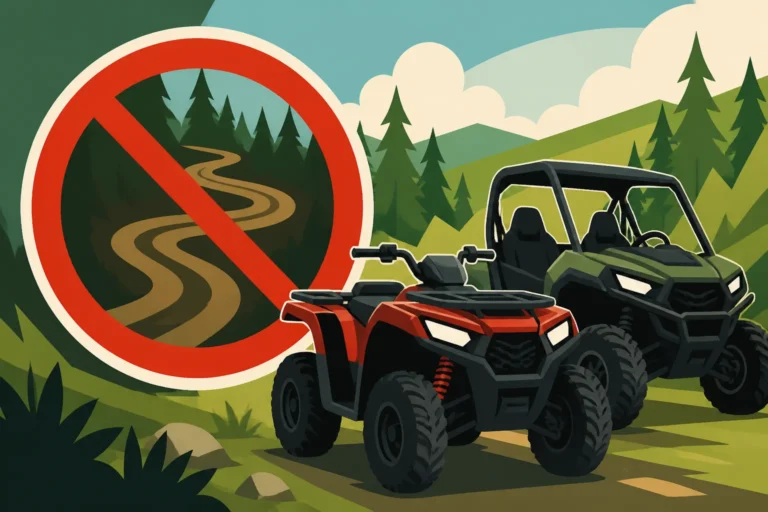
The most important land-care habit is also one of the simplest: stay on the established route. Riding around a muddy patch, puddle, or obstacle can turn one narrow trail into several parallel tracks. Those detours may widen the disturbed area, damage plants, and create a bigger mess for the next group. If the trail seems impassable, stop and assess it rather than immediately cutting a new line through the bush.
Avoid driving through crops, fenced areas, gated rangeland, wetlands, shorelines, and other sensitive ground. A visible opening is not necessarily permission to ride there. Access rules can vary by location and land status, so confirm that you’re allowed to use the route before unloading. On Crown land or land associated with a lease, access should never be assumed; check the applicable permissions and local restrictions.
A map can help you follow a planned route, but it cannot by itself establish that you have permission or that a trail is open. Some riders use onX Offroad as one navigation reference alongside official information, posted signs, and local guidance. The same basic caution applies to any mapping tool: a line displayed on a map is not automatically a legal or maintained riding route.
Avoid rutting, spinning, and unnecessary damage
Manitoba’s soft ground can be vulnerable after rain or during seasonal thaw. A machine that struggles for traction can churn a small rut into a long trench, especially when the rider keeps applying throttle. If you’re losing grip, stop spinning the tires. Consider whether you can turn around safely, wait for firmer conditions, or use a recovery plan that won’t widen the damage.
Don’t ride around barriers, closed signs, or obvious trail damage. Closures may protect a route while it dries, after a storm, or while repairs are underway. Even when a detour looks easy, going around a closure can damage the adjacent ground and make the original problem worse. For a closer look at why conditions matter, read [Manitoba Riding After Heavy Rain](Manitoba Riding After Heavy Rain) and [Manitoba Trail Closures After a Storm](Manitoba Trail Closures After a Storm).
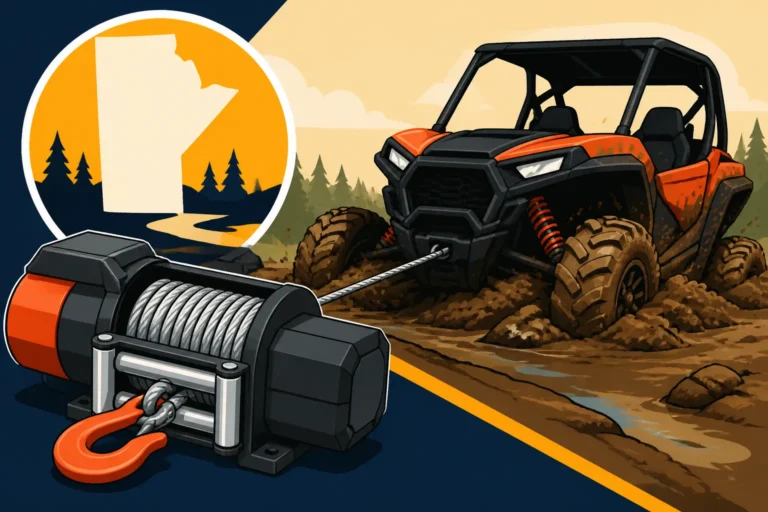
If a machine gets stuck, focus on recovery without turning the area into a bigger mess. Avoid repeated high-speed attempts that dig the tires deeper. Use appropriate recovery equipment if you have it, and don’t put anyone in a position where a strap, winch line, or moving machine could cause injury. If the safest option is to wait for help, do that rather than damaging the trail in a hurry.
Leave campsites, trailheads, and shared spaces tidy
At a trailhead or rest stop, park so other vehicles and trailers can get in and out. Don’t block a gate, driveway, access lane, or the area another group needs to unload. If you’re stopping along the route, choose a spot where the group can move off the main track without trampling vegetation or creating a hazard for approaching riders.
Pack out everything you bring in, including food wrappers, drink containers, broken straps, and small pieces of equipment. Don’t leave trash beside a firepit, trail sign, or parking area on the assumption that someone else will collect it. At campsites, follow posted rules and use only facilities or fire areas provided for that purpose. A clean site is welcoming to the next visitor and helps protect continued access.
Take care with noise near homes, cabins, campgrounds, and other places where people may be resting. Ease off the throttle as you approach occupied areas, avoid unnecessary revving while stopped, and keep music at a level that doesn’t spill across the landscape. Respectful riding is not just about what happens on the trail; it includes how your group behaves at the start and end of the day.
Prepare before you ride and respond well when plans change
Check route information before unloading
Before you leave home, confirm that the route is open, suitable for your machine, and accessible to the kind of riding you plan to do. Trail conditions can change after heavy rain, storms, maintenance work, or seasonal restrictions. A route that appeared usable on a previous trip may not be in the same condition now.
Use more than one source when the details matter. Look for signs at the trailhead, local club updates, park information, and guidance from people familiar with the area. onX Offroad can be one part of your navigation setup, but don’t treat an app’s map as proof that access is allowed or that a route has no closure. Carry a backup plan for navigation, especially where cell service may be unreliable, and let someone know where you expect to ride.
Pay attention to signs and barriers when you arrive, even if your digital route shows a line continuing ahead. If information is unclear, pause and ask a local club, park office, land manager, or other appropriate contact before proceeding. [Manitoba Trail Conditions Before You Haul](Manitoba Trail Conditions Before You Haul) is a helpful reminder to check the practical details before towing a machine a long distance.
| Situation | Considerate response | Avoid |
|---|---|---|
| Meeting hikers | Slow down, give space, and pass only when it’s safe | Rushing past or covering people with dust |
| Meeting horses | Stop or slow well in advance and follow the rider’s direction | Revving, crowding, or passing without warning |
| Finding a muddy section | Stay on the established route and assess conditions | Riding around it and creating another track |
| Reaching a closed area | Turn back and check for current route information | Moving a barrier or riding around it |
| Stopping with a group | Move fully off the trail where it’s safe | Blocking a junction or access point |
| Finding damage or litter | Report the issue and share clear details | Leaving trash or attempting an unsafe repair |
Treat local knowledge as useful, not optional
Locals and club volunteers often know which areas are soft, where a route has changed, and what kinds of use create problems for nearby residents. Listen without getting defensive if someone asks your group to slow down, move over, or avoid a particular section. They may be trying to protect the trail or keep a shared route usable for everyone.
That doesn’t mean every person you meet can grant permission to use a route. Take advice seriously, then confirm access and restrictions through the appropriate source if you’re unsure. A courteous question is usually better than an argument at a gate or a rushed decision that leaves you somewhere you shouldn’t be.
If you use onX Offroad or another navigation app to follow a track, compare what you see with current signs and local information. A digital route may be helpful for orientation, but conditions and access permissions are ground-level realities. If the map and the signs disagree, don’t assume the app is right; stop and clarify before riding onward.
Report damage and pitch in where you can
When you see a downed tree, washed-out section, damaged sign, or unsafe obstruction, share the location and a clear description with the club or authority responsible for the route. If you can safely note a nearby junction or take a location pin, the information may be easier to act on. Don’t try to make repairs that require tools, create a hazard, or could cause further damage.
Reporting a problem is also more useful than posting a vague complaint that doesn’t identify the route. Explain what you observed, when you noticed it, and whether the trail was passable. For information on contributing to local trail work, see [Manitoba Trail Volunteer Days](Manitoba Trail Volunteer Days). Even if you can’t attend a work day, a clear report can help the people maintaining the route understand what needs attention.
If you notice litter, pick it up when it’s safe and practical, but don’t put yourself or your machine at risk. Be especially cautious around broken glass, sharp metal, hazardous materials, or anything that may be unsafe to handle. Good etiquette includes knowing when to help directly and when to pass information to someone equipped to deal with the problem.
Build habits that make you welcome back
Be predictable, even when the trail is quiet
Good etiquette matters on an empty weekday ride as much as on a busy weekend. A trail can become crowded around a junction, campground, or popular riding area with little warning. Keep your machine under control, stay alert for people and wildlife, and leave room for others to use the route without feeling pressured.
Be especially careful when visibility is limited by dust, trees, darkness, or weather. Slow down enough to stop within the space you can see, and make sure your lights and equipment are appropriate for the conditions. If you’re unsure about a local rule or whether a route is open to your machine, stop to check rather than relying on what another rider appears to be doing.
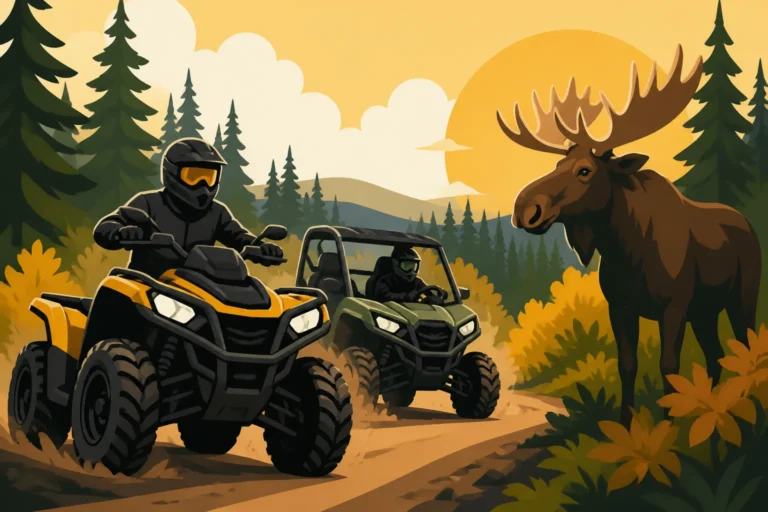
Wildlife encounters call for calm, generous space. Don’t chase animals or crowd them for a closer look. Give them an opportunity to move away, and avoid turning a sighting into a group stop that blocks the trail. [Manitoba Wildlife on the Trail](Manitoba Wildlife on the Trail) offers further context for sharing riding areas with wildlife.
Make a good impression on the people around the trail
A trail doesn’t exist in isolation. It may pass near homes, cabins, farms, campsites, or roads used by people who aren’t riding. Keep noise and speed under control near those places, respect gates and private property, and don’t assume that a visible track gives you the right to use it. When someone is working, driving, or managing land nearby, give them room and avoid obstructing their access.
Courtesy also means taking responsibility for your own group. If a rider in your party is pushing the pace, throwing dust, or drifting off the established route, speak up before a small issue becomes a bigger one. A calm reminder can be more effective than waiting for someone else to complain. New riders often take their cues from the group; set an example that makes safe, considerate behaviour feel normal.
The habits are straightforward: ride at a sensible speed, yield with care, stay on the established route, check access before setting out, and leave the place as you found it. Those choices protect the trail and make it easier for riders, hikers, horse users, land managers, and nearby residents to share the same area.
Disclaimer
This article is for general informational purposes only and does not constitute professional advice. Laws, prices and regulations vary by location and change over time. Consult a qualified professional for guidance on your specific situation.