Winches for a Stuck Manitoba Machine
A Manitoba ATV or UTV can feel firmly planted after just a few turns of a tire in muskeg, wet clay, or deep trail mud. Spinning harder often makes the hole deeper and recovery riskier. This guide explains how to choose an anchor, set up a winch, recover a machine safely, and avoid damaging the trail or surrounding ground.
Before You Winch a Stuck ATV or UTV
Stop before the tires dig deeper
When a machine bogs down, the first instinct is often to add throttle. That can work if a tire has only slipped briefly, but repeated spinning can quickly turn a shallow rut into a deep hole. Mud may pack around the tires or chassis, and a UTV’s belly can settle onto the ground. In muskeg or soft wet ground, the machine may sink while the soil around it gives you fewer reliable places to stand.
Stop, take a breath, and look at what is holding the machine. Check whether the frame, skid plate, or differential is hung up on a rut, log, or ridge. Look for the firmest direction of travel, which may be back the way you came rather than farther along the trail. If the vehicle is leaning, near water, or moving unpredictably, keep people clear and do not try to yank it free with a sudden pull.
Before getting out, set the brake and follow your machine’s instructions for safely putting it in neutral or park during a recovery. Ask passengers to move to a safe location away from the cable or rope and the direction the machine could move. If your riding group needs a refresher on carrying recovery gear, First Aid on a Long Manitoba Loop and Packing for a Cold Manitoba Morning are useful reminders that a recovery can become a longer stop than expected.
Check whether winching is the right recovery method
A winch is useful when a machine can be pulled steadily toward a suitable anchor, but it is not a cure-all. If the machine is sharply tipped, trapped in deep water, buried to the chassis, or positioned where a pull could drag it into a hazard, stop and reassess. A second machine is not automatically a safe anchor; it can be pulled forward too, especially on soft ground or a slope.
Look for warning signs such as a tree with loose roots, a cracked trunk, a moving anchor, or a cable that would have to pass over a sharp edge. A winch pull should be controlled, with a clear path and no one standing near the line. If the machine cannot be recovered without putting someone in the likely path of a moving vehicle, cable, or anchor, a trained recovery operator may be the safer choice.
Protect the trail and surrounding ground
A recovery can cause more damage than the original stuck spot if people widen the trail, drag brush across sensitive ground, or drive around a muddy section. Stay on the established route where possible and do not use a winch to pull a machine across a wetland, planted area, or other sensitive ground. Trail choices matter especially in Manitoba’s muskeg and wet forest areas; Manitoba Muskeg and Machines explains why these surfaces need extra care.
If an anchor point is near a club trail or public riding area, use a tree-protection strap rather than wrapping a bare winch cable or rope around the trunk. Avoid cutting vegetation or attaching to signs, trail markers, gates, or infrastructure. If the route is badly damaged, note the location and report it to the local club or land manager rather than trying to conceal the damage by making a wider bypass. Reporting Trail Damage to a Manitoba Club covers why that follow-up matters.
Choosing and Preparing a Winch Setup
Match the winch and mounting hardware to the machine
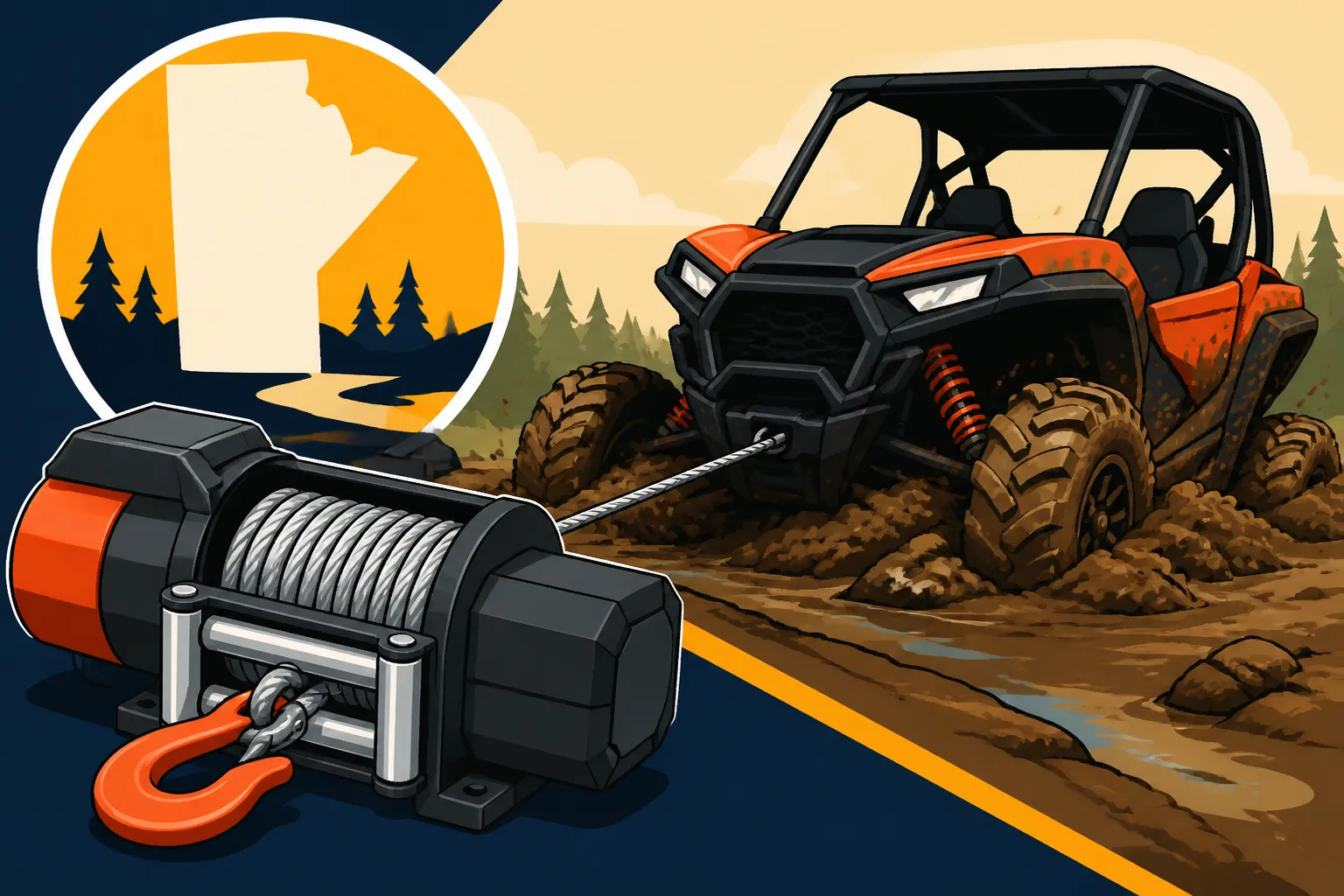
Choose a winch rated for your ATV or UTV and intended use, and follow the vehicle and winch manufacturers’ guidance for capacity, mounting, wiring, and operation. A larger-looking winch is not automatically a safe setup if the mounting plate, bumper, electrical system, or attachment points are not suitable for the load. Check the complete system, not just the winch label.
Before a ride, inspect the fairlead, hook, mounting bolts, cable or synthetic rope, electrical connections, and remote control. Look for fraying, kinks, crushed sections, corrosion, loose hardware, or signs that the rope has been dragged across sharp rock. Replace damaged components according to the manufacturer’s instructions. A winch that works in the driveway but has a damaged line or loose mount can fail when the machine is under load.
Carry the right recovery accessories
A useful recovery kit usually includes a tree-protection strap, a rated shackle or connector compatible with your equipment, gloves, and a winch-line damper or suitable heavy blanket. The right connector depends on the winch line and recovery accessories, so check that every part is designed for the intended load and used as directed. Do not substitute a trailer ball, tow strap, chain, or improvised knot for a proper winching connection.
Keep the kit together and accessible. It is frustrating to discover that the gloves are under the cargo, the strap is buried beneath a cooler, or the remote is back at camp when the machine is stuck. Before a longer ride, tell your group where the recovery gear is stored and agree on who will operate the winch. For trail planning and navigation, Manitoba Trail Apps and Maps can help you prepare, while onX Offroad may be one option to consider for reviewing a route before setting out. Check the app’s available maps and features for your area before relying on it in the bush.
Choose an anchor you can trust
A strong, healthy tree with suitable roots can sometimes provide an anchor when used with a tree-protection strap. Do not assume that a large trunk is secure: a dead tree, leaning tree, shallow-rooted tree, or tree growing in soft saturated ground may move or fail under load. A purpose-built ground anchor is another option if it is appropriate for the terrain and used according to its instructions.
Never anchor to another machine unless the other vehicle’s operator understands the plan, the anchor point is suitable, and both machines can remain stable. Avoid attaching to a bumper or rack unless the manufacturer identifies it as a recovery point. If the only available anchor is questionable, do not force the pull. A short walk to find a safer anchor—or waiting for help—may be preferable to a failed recovery.
How to Winch a Machine Out Safely
Set up the pull before powering the winch
- Move bystanders well away from the winch line and the likely path of the machine. Keep everyone out of the line’s direction of travel and away from the anchor.
- Put on gloves and inspect the winch line. Do not handle a moving line, and keep hands away from the fairlead, hook, and other pinch points.
- Attach the line to a manufacturer-approved recovery point. If using a tree, wrap the tree-protection strap around the trunk and connect the winch line to the strap with a compatible connector.
- Check the line path. Make sure it will not rub against a sharp edge, become trapped under a tire, or pull the machine toward a drop, water, or other hazard.
- Place a winch-line damper or suitable heavy blanket over the line as directed by the equipment maker. It does not make a failure harmless, but it can help reduce the line’s movement if something breaks.
- Confirm that the anchor and all connections are secure. Keep the line as straight as practical and avoid unnecessary side pulls that could stress the winch or mounting points.
If the line needs to be redirected, use only suitable recovery equipment and follow its instructions. A pulley or snatch block changes the direction of the line and can alter the forces on the anchor and rigging. Do not add components unless you understand how they are meant to be used.
Pull steadily and communicate clearly
Have one person operate the winch and one person watch the recovery from a safe position. Everyone else should stay back. Agree on simple instructions before the pull begins, such as “stop” if the anchor shifts, the line snags, or the machine begins to move in an unsafe direction. Do not crowd the operator or try to guide the line by hand while it is under load.
Winch in slowly and steadily. If the machine has a safe position available, the operator can follow the vehicle’s instructions while the winch helps it move, but avoid adding throttle in a way that causes the tires to spin or the machine to lurch. Pause if the line winds unevenly, a connection moves, the anchor starts to pull out, or the winch sounds or behaves abnormally. Do not keep pulling against a machine that is physically hung up; clear the obstruction only when the setup is safe and the line is no longer under tension.
Once the machine moves, stop and reassess rather than assuming it is free. It may need to be pulled a short distance onto firmer ground before disconnecting. Keep people away until the line is slack, then disconnect carefully and inspect the equipment.
Avoid common recovery shortcuts
Never step over a tensioned line, stand in a loop of rope, or put your body between the machine and its anchor. Do not use a damaged line, overload the winch, or wrap a cable around a tree. Keep clothing, fingers, and tools clear of moving parts. If the winch motor overheats or the manufacturer’s guidance calls for a rest period, stop and let the equipment cool as instructed.
A tow strap and a winch line are not interchangeable. A tow strap is designed for a different kind of pull, and a sudden jerk can create dangerous forces. Do not use a running start to “snatch” a stuck ATV or UTV unless the recovery equipment is specifically designed for that method and everyone involved knows how to use it. Most trail recoveries benefit from calm, controlled movement rather than a dramatic burst of force.
Recovery Decisions for Manitoba Trails
Understand how terrain changes the plan
Manitoba conditions can shift over a short distance: a firm-looking track may give way to saturated ground, deep mud, or muskeg. In the Interlake, boreal forest, and other wet or low-lying areas, the ground may not provide the solid footing an anchor needs. A tree that seems sturdy can move when its roots are in soft soil, and a machine that looks close to the trail’s edge may be much harder to recover than expected.
Use your route plan to avoid committing to a questionable stretch without an exit option. Check for closures and local trail guidance before hauling out, and do not treat a mapped line as proof that the ground is passable today. onX Offroad can be considered as one route-planning tool, but local club information and posted signs remain important. For a broader look at riding surfaces and seasonal conditions, see Manitoba Trail Conditions Before You Haul and Manitoba Riding After Heavy Rain.
| Situation | Safer first response | Avoid |
|---|---|---|
| Tires are spinning in shallow mud | Stop, assess the machine, and look for a controlled route back to firm ground | Repeated throttle that digs deeper |
| Chassis is hung up | Check whether a gentle pull can clear the obstruction safely | Pulling hard against a fixed obstacle |
| Anchor is in soft or wet ground | Find a more reliable anchor or wait for help | Assuming a large tree is automatically secure |
| Machine is tipped or near water | Keep people clear and reassess the hazards | A quick pull that could roll or drag the machine |
| Trail edge is sensitive or waterlogged | Stay on the established route and limit disturbance | Cutting a new bypass through vegetation |
Prepare for help to take longer than expected
A winch does not replace basic trip preparation. Tell someone where you are riding and when you expect to return. Carry a charged phone or another communication device appropriate to the route, and do not count on continuous service in remote areas. A paper map and a clear understanding of your route can help if a device loses power or reception; Carrying a Paper Map in the Manitoba Bush offers a practical reminder.
Pack for an unplanned delay, especially when the weather is cold, wet, or changing. Water, food, warm layers, a first-aid kit, and basic tools matter if a recovery takes longer than expected or the machine cannot be moved. Keep onX Offroad or another navigation tool from becoming your only plan: know the route before riding and share it with someone outside the group. A map is most useful when you have already considered where you can turn around or get help.
Know when to stop and get assistance
Stop the recovery if the anchor moves, the machine shifts toward a hazard, the line becomes damaged, or the group cannot maintain a safe distance. Also stop if the required pull is beyond the capacity of the equipment, if the machine is pinned or submerged, or if the ground is too unstable to support the recovery. Continuing because you have already spent time setting up can turn a manageable problem into an injury or major equipment failure.
If the machine is recovered, inspect it before riding farther. Look for damage to the winch line, mounting points, steering, tires, undercarriage, and electrical connections. Check for mud or debris around moving parts and follow the owner’s manual for any cleaning or maintenance. If something feels loose, bent, overheated, or unreliable, avoid riding until it has been checked. A quiet, cautious return is better than discovering a recovery-related problem several kilometres down the trail.
Disclaimer
This article is for general informational purposes only and does not constitute professional advice. Laws, prices and regulations vary by location and change over time. Consult a qualified professional for guidance on your specific situation.