Manitoba Riding Compared to Ontario
A ride that feels straightforward in one province can become confusing after you cross a border: trail access, permits, registration and local rules may all change. This guide compares ATV and UTV riding in Manitoba and Ontario, explains what visitors should check before unloading, and helps you plan a trip without assuming that a familiar trail rule applies everywhere.
Manitoba and Ontario riding at a glance
Terrain and the kind of ride you can expect
Manitoba and Ontario both offer plenty of variety, but riders often experience that variety differently. In Manitoba, trips can mean sandy club trails, forest roads, open country and long stretches between services. Areas such as the Eastman region, the Interlake and Duck Mountain offer very different riding experiences. The Mossberry Trail in Duck Mountain is one example of a designated route shared with other trail users, so riders need to plan for more than just the condition of the surface.
Ontario has extensive riding areas too, but the experience depends heavily on the region and the trail system. Routes around places such as the Haliburton Highlands may feel different from riding in northern Ontario or in more developed areas. A route that appears close on a map can involve different land managers, club networks or local access rules along the way.
The practical difference is not that one province is simply “better” for riding. It is that your trip may require different preparation. A Manitoba ride might involve longer distances between fuel, cell service or communities. An Ontario route may have more route-network or local-access details to confirm, depending on where you go. In either province, check the route as a whole rather than judging it by one trailhead or a single map line.
Trail networks, permissions and access
In Manitoba, a trail shown on a map is not automatically open to motorized use. Club trails, Crown land and provincial parks can have different access rules. Provincial parks generally allow machines on designated routes rather than wherever a rider can find a track. Crown land access can also depend on restrictions, leases, sensitive areas and the permission of an occupier or lease holder.
Ontario riding likewise depends on the specific land and trail system. A route may be maintained by a club, pass through land with particular access conditions or connect to an area where motorized use is not allowed. Do not assume that a public-looking road, forest track or trail is open to ATVs just because it appears on a consumer map.
For Manitoba-specific planning, start with [Manitoba ATV Trails: Club Ground and Crown Land](Manitoba ATV Trails: Club Ground and Crown Land) and [Manitoba Parks Allow Machines on Designated Routes Only](Manitoba Parks Allow Machines on Designated Routes Only). Those distinctions matter when a route crosses from club-managed ground to a park or Crown land. The broader guide to [Manitoba Crown Land Riding Explained](Manitoba Crown Land Riding Explained) is also useful if your plan includes riding beyond a marked club trail.
| Planning question | Manitoba | Ontario |
|---|---|---|
| Is every visible trail open to ATVs and UTVs? | No. Confirm that motorized use is permitted on the specific route and land. | No. Access depends on the route, land manager and local rules. |
| Should you check local rules? | Yes. Municipal rules and trail access can vary by location. | Yes. Check local rules and trail-system requirements where you plan to ride. |
| Is registration the same as permission to ride? | No. Registration does not grant access to a trail or property. | No. Registration does not itself provide trail or land access. |
| Can one map settle the question? | No. Use maps as planning tools, then confirm access and closures. | No. Confirm current route access with the relevant club or land manager. |
| What should visitors verify? | Home registration, insurance, operating rules and route access. | Ontario requirements, the specific trail system’s access conditions and local rules. |
Rules, registration and permits
Registration is not the same as trail access
A common point of confusion is treating registration, insurance and trail permission as one thing. They are separate questions. Registration concerns the machine’s legal status. Insurance concerns required financial protection. Permission concerns where you may ride. Having paperwork in order does not mean you can ride across private land, use a closed route or enter a park area without authorization.
Manitoba’s registration system includes a trails fee, but that fee should not be mistaken for a universal trail pass. Manitoba does not have a general ATV trail pass that automatically authorizes use of every club trail or public route. Check [Manitoba Has No ATV Trail Pass](Manitoba Has No ATV Trail Pass) for the distinction between the registration-related fee and permission to ride a particular trail.
Ontario riders should not assume that Manitoba’s registration and access arrangements match what they know at home. Requirements can differ between provinces and trail networks. A club trail may have its own rules or access arrangements, while public land and parks may have separate restrictions. Before the trip, check what applies to the exact route rather than relying on a general statement about riding in Ontario or Manitoba.
Visitors need to check both home and destination requirements
If you are bringing an Ontario-registered machine to Manitoba, confirm that its registration and insurance meet the requirements for a visiting rider. You also need to follow Manitoba’s operating rules while riding there. A visitor’s home paperwork does not exempt them from destination rules about where machines may travel, how they may cross roads or which routes are open.
The same planning principle applies when a Manitoba rider heads to Ontario. Confirm your machine’s status for the destination and find out whether the trail system you intend to use has additional access requirements. There is no substitute for checking the rules attached to the actual route. For a Manitoba-bound visitor, [Manitoba Visitors and Operating Rules](Manitoba Visitors and Operating Rules) and [Ontario Riders Bringing a Quad Across the Border](Ontario Riders Bringing a Quad Across the Border) are useful starting points.
Also check local bylaws. A route can pass through several municipalities, and local restrictions may affect where an ATV or UTV can operate. Manitoba’s rules can vary between communities, so consult [Manitoba Municipalities With ORV By-Laws](Manitoba Municipalities With ORV By-Laws) when your ride approaches or passes through a town. Do not treat a provincial rule as permission to ride on every municipal road.
Planning a safe and enjoyable trip
Build your route from confirmed access, not map lines
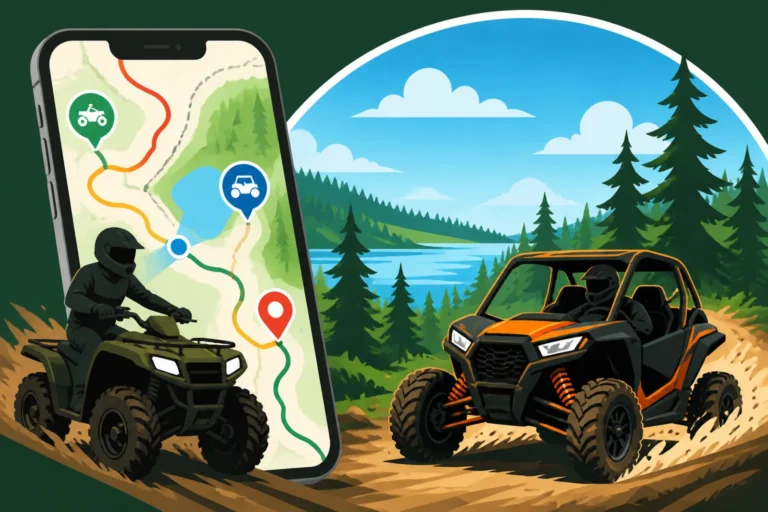
Mapping apps can help you understand distance, terrain and nearby roads, but a mapped line does not prove that riding is permitted. Treat digital tools, including onX Offroad, as planning aids. Before you go, compare the route with information from the relevant club, park office, municipality or land manager. If access is uncertain, get confirmation rather than relying on the app’s display.
A practical way to plan is to break a long trip into sections. For each section, identify who manages the route, whether motorized use is allowed, and what could interrupt the ride. A trail may be closed for maintenance, weather, fire risk or another temporary reason. This matters especially if your planned route depends on a single corridor to reach fuel, a campsite or the return trailhead.
Keep a backup plan. Save the trailhead location and route details before leaving reliable cell coverage, and carry a paper map for remote areas. onX Offroad can be part of your preparation, but it should not replace local confirmation or a second navigation option. Manitoba riders can also consult [Manitoba ATV Trail Map Downloads](Manitoba ATV Trail Map Downloads) and check [Manitoba Trail Conditions Before You Haul](Manitoba Trail Conditions Before You Haul) before loading machines onto a trailer.
Prepare for distance, weather and shared-use trails
A ride can feel very different once you are away from the truck. In parts of Manitoba, a route may take you through bush or open country where services and cell coverage are limited. Carry enough water, food, basic repair supplies and warm or waterproof layers for the conditions. A spare belt may make sense for some machines and routes, while a first-aid kit and a way to contact help are sensible basics anywhere.
In Ontario, don’t assume that a more connected trail network means every section is easy to navigate or close to services. A planned loop can still include long stretches, changing surfaces and poor reception. Check fuel availability and safe stopping points before setting out, and give someone at home your route and expected return time. If the trail system has a club map or route notice, review it before departure.
Shared-use trails call for extra care in both provinces. Slow down when approaching hikers, horseback riders, cyclists or other machines, and follow any posted direction or speed guidance. On Manitoba routes such as Mossberry, the presence of other trail users is part of the planning—not an unexpected complication. onX Offroad may help you orient yourself, but it cannot tell you how busy a trail is at that moment or replace courteous riding.
Common mistakes when comparing Manitoba and Ontario
Assuming familiar rules carry across the border
The most frustrating travel mistake is finding out about a requirement after the machine is already unloaded. Riders may assume that a familiar registration arrangement, permit, roadway rule or trail pass works the same way in the other province. Instead, treat the border as a reason to recheck the basics: paperwork, insurance, permitted routes, local rules and any trail-system conditions.
A Manitoba rider visiting Ontario should not assume that the destination has the same trail-fee approach or access rules as home. An Ontario rider in Manitoba should not assume that paying a registration-related trails fee provides access to every trail. In both cases, the safest question is specific: “May I ride this machine on this route, on this date, under these conditions?”
It also helps to distinguish legal access from convenient access. A trail might be legal to use but difficult to reach with a trailer, far from fuel or unsuitable for a novice rider. Conversely, a route that looks convenient on a phone may cross private or restricted land. Tools such as onX Offroad can help organize route research, but verify unclear sections with the people responsible for the land or trail.
Treating a regional comparison as a route recommendation
“Manitoba versus Ontario” is too broad to tell you whether a particular weekend ride will suit your group. A family with young riders may prioritize clear route markings, shorter loops and nearby services. Experienced riders may be comfortable with remote terrain but need to plan carefully around fuel, weather and communications. A side-by-side group may also need to confirm that trail dimensions and route restrictions suit their machines.
Choose your destination based on the ride you actually want. If you want a more structured outing, look for a maintained club trail and confirm its current conditions. If you want a remote trip, plan conservatively and confirm land access, emergency options and closures. Before committing to a long tow, review [Manitoba Trail Conditions Before You Haul](Manitoba Trail Conditions Before You Haul), then confirm any details that could change your route.
The best comparison is ultimately practical: identify your preferred terrain, find a route that is explicitly open to your machine, check local and provincial rules, and prepare for the distance and conditions. That approach works whether your next ride is in Manitoba, Ontario or both.
Disclaimer
This article is for general informational purposes only and does not constitute professional advice. Laws, prices and regulations vary by location and change over time. Consult a qualified professional for guidance on your specific situation.