Manitoba Trailheads With Trailer Parking
A trail can look perfect on a map and still be a headache if your truck and trailer have nowhere safe to turn around or unload. In Manitoba, parking conditions vary by trail system, season, land manager, and local access rules. This guide explains how to find suitable ATV and UTV staging areas, what to confirm before leaving home, and how to avoid hauling to a trailhead that cannot accommodate your rig.
How to find Manitoba trailheads with trailer parking
Start with the riding area, then verify the staging point
A trail map tells you where routes go; it does not always tell you whether the access point has room for a truck and trailer. A mapped trail may begin at a narrow roadside pull-off, a gated access road, a busy park entrance, or a spot where stopping is not permitted. Treat “trailhead” and “trailer parking” as separate questions.
Begin by choosing a riding area that fits your plans. Manitoba has club trail systems and riding areas in regions such as Eastman, the Interlake, Westman, and the north. Names such as Agassiz, Belair Forest, Woodridge, Duck Mountain, and Snow Lake can help you narrow your search, but a familiar riding-area name alone does not confirm that a particular access point has suitable parking.
Once you have a likely destination, identify the exact place where you intend to unload. Look for information from the club, park, municipality, or land manager responsible for that area. A small amount of checking can prevent a frustrating arrival where the trail is accessible but the parking area is not.
For a starting point, use [Manitoba ATV Trail Map Downloads] and [Manitoba Trailheads With Trailer Parking]. Then check [Manitoba Trail Conditions Before You Haul] for changes that could affect access. A trailhead that worked for a smaller trailer may not work for a long enclosed trailer or a multi-machine group.
Use maps as a screening tool, not a guarantee
Online maps are useful for spotting access roads, nearby communities, possible staging areas, and alternate routes. Satellite views can sometimes show whether a place appears to have an open lot, but they cannot reliably tell you whether trailers are allowed, whether a gate is locked, or whether the surface is firm enough for a heavy rig.
Apps such as onX Offroad can help you study route options and orient yourself before a trip. Use the map to find questions to ask, not as final permission to park or ride. A visible clearing could be private land, a work area, or a site with seasonal restrictions. Confirm access with the relevant club or land manager before you rely on it.
It also helps to check the approach route separately from the trail. A large trailer may be manageable in an open lot but difficult on a narrow gravel road, a tight turn, or a soft shoulder. If your map shows a short connector road, do not assume it is suitable for a long truck-and-trailer combination.
What to check before hauling your ATV or UTV
Confirm space, surface, and turning room
“Parking available” can mean very different things. Before setting out, ask whether the staging area has room for your truck and trailer, whether you can turn around without backing a long distance, and whether the parking surface is appropriate for the weight of your vehicle. If you are taking more than one machine, ask whether there is room for the whole group to unload without blocking other visitors.
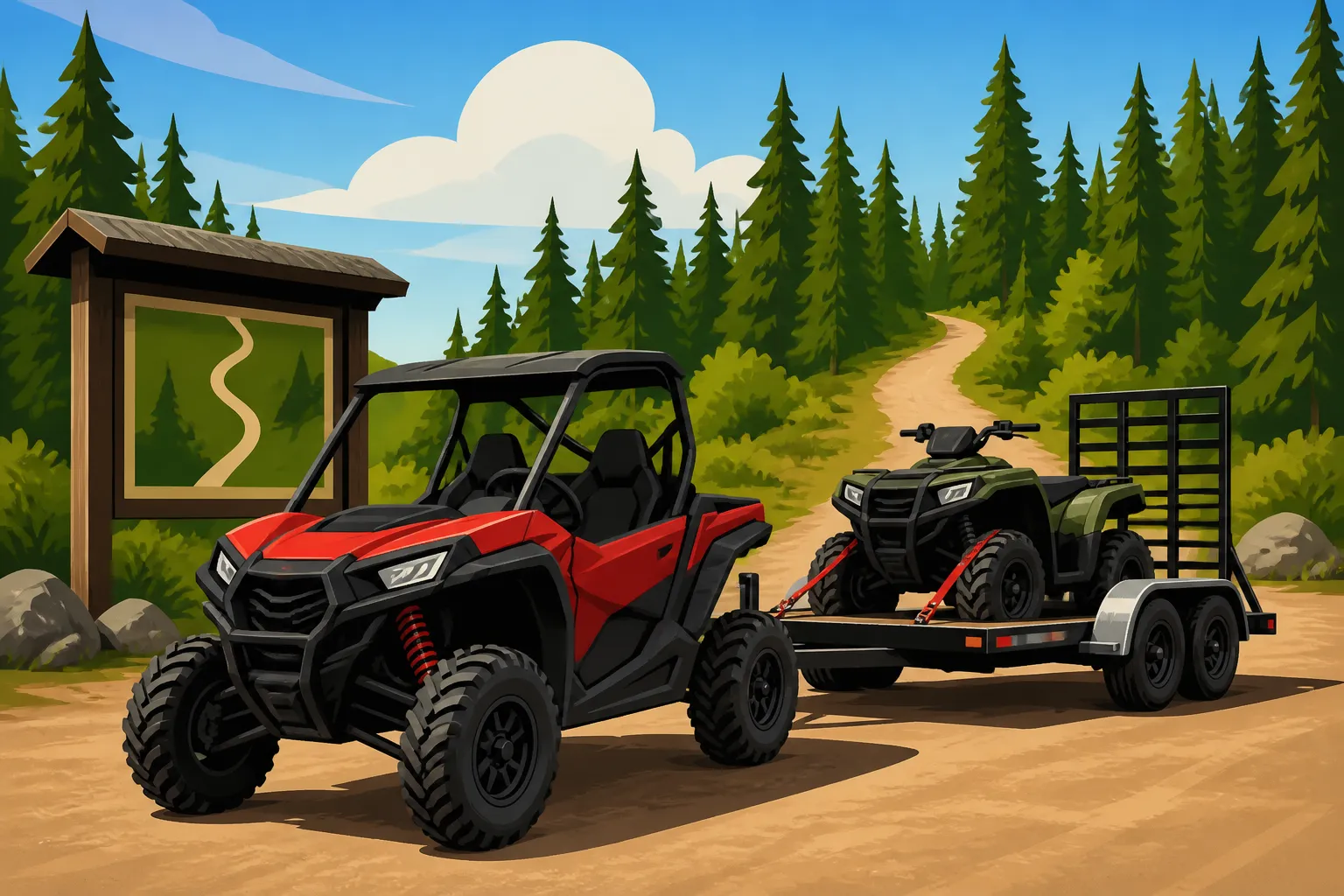
Think through the full unloading sequence. You need a place to park, space to lower ramps, room to get the ATV or UTV off the trailer, and a safe spot to secure straps and gear. A narrow shoulder may technically let you stop, but it can leave you unloading close to traffic or obstructing access for other users.
A useful call or message to a local club can be specific: “Can a pickup with a long tandem-axle trailer turn around and unload at this access point?” If you are unsure which access point they mean, share its name or map location. It is also worth asking whether recent rain, thaw, or construction has changed the condition of the lot or approach road.
| What to confirm | Why it matters | Useful question |
|---|---|---|
| Trailer length and parking space | A small pull-off may not fit a full rig | Can a truck and my trailer park without blocking access? |
| Turning and backing room | Tight entrances can make arrival difficult | Is there room to turn around, or should I expect to back in? |
| Surface and drainage | Soft ground can trap a loaded vehicle | Is the lot firm and usable after rain or thaw? |
| Unloading space | Ramps and machines need room beyond the parking spot | Can we unload safely without using the road shoulder? |
| Access restrictions | Gates, signs, or seasonal rules may limit entry | Is this access point open to riders and trailers today? |
| Overnight parking | Day-use access does not imply overnight permission | Is overnight parking allowed, and where? |
Check who manages the land and access
A trail can cross land managed by different organizations, and the parking area may be controlled by someone other than the trail club. That matters because permission to ride a route does not automatically mean permission to leave a vehicle or trailer nearby. Ask who manages the staging area and follow posted signs and instructions.
Provincial parks require particular care. Do not assume that every road, campsite, parking area, or hiking trail within a park is open to off-road machines. Check which designated routes are available and whether the parking arrangement is intended for day visitors hauling machines. [Manitoba Parks Allow Machines on Designated Routes Only] is a useful companion topic when your planned route enters a park.
Crown land and Crown leases also have different access considerations. Public-looking land is not a blanket invitation to ride or park wherever you choose, and leaseholders may have rights over the land they occupy. Before heading out, review [Manitoba Crown Land Riding Explained] and [Manitoba Crown Lease Access Rules]. When the access point is unclear, ask the relevant land manager or leaseholder rather than relying on a map label.
Choosing a staging area for different kinds of rides
For a first visit or family outing
If you are taking children, newer riders, or people unfamiliar with the area, prioritize a straightforward staging point over the shortest drive to a trail. A larger, clearly marked area can make it easier to unload, organize helmets and supplies, and regroup before entering the trail system. Ask about the trail’s difficulty and whether the access point is close to the routes you intend to ride.
Do not plan around a parking spot that requires your group to unload beside moving traffic or make a complicated multi-point turn. For a family day, a little extra driving to a known access area is often less stressful than improvising after arrival. Check that the route is appropriate for your machines and riders, and review [Best Manitoba ATV Trails for Beginners] when you are choosing where to start.
If children are riding, make sure the adult supervision and operating rules are clear before the trip. Keep the group together through the staging area and agree on a meeting point if riders become separated. A relaxed start matters: rushed unloading, unclear directions, and last-minute parking decisions can make even an easy ride feel chaotic.
For a large group or a multi-day trip
A group ride needs more than one vehicle-sized space. Several trucks and trailers can quickly fill a lot that looked generous in a photo. Before inviting everyone, find out whether the area can accommodate the group, whether parking is shared with other visitors, and whether there is an approved overflow option. Avoid treating roadside space or an unmarked clearing as overflow parking unless the land manager says it is acceptable.
For overnight or multi-day plans, separate the questions of trail access, camping, and vehicle storage. A trailhead may allow daytime unloading but not overnight parking. A nearby campground may welcome trailers but have separate rules about where machines can be operated. Confirm each part of the plan independently, including where you can leave the truck and trailer while riding.
When travelling farther from home, build in a backup plan. Save the confirmed access point, a nearby fuel stop, and the contact information for the local club or park office. onX Offroad can help you keep route information available for navigation, but pair digital mapping with current local guidance and a downloaded or printed map when service may be unreliable. For a group, [Manitoba Group Ride Planning] can help you think through spacing, communication, and meeting arrangements.
A practical pre-trip routine
Call or message before you load
A quick confirmation is especially worthwhile when you have a long trailer, are visiting during a busy weekend, or have not ridden the area before. Ask about the exact staging location rather than just whether “parking” is available. If the answer is unclear, describe your vehicle and trailer or send the access-point name you found on the map.
Ask whether there are current closures, gates, construction, fire restrictions, or changes to the route. Conditions can shift after heavy rain, during spring thaw, or when maintenance work is underway. For a ride in a park or managed area, check the relevant official information as well as any club updates.
It is sensible to confirm the return plan, too. Find out whether you can leave a trailer parked while you ride, whether the area closes at a particular time, and whether overnight stays are permitted. Those details are easy to overlook when everyone is focused on the trail.
Pack for a change of plan
Even a well-checked trip can meet a full parking lot, a soft approach road, or a closure. Keep a short list of alternative staging areas, but do not use one unless access and parking are permitted. Have enough fuel and supplies to reach the alternative, and avoid riding unfamiliar connecting roads simply because they appear to lead toward the trail.
Download maps or save essential information before leaving service. onX Offroad may be useful for reviewing your route and keeping map details accessible, but it does not replace posted signs, local instructions, or permission from the people responsible for the land. Carry the contact details you need offline and make sure someone in the group knows the planned route.
Finally, leave the staging area as you found it. Keep ramps and gear out of traffic, avoid blocking gates or access lanes, and take rubbish home. Courteous parking helps protect access for the next rider and makes it easier for clubs and land managers to keep working with local trail users.
A good Manitoba ATV or UTV trip begins before the first kilometre on the trail. Choose a riding area, identify the exact unloading point, verify that your trailer fits, and confirm access with the responsible local source. That simple routine is more dependable than assuming that a trail line on a map comes with a suitable place to park.
Disclaimer
This article is for general informational purposes only and does not constitute professional advice. Laws, prices and regulations vary by location and change over time. Consult a qualified professional for guidance on your specific situation.