Manitoba Accident Reporting Rules
It's one of those heart-stopping moments no ATV or UTV owner ever wants to experience: that sudden crunch, the unexpected flip, or the sickening realization that you've just been involved in an off-road accident. Whether it's a fender-bender with another machine on a tight trail, an unexpected rollover, or something more serious involving a collision with property or, heaven forbid, another person, the immediate aftermath can be disorienting. Knowing what to do, who to call, and what you're legally obligated to report in Manitoba can feel like trying to solve a puzzle while your adrenaline is through the roof. This guide is here to cut through that confusion, giving you a clear, empathetic roadmap for handling accident reporting rules in our beautiful province.
Understanding What Constitutes an "Accident" in Manitoba for ORVs
When we talk about "accidents" involving off-road vehicles like ATVs and UTVs in Manitoba, it's easy to picture just the most dramatic scenarios. But the legal definition and what requires reporting can cast a much wider net than you might think. It's not always about a mangled machine or a trip to the hospital. Sometimes, even what feels like a minor mishap can have reporting implications you need to be aware of.
When a Collision Involves Another Vehicle or Property
Imagine you're navigating a tight section of a forest trail, maybe a bit too focused on the mud hole ahead, and you misjudge a turn. Suddenly, you hear a scrape, and you've bumped into a parked truck belonging to a fellow rider, or perhaps a fence post on private land near the trail. Or maybe you're out on the edge of a field, and your UTV slides into a farmer's carefully maintained irrigation system or a mailbox near a rural driveway.
These kinds of incidents, where your ORV comes into contact with another vehicle (whether it's another ATV, a car, or even a tractor) or any form of property, almost always trigger reporting requirements. It doesn't matter if you think the damage is minor – if there's any visible damage to the other vehicle or property, you have a responsibility. The key here is the potential for significant cost to repair, or the actual presence of damage. Even if it's just a scratched bumper on someone else's machine, or a bent rail on a fence, these are situations where you need to be prepared to exchange information and potentially involve law enforcement or your insurer. Always err on the side of caution.
When There's Injury or Fatality
This is, understandably, the most critical and non-negotiable situation for reporting. If an accident involving your ATV or UTV results in any bodily injury to anyone – yourself, a passenger, another rider, a pedestrian, or even a bystander – or, tragically, a fatality, immediate and comprehensive reporting is mandatory. This isn't just about property damage; it's about human well-being and the legal ramifications that follow.
Even if the injury seems minor at first – a twisted ankle, a cut, or a bump on the head – it's crucial to report it. Injuries can sometimes present themselves hours or even days after an incident, and having a documented record from the outset is vital for everyone involved. In these situations, your first priority is always the safety and medical attention for anyone injured, and then contacting emergency services to ensure a proper response and investigation. There's no grey area here; injuries or fatalities demand immediate attention from both medical professionals and law enforcement.
Single-Vehicle Incidents Without Obvious Damage or Injury
This is where the waters can get a little murky and riders sometimes make assumptions that can lead to problems later. Let's say you're riding solo, maybe pushing a little too hard on a sandy track, and you hit a soft spot, causing your ATV to roll onto its side. You're shaken but unhurt, and the machine seems mostly okay, maybe just a bent handlebar or a few cosmetic scratches. You right the machine, dust yourself off, and continue your ride, thinking nothing more of it.
While you might not have to report every single-vehicle tip-over to the police if there's absolutely no injury and minimal damage (say, under a certain threshold), it's important to understand the broader implications. What if that bent handlebar indicates a deeper structural issue? What if you feel a pain in your back the next day that wasn't apparent right away? What if your "minor" scratches are actually hiding frame damage that compromises the machine's safety? For insurance purposes, even if you don't call the police, you should consider notifying your insurance provider if there's any damage to your own machine that you might want covered later. Remember, [Why Basic Manitoba ORV Coverage Skips Injuries] and other personal damage, so if you have optional collision coverage, you'll want to engage them. Over time, that "minor" incident might become a major headache if not properly addressed or documented, especially if you later try to sell the machine and a buyer discovers undisclosed damage.
The Immediate Steps After an ORV Accident in Manitoba
When an accident happens, the moments immediately following can be chaotic. Your heart is pounding, your mind races, and it can be hard to think straight. But having a clear, actionable plan in your head – even a simple one – can make all the difference in ensuring safety, fulfilling your legal obligations, and protecting yourself in the long run.
Ensuring Safety and Checking for Injuries
Your absolute first priority after any accident, no matter how minor it seems, is safety. Before you even think about damage, registrations, or who was at fault, stop, take a breath, and assess the situation.
- Secure the Scene: If possible and safe to do so, turn off your machine's engine and make sure it's not posing a further hazard, especially if it's leaking fuel. If you're on a shared trail or near a road, consider how to warn others of the accident scene, perhaps by using reflective gear or signalling to other riders.
- Check on Everyone Involved: Immediately check yourself for injuries. Even minor scrapes can become worse if ignored. Then, if you have passengers, check on them. If other machines or people were involved, go check on them too. Ask if they're hurt. Remember, shock can mask pain, so even if someone says they're "fine," encourage them to take a moment and genuinely assess their condition. Don't move anyone who complains of neck or back pain unless they are in immediate danger.
- Move to a Safe Location (If Possible): If you're in the middle of an active trail or near a road, and if no one is seriously injured, try to move yourself, your passengers, and the machines to a safer spot off the main path to prevent further collisions. This is especially important on shared-use trails where other ORVs, hikers, or even snowmobiles in winter might be present.
Contacting Emergency Services (911) When Necessary
Knowing when to pick up the phone and dial 911 is crucial. It's not just for life-threatening situations; emergency services can provide critical support and documentation.
- Call 911 Immediately If:
- Anyone is seriously injured or unconscious.
- There's significant bleeding, head trauma, or suspected broken bones.
- The accident has caused a fire.
- The accident is blocking a trail, road, or access point, creating a hazard for others.
- You suspect impaired operation by any party.
- You are unsure of the extent of injuries, even if they seem minor at first. It's always better to let medical professionals assess.
- What to Tell the Operator: Be clear and concise. State your exact location (use landmarks, trail names, or GPS coordinates if possible), describe the nature of the accident, the number of people involved, and any visible injuries. Follow their instructions carefully. They will dispatch police, ambulance, or fire services as needed.
Exchanging Information with Other Parties
Once safety is established and emergency services are en route (if called), you'll need to gather and share information with any other parties involved. This is vital for insurance claims and any potential police reporting.
- Collect Key Information:
- From Other Operators/Owners: Full name, contact information (phone, email), driver's license number, ORV registration number, and insurance information (if applicable, beyond basic MPI liability). Remember [Manitoba Registration Cards Carried at All Times] for easy access to this info.
- From Witnesses: If anyone saw the accident, get their names and contact information. Their account could be invaluable.
- About the Machines: Make, model, year, and VIN (Vehicle Identification Number) for all involved ORVs.
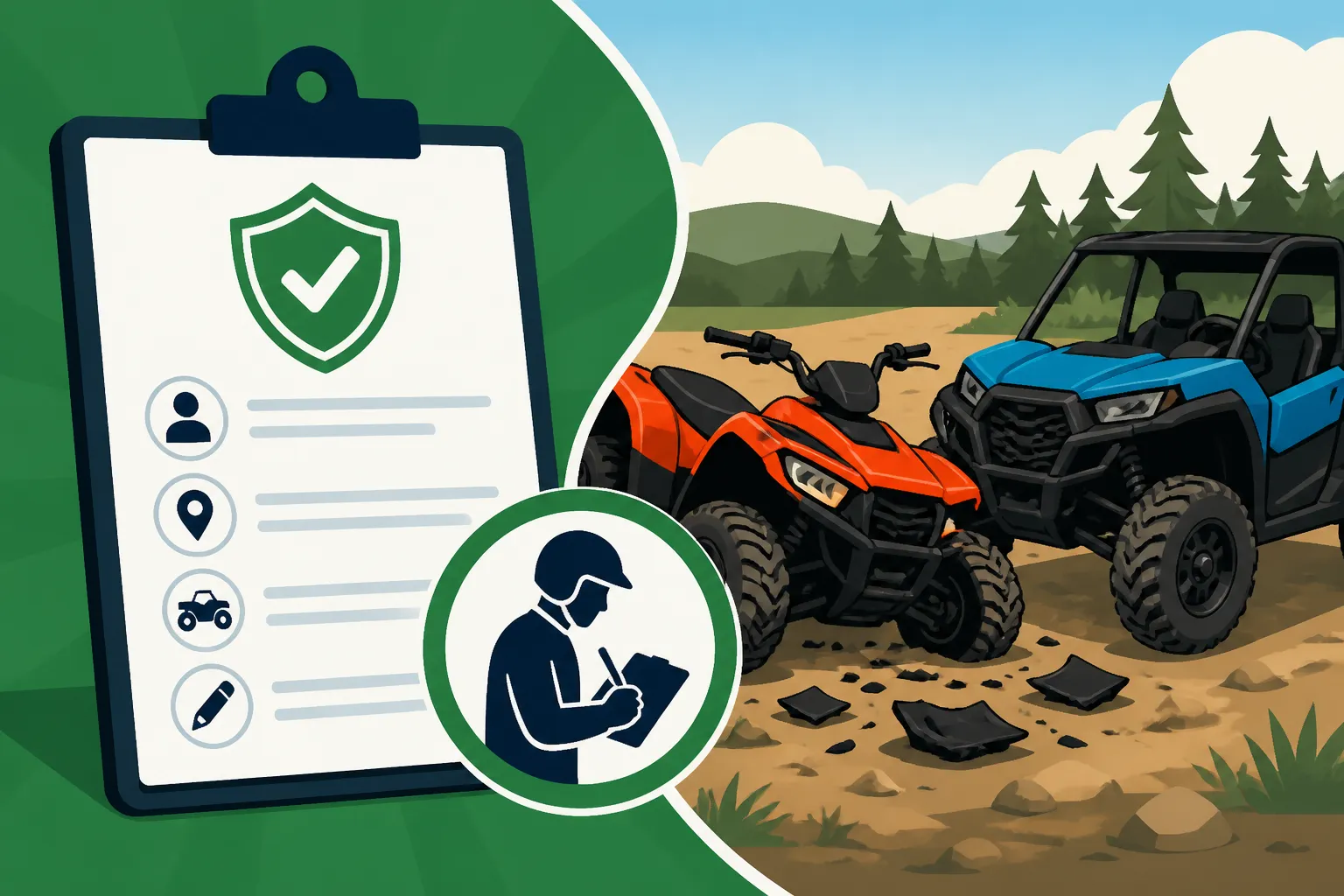
- Document the Scene: Use your phone to take photographs and videos.
- Capture the overall scene from multiple angles.
- Take close-ups of all damage to your machine, other machines, and any property involved.
- Photograph any relevant environmental factors: trail conditions, obstacles, skid marks, or anything that might have contributed to the accident.
- If you can, make notes about the date, time, weather conditions, and exact location. A good set of photos and detailed notes can be a lifesaver when dealing with insurance or police reports.
- Do Not Admit Fault: While it's natural to be apologetic or want to explain, avoid admitting fault or making statements that could be interpreted as such. Stick to factual descriptions of what happened. Let the police and insurance companies determine fault after reviewing all the evidence.
When and How to Report an ORV Accident to the Police
Even if emergency services weren't needed on the scene, there are specific situations where you are legally required to report an ORV accident to the police in Manitoba. Failing to do so can lead to penalties and complicate future insurance claims. This isn't just a suggestion; it's a legal obligation outlined in the Off-Road Vehicles Act and the Highway Traffic Act when applicable.
Mandatory Reporting Thresholds
In Manitoba, you are generally required to report an accident to the police (specifically, the Royal Canadian Mounted Police or local police service, depending on jurisdiction) if:
- Any Person is Injured or Killed: This is the most critical threshold. As discussed, if anyone suffered any bodily harm, regardless of how minor it initially seems, or if there's a fatality, a police report is mandatory. Do not delay in these situations.
- Combined Damage Exceeds a Certain Value: If the total apparent damage to all vehicles (including your ORV, other ORVs, cars, etc.) and/or property (fences, signs, buildings, natural features) appears to exceed a specific dollar amount, you must report it. While specific figures can change, a common threshold in many jurisdictions is around $2,000. This isn't just your damage; it's the combined damage. So, a minor scrape to your bumper and a minor scrape to another ORV's side panel could easily push you over this threshold.
- "Reasonable Grounds" to Believe an Offence Occurred: If you have reason to believe that a criminal offense, such as impaired operation, hit and run, or reckless endangerment, contributed to the accident, you must report it. This also includes situations where someone leaves the scene without exchanging information.
If you're ever in doubt, it's usually safer to report the accident to the police. They can advise you on whether a formal report is necessary and guide you through the process. A quick call to the non-emergency line of your local police detachment can provide clarity.
Information Required for a Police Report
When you report an accident to the police, whether at the scene or at a detachment afterward, they will need specific details to complete their report. Being prepared with this information will make the process smoother.
- Your Details: Name, address, phone number, driver's license number (if you have one, which you need for certain ORV operations and crossings), and details of your ORV.
- Accident Details:
- Date and Time: Be as precise as possible.
- Exact Location: Street names, trail names, nearest intersection, GPS coordinates, or clear landmarks. Even stating "about 2 km west of the old Seddons Corner store on the Trans-Canada Snowmobile Trail" can be helpful.
- Weather and Road/Trail Conditions: Was it raining? Muddy? Icy? Dusty? What was visibility like?
- Description of What Happened: A clear, concise, factual account of the events leading up to, during, and immediately after the collision. Do not speculate or assign blame.
- Other Parties Involved: Names, contact information, vehicle details (make, model, license plate if applicable, VIN, registration info) for any other operators, passengers, or property owners.
- Injuries: Details of anyone injured, including their names, nature of injuries, and if they received medical attention.
- Damage: A description of the damage to all vehicles and property involved.
- Witnesses: Names and contact information of anyone who saw the accident.
The police report serves as an official record of the incident and can be crucial for insurance claims and any subsequent legal proceedings. Make sure you get a copy or at least the report number for your records.
Penalties for Failing to Report
Ignoring your legal obligation to report an accident can lead to serious consequences. It's not just about avoiding a minor inconvenience; it's about adhering to the law and protecting yourself from significant legal and financial repercussions.
- Fines and Charges: Under the Off-Road Vehicles Act or the Highway Traffic Act, failing to report an accident when required can result in fines. These aren't trivial and can add up, especially if other charges, such as [Manitoba Careless Operation Penalties], are also laid due to the circumstances of the accident.
- Driver's Licence Demerits: Depending on the specific circumstances and if the incident occurred in a scenario where the Highway Traffic Act applies (e.g., crossing a highway), demerit points could be applied to your driver's license.
- Insurance Complications: This is a big one. If you don't report an accident to the police when required, your insurance provider (like MPI) might deny your claim for damages or injuries. They rely on official documentation to process claims. Without a police report, it becomes your word against potentially difficult circumstances, making it harder to prove what happened or establish fault. This can leave you on the hook for expensive repairs or medical bills that would otherwise have been covered.
- Increased Liability: If injuries or property damage are discovered later, and you failed to report the incident, you could face increased personal liability. For instance, if someone involved claims injuries days or weeks later, and there's no official report, it becomes much harder to defend yourself against claims or ensure fair resolution.
The bottom line is that while reporting an accident might seem like a hassle, it's a necessary step that protects everyone involved and ensures you remain compliant with Manitoba law.
Navigating Insurance Claims After an ORV Accident
After you've handled the immediate aftermath and any police reporting, the next critical step is almost always dealing with your insurance. In Manitoba, our public insurance provider, MPI (Manitoba Public Insurance), plays a central role for ORVs, just as it does for on-road vehicles. However, the scope of basic coverage for off-road machines has some important distinctions you absolutely need to understand.
Contacting MPI (Manitoba Public Insurance)
As soon as it's practical, and especially after any police reporting is complete, you need to contact MPI to report the accident. This typically involves calling their claims centre or visiting an Autopac agent.
- When to Call: Generally, you should contact MPI as soon as you've taken care of safety and any emergency services. The sooner you report, the better, as it ensures all details are fresh and prevents delays in processing your claim. Don't wait until you've fully repaired your machine or until injuries have completely healed.
- What Information They'll Need: When you call, be prepared to provide:
- Your personal details and ORV registration information.
- The date, time, and location of the accident.
- A factual description of how the accident happened.
- Details of any other vehicles or property involved, and the contact information of other parties.
- Details of any injuries sustained by yourself, passengers, or others.
- Whether the police were involved and, if so, the police report number.
- Any witness contact information.
- Your preferred repair shop if you're making a claim for your own machine's damage (if you have appropriate coverage).
The MPI claims adjuster will guide you through the process, which may involve getting estimates for repairs, arranging medical assessments, or investigating the incident further. Be honest and thorough in your communication.
Understanding Basic vs. Optional Coverage for ORVs
This is perhaps the most crucial aspect of ORV insurance in Manitoba and a common source of confusion for riders. When you register your ATV or UTV with MPI, you automatically receive basic coverage, but this coverage is much more limited than what you might be used to with a car.
-
Basic Registration Coverage Includes:
- Third-Party Liability: This is the most significant part of the basic coverage. It protects you financially if you're found legally responsible for causing injury to another person or damage to someone else's property in an accident. This coverage typically has a limit, which you can usually increase through optional coverage.
- Accident Benefits: This provides some limited benefits to you if you're injured in an ORV accident, regardless of who was at fault. However, [Why Basic Manitoba ORV Coverage Skips Injuries] to a significant degree compared to what you get with a typical Autopac policy for a car. It's critical to understand that this basic benefit might not cover all your medical expenses or lost income in serious injury cases.
-
What Basic Registration Coverage Does Not Include:
- Damage to Your Own ORV: This is the biggest surprise for many. If your ATV or UTV is damaged in an accident, your basic registration does not cover the cost of repairing or replacing your machine. This means if you roll your quad or hit a tree, you're on the hook for those repair bills unless you have additional coverage.
- Theft: [Basic Manitoba Registration Does Not Cover Theft] of your machine.
- Collision with an Animal: While on-road vehicle policies often cover collisions with animals, basic ORV coverage typically does not.
- Increased Accident Benefits: As mentioned, the basic accident benefits are limited.
-
Optional Coverage You Can Purchase: To truly protect your investment and yourself, you'll need to purchase additional, optional coverage from MPI or a private insurer. This is where [Manitoba ATV Insurance Options] really come into play. These options can include:
- Collision Coverage: Covers damage to your own ORV if you're involved in a collision, regardless of fault.
- Comprehensive Coverage: Protects against non-collision incidents like theft, fire, vandalism, or striking an animal.
- Increased Third-Party Liability: Raises the basic liability limit to a higher amount (e.g., $1 million or $2 million) for greater financial protection.
- Increased Accident Benefits: Offers higher levels of compensation for medical expenses and lost income if you're injured.
When considering optional coverage, think about how you use your machine. If you're a hardcore bush rider, you might want extra robust protection, perhaps even considering heavy-duty aftermarket components like SuperATV bumpers or skid plates to help prevent damage in the first place, or to mitigate it when it occurs. While these don't prevent all damage, investing in quality protective accessories can complement your insurance by reducing the severity of certain impacts.
Documenting Your Claim with Photos and Evidence
We've touched on this before, but it bears repeating: documentation is your best friend when filing an insurance claim. The more evidence you have, the smoother the process will be and the stronger your claim for compensation.
- Photos and Videos: These are paramount. Take pictures of every angle of the scene, all damage, injuries, road/trail conditions, and any relevant objects. If your ORV is equipped with a dash cam or helmet cam, save that footage immediately.
- Police Report: Ensure you have the police report number and, if possible, a copy of the report itself. This provides an objective, third-party account of the incident.
- Witness Statements: Any written or recorded statements from witnesses can corroborate your version of events.
- Medical Records: Keep detailed records of any medical treatment, doctor's visits, prescriptions, or therapy related to your injuries.
- Repair Estimates: MPI will likely require estimates from approved repair shops. Get multiple if possible.
- Lost Wages Documentation: If your injuries result in time off work, keep records of your income and lost wages.
Having a meticulously organized file of all this information will not only expedite your claim but also ensure you receive fair compensation for your damages and injuries, within the limits of your policy.
Common Misconceptions About ORV Accident Reporting in Manitoba
When it comes to off-road vehicles, there's sometimes a casual attitude that doesn't quite align with the legal realities, especially concerning accidents. Many riders, through no fault of their own, operate under assumptions that could lead to trouble if they find themselves in an accident situation. Let's clear up some of these common misconceptions.
"It Only Counts If I'm on a Road"
This is perhaps one of the most widespread and potentially dangerous misconceptions among ORV riders. Many people believe that rules, including accident reporting requirements, only apply when they're operating their ATV or UTV on a public road or highway. The truth is, that's simply not the case in Manitoba.
The Off-Road Vehicles Act (ORVA) governs the operation of ATVs and UTVs across the province, not just on paved surfaces. While there are specific rules about [Manitoba ORV Road Rules Explained] (like ditch riding, highway crossings, and municipal by-laws), the core requirements for registration, insurance, and yes, accident reporting, apply whether you're deep in the bush on Crown land, on a designated club trail, or even crossing a farmer's field with permission. If an accident occurs on private property, Crown land, or any trail system, and it meets the criteria for mandatory reporting (injury, fatality, significant damage), then you are still legally obligated to report it to the police. An ORV accident is an ORV accident, regardless of the terrain it happened on.
"My Machine is Old, No Point Reporting Minor Damage"
It's tempting, especially if you're riding an older quad with a few battle scars already, to shrug off what seems like minor damage after a tip-over or a brush with a tree. "It's just cosmetic," you might think, "and the machine's old anyway, so it's not worth the hassle of an insurance claim." While you might be right about the hassle, this mindset overlooks several critical points.
First, "minor" cosmetic damage can sometimes hide more serious structural issues. A bent frame, a compromised suspension component, or an engine mounting point that took a hit might not be immediately obvious but could lead to dangerous failures down the line. Getting an official assessment, even if you don't claim it, can help you understand the true condition of your machine. Second, if you have optional collision coverage, you've paid for it – why not use it? Even if the repair cost is low, it might be worth claiming, subject to your deductible, especially if it points to a safety issue. Finally, if that "minor" incident was part of a larger chain of events that involved another party or led to a delayed injury, your failure to report even seemingly minor damage to your machine could weaken your position if a dispute arises later. It's often better to have the incident on record, even if you decide not to pursue a full claim right away.
"I Can Fix It Myself – No One Needs to Know"
The DIY spirit is strong among ORV enthusiasts, and for many minor repairs and maintenance tasks, it's a great skill to have. However, applying this "fix it myself" attitude to accident reporting, particularly when it involves other parties, injuries, or significant damage, can be a grave mistake. The idea that you can just quietly fix things and nobody needs to know can quickly backfire with severe consequences.
- Liability Issues: If you've been involved in an accident that caused injury to another person or damage to their property, you could be held financially liable. If you don't report the accident and try to handle it "under the table," you might be bypassing your insurance (MPI's third-party liability coverage) that is there to protect you. What if the other person's injuries are more severe than initially thought, or their property damage costs far more to repair? You could find yourself personally responsible for huge bills without the backing of your insurance.
- Legal Penalties: As discussed earlier, failing to report a mandatory accident can result in fines and legal charges. Attempting to conceal an accident is not only risky but also illegal.
- Delayed Injuries: A bump or bruise that seems minor at the scene could develop into a serious injury days or weeks later. If there's no official record of the accident, it can be extremely difficult to prove that the injury was related to the incident, making it harder to claim medical benefits or pursue legal action if necessary.
- Fraud Allegations: If an incident comes to light later, and you attempted to hide it, you could face allegations of insurance fraud or attempting to obstruct justice, which carry very serious penalties.
While the thought of dealing with paperwork and phone calls after an accident is never fun, the potential downsides of not reporting are far, far greater. It's always best to follow the rules, report mandatory incidents, and let the proper channels (police, MPI) handle the investigation and resolution. It protects you, other riders, and ensures the integrity of our off-road community.
Disclaimer
This article is for general informational purposes only and does not constitute professional advice. Laws, prices and regulations vary by location and change over time. Consult a qualified professional for guidance on your specific situation.