Manitoba Moose Encounters While Riding
A moose stepping onto a Manitoba trail can turn a relaxed ride into a tense few minutes, especially when dense bush makes it hard to judge how close the animal is. This guide explains why encounters happen, how to respond without escalating one, and how to plan a ride that gives you room to notice wildlife and make a safe retreat.
Why moose encounters happen on Manitoba trails
Where riders are more likely to spot a moose
Moose use a range of habitats, including forest, wetlands, lakeshores, and areas with young vegetation. In Manitoba, a trail may pass through several of these landscapes in a short distance. A moose might be feeding beside a wet area, crossing a cutline, or standing in brush just beyond the trail edge. Because vegetation can conceal most of a large animal, you may notice movement or a shape before you can clearly identify it.
Pay particular attention where a narrow trail opens into a clearing, crosses a wet patch, follows a shoreline, or runs through thick brush. These places can limit your sightlines. A bend, crest, or stand of young trees can also hide an animal until you are close. Slowing down before these features gives you more time to respond than braking hard after an unexpected sighting.
Moose activity can vary with season, weather, food, and local conditions. Calves may be present in spring and early summer, while adult animals may be more active during the fall rut. These are reasons to stay observant, not guarantees that you will see a moose at a particular time or place. For wider seasonal planning, see [Manitoba Riding Season Month by Month] and [Manitoba Wildlife on the Trail].
Why a moose may behave unpredictably
A moose may be focused on feeding, moving through its range, or protecting itself. It can react strongly if it feels cornered, surprised, or separated from a calf. A quiet animal is not necessarily a safe one, and a moose standing still on the trail may be deciding where to go. Do not assume that it will move away just because a machine is nearby.
The risk can rise when riders close the distance, surround the animal, or leave it with no obvious way to retreat. Noise and movement may also increase its stress. A group that gathers around for a closer look can unintentionally turn a single encounter into a more threatening situation, particularly if the animal is between riders and the route out.
Give extra space when you see a calf, an animal that appears agitated, or a moose that is holding its ground. Warning signs can include ears laid back, raised hair, head lowered, or repeated movements toward you. You do not need to identify every sign perfectly to act cautiously: if the animal’s behaviour changes or you feel unsafe, create distance rather than waiting to see what happens.
What to do when you meet a moose
Stop, assess, and leave an escape route
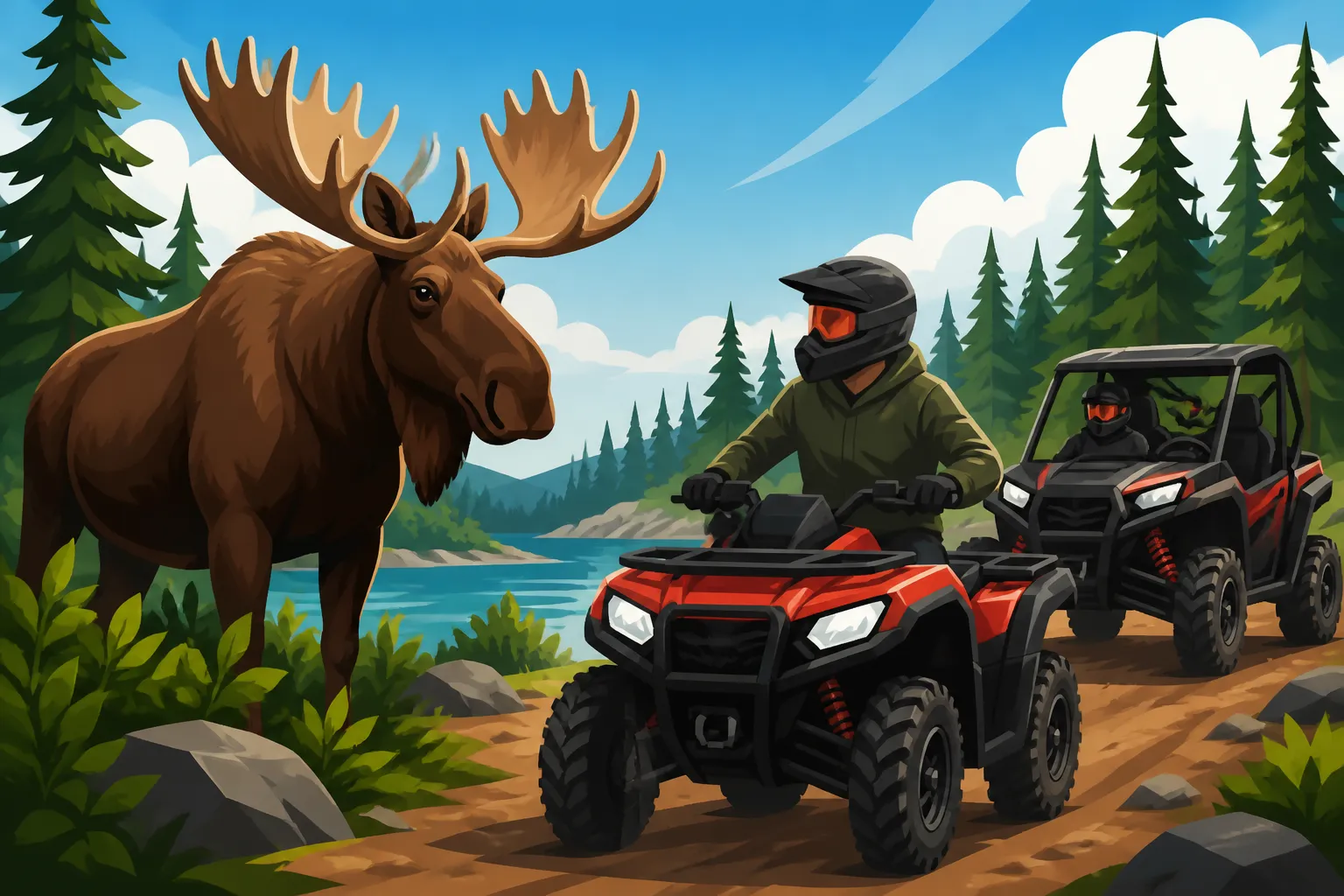
When you spot a moose, stop at a distance that feels safe and avoid riding closer to get a better look. If you are with others, signal them to stop behind you rather than crowding forward. Keep the group together and give the animal an open route away from the trail if one is available. Do not position machines on multiple sides of the moose or block its path.
If there is room to retreat, back away slowly and calmly. Avoid sudden turns, fast approaches, or attempts to pass close by. Do not rev the engine, honk, chase the moose, or use the machine to push it off the trail. A moose may not respond as you expect, and a machine’s noise or movement can make a stressful encounter worse.
A useful rule is to put more distance between you and the animal instead of trying to make it move. If the moose is directly across a narrow trail, wait from a safe position if that is practical. If it approaches or you cannot retreat along your route, look for a substantial object such as a large tree or another solid barrier that can separate you from it. Prioritize a safe exit over getting a photo or continuing the ride.
Take extra care around calves and rutting animals
If you see a calf, assume its mother may be nearby even if you cannot see her. Do not ride between a calf and an adult moose, and do not stop close to the calf to take a picture. Back away along the route you came from, giving the animals plenty of room to remain together. A calf’s small size does not make the situation harmless; the nearby adult may react defensively.
During the fall rut, adult moose may be more focused on mating and can be less predictable. Keep your distance from any moose, and be especially cautious if an animal is moving toward you, circling, or refusing to leave the trail. Do not interpret a pause as an invitation to pass. If the route is blocked and the animal appears unsettled, wait or turn back rather than squeezing past.
Dogs can add risk by approaching, barking at, or chasing wildlife. Keep dogs secured and under control when riding or stopping. If your group has a dog with it, do not let the dog run toward a moose or draw the animal toward riders. A dog that returns to you while being pursued could bring the danger close.
Use the machine carefully
An ATV or UTV is not a shield you should use to confront a moose. Do not drive toward it, try to herd it, or assume the machine will protect you if the animal charges. If there is a clear, safe route away, use it to increase distance without accelerating toward or past the animal.
If the moose moves toward you, focus on getting behind a substantial barrier or away from its path, if you can do so safely. A tree, large rock, or other solid object may help separate you from the animal. Avoid being trapped between the moose and your machine, a group of riders, or a steep or boggy section where you cannot move freely.
These encounters can unfold quickly, so there is no single manoeuvre that suits every trail. Your best options depend on visibility, terrain, the animal’s behaviour, and where your group can retreat. Leave room to turn around when you stop, and avoid parking in a way that blocks the only route out.
| Situation | Safer response | Avoid |
|---|---|---|
| Moose is visible well ahead | Stop at a distance and assess where it can move | Riding closer for a photo |
| Moose is on a narrow trail | Wait or retreat if safe, and give it space | Squeezing past or trying to drive it off |
| Calf is visible | Assume an adult may be nearby and back away | Moving between the calf and adult |
| Moose approaches or appears agitated | Increase distance and use a substantial barrier if available | Revving, honking, chasing, or surrounding it |
| Group is spread out | Signal riders to stop and regroup without moving toward the animal | Having riders approach from different directions |
Plan your ride to reduce the chance of a close encounter
Slow down where visibility is limited
Speed that feels comfortable on an open, familiar stretch may be too fast for a blind corner, a wooded trail, or a wetland crossing. Ease off before you reach areas where brush, terrain, or bends cut down your sightline. Keep enough space between machines for the riders behind you to react if the lead rider stops suddenly.
Scan the trail edges as well as the track in front of you. Watch for movement in brush, fresh tracks, or other signs of wildlife, but do not treat tracks as a precise forecast of what is ahead. On a shared trail, keep your attention on the route and avoid distracting conversations or phone use while moving. If you need to check a map, stop somewhere safe and clear of the travel line.
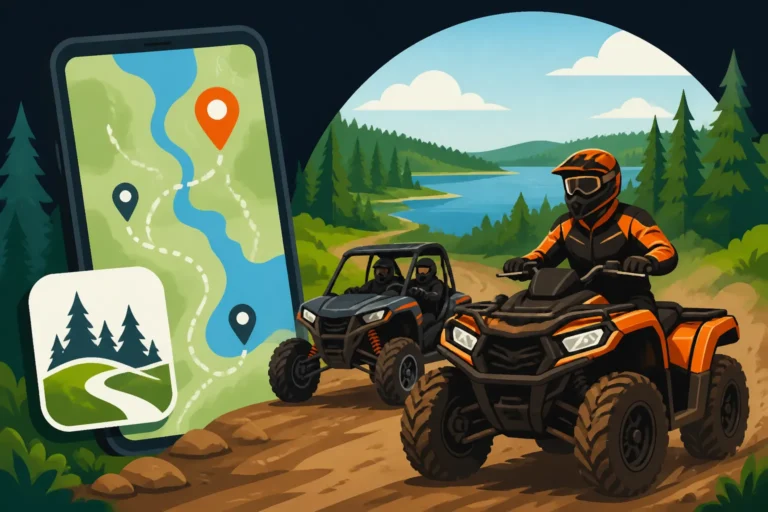
Route research can help you understand where a trail runs and where you may need to turn around, but a map cannot tell you that a moose is on the trail today. Some riders use tools such as onX Offroad to review a route before leaving; check your route details in advance and carry a backup plan for areas with limited connectivity. A downloaded map or saved route can be useful for navigation, but it does not replace looking ahead and riding at a speed that allows you to stop.
Prepare for remote sections and changing conditions
A wildlife encounter is more stressful if your group is already tired, lost, or running low on daylight. Before leaving, tell someone where you intend to ride and when you expect to return. Carry drinking water, a charged phone, and appropriate emergency supplies. In areas where cell service may be unreliable, make sure everyone understands the planned route and regrouping points. [Cell Dead Zones in Northern Manitoba] offers related planning considerations.
Check trail information and local restrictions before hauling your machine to a trailhead. Conditions can change after heavy rain, wildfire activity, or other closures, and an alternate route may not be available when you arrive. Reviewing [Manitoba Trail Conditions Before You Haul] can help you avoid a frustrating trip to a closed or unsuitable trail.
For navigation, onX Offroad may help you review route options before a ride, but do not rely on a phone alone in remote country. Battery life, device damage, and weak service can all complicate navigation. Keep a paper map or another backup suited to your route, and make sure your riding partners know how to use it. For more route-planning ideas, see [Manitoba Trail Apps and Maps].
Keep your group organised
A group ride can make it easier to get help if someone is hurt, but a scattered group can also make a moose encounter more confusing. Agree on a simple stop signal before you start, keep a sensible gap between machines, and make sure the last rider knows when the lead rider has stopped. If you meet wildlife, the goal is to halt the group without sending anyone forward to investigate.
Talk through what you will do if the trail is blocked. Decide who will communicate with the group, where riders should wait, and how you will turn back without leaving anyone behind. That preparation matters on a narrow bush trail where riders may not be able to see one another around bends. [Manitoba Group Ride Planning] and [Manitoba Trail Etiquette Locals Expect] cover other ways to keep a ride orderly and considerate.
If you are unsure whether a route crosses sensitive habitat or an area with access restrictions, check local information before riding. Do not create a new track around an animal by driving through vegetation, wetlands, or private land. [Manitoba Sensitive Areas to Avoid] is a helpful companion when planning where to ride and where to stay on established routes.
What to do after a close encounter
Leave the area calmly
Once the moose has moved away or you have safely retreated, do not follow it to see where it went. Give the animal time and room to leave the area. If the trail remains blocked, choose another route or turn back rather than repeatedly approaching. A moose that has disappeared into brush may still be nearby, so keep your speed low and stay alert as you leave.
Check on everyone in your group before continuing. A rider may be shaken, have dropped equipment, or need a moment to settle down. If anyone has been injured, move to a safe location if possible and seek appropriate emergency help. Do not approach or try to handle an injured or dead moose.
If an animal appears injured, trapped, or presents an immediate danger to people, contact the appropriate local authorities when it is safe to do so. Share the location as clearly as you can, using a trail name, nearby landmark, or map position if available. Do not crowd the animal while waiting for help.
Learn from the encounter
After a close call, take a few minutes to review what happened. Was the group travelling too quickly for the sightline? Did the trail pinch down at a bend? Was the spacing between machines too short? These are not questions for assigning blame; they help you make the next ride safer. You might decide to slow down in that section, change the route, or agree on a clearer group signal.
Consider noting the location and general conditions for your own planning. Do not post directions that encourage others to approach wildlife or crowd a sensitive spot. If you share a route or encounter with other riders, make the safety message clear: keep your distance, do not feed or pursue wildlife, and respect closures and access rules. More general preparation tips are covered in [First Aid on a Long Manitoba Loop] and [Manitoba Bear Encounters While Riding].
A moose sighting can be memorable without becoming a close encounter. Give the animal room, keep an escape route open, and be willing to wait or turn around. That small change in plans is usually far easier than trying to manage a dangerous situation on a narrow trail.
Disclaimer
This article is for general informational purposes only and does not constitute professional advice. Laws, prices and regulations vary by location and change over time. Consult a qualified professional for guidance on your specific situation.