Why Conservation Officers Skip the Helmet Rule
Ever been out riding your ATV or UTV in the beautiful Manitoba wilderness, helmet securely fastened, only to see a Conservation Officer (CO) zip by on their machine, seemingly without one? It’s a moment that can spark a fair bit of confusion, and maybe even a little frustration, right? You're out there doing your best to follow all the rules, ensuring you and your passengers are safe and legal, and then you see an authority figure who appears to be an exception to the very rules they enforce. This guide is here to unravel that mystery, explaining the specific legal exemptions that allow certain government and emergency personnel, including our dedicated Conservation Officers, to operate off-road vehicles without a helmet under very particular circumstances, while underscoring why these rules don't apply to the rest of us.
The Core Legislation: Manitoba's Off-Road Vehicles Act
The foundation of all off-road vehicle (ORV) operation in Manitoba lies within The Off-Road Vehicles Act. This crucial piece of legislation sets out everything from registration requirements to where you can ride and, critically for our discussion, what safety gear you must wear. It’s designed to keep everyone safe, protect our natural environments, and ensure responsible recreation.
General Helmet Requirements for Riders
For the vast majority of us who love to hit the trails, the helmet rule is crystal clear and non-negotiable. Section 13 of The Off-Road Vehicles Act states that "no person shall operate or be a passenger on an off-road vehicle on a highway or in a public place unless the person is wearing a helmet." This isn't just a suggestion; it's a legal requirement enforced with fines and penalties. The Act further specifies that this helmet must be designed for motor vehicle use and comply with approved safety standards, like those set by the Snell Memorial Foundation or the Federal Motor Vehicle Safety Standard (FMVSS).
We all know the feeling of getting ready for a ride, gearing up with your sturdy helmet, gloves, and protective clothing. It's a ritual that signifies safety and preparedness. So, when you spot a Conservation Officer or another official on a powerful side-by-side, maybe a well-equipped SuperATV unit designed for rugged terrain, without a helmet, it can be perplexing. It might even feel a bit unfair, especially when you consider the emphasis placed on helmet use for every other rider. But rest assured, there's a specific reason for this apparent discrepancy, one that's rooted in the practical realities of their demanding work.
Understanding Exemptions within the Act
While the Act is quite comprehensive, it's also built with an understanding that certain situations call for specific deviations from the general rules. These aren't loopholes for the public to exploit, but rather carefully considered exemptions designed to allow essential services and government functions to operate effectively. Think of it like a puzzle where most pieces fit together in a standard way, but a few unique pieces have a very specific, legitimate place where they don't conform to the common pattern.
These exemptions are meticulously detailed within the Act itself, or in associated regulations, and they apply only to a very narrow set of circumstances or individuals. They aren't meant to create an "us versus them" scenario, but rather to facilitate critical tasks that protect our communities and natural resources. It’s important to remember that these exemptions are typically tied to the official duties being performed and do not extend to personal use or recreational riding by the individuals covered.
Specific Exemptions for Law Enforcement and Government Officials
The reason you sometimes see a Conservation Officer without a helmet isn't because they're ignoring the law; it's because the law specifically exempts them under certain, very defined conditions. These exemptions are critical for enabling them to perform their often urgent and dangerous duties effectively.
Conservation Officers on Duty
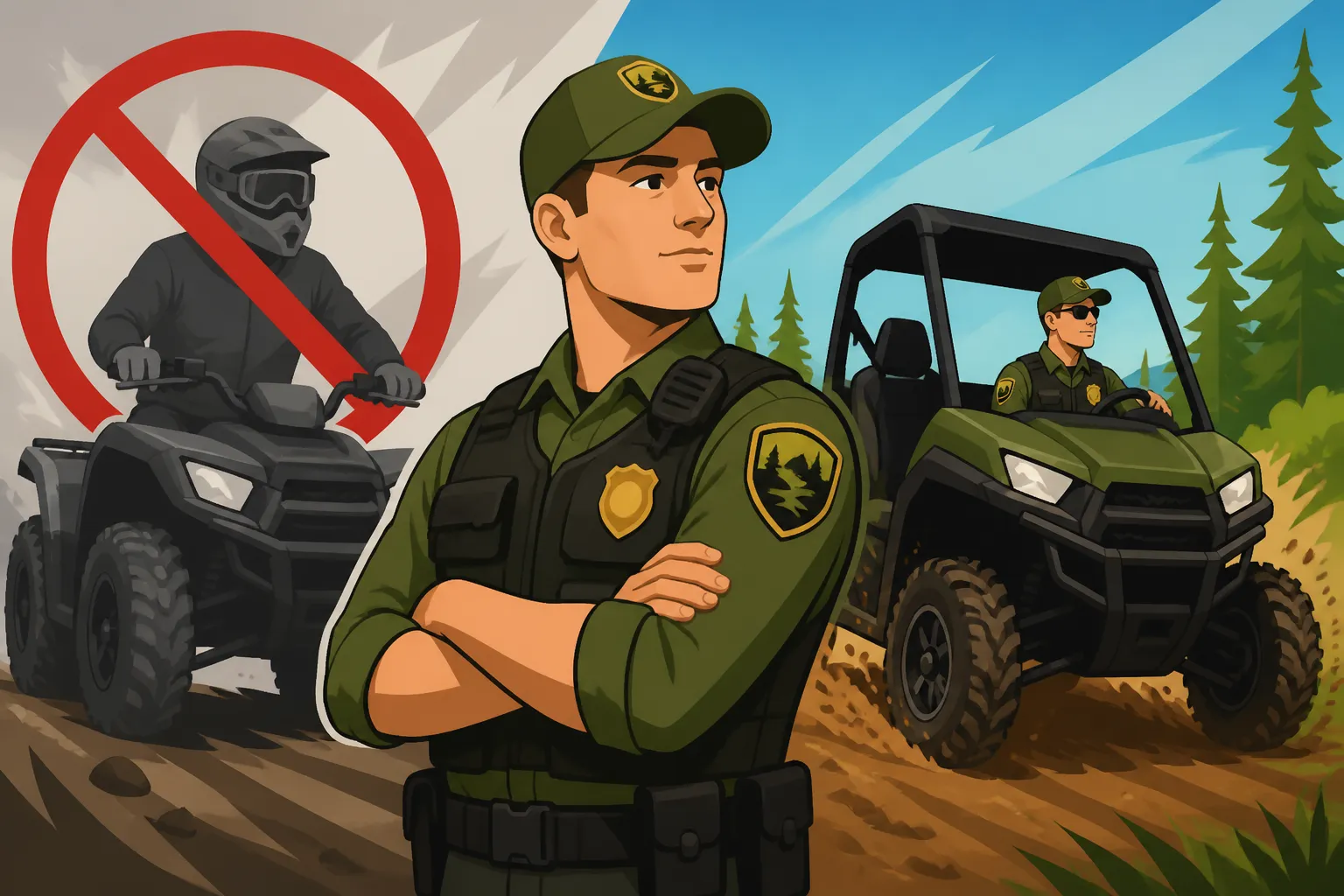
The Off-Road Vehicles Act includes a crucial exemption in subsection 13(4)(b) that directly addresses this situation. It states that the general helmet requirement "does not apply to a person who is operating or is a passenger on an off-road vehicle while engaged in a public service activity, including policing, emergency medical services, firefighting, or search and rescue operations." Conservation Officers fall squarely within the "policing" aspect of public service activities, as they are peace officers with specific enforcement powers related to natural resources and public safety.
Imagine a scenario: a CO receives an urgent call about illegal hunting activity deep in the backcountry, or perhaps a report of an injured animal that needs immediate attention. Time is of the essence. In such situations, the need for rapid deployment and unhindered communication can sometimes outweigh the helmet requirement. A helmet, while vital for protection, can impede peripheral vision, muffle sounds, and make it more difficult to quickly dismount a machine – perhaps a rugged SuperATV Defender UTV – to pursue a suspect on foot or provide immediate assistance. Their work often involves dynamic situations where split-second decisions and unimpeded sensory input are crucial for officer safety and mission success.
Other Government or Public Service Roles
While COs are the most common example riders might encounter, they aren't the only ones covered by these public service exemptions. Other individuals engaged in similar critical roles may also be exempt from the helmet rule when performing their duties. For instance, staff from Manitoba Hydro working in remote areas, particularly north of the 53rd parallel, may have specific exemptions related to their operational needs. [Manitoba Hydro Crews North of the 53rd Parallel] are often responding to emergencies or conducting maintenance in challenging environments where strict adherence to all recreational ORV rules might hinder their ability to restore power or maintain essential services.
Similarly, other emergency services personnel, such as those involved in search and rescue operations, might find themselves in situations where a helmet could momentarily impede their ability to hear faint cries for help or communicate clearly with a team member in a rapidly evolving crisis. These exemptions are not granted lightly and are always balanced against the inherent risks involved. The underlying principle is to allow trained professionals to carry out essential public safety and infrastructure maintenance tasks without undue operational hindrance, recognizing the specialized training and context of their work.
Distinguishing Exemptions from General Public Rules
It’s easy to look at these exemptions and feel like there’s a double standard, but it’s crucial to understand the very clear lines drawn between the operational needs of public service professionals and the general safety requirements for recreational riders. These are not about "officer privilege" but rather about functional necessity for specific, high-stakes jobs.
No "Officer Privilege" for Personal Use
One of the most important distinctions to make is that these exemptions apply only when a Conservation Officer, or any other exempted individual, is actively performing their official duties. If that same CO is out on their personal ATV or UTV on a Saturday afternoon, enjoying a trail ride with friends or family, they are absolutely subject to the exact same helmet laws as everyone else. There is no special status that carries over into their personal life or recreational activities.
This means if you see a CO off-duty without a helmet, they are breaking the law just like any other citizen would be. The exemption is intrinsically tied to the uniform, the badge, the vehicle being used for official purposes, and the specific tasks being performed. It's not a blanket pass to disregard safety gear whenever they choose; it's a narrowly defined allowance for very specific operational contexts that are essential for their job.
Why the Rules Differ
The primary reason the rules differ for these professionals lies in the unique blend of public safety, operational effectiveness, and the inherent risks associated with their roles. When a Conservation Officer is responding to an emergency or enforcing laws in the field, they often face unpredictable and rapidly changing circumstances. They might need to quickly dismount their machine, communicate vital information without delay, or maintain a wide field of vision to detect potential threats or evidence. A helmet, while a life-saver in a crash, can, in certain critical moments, be an impediment to these functions.
Furthermore, these individuals typically undergo specialized, rigorous training that far exceeds what the average recreational rider experiences. They are trained in advanced operating techniques, tactical responses, and risk assessment specific to their enforcement and emergency roles. This specialized training, combined with the often critical nature of their duties, warrants a different approach to certain safety regulations compared to the general public. It's a pragmatic balance between maximizing individual protection and enabling the efficient execution of vital public services. For instance, while a recreational rider on a [Manitoba Ditch Riding Rules] section should always wear a helmet, a CO tracking a suspect through a ditch might momentarily remove theirs for better situational awareness.
What This Means for the Average Rider
For those of us who ride ATVs and UTVs for recreation, enjoyment, and to explore the incredible landscapes Manitoba offers, the message remains consistent and clear. While understanding the nuances of exemptions is helpful, it doesn't change our personal responsibilities on the trail or road.
Stick to the Rules
For 99.9% of recreational riders in Manitoba, wearing an approved helmet is not just good practice, it’s the law. This requirement is in place for your safety, plain and simple. Head injuries are among the most severe and preventable injuries in ORV accidents, and a helmet is your best line of defense. Ignoring this rule can lead to significant consequences, both in terms of personal injury and legal penalties. [Manitoba ATV Helmet Law] is enforced, and officers are not hesitant to issue tickets to those who disregard it.
When you're out there, whether on designated trails, crossing highways (where permitted), or even riding on your own private property, if you’re in a "public place" or on a "highway" as defined by the Act, that helmet needs to be on and properly fastened. This commitment to safety helps ensure that our riding community remains vibrant and responsible, setting a good example for new riders and ensuring that we can continue to enjoy our machines for years to come.
Don't Confuse Exemptions with Exceptions
It's vital to differentiate between an "exemption" and what some might mistakenly consider a general "exception" to the helmet rule. Exemptions, like those for Conservation Officers, are specific legal allowances granted to particular individuals or groups performing specialized duties. They are narrow in scope and do not create a precedent for the general public. An exception might refer to a broader condition that could apply to more people, but even those are rare and highly regulated.
For example, there are specific exemptions related to certain activities, such as [Manitoba Farming and Fishing Helmet Exemptions] or [Manitoba Hunting and Trapping Helmet Exemptions]. These are also very particular conditions, requiring the operator to be actively engaged in those specific tasks, often on private land or within very defined operational parameters. They are not an invitation for general recreational riding without a helmet. Always clarify the exact nature of any perceived exception, as misunderstanding can lead to serious legal trouble and injury.
Other Scenarios Where Helmets Might Not Be Required
While Conservation Officers' exemptions are about operational necessity, there are other, distinct situations where a helmet might not be legally required for some riders, though these are entirely different from the CO scenario. The most common of these relates to machines equipped with specific safety features designed for occupant protection. For instance, some UTVs come factory-equipped with a robust roll-over protective structure (ROPS) and seat belts. In these cases, depending on the specific design and if the seatbelt is worn, the Act may provide an exemption where a helmet is not required.
This is why you might sometimes see someone operating a newer side-by-side wearing a seat belt but no helmet. The underlying principle here is that the ROPS and seat belt are designed to offer a similar, or in some cases, enhanced level of protection against head injury in a roll-over situation. [When a Seat Belt Replaces a Helmet] or [Manitoba Roll-Over Protection Exemptions] are specific clauses within the legislation that address these particular vehicle safety designs. However, it's absolutely crucial to confirm that your specific machine and the circumstances of its use truly meet these strict exemption criteria. Never assume; always verify with the official regulations or an Autopac agent.
Manitoba ORV Helmet Exemptions
| Category | Applies To | Condition for Exemption | Example Scenario | Applies to Recreational Riders? |
|---|---|---|---|---|
| Public Service/Law Enforcement | Conservation Officers, Police, EMS, Firefighters, Search & Rescue | Actively engaged in official duties (e.g., policing, emergency response) | CO responding to a poaching incident or Hydro crew restoring power above 53rd parallel | No |
| Farming/Fishing/Hunting/Trapping | Individuals engaged in these specific activities on certain lands | Actively performing farming, fishing, hunting, or trapping duties | Farmer checking fences on their land, trapper on their registered trapline | No (specific conditions apply) |
| Roll-Over Protective Structures | ORVs equipped with a factory-installed ROPS and seat belts | Operator (and passengers) are wearing the seat belt, and the ROPS meets standards | Riding a side-by-side with a roll cage and seat belts fastened | Yes (if machine meets criteria) |
| General Recreational Riding | All other ORV operators and passengers | N/A (Helmet is always required) | Trail riding, recreational ditch riding, crossing highways | N/A (Helmet is mandatory) |
Disclaimer
This article is for general informational purposes only and does not constitute professional advice. Laws, prices and regulations vary by location and change over time. Consult a qualified professional for guidance on your specific situation.