Why Basic Manitoba ORV Coverage Skips Injuries
Many riders in Manitoba feel a real punch to the gut when they find out their basic Off-Road Vehicle (ORV) registration and included insurance don't actually cover their own injuries if something goes wrong. It's a common misconception, leading to a lot of frustration and potential financial hardship for those who thought they were fully protected. This guide will clarify exactly why basic coverage skips injuries and, more importantly, what you can do to ensure you’re truly protected when you hit the trails or the open bush.
The Core Reality of Basic ORV Coverage in Manitoba
Let's be honest, navigating insurance can feel like trying to ride a quad through thick muskeg – confusing and you're not always sure where you'll end up. When it comes to your ATV or UTV in Manitoba, the base level of coverage that comes with your registration from Manitoba Public Insurance (MPI) often surprises people. Many assume "insurance" means total protection, but that's just not how it works with ORVs here.
What "Basic" Really Means for Your Machine
Your basic ORV registration in Manitoba is absolutely essential. It's not just a formality; it includes a mandatory component that's designed to protect other people and their property from damage you might cause. This is known as third-party liability coverage. Think of it this way: if you accidentally hit someone else's parked truck with your UTV while backing out of a staging area, or if you collide with another rider and cause damage to their machine, your basic coverage steps in to pay for their damages and their injuries, up to a certain limit.
It's a crucial safety net for the general public, and it’s a legal requirement to ride almost anywhere. You can find more about this in articles like [Manitoba ORV Registration Through MPI]. However, what it absolutely does not cover, by default, is damage to your own machine or, critically, your own personal injuries. This is where the surprise often hits hard, especially for new riders or those who haven't delved into the fine print. You've gone through the process of getting your machine registered, you see the "insurance" line item, and you naturally think you're good to go. The reality is more nuanced, and it's a distinction that can have significant consequences.
Why Your Injuries Aren't Covered by Default
The reason your own injuries aren't automatically covered by your basic ORV registration is tied to the fundamental structure of how ORVs are viewed compared to, say, your daily driver car or truck. For on-road vehicles, a comprehensive "no-fault" system often includes personal injury benefits as a standard part of your basic insurance, regardless of who caused the accident. This isn't universally the case for ORVs.
Off-road machines are often categorized differently due to their recreational nature and the inherently higher risks associated with the environments they operate in. When you're out tearing up the trails, tackling rough terrain, or pushing the limits, there's an acknowledged level of risk you're taking on. Because of this, personal injury protection for the operator or passengers of an ORV is generally treated as an optional add-on, something you consciously choose and pay extra for. It's not baked into the basic third-party liability that covers others.
This distinction is a common source of confusion. Many riders, especially if they're used to how car insurance works, simply assume their personal medical costs or lost income from an ORV accident would be covered. Unfortunately, that assumption can leave you in a very vulnerable position. The provincial system focuses on basic protection for the public and property, leaving the rider's personal well-being as a separate, elective consideration.
The Cost of a Misconception: What Happens Without Additional Coverage?
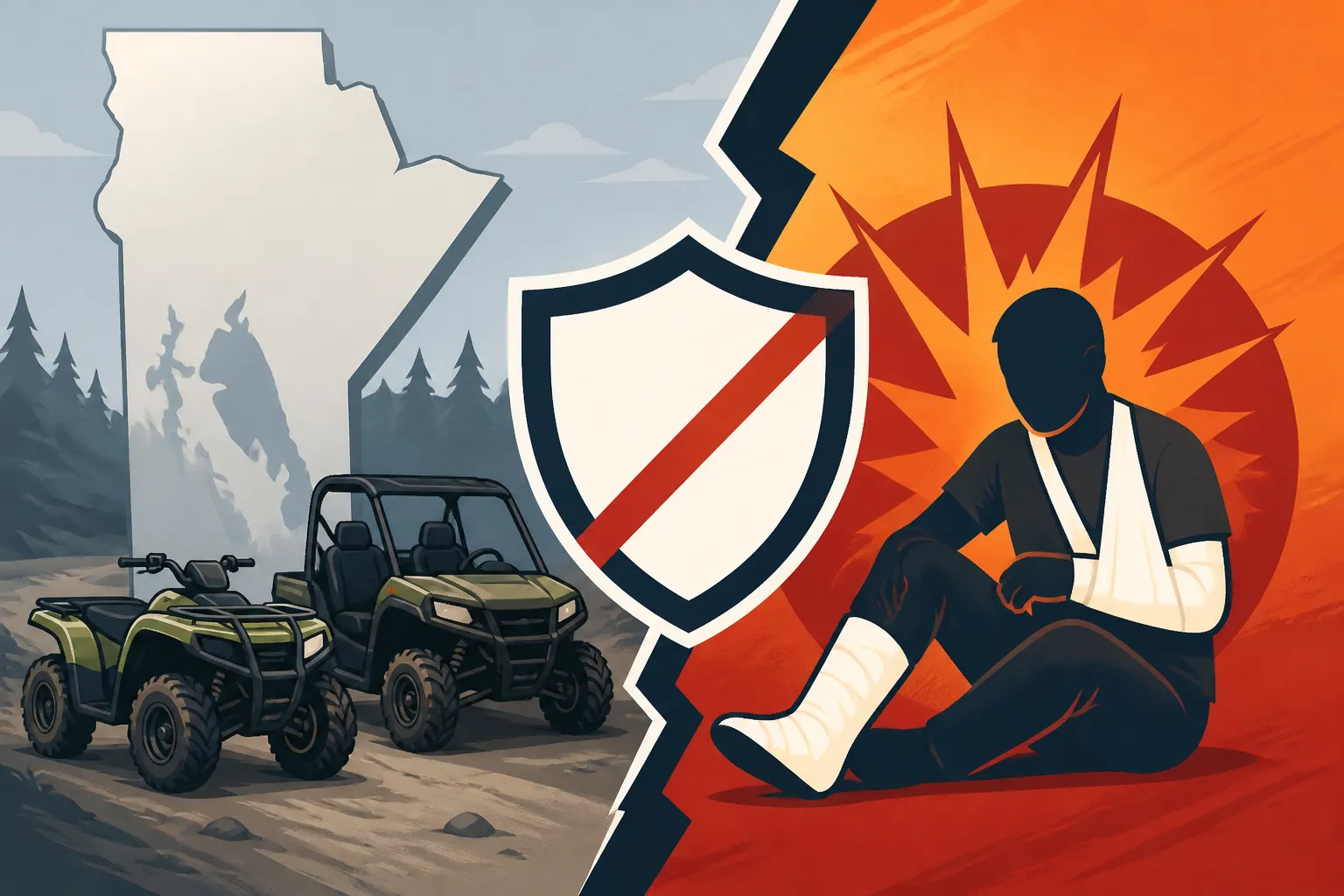
Imagine this all-too-common scenario: You're enjoying a beautiful fall day on a remote trail in the Whiteshell, pushing your UTV a little harder on a particularly challenging climb. Suddenly, a hidden rock or an unexpected rut throws you off balance, and your machine tips over. You're shaken, but your arm is definitely not right. It's clear you've broken something.
Now, with only basic ORV coverage, here's what happens next:
- Ambulance and Emergency Room: These immediate costs for transport and initial assessment will likely be covered by your provincial health insurance (Manitoba Health).
- Ongoing Medical Treatment: Follow-up appointments, specialist visits, X-rays, physiotherapy, and any necessary medications will also generally fall under Manitoba Health.
- However, the big hit comes with anything beyond basic medical care: If you need specific rehabilitation that isn't fully covered by Manitoba Health, or if you require specialized equipment or long-term care, those costs could quickly pile up.
- Lost Income: If your broken arm means you can't work for weeks or even months, your basic ORV insurance offers absolutely no compensation for your lost wages. This can be devastating, impacting your household budget, ability to pay bills, and overall financial stability.
- Pain and Suffering: There's no provision in basic coverage for the non-economic impacts of your injury.
- Damage to Your Machine: And let's not forget the machine itself. Your basic coverage won't pay a dime to repair or replace your damaged ATV or UTV. If you've invested in quality aftermarket parts, say from SuperATV, to enhance your ride, those upgrades could be gone and not covered.
Without optional accident benefits, collision, and comprehensive coverage, an ORV incident can quickly become a significant financial burden, far beyond the initial medical treatments. It's a stark reminder that peace of mind on the trail often requires looking beyond the bare minimum. You can learn more about general coverage options in [Manitoba ATV Insurance Options].
Beyond Basic: Understanding Your Options for Injury Protection
The good news is that you don't have to ride unprotected. While basic coverage leaves a significant gap, MPI, like most insurers, offers a range of additional options designed to safeguard both you and your machine. It's about being proactive and understanding what’s available.
Optional Accident Benefits: Your Safety Net
This is the direct answer to the "why aren't my injuries covered?" question. Optional Accident Benefits are the key to personal injury protection for you and any passengers on your ORV. When you add this to your policy, you're essentially buying a safety net that steps in when you or your passengers are injured in an ORV incident, regardless of who was at fault.
What do these benefits typically cover?
- Medical and Rehabilitation Expenses: This can include ambulance fees, hospital stays, doctor visits, physiotherapy, chiropractic care, prescription drugs, and even specialized equipment or home modifications if needed for recovery. These go beyond what Manitoba Health might cover or supplement it.
- Income Replacement: This is a huge one. If your injuries prevent you from working, accident benefits can provide compensation for a portion of your lost income, helping you keep up with your financial obligations during recovery. There are often waiting periods and maximum benefit amounts, so it's vital to understand these details.
- Death Benefits: In the tragic event of a fatal accident, these benefits can provide financial support to your family.
- Funeral Expenses: Coverage for funeral costs is often included as well.
The specifics of optional accident benefits, including the limits and any deductibles, can vary. It’s absolutely crucial to sit down with an Autopac agent and discuss these options in detail. They can help you tailor the coverage to your personal circumstances and risk tolerance. This is also where you might learn about increasing your basic liability coverage with [Manitoba Third Party Liability Plus Options].
The Role of Personal Health Insurance and Other Policies
While ORV-specific accident benefits are ideal, it's also worth remembering that other insurance policies you might already have play a critical role in your overall protection. Your personal health insurance, whether it's through your employer, a private plan, or even additional provincial benefits, can act as a primary or secondary layer of coverage for medical expenses arising from an ORV accident.
For example, if your employer's health plan offers excellent physiotherapy or prescription drug coverage, that might pick up where Manitoba Health leaves off, potentially reducing the strain on your ORV accident benefits. It's vital to understand the coordination of benefits between these different plans. Which one pays first? Are there any exclusions for "risky" activities like off-roading? These are questions worth asking your health insurance provider.
Beyond health insurance, consider other forms of personal financial protection:
- Disability Insurance: If you have short-term or long-term disability insurance, this could be your main line of defense for lost income if an ORV injury keeps you out of work for an extended period.
- Critical Illness Insurance: While not directly tied to accidents, if an accident leads to a life-altering illness or condition, this policy could provide a lump sum payment.
- Life Insurance: In the most unfortunate circumstances, your life insurance policy would provide for your loved ones.
These personal policies are not substitutes for ORV-specific accident benefits, but they form part of a broader financial safety net. A holistic approach to your personal and financial well-being is always the best strategy, ensuring that multiple layers of protection are in place.
Collision and Comprehensive: Protecting Your Machine, Too
While our main focus here is on personal injuries, it's impossible to talk about being fully protected without mentioning coverage for your ORV itself. After all, if you're injured, your machine might be too, and the costs can be staggering. This is where Collision and Comprehensive coverage come in, both of which are optional add-ons to your basic ORV policy.
- Collision Coverage: This protects your ORV from damage resulting from a collision with another object, whether it's another vehicle, a tree, a rock, or even just rolling over. If you have an accident and need to repair or replace your quad or UTV, collision coverage pays out (minus your deductible). This is crucial, especially if you have a newer machine or have invested heavily in aftermarket upgrades. Imagine custom bumpers, lights, or a sophisticated SuperATV lift kit – you'd want those protected. You can investigate [What Collision Coverage Costs a Manitoba ORV Owner].
- Comprehensive Coverage: This covers non-collision related damages or losses to your ORV. Think theft, vandalism, fire, hail, or even hitting an animal. If your ORV is stolen from your garage or vandalized at a trailhead, comprehensive coverage helps you repair or replace it. This is a vital layer of protection for significant investments. Without it, you'd be out of luck if your machine went missing, as [Manitoba Basic Coverage Does Not Cover Theft] makes clear.
While these don't directly cover your medical bills, having your machine covered means you won't be facing a double whammy of medical expenses and machine replacement costs out of pocket. It's all part of the larger picture of securing your investment and your peace of mind when riding.
Practical Steps to Ensure You're Protected
Knowing the difference between basic and optional coverage is the first step, but putting that knowledge into action is what truly matters. It's about being proactive and making informed decisions before you ever need to file a claim.
Reviewing Your Current Policy with an Autopac Agent
The single most important action you can take is to connect with a qualified Autopac agent. These professionals specialize in MPI policies and can walk you through all the intricacies of ORV insurance in Manitoba. They are your best resource for personalized advice and understanding your specific policy details. You can find more information about this process in [Manitoba Autopac Agents and ORV Registration].
When you meet with an agent, be prepared to ask specific questions:
- "What exactly is covered for personal injury under my current ORV policy?" Don't assume. Get a clear, unambiguous answer.
- "What are my options for Optional Accident Benefits, and what do they typically cover?" Ask about limits, deductibles, income replacement percentages, and any exclusions.
- "What would adding comprehensive and collision coverage cost, and what are the benefits?" Understand how protecting your machine fits into the picture.
- "How does my existing personal health insurance (e.g., through my employer) integrate with my ORV policy for injury claims?" This helps avoid gaps or overlaps.
- "Are there any specific scenarios or risks unique to my riding style or the areas I ride that I should consider adding more coverage for?" A good agent will probe to understand your needs.
- "What is the process for making a claim if I get injured or my machine is damaged?" Knowing the steps beforehand can reduce stress during a difficult time.
Don't be afraid to ask for explanations in plain language. Your agent's job is to ensure you understand what you're buying. This isn't a quick transaction; it's a critical discussion about your financial security and well-being.
Calculating Your Risk and Budget
Deciding how much additional coverage to purchase involves a personal assessment of your risk tolerance, riding habits, and financial situation. There's no one-size-fits-all answer, but here are some factors to consider:
- Your Riding Style and Frequency: Do you casually cruise on well-maintained trails a few times a year, or are you an aggressive rider tackling extreme terrain every weekend? The more frequently and aggressively you ride, the higher your statistical risk of an incident, and the more robust your coverage should likely be.
- Your Financial Vulnerability: Could you easily absorb thousands of dollars in medical bills or lost income for several months without significant financial strain? If not, then investing in stronger accident benefits is a wise move.
- Value of Your Machine: A brand-new UTV packed with custom SuperATV accessories is a significant investment. Losing it to theft or total damage without collision or comprehensive coverage would be a major financial hit. Compare the cost of the premiums to the cost of replacing your machine.
- Existing Coverage: As discussed, factor in your personal health, disability, and life insurance policies. What gaps might remain after these are considered?
- Budget: Naturally, cost is a factor. Premiums for additional coverage will increase your overall cost of ownership. It’s about finding a balance between what you can afford and what level of risk you’re comfortable taking. Think about what a [Manitoba ORV Registration Cost] truly entails when you add all these layers.
By honestly assessing these points, you can make an informed decision about how much protection you truly need for your peace of mind on the trails.
What to Do If an Incident Occurs
Even with the best preparation, accidents can happen. Knowing what to do in the immediate aftermath can make a significant difference in how smoothly your claim process goes and how effectively you receive the benefits you're entitled to.
- Safety First: Ensure your safety and the safety of others. If possible and safe, move to a secure location.
- Assess Injuries: Check yourself and anyone else involved for injuries. If anyone is seriously hurt, call 911 immediately. Seek medical attention as soon as possible, even if injuries seem minor at first.
- Secure the Scene (If Safe): If possible, take photos of the scene, including the position of the ORV, any damage, and the surrounding area. Note down weather conditions and time of day.
- Gather Information:
- Witnesses: Get names and contact information for any witnesses.
- Other Parties: If another ORV or vehicle was involved, exchange names, contact information, ORV/vehicle details (make, model, license plate), and insurance information.
- Police/Conservation Officers: If police or conservation officers respond, get their badge numbers and a report number if one is issued. This is vital for [Manitoba Accident Reporting Rules].
- Do Not Admit Fault: Stick to the facts. Do not admit fault or make assumptions about who is to blame.
- Contact Your Autopac Agent/MPI: Report the incident to your Autopac agent or MPI as soon as reasonably possible. They will guide you through the claims process. Provide them with all the information you've gathered.
- Follow Medical Advice: Adhere strictly to all medical advice and treatment plans. This is crucial for your recovery and for validating any injury claims. Keep detailed records of all medical appointments, treatments, and expenses.
- Document Everything: Maintain a file with all correspondence, photos, medical reports, receipts, and any other relevant documents related to the incident and your recovery.
Following these steps will not only help ensure your well-being but also streamline the insurance claim process, making it easier to access the benefits you've paid for when you need them most. Remember, carrying your [Manitoba Registration Cards Carried at All Times] is also important, as is any proof of additional coverage you've purchased.
Basic vs. Enhanced ORV Coverage in Manitoba
To help visualize the differences, here's a quick comparison of what you typically get with basic registration versus what enhanced coverage can offer:
| Feature | Basic ORV Registration (Mandatory) | Enhanced ORV Coverage (Optional Add-ons) |
|---|---|---|
| Third-Party Liability | Yes (Covers damage/injury you cause to others) | Yes (Can be increased beyond basic limits for added protection) |
| Personal Injuries | No (Does NOT cover operator or passenger injuries) | Yes (Optional Accident Benefits cover medical, rehab, income loss for operator/passengers) |
| Damage to Your ORV | No (Does NOT cover damage to your ATV/UTV) | Yes (Optional Collision coverage for accident damage, Comprehensive for theft, fire, vandalism, etc.) |
| Theft of Your ORV | No (Not covered by basic registration) | Yes (Included with Optional Comprehensive coverage) |
| Medical Expenses | Manitoba Health covers some, but gaps exist | Supplements Manitoba Health; covers rehabilitation, prescriptions, etc., beyond basic provincial care |
| Lost Income | No | Yes (Optional Accident Benefits can provide income replacement during recovery) |
This table highlights the significant areas where basic coverage falls short, particularly regarding personal injury and damage to your own machine. It makes a strong case for exploring the optional enhancements to ensure comprehensive protection.
Disclaimer
This article is for general informational purposes only and does not constitute professional advice. Laws, prices and regulations vary by location and change over time. Consult a qualified professional for guidance on your specific situation.