Wildfire Season Ends on the Fifteenth of November
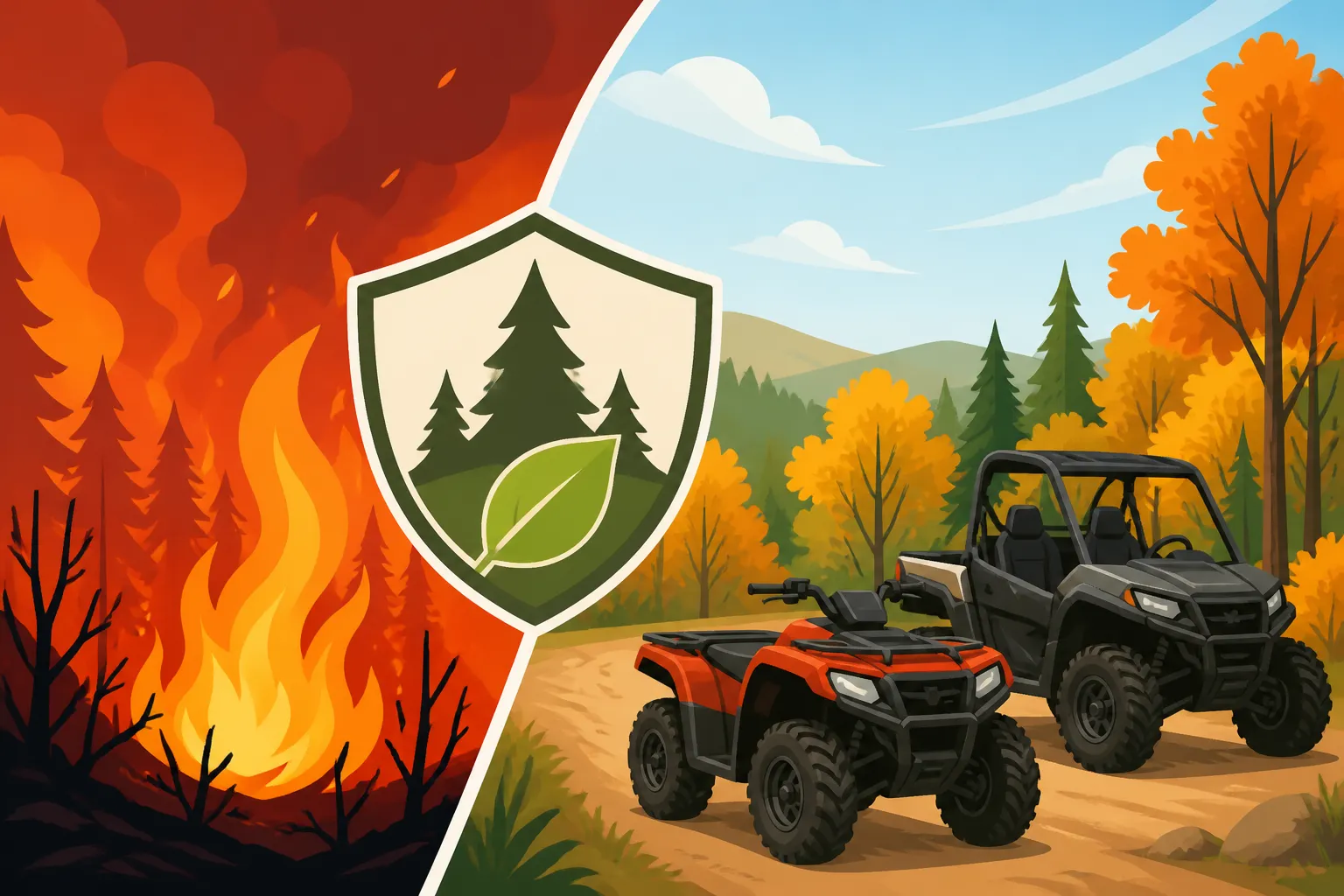
Manitoba’s wildfire season ends on November 15, but that date is not an automatic all-clear for ATV and UTV riding. Area closures, local fire restrictions, unsafe trail conditions and year-round equipment rules may still apply. The key is to treat the date as one part of your trip planning: check current orders for your destination before unloading, even late in the season.
What November 15 means for ATV and UTV riders
Manitoba’s defined wildfire season runs from April 1 through November 15. The end date marks the close of that seasonal period; it does not guarantee that every trail, forest road or piece of Crown land is open the next day. For background, see Manitoba Wildfire Season From April to November and Wildfire Season Starts the First of April.
The practical distinction is between a general season and restrictions that apply to a particular place or situation. A provincial or local order can restrict travel in a defined area. A trail can also be closed because of fire damage, wet ground, storm damage or maintenance. Those conditions may not disappear when the seasonal period ends.
Before a ride, check for current fire restrictions and any area closure notices covering your intended route. If an order applies, follow its boundaries and conditions rather than assuming a trail is available because it appears on a map or was open on a previous visit. The Manitoba Fire Restrictions Map and Manitoba Area Closure Orders are useful topics to review when deciding what to verify.
| Situation | What the November 15 end date tells you | What to check before riding |
|---|---|---|
| General wildfire season | The defined seasonal period has ended | Whether a current restriction or closure still applies |
| A specific area is closed | The date does not itself reopen the area | The closure notice and its boundaries or end conditions |
| A trail has been damaged | The seasonal date does not confirm the trail is safe | Trail status, access notices and ground conditions |
| Your machine may throw sparks | The seasonal end does not remove equipment requirements | Whether your machine has the required spark-control equipment |
| You are visiting from outside Manitoba | The date does not create an exemption for visitors | Manitoba operating rules, your home registration and insurance requirements |
A late-season trip can still be affected by dry vegetation, wind, a new fire or a restriction issued for a particular location. Conversely, the fact that a fire restriction applied earlier in the season does not necessarily mean it remains in force after its stated end. The details matter: read the current notice, including which area and activities it covers.
Do not rely on an old screenshot, a club post from a previous week or a navigation app alone. Those can help you find a route, but they may not reflect a recent closure. Check current official information close to departure and again if your plans change.
Restrictions can continue after the season ends
The end of the defined wildfire season does not cancel every order or restriction automatically. Some measures are tied to a specific area, event or stated period. Others may be updated as conditions change. If a notice gives an end date or a condition for reopening, follow that wording; if the status is unclear, confirm it with the relevant authority before entering the area.
An area closure is different from a general fire-risk warning. A closure may prohibit travel or access in a defined place, while other fire rules may limit particular activities without closing every route. Do not treat a map colour, a trail marker or a verbal report as a substitute for reading the applicable notice. If your route crosses several jurisdictions or land types, check each one that could affect your ride.
This is especially important on Crown land, where access permission and land-use restrictions can vary. A route that looks like an established track is not proof that riding is allowed. Check Manitoba Crown Land Riding Explained and, where a trail enters a provincial park, Manitoba Park Trail Closures. Park rules and designated-route requirements remain relevant regardless of the wildfire-season end date.
A trail can also become unsafe without a formal fire closure. Fire-damaged trees, soft or flooded ground, deep ruts and blocked access can make a route unsuitable for an ATV or UTV. Recheck trail conditions close to your trip and be ready to turn around. For additional planning, see Manitoba Trail Closures After a Storm.
Equipment rules still matter
The November 15 date is not a reason to remove equipment or overlook operating requirements. Manitoba’s spark arrester requirements apply as a separate equipment issue; check Manitoba Spark Arrester Requirements to understand what applies to your machine. A machine that is not properly equipped can create risk even when a seasonal restriction is no longer in effect.
Keep the machine maintained, clear away packed vegetation where appropriate, and avoid parking or stopping over dry grass or brush when hot components could ignite it. These are sensible precautions, not permission to ignore a closure or an equipment rule. If a restriction says not to travel or not to use certain equipment in an area, follow the restriction.
Visitors follow Manitoba rules too
A visitor’s home registration does not make Manitoba fire and access restrictions optional. Visitors must follow the operating rules that apply in Manitoba, as well as any valid requirements tied to their home registration and insurance. The seasonal end date does not change that. See Manitoba Rules for an Out-of-Province Machine for the wider visitor context.
If you are travelling with a group, make sure every operator knows the planned route and any restrictions. One rider’s assumption that the area is open can put the whole group in a difficult position. Agree on a turnaround plan and do not split up to get around a closed section.
How to check conditions before a late-season ride
A reliable pre-ride check takes a few minutes and can prevent a long tow or an avoidable violation. Do it close to departure because conditions and notices can change.
- Identify the exact riding area. Use a current map to locate the trailhead, route and land type. If the route crosses private land, Crown land, a park or municipal territory, identify those boundaries before you go.
- Check current fire restrictions and closure notices. Look for notices that name your destination or include it within a mapped boundary. Read the actual conditions and dates rather than relying only on a summary.
- Confirm the trail is open. Check with the relevant park office, land manager or local riding club when the trail status is uncertain. A route shown on an older map may not be passable or open now.
- Review machine requirements. Confirm your ATV or UTV meets applicable equipment rules, including spark-control requirements. Carry the required registration and insurance documents for your ride.
- Check the weather and ground conditions. Wind, dry brush, rain, snow and freeze-thaw conditions can change both fire risk and trail safety. A trail that was passable recently may be damaged or blocked.
- Tell someone your plan. Share your route and expected return time, especially if cell service may be limited. Have a paper or offline map and a plan for turning back.
- Recheck before unloading. If an order has changed or a closure appears, do not enter the restricted area. Choose an open alternative rather than trying to detour around a closure.
The exact authority to contact depends on the place and the type of notice. A park office can clarify park access, while a club may know the condition of its maintained corridor. Neither should be assumed to override a provincial closure or other binding order. When sources appear to conflict, get confirmation from the authority responsible for the restriction before riding.
For general preparation and rule details, Manitoba Wildfire Season Rules for Riders is a useful companion. Keep the information current: the question is not simply whether wildfire season has ended, but whether your particular route is open and your machine is allowed there today.
A practical late-season decision
Use November 15 as a calendar marker, not a green light. If there is no applicable closure, the route is open, your machine meets its requirements and conditions are safe, the seasonal end date alone does not tell you that riding is prohibited. But it also does not assure you that riding is permitted.
The safest decision is based on the location and current conditions. Verify the route, read any active notice, carry your documents and be prepared to change plans. If you cannot confirm that an area is open, do not assume it is. Choose a route with a clear status or postpone the ride until you can verify access.
This approach also avoids a common planning mistake: treating the province-wide season dates as a substitute for local information. The date provides context, but the rules for an actual ride depend on the area, current orders and the machine being used. A few minutes checking before departure is more useful than relying on the date alone.
Disclaimer
This article is for general informational purposes only and does not constitute professional advice. Laws, prices and regulations vary by location and change over time. Consult a qualified professional for guidance on your specific situation.