Where Manitoba’s Off-Road Trails Fee Actually Goes
Manitoba’s off-road trails fee raises a fair question: does the money pay for trail repairs, rider education, or something else? The key is to separate the fee’s stated purpose from claims about how each dollar is spent. Here’s what the available information says, what it does not confirm, and how to check the fee’s current status.
What the trails fee is meant to support
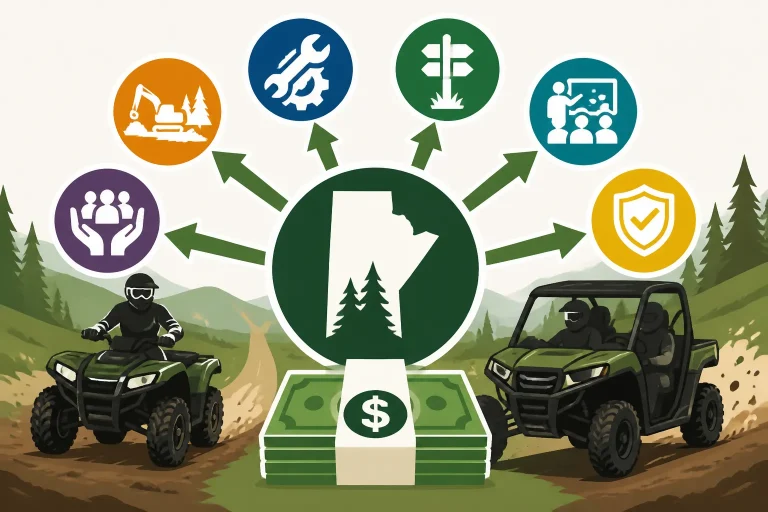
Manitoba introduced the proposed Off-Road Trails Safety and Maintenance Act to support the province’s off-road vehicle trail network. The proposal includes an annual fee collected with off-road vehicle registration. According to the Manitoba Government, that fee is $25 for registered off-road vehicles, and Manitoba Public Insurance would collect it.
The stated purpose is connected to trail safety and maintenance. That gives riders a broad idea of why the fee was proposed: supporting the system of trails and the work needed to manage them. It does not, by itself, tell you how much goes to a particular club, project, or type of work.
There is an important status caveat. As of November 2026, the Manitoba Government material describes the fee as part of proposed legislation. It also refers to an anticipated late-2023 start date, which should not be treated as proof that the fee is currently being collected. Before budgeting for a registration or assuming a payment is due, confirm the present rules with Manitoba Public Insurance or an Autopac agent. For the broader registration process, see Manitoba ORV Registration Through MPI.
| What the information says | What it can reasonably tell you | What it does not establish |
|---|---|---|
| A proposed annual fee is $25 | The proposal sets out a flat annual amount for covered registered machines | Whether the fee is currently being collected |
| Manitoba Public Insurance would collect it | The proposed collection point is tied to registration | A specific spending breakdown |
| The fee is intended to support trail safety and maintenance | The purpose relates to the off-road trail system | That a particular trail repair or club receives a set amount |
| Some registration-exempt machines would not pay it | The proposal links the fee to registration requirements | That every machine or rider is covered |
The fee is also not the same thing as permission to ride wherever you choose. Registration, access, and trail conditions are separate questions. A registered machine still needs to be operated where it is allowed, and closures or local restrictions can affect a planned ride. Manitoba’s Off-Road Trails Fee Explained covers the registration-fee distinction, while Manitoba Crown Land Riding Explained is useful when your route involves Crown land.
Who manages Manitoba’s trail network
The Manitoba Government identifies Snowmobilers of Manitoba Inc. and the All-Terrain Vehicle Association of Manitoba as organizations involved in managing the province’s off-road vehicle trail networks. Together, they are involved in managing more than 13,000 kilometres of trail, according to the Manitoba Government.
That figure shows the scale of the network, but it does not mean that every trail is open to every kind of vehicle or maintained in the same way. A province-wide network can include different trail types, managers, conditions, and operating restrictions. Riders should still check the particular route they plan to use rather than treating the network as one uniformly open system.
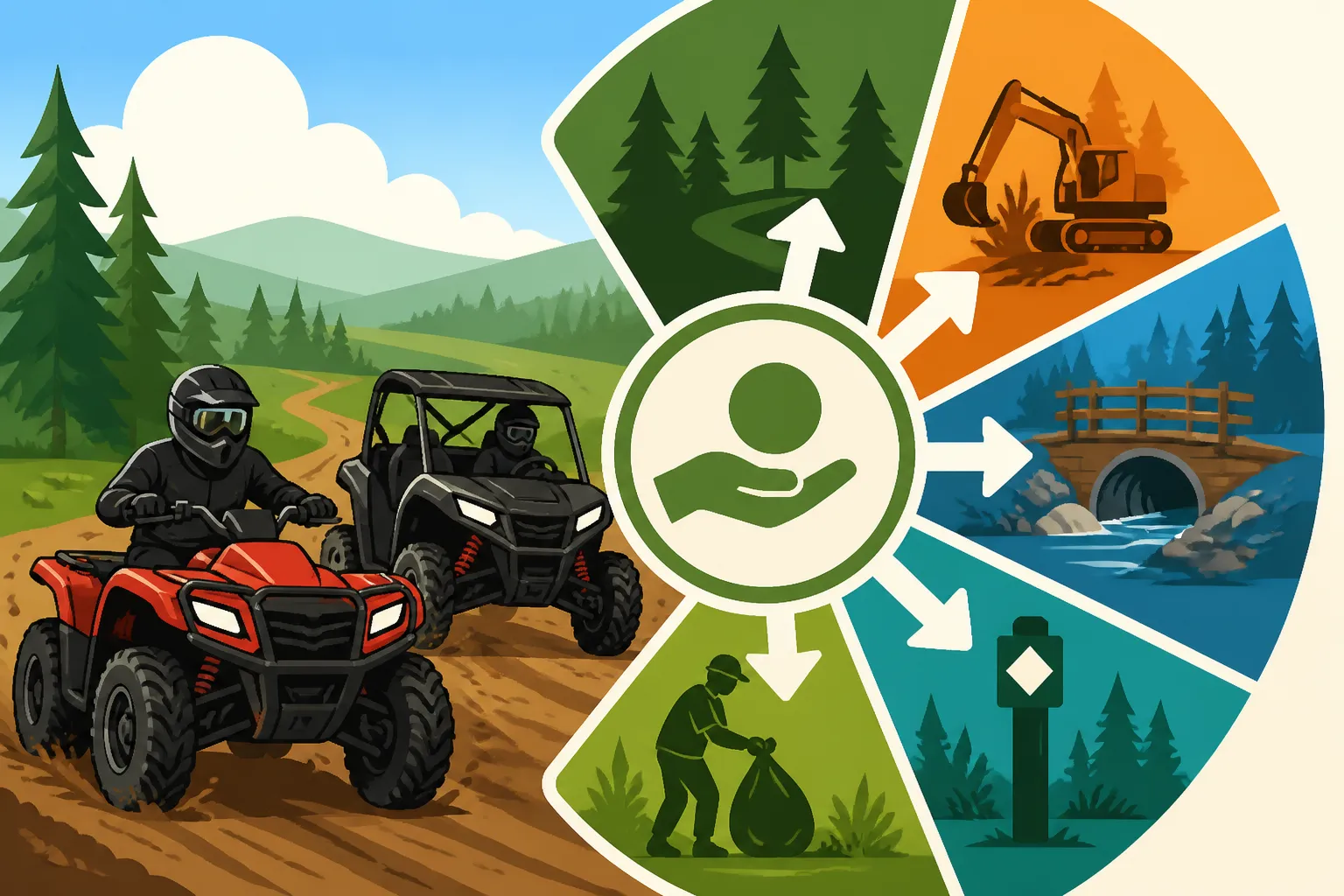
A fee intended to support safety and maintenance could relate to work across a network of this size. But without a confirmed financial breakdown, it would be misleading to say that the fee pays for a specific amount of grading, signage, repairs, or education. The responsible answer is narrower: the proposed fee is described as a contribution toward off-road trail safety and maintenance, while the precise allocation is not specified in the information available here.
For more on the broader funding question, How Manitoba’s Registration Surcharge Funds Trails and Money Flowing to Trail Grants address related topics. Their titles point to connected questions, but riders should still distinguish general programme information from a confirmed accounting of this particular fee.
Registration exemptions matter
The proposal does not apply the annual fee to off-road vehicles exempt from registration under the Drivers and Vehicles Act, according to the Manitoba Government. That means the fee is not simply a charge for anyone who owns or rides an off-road vehicle; its proposed reach is tied to whether the machine must be registered.
Exemptions can depend on a rider’s circumstances or the way a machine is used. Don’t assume an exemption applies just because a vehicle stays on private property, works on a farm, or is used in a remote area. Check the applicable rule for the machine and situation. Manitoba Registration Exemptions Explained and Manitoba Machines Used Only on Your Own Land can help identify the right questions to ask.
If the machine is covered by registration, the fee proposal describes collection through Manitoba Public Insurance. For individual registration details, an Autopac agent can help confirm what applies to a particular vehicle. Manitoba Autopac Agents and ORV Registration explains the service-counter side of the process.
What the fee does not buy
A registration-linked fee should not be read as an all-access pass. It does not override route restrictions, park rules, closures, landowner permission requirements, or safe-operation requirements. Those are separate parts of planning a ride.
Within provincial parks, off-road vehicles are strictly limited to designated routes, according to Environment and Climate Change. A route shown on a map may also be affected by temporary closures or changing conditions. Environment and Climate Change Manitoba, for example, reports closures affecting trails and backcountry routes in several provincial parks. A fee payment would not make a closed route available or expand the routes where machines are permitted.
Duck Mountain Provincial Park is highlighted as a signature destination for off-road vehicle riders by Environment and Climate Change. The Mossberry Trail spans 30 kilometres and accommodates off-road vehicles alongside other activities, according to Environment and Climate Change. The trail’s shared use is a practical reminder that riders need to account for other people on the route, not just their own machine and destination.
The park network also includes three backcountry campsites along remote lakes that allow multi-day riding, fishing, and camping in the Duck Mountains, according to Environment and Climate Change. These details describe recreational opportunities, not a guarantee that every trail or campsite is open at the time of a trip. Check current park notices and route conditions before hauling your machine.
For a broader look at designated routes and access, see Manitoba Parks Allow Machines on Designated Routes Only. For a particular trail, Manitoba Trail Conditions Before You Haul can help you think through the checks to make before leaving home.
How to check where your money goes
If the fee is being collected, the most useful way to understand it is to ask for information at the right level. Start by confirming whether the charge applies to your registration. Then ask what current public information is available about the fee’s purpose, administration, and spending. A general statement that money supports trail safety and maintenance is not the same as a project-by-project report.
Use a practical check-list:
- Confirm whether the fee is currently in force. The proposed status and the old anticipated start date make it especially important not to rely on an outdated summary. Ask Manitoba Public Insurance or an Autopac agent what is currently included in your registration transaction.
- Check whether your machine is required to be registered. The proposal excludes machines exempt from registration under the Drivers and Vehicles Act, according to the Manitoba Government. If you think an exemption fits, confirm the applicable rule rather than assuming.
- Ask what the fee is intended to support. Request the current explanation of its purpose and any available reporting on how funds are administered. If the information gives only a broad purpose, don’t infer a detailed allocation.
- Separate the fee from access rules. Confirm whether your intended route is legal and open. Registration does not make a route available if it is outside designated park routes or subject to a closure.
- Check trail conditions close to your trip. A network may be extensive but still include local closures, damage, or changing conditions. A club or park notice can be more useful than a general provincial description.
That last distinction is important for riders trying to judge whether the fee is worthwhile. The fee’s stated purpose may be broad, while the ride you have planned depends on a specific trail being open, suitable for your machine, and maintained to a standard you find acceptable. Those are related concerns, but they are not interchangeable.
Riders can visit ATVMB to find additional riding areas in Manitoba, as noted by Environment and Climate Change. Use that as a starting point, then check route-specific information and any local restrictions. For questions about the relationship between registration and trail funding, Where Your $25 Trails Fee Actually Goes and Trails Fee Money Spent on Trail Maintenance Grants are related reading.
The clearest conclusion is modest: the proposed $25 annual fee is described as supporting off-road trail safety and maintenance, and it is linked to registration rather than general access. The available information does not confirm a detailed breakdown of where each dollar goes. Confirm the current collection status with Manitoba Public Insurance, and verify your route separately before riding.
Sources
- Manitoba Government — Province of Manitoba | News Releases | Manitoba Government Introduces Off-Road Trails Safety and Maintenance Act (checked November 3, 2026)
- Environment and Climate Change — Parks and Protected Spaces | Environment and Climate Change | Province of Manitoba (checked November 3, 2026)
Disclaimer
This article is for general informational purposes only and does not constitute professional advice. Laws, prices and regulations vary by location and change over time. Consult a qualified professional for guidance on your specific situation.