Manitoba Supervision Requirements for Young Riders
Young riders can be ready to ride before they are old enough to ride alone under Manitoba’s rules. The practical question is not just a child’s age: it is whether an adult must supervise, what “supervision” means on the ground, and whether the route itself is legal. Here’s how to plan a ride without confusing age rules with road or machine restrictions.
Who must supervise a young rider in Manitoba
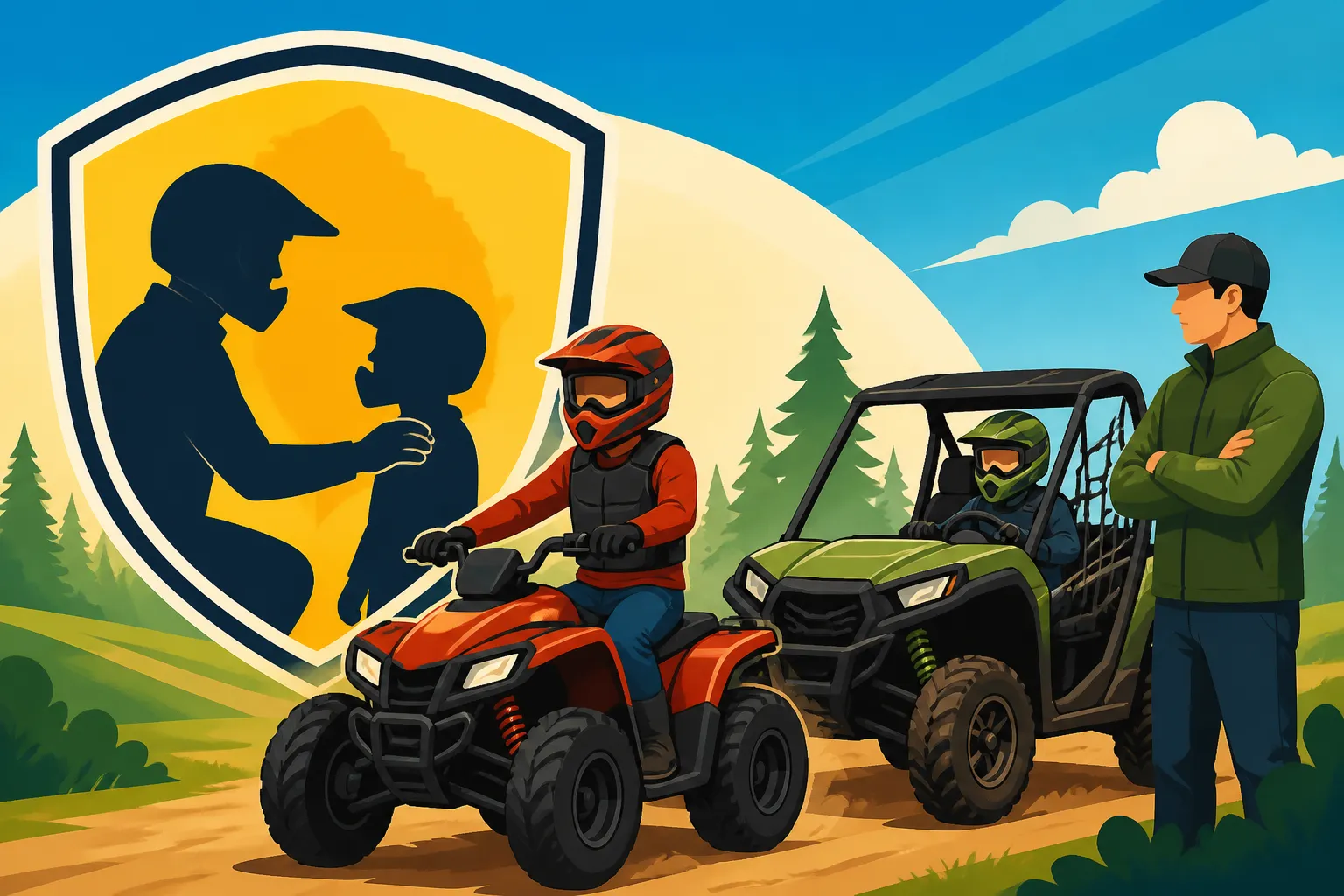
In Manitoba, a rider under 14 must be accompanied by an adult who is at least 18 years old. The adult must keep the young rider in clear view. In practice, that means supervision needs to be active: an adult watching from a place where they can see the rider is not the same as relying on a phone call or checking in later.
The rule is about the rider’s age, not the size or power of the ATV or UTV. A child riding a small youth quad does not get an exemption just because the machine is designed for children. Likewise, a young person who is confident and experienced still has to meet the legal supervision requirement.
For a closer look at how age rules fit together, see Manitoba Age Tiers for Young Riders and Manitoba Riders Under 14 Need Supervision.
| Rider’s age | Supervision takeaway | Important limit |
|---|---|---|
| Under 14 | Must ride accompanied by an adult at least 18 who can keep the rider in clear view | The adult’s presence does not make a prohibited route or machine legal |
| 14 or 15 | The under-14 supervision requirement no longer applies in the same way | Other age, route, licence, equipment and operating rules still apply |
| 16 or older | The under-14 supervision rule is not the main age restriction | Riding on a roadway or crossing one may still require a qualifying licence and other conditions |
A child’s age is only one part of the decision. The rider must also be capable of controlling the machine, fit the machine properly, and follow rules about helmets, passengers, location and operation. A parent or guardian should not treat the end of the under-14 supervision requirement as a general permission to ride anywhere.
What “under 14” means for family rides
If the young operator has not turned 14, plan the outing so the adult can actually maintain visual contact. A long gap between machines, a blind corner, thick bush, dust, darkness or a winding trail can break that line of sight. A group ride can make supervision harder if adults are spread out or riders get separated.
The safest arrangement is to keep the child close enough that the supervising adult can see what is happening and respond quickly. Choose a route that matches the child’s ability, and agree in advance that the group will stop if it loses sight of the young rider. On a trail with limited visibility, a slower pace and a smaller group are more useful than trying to keep up with faster riders.
The law’s supervision rule is not a substitute for judgment. If the adult cannot see the child, cannot communicate with the group, or cannot safely reach the rider if something goes wrong, the outing is not being supervised effectively.
What supervision should look like on a ride
The adult should be able to see the young rider, notice when the rider is struggling and intervene before a small problem becomes an emergency. That requires more than being somewhere on the same trail. Before setting out, decide who is responsible for the child and how the group will stay together.
A practical plan can include:
- Choose a suitable route. Start with a familiar, manageable trail or area. Avoid routes with steep slopes, deep water, heavy traffic, poor visibility or conditions the child has not handled before.
- Keep the adult and child within view. Place the supervising adult close enough to see the child continuously, especially at turns, trail junctions and changing terrain.
- Set a pace the child can manage. The group should ride at the speed of the least experienced operator, not expect a young rider to catch up.
- Agree on signals and stopping points. Make sure the child knows to stop when the group stops and not to follow an unfamiliar rider or take an unplanned branch.
- Check the machine and protective equipment. Confirm controls are reachable, the child can operate them, and the helmet fits and is properly secured.
- Reassess as conditions change. Mud, rain, darkness, fatigue or a new route can make a previously manageable ride unsuitable.
Supervision also means being prepared to end the ride. A child who is tired, upset, cold, overheated or having trouble controlling the machine should not be pressured to continue. The adult’s role is not just to satisfy a rule; it is to make sure the child can ride safely and stop when needed.
The adult’s machine and the child’s machine
The rule does not mean a child is automatically allowed to ride as a passenger on any adult’s machine. Passenger limits depend on the vehicle’s design and applicable rules. A UTV with seats and seat belts intended for passengers is different from a single-rider quad. Never carry a child on a machine in a position it was not designed to accommodate.
If the child is operating their own machine, the adult should be able to manage the group without riding so far ahead that the child is out of view. If the adult is operating a separate machine, plan positions and stopping points so the child remains visible. Do not assume that putting the child on a machine with a larger engine or extra equipment makes supervision unnecessary.
For passenger-specific considerations, see Manitoba Rules for a Child Passenger. For broader age guidance, Manitoba ATV Age Requirements is also relevant.
Where the age rule does and does not apply
Supervision does not determine where an ATV or UTV may be ridden. A legal adult riding beside a child cannot turn a closed road, restricted trail or private property without permission into an authorized route. Before riding, check the land access rules, local restrictions and any posted closures.
This distinction matters on public roads. Manitoba’s off-road vehicle rules generally restrict roadway riding, with specific exceptions for situations such as permitted crossings or other narrowly defined cases. A child being accompanied by an adult does not create a general right to ride along a road, on a sidewalk, or through a place where ORVs are prohibited.
Crossing rules are separate from the under-14 supervision rule. A rider may need to meet licence and other conditions to cross a roadway, and an adult’s supervision does not replace those conditions. Do not assume that a young rider can cross simply because the adult crosses first or gives permission. Review Manitoba Crossings Need a Driver’s Licence before planning a route that involves a road crossing.
Ditch riding and shoulder riding have their own restrictions as well. Where riding is allowed, the rules can depend on the type of machine, the rider’s age and licence, the side of the road, and the purpose of the trip. The adult should confirm the route is permitted for that particular rider and vehicle, rather than relying on a local habit or an old trail map.
Private land is not automatically open for riding either. The landowner’s permission may be needed, and additional rules can still apply. A family riding on its own property should also check whether an exemption applies to registration or other requirements; an exemption from one rule does not necessarily waive the rest. For location-specific questions, see Manitoba Rules for Riding Private Land and Manitoba Trespass Law for Riders.
Age does not replace a licence or equipment rule
The under-14 supervision rule is only one part of Manitoba’s system. Depending on where the machine is being operated, other requirements may apply to the rider, vehicle and route. For example, a licence needed for a roadway crossing cannot be supplied by an accompanying adult. Nor does supervision exempt a rider from helmet requirements, passenger limits or rules against impaired operation.
The machine matters, too. A manufacturer’s youth age rating can help a family choose an appropriately sized ATV, but it is not a legal permission slip. A machine can be too powerful or difficult for a child to control even if the child meets its age recommendation. Conversely, being tall enough to reach the controls does not remove the law’s age-based conditions.
Before a ride, check the machine’s operating instructions, confirm the rider can use the controls without stretching or shifting position, and make sure any passenger is carried only in a seat intended for that purpose. Review Manitoba Helmet Law and Its Exemptions for helmet requirements. When buying a helmet online, including on Amazon, check the actual certification markings, condition and fit rather than relying only on a product listing or a youth label.
A pre-ride checklist for parents and supervising adults
A few minutes of planning can help prevent common misunderstandings. Use this checklist before taking a rider under 14 out:
- Confirm the rider’s age. If the rider is under 14, arrange an accompanying adult at least 18 years old who can keep the rider in clear view.
- Name the supervising adult. In a group, avoid leaving responsibility vague. One adult should know they are responsible for keeping the child in sight.
- Check the route. Confirm that the trail, property or access area is open to the type of machine being used. Check local rules and signs, and do not use an adult’s permission as a substitute for land access permission.
- Plan around visibility. Consider brush, hills, bends, dust, weather and light. If the adult cannot maintain a clear view, choose another route or ride arrangement.
- Match the machine to the child. The child should be able to reach and operate the controls while maintaining a stable position. Follow the manufacturer’s instructions, but do not treat its age rating as a replacement for legal requirements.
- Check protective gear. Make sure the helmet fits securely and that the rider has suitable clothing and footwear. A helmet should not shift over the eyes or wobble when fastened.
- Set simple group rules. Agree on where to stop, what to do if separated and which adult the child should follow. Tell the child not to leave the route or ride ahead without permission.
- Confirm road-related rules separately. If the route could involve a road, ditch, shoulder or crossing, establish whether the young rider is allowed to use that section and whether additional licence conditions apply.
- Be ready to turn back. Fatigue, poor weather, mechanical trouble or a child losing confidence are good reasons to end the ride.
For 12-year-olds, the age restriction is especially important because the rider remains under 14 even if the machine is small or the route is familiar. Manitoba Rules for a 12-Year-Old Rider can help with age-specific questions. At 14, the supervision requirement changes, but that does not remove other restrictions; Manitoba Rules for a 14-Year-Old Rider can help clarify the next age tier. At 16, licensing and other rules still matter, so check Manitoba Rules for a 16-Year-Old Rider rather than assuming that reaching a particular birthday makes every route available.
When the situation is unusual—such as a child riding near a road, operating in a remote area, or joining a group on unfamiliar land—confirm the current rule with an appropriate official source before setting out. If a route depends on a local by-law or land access permission, ask the relevant local authority or landholder directly.
Disclaimer
This article is for general informational purposes only and does not constitute professional advice. Laws, prices and regulations vary by location and change over time. Consult a qualified professional for guidance on your specific situation.