Paying the Trails Fee Without Using a Trail
If you register an ATV or UTV in Manitoba but never ride an organized trail, the trails fee can feel like a charge for something you do not use. The key distinction is that it is collected with registration, not bought as a pay-per-ride trail pass. Here is what that means, when it may apply, and what to check before assuming you can avoid it.
Why the fee can apply even if you never ride a trail
Manitoba’s off-road vehicle trails fee is linked to registering an eligible machine. It is not normally triggered by a particular trip, trailhead, club membership or amount of riding. If you register a machine and your registration includes the fee, the fact that you ride only on private land, farm property or no trail at all does not, by itself, make the fee optional.
That can seem counterintuitive. Many riders picture a trail fee as a ticket bought when they plan to use a managed route. Manitoba’s registration-linked charge works differently: it is collected through the registration process and supports trail-related funding. You do not need to show that you used a trail to be charged, and you should not assume that avoiding trails creates a refund.
For a fuller explanation of how the levy works, see Manitoba’s Off-Road Trails Fee Explained. The important practical point is that the fee follows the registration transaction, rather than a record of where you rode.
What the fee is, and what it is not
The fee is not the same as a club membership, a park vehicle permit, a special event permit or a snowmobile trail pass. Those are separate arrangements with their own purposes and conditions. Paying the registration-linked trails fee does not necessarily give you permission to ride a particular route, enter a provincial park with an ORV, or use club-maintained property.
The fee also does not replace the underlying registration requirements. A machine may need to be registered even if it is used for work, kept at a cabin or driven only on land you own. The facts that matter include the type of machine, where it is operated and whether a specific exemption applies. Manitoba Requires Registration in Any Location explains why the place you ride is not, on its own, a reliable way to decide whether registration is required.
If you want to understand the payment itself, Manitoba Trails Fee Collected With Registration covers how it is collected. For the broader distinction between registration and access, Manitoba Has No ATV Trail Pass is useful: paying the fee does not act like a universal pass that opens every trail.
Why it is not based on your personal trail use
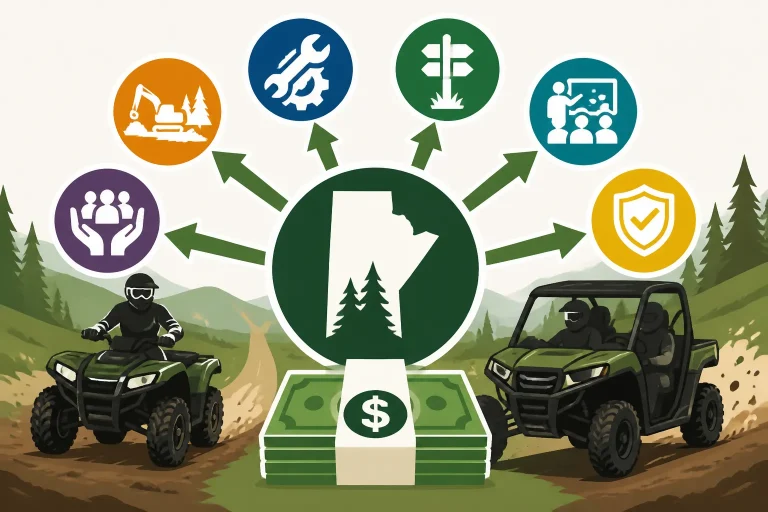
A registration-based fee is simpler to collect than a charge tied to individual trail use. A rider may use several routes, ride only occasionally, or use a machine in a place with no formal trail system. Tracking each person’s rides would require a different system. Instead, the fee is attached to registration as a general contribution to trail-related programs.
That does not mean every registered owner receives the same direct benefit. One owner may ride a club route regularly; another may never leave a worksite. Funding is not a personal account that is returned in proportion to miles ridden, and the charge should not be treated as payment for a specific service on a specific day.
Trail funding can support work such as grants and maintenance, but it does not guarantee that a route near you will be open, maintained to a particular standard or suitable for your machine. Local access can depend on land permission, club arrangements, park rules, closures and conditions. See Where Manitoba’s Off-Road Trails Fee Actually Goes for more on the funding purpose.
Who may have to pay it
In general, an owner registering a machine that is subject to Manitoba’s registration requirements should expect the applicable registration charges to be explained during the transaction. The trails fee is part of that registration process, rather than an optional add-on selected according to the owner’s riding plans.
That is why the question is not simply, “Will I use a trail?” A more useful set of questions is:
- Does this machine fall within the registration rules?
- Is there a specific exemption that applies to this owner and use?
- Is the machine being registered in Manitoba or is it visiting from elsewhere?
- What charges apply to this particular registration or renewal?
If you are registering a side-by-side or another utility vehicle, confirm how the machine is classified and which charges apply. The rules can depend on the machine, not just the name used in a sales listing. Registering a Side-by-Side in Manitoba provides more detail for UTV owners.
Private land and work use do not automatically settle the question
Owners sometimes assume a machine used only on their own property does not need registration, so it should not carry a trails fee. That conclusion may be right only if the owner and machine qualify for an applicable exemption. Private-property use alone is not a safe substitute for checking the full rule.
The same caution applies to farm, fishing, trapping, commercial and remote-community use. Manitoba has specific exemptions for some circumstances, but an exemption is not a general “I do not use trails” option. It may depend on the owner’s status, the machine’s use, the location, or the area in which it is operated. The details matter.
Start with Manitoba Registration Exemptions Explained rather than assuming that an exemption applies. If you believe the machine qualifies, describe your exact use and circumstances to Manitoba Public Insurance or an Autopac agent before leaving the fee out of your budget. Ask what documentation is needed and whether the exemption applies to the machine’s registration, the trails fee, or both. Do not treat an exemption for one requirement as proof that every other rule disappears.
Visitors and machines registered elsewhere
A visitor bringing a machine registered in another jurisdiction should not assume they need to pay Manitoba’s registration-linked fee simply because they ride in the province. Visiting riders may be able to rely on their home registration, subject to the rules that apply to visiting machines and the requirements for proof of registration and insurance.
That is different from a Manitoba resident registering a machine in Manitoba. It is also different from receiving permission to use a particular trail or property. Visitors still need to follow Manitoba operating rules and respect local closures and land access conditions. For more on the registration issue, see Manitoba Non-Resident Registration Exemption and Manitoba Visitors and Operating Rules.
If you have moved to Manitoba, do not assume that a former home registration continues to settle the matter indefinitely. Check the requirements for a new resident and the timing of any required registration change. Manitoba Registration for a New Resident is relevant if the machine has become part of your Manitoba household rather than a temporary visit.
| Situation | Is trail use the deciding factor? | What to check |
|---|---|---|
| Manitoba owner registering an eligible machine | No. The fee is associated with registration, not the number of trail rides. | Which registration charges apply and whether a specific exemption fits |
| Owner rides only on private property | Not by itself. Private-land use may not remove registration duties. | Whether the owner and machine meet an exemption’s conditions |
| Farm, fishing, trapping or commercial use | No. A qualifying exemption may exist, but the activity alone is not enough to assume it applies. | Eligibility, location, machine use and supporting documents |
| Visitor with a machine registered elsewhere | Not necessarily. A visitor may be treated differently from a Manitoba registrant. | Home registration, insurance and Manitoba visitor rules |
| Machine entering a provincial park | The trails fee is not a park entry permit. | Park vehicle permit and park-specific ORV rules |
| Rider using a club trail | The registration fee is not the same as club membership or trail permission. | Club access arrangements, route status and landowner permission |
What happens if you do not use trails
If you register a machine and do not ride trails, the practical result is usually straightforward: you still pay the fee included in the registration if it applies to that transaction. There is no ordinary “I did not ride” adjustment to claim later. A rider does not need to make a trip or join a club to justify the charge.
The fee should not be confused with a user account that gains or loses value depending on use. It is not calculated from your riding hours, odometer reading, number of trail visits or club membership. Nor does not using trails create a credit that can be applied to a later registration.
Selling or stopping use of the machine
Selling the machine, storing it or deciding not to ride during a season does not automatically mean the trails fee will be refunded. The registration itself may have separate rules for transfer, cancellation or changes, but the trails fee has its own refund treatment. Manitoba Trails Fee Is Non-Refundable explains the key limitation.
Before selling, transferring or cancelling anything, ask what happens to the registration, plate and any refundable portion of the charges. Do not assume that every amount paid at registration is handled the same way. Manitoba Transfer of Ownership Rules covers the ownership side of the process, while What MPI Refunds When You Sell an ORV can help you understand which amounts may be treated differently.
If a machine is kept unused for a long period, check how its registration status should be managed before the next renewal. Renewal may be associated with an Autopac policy, and the process can bring charges back into view even when the machine spent much of the previous period in storage. Manitoba Registration Renews With Your Autopac Policy explains the connection.
Do not confuse a fee with access permission
Paying the fee does not make every trail legal to ride. It does not override a landowner’s decision, a club’s access rules, a park’s designated-route restrictions, a municipal by-law or a temporary closure. A registered machine can still be in the wrong place if the rider lacks permission or the route is closed.
The reverse is also important: if you have permission to ride on a private property or a particular route, that permission does not necessarily remove a registration requirement. These are separate questions. Think of compliance as several checks rather than one payment:
- Is the machine required to be registered?
- Does the rider have the required insurance and carry the required documents?
- Is the route open to that kind of machine?
- Does the rider have permission to use the land?
- Do local rules, closures or park conditions limit access?
A registration-linked trails fee answers none of those access questions on its own. For example, a provincial park may require a separate vehicle permit, and a club trail may have its own rules. If you plan a park visit, review Manitoba Park Vehicle Permits. If you plan to ride a club route, check the club’s current access information rather than assuming the registration fee serves as a trail pass.
How to check whether you can avoid the charge
For most owners, the right approach is not to try to prove they never ride trails. Instead, find out whether the machine must be registered and whether a particular exemption applies. If the registration is required and no exemption fits, the fact that you do not use trails generally does not remove the registration-linked charge.
Use this process before a registration or renewal:
- Identify the machine accurately. Note whether it is an ATV, UTV, snowmobile or another off-road vehicle, along with its make, model and vehicle identification number. Classification can affect which rules apply.
- Describe how and where it is used. Be specific about whether it stays on private land, is used for farm work, operates in a remote community, or crosses or travels on public routes. A broad description such as “work machine” may not be enough.
- Check for a named exemption. Compare your circumstances with the applicable exemption rules. Do not infer eligibility solely from never using a trail.
- Ask Manitoba Public Insurance or an Autopac agent. Explain the details and ask what registration charges apply, whether the exemption covers them, and what proof the agent needs.
- Get the answer before completing the transaction. If the fee appears on a registration quote, ask what it represents and whether any exemption applies. This is easier to resolve before payment than after.
- Keep records. Retain the registration documents and any correspondence or supporting paperwork relevant to an exemption.
If the answer depends on a specific use or location, ask the agent to identify the condition that makes the exemption apply. That helps avoid a common misunderstanding: an owner may be exempt in one narrow circumstance but still subject to registration when the machine is used differently.
Questions worth asking an agent
A short, precise conversation is more useful than asking only, “Can I skip the trails fee?” Consider asking:
- Is this machine required to be registered in my circumstances?
- Is a trails fee included in this registration or renewal?
- Does any exemption apply to my use, location or owner status?
- What documents are required to establish that exemption?
- Does an exemption remove the registration requirement, the trails fee, or another charge?
- If I sell or stop using the machine, what happens to each amount already paid?
- If I am a visitor or have recently moved, which registration rules apply?
For a visit to a service counter, Planning a Visit to a Manitoba Service Counter and Questions Worth Asking an Autopac Agent can help you prepare. If you are unsure which paperwork establishes ownership or identity, bring the documents you have and ask what else is required before making a trip.
Budget for separate costs separately
Even when the trails fee is included with registration, it is only one part of the cost of using an ORV. Depending on what you plan to do, you may also need insurance, a park permit, club membership or event authorization. These costs do not all apply to every rider, and one payment does not automatically satisfy another requirement.
The clearest way to budget is to separate costs by purpose:
- Registration-related charges: paid when registering or renewing, where required.
- Insurance: coverage and proof requirements are separate from trail funding.
- Park access: a park permit may be required for a vehicle entering a provincial park.
- Club access: membership or other club arrangements may be required for particular routes.
- Special events: an organized ride may have additional permit requirements.
- Machine upkeep and transport: fuel, maintenance and trailering are unrelated to the registration fee but still part of the cost of riding.
This distinction avoids two opposite mistakes: paying the registration-linked fee and assuming you can ride anywhere, or avoiding a trail entirely and assuming you no longer need to register. The fee is one piece of a broader set of rules, not a substitute for checking the route and the machine’s status.
Frequently Asked Questions
Do I have to pay Manitoba’s trails fee if I never ride trails?
If you register a machine and the fee applies to that registration, not riding trails does not generally make the charge optional. Ask whether a specific registration exemption applies to your circumstances.
Is the trails fee a trail pass?
No. It is associated with registration and does not automatically grant access to every club trail, provincial park route or private property. Check access rules separately.
Can I get the fee back if I sell my ATV or UTV?
Do not assume so. The trails fee is non-refundable, even if other parts of a registration transaction may be treated differently. Confirm the details before cancelling or transferring a registration.
Does a private-property-only machine always avoid the fee?
No. Private-property use alone does not prove that registration is unnecessary or that an exemption applies. Check the machine’s status and the exact conditions of any exemption with Manitoba Public Insurance or an Autopac agent.
Disclaimer
This article is for general informational purposes only and does not constitute professional advice. Laws, prices and regulations vary by location and change over time. Consult a qualified professional for guidance on your specific situation.