Manitoba Wildfire Penalties for Riders
A wildfire restriction can turn a familiar Manitoba route into an illegal one, and an ATV or UTV can create serious fire risk even without an open flame. Riders need to know the difference between a fire ban and an area closure, what equipment rules apply, and what penalties may follow a breach. The safest approach is to check current restrictions before unloading and change plans when access is uncertain.
What wildfire rules mean for Manitoba riders
Wildfire season brings restrictions that can affect where and how you ride. The restrictions are not all the same: a fire ban, an equipment requirement and an order closing an area can each have different effects. A route that is open under ordinary riding rules may still be off limits under a temporary order.
Manitoba’s wildfire season is generally described as running from April 1 to November 15, but the dates do not tell you whether a particular trail is open on a particular day. Conditions and orders can change during the season. Check Manitoba Wildfire Season Rules for Riders and current official notices before heading out.
A fire restriction may control activities that can start or spread a fire, such as using a firepit or operating equipment that can throw sparks. An area closure is different: it restricts access or travel in a defined place. Riding into a closed area can be an offence even if your machine is in good condition and you are not carrying a campfire.
For a practical pre-ride check, ask:
- Is the trail or riding area covered by a current closure order?
- Are fire restrictions in force for the area?
- Does the machine meet applicable spark-arrester or other equipment requirements?
- Are there route changes, gates or signs at the trailhead?
- Does a local or park rule impose an additional restriction?
Start with Manitoba Fire Ban Lookups, then check Manitoba Area Closure Orders and the land manager’s notices. A map or app can help with navigation, but it may not show a newly issued restriction. A trail that appears on a map is not automatically open.
Fire bans and closures are not interchangeable
A fire ban generally addresses ignition sources and fire-related activities. A closure order can prohibit entry or travel in a particular area, sometimes for safety or wildfire response. Riders should not assume that following one set of restrictions means they have complied with the other.
Nor should a rider assume that a closure applies only to campfires or vehicles with visibly faulty equipment. If an order closes an area to travel, the key question is whether your route enters the closed boundary and whether the order includes an exception that applies to you.
Penalties for breaking wildfire restrictions
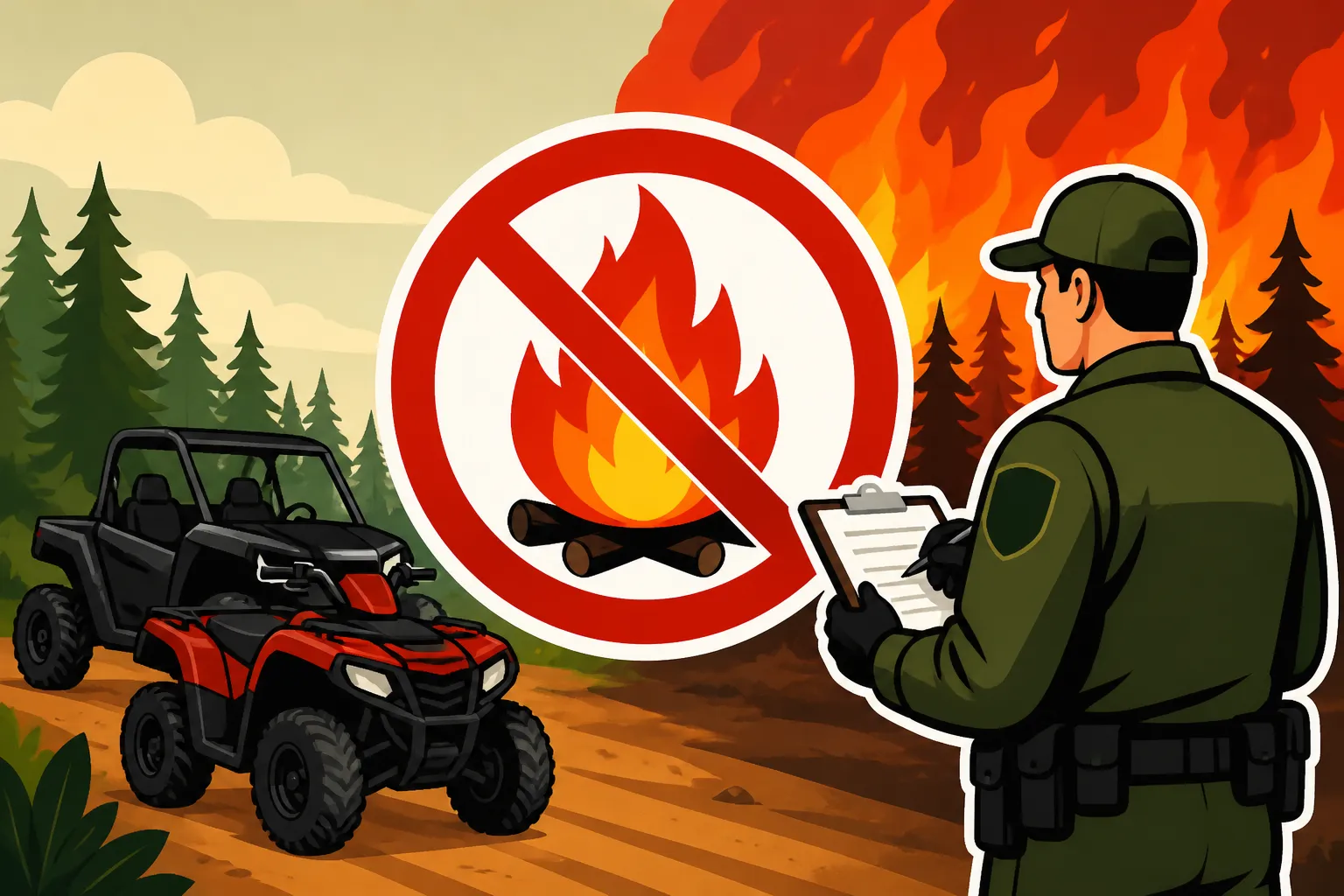
Wildfire offences can carry serious consequences. Manitoba’s wildfire penalty provisions can allow fines of up to $100,000 for an individual and up to $1,000,000 for a company, along with possible imprisonment of up to two years. The actual consequence depends on the offence, the facts and how the law applies. These are potential maximums, not a prediction of what a particular rider will receive.
A rider may also face a claim for restitution for wildfire suppression costs. If conduct causes a fire, the financial consequences can go beyond a ticket or fine: responding agencies may incur substantial expenses, and restitution may be sought in addition to other penalties. A fire that spreads can also cause damage to land, property, wildlife habitat and nearby communities.
| Situation | Why it matters | What a rider should do |
|---|---|---|
| Riding into an area covered by a closure order | Entry or travel may be prohibited even if the trail is normally open | Check the order boundary and stay out unless an exception clearly applies |
| Using a prohibited fire or ignition source | A ban may restrict activities that can start or spread a fire | Follow the current restriction and use only what is expressly permitted |
| Operating a machine that does not meet fire-related equipment rules | Equipment can create sparks or heat that may ignite dry vegetation | Check Manitoba Spark Arrester Requirements and maintain the machine |
| Ignoring a posted closure or route change | Signs may reflect a current hazard or an order not shown on an older map | Stop, turn around and confirm the route status |
| Starting a wildfire through prohibited or unsafe conduct | Penalties may include significant fines, possible imprisonment and restitution | Cooperate with responders and seek qualified legal advice if charged |
Penalties are not limited to riders who deliberately start a fire. A rider can create legal risk by knowingly entering a closed area or disregarding a restriction, even if no fire results. If a fire does start, investigators may consider the conduct, equipment, warnings and conditions involved.
A separate riding offence may also apply depending on what happened. For example, operating carelessly can have consequences under other rules in addition to wildfire-related provisions. Do not treat a fire-related maximum as the only possible exposure, and do not assume that a lack of damage means there can be no offence.
For more on consequences specifically tied to entering restricted land, see Manitoba Penalties for Riding a Closed Area. When an order has been issued, its wording and geographic scope matter. If you are unsure whether a trail crosses the boundary, the practical answer is to choose another route until you can confirm.
How to avoid a wildfire-related violation
The most reliable protection is to check conditions close to departure, not only when planning a trip days ahead. Wildfire activity and access restrictions can change quickly. A call to the relevant park office, land manager or local authority can be useful when the notice is unclear, especially if a trail crosses several jurisdictions.
Use this process before and during a ride:
- Check current fire restrictions. Review official notices for the area you plan to visit. Do not rely only on a social post, an old screenshot or a trail map that may not have been updated.
- Check for area closure orders. Confirm whether your trailhead, route, staging area or destination lies inside a closed boundary. If the boundary is unclear, stay out while you seek clarification.
- Inspect your machine. Keep required fire-prevention equipment in working order and remove debris that could contact hot components. Follow the rules in Equipment That Must Not Throw Sparks and the more specific Manitoba Spark Arrester Requirements.
- Read signs at the access point. A sign may communicate a current closure or route change. Do not pass a gate or barrier because other tracks appear to continue beyond it.
- Carry a backup route. A detour should lead to an area confirmed as open, not simply to another trail shown on a map.
- Turn back when conditions change. Smoke, active fire response, new barriers or instructions from officials are reasons to stop and reassess rather than continue toward a destination.
Fire-safe riding also means thinking about the machine and the terrain. Dry grass, brush and debris can collect near hot parts. A rider should keep the machine maintained, avoid stopping over easily ignited material when practical, and follow any current direction about equipment or travel. These precautions do not replace legal requirements; they help reduce the chance of causing harm.
If you see a wildfire, smoke or a fire response operation, keep clear and report what you observed through the appropriate emergency channel. Do not ride toward the scene to investigate. Response crews need access, and an extra vehicle can create a hazard or obstruct their work.
What to do if an order affects your route
A closure can disrupt a planned ride, but trying to find an informal way around it can make the situation worse. Do not cross a barrier, use a closed trail to reach an open one, or assume that a route is exempt because it is commonly used by local riders.
Some orders may provide exceptions or directions for particular travel. The details depend on the order. Manitoba’s guidance has described residents being allowed to use the most direct route home in certain closure situations, while trunk highways may remain open. Those points are not a general licence to ride through a closed area. Check Residents Allowed the Most Direct Route Home and Why Trunk Highways Stay Open in a Closure, and follow the wording of the current order and directions from officials.
If you are already inside an affected area when a closure is announced:
- Follow official instructions and use the route directed for evacuation or departure.
- Do not travel deeper into the closed area or take a recreational detour.
- Avoid blocking emergency vehicles, gates or access roads.
- If you cannot determine a safe legal exit, contact the relevant authority for instructions rather than guessing.
A normal riding permission does not override an emergency closure. This includes permission from a private landowner or access normally allowed on a trail. Riders also need to distinguish a closure from ordinary access rules: public land is not automatically open to motorized travel, and private or leased land can have its own restrictions. For related access questions, see Manitoba Crown Land Riding Explained and Manitoba Private Land Permission.
If you are stopped or contacted about a possible breach, remain calm, provide required information and follow lawful directions. Do not argue roadside about a boundary you have not verified. Record the location and details afterward, and get legal advice if you are charged or receive a formal notice. A general summary of penalties cannot determine how a particular case will be handled.
The simplest rule is also the most useful: verify the exact area and current restriction before riding, then turn around if the status is uncertain. A day’s route is replaceable; a wildfire, an obstructed response operation or a serious offence is not.
Disclaimer
This article is for general informational purposes only and does not constitute professional advice. Laws, prices and regulations vary by location and change over time. Consult a qualified professional for guidance on your specific situation.