No Safety Certificate Required at Any Age
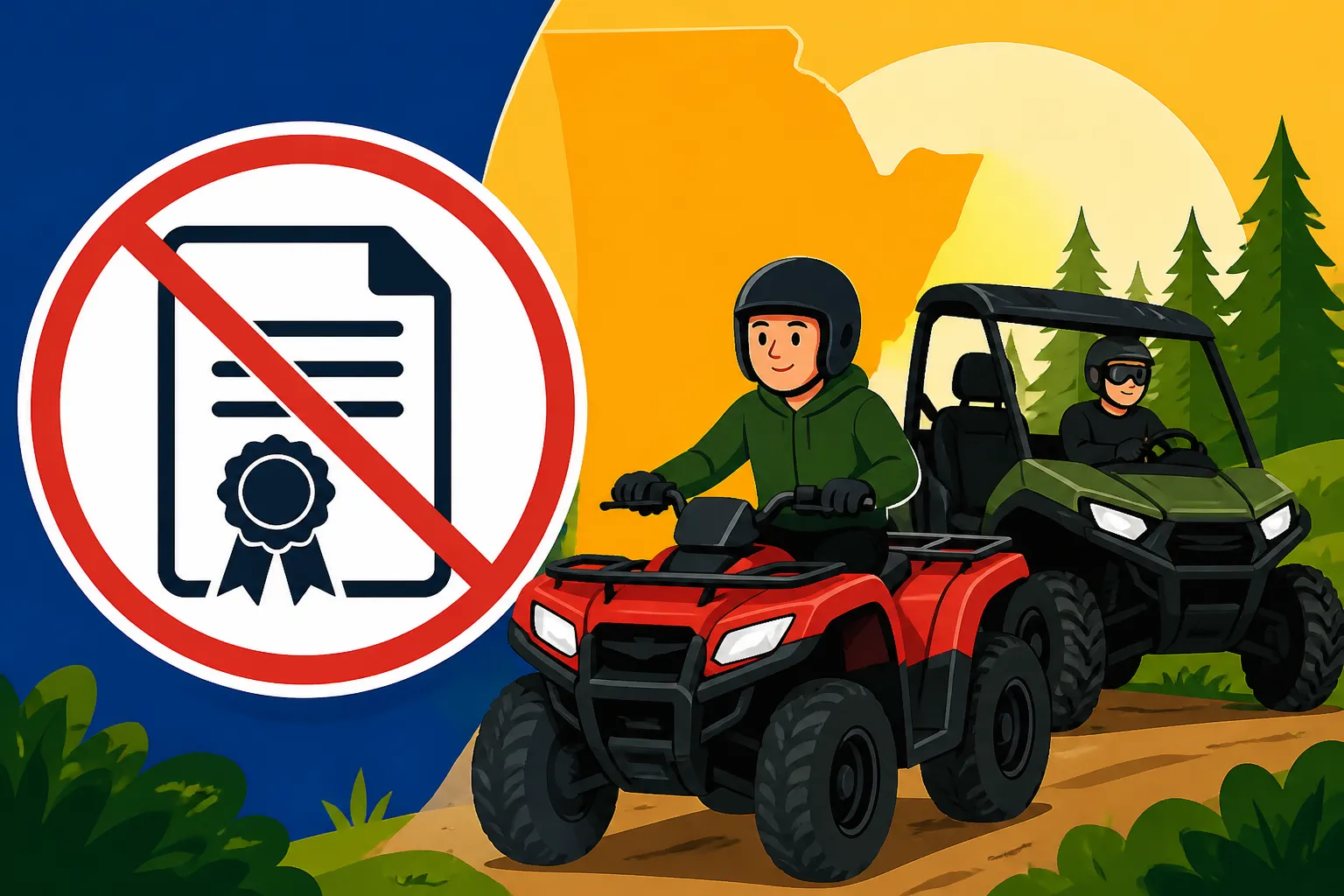
Manitoba does not require ATV or UTV riders to earn a safety certificate before riding, regardless of age. That can be easy to misread as permission for anyone to ride anywhere. It is not: age-based supervision, insurance, registration, road-crossing rules and local access requirements still matter.
What the no-certificate rule means
There is no mandatory Manitoba ATV or UTV safety course that riders must complete to obtain a certificate before operating an off-road vehicle. In other words, a rider does not need to show proof of course completion simply because they are a certain age or because they are registering or operating a machine. Training is voluntary under the general provincial requirement, as explained in Manitoba Training Is Voluntary for Everyone and No Safety Certificate Required at Any Age.
That answers a narrow question about training credentials. It does not remove the other rules that apply to a ride. A rider can be exempt from a safety-certificate requirement and still be too young to ride without supervision, unable to cross a road legally, or missing required insurance or registration.
It also does not mean safety training has no value. An ATV or UTV can be difficult to control on loose ground, in mud, on slopes or when towing. A course can help a new rider practise basic skills and understand the machine’s limits. It may also be required by an employer, an organized activity, a landowner or another organization as a condition of participating, even though the province does not generally require a certificate for riders.
Keep these distinctions in mind:
| Requirement or document | What it is for | Does a safety certificate replace it? |
|---|---|---|
| Safety course certificate | Shows that a rider completed a course, if one is taken or required by an organization | Not applicable; Manitoba does not generally require one to ride |
| Registration | Identifies a machine for use under Manitoba’s registration rules | No |
| Insurance | Provides required coverage for the machine and its use | No |
| Park or event permit | Authorizes a particular kind of access or organized activity where required | No |
| Age and supervision rules | Set limits on who may ride and when supervision is needed | No |
| Driver’s licence for certain crossings | Applies to particular highway-crossing situations | No |
A course certificate is not a substitute for the paperwork or permissions that do apply. Likewise, owning the right documents does not prove that a rider has the practical skills to handle the machine safely.
For the separate registration rules, see Manitoba ORV Registration Through MPI. If you are trying to determine whether you need a separate trail pass, Manitoba does not have a general ATV trail pass; that is different from registration and from a park or event permit. Manitoba Has No ATV Trail Pass explains that distinction.
Age and supervision rules still apply
“No certificate required at any age” does not mean “no age rules.” Manitoba has age-related operating requirements, including rules for younger riders and the supervision they need. Those requirements are separate from training-course requirements. A child who has completed a voluntary course must still follow the rules that apply to their age, the machine and the place they are riding.
Before a young person rides, check the rules for their age group rather than relying on a course card, a manufacturer’s suggested age or what another family does. Start with Manitoba ATV Age Requirements, then check the detailed guidance in Manitoba Riders Under 14 Need Supervision and Manitoba Rules for a 16-Year-Old Rider if either applies.
A manufacturer’s age recommendation is useful when deciding whether a machine is physically suitable, but it is not a replacement for Manitoba’s operating rules. Consider the machine’s size and power, how easily the rider can reach and use its controls, whether the rider can manage its weight, and whether the rider can respond calmly to an unexpected obstacle. A course can help build skills, but it cannot make an unsuitable machine appropriate for a particular rider.
Supervision also needs to be meaningful. An adult who is far ahead, out of sight or unable to respond may not provide the practical oversight a young rider needs. Before setting out, agree on where the young rider may go, how far they may get from the supervising adult, how to stop if they are unsure, and what to do if the group becomes separated.
Think through these points before a young rider joins a trip:
- Age and legal conditions: Confirm the rider’s age-related operating requirements, including any supervision rules.
- Machine fit: Make sure the rider can reach the controls and operate the machine without stretching or losing balance.
- Terrain: Begin on an appropriate, familiar surface and avoid routes that exceed the rider’s ability.
- Passengers: Do not assume a second person can ride along. Follow the machine’s design and applicable passenger rules.
- Road crossings: A course certificate does not grant permission to cross a highway or roadway. Check the rules for the specific crossing before the ride.
- Protective gear: Select equipment that fits properly and is suitable for the conditions, whether or not the rider has taken a course.
For a younger rider, the practical question is not only whether they have learned a few techniques. It is whether they can control this particular machine, on this particular route, with the supervision and judgment the law requires.
Registration, insurance and permits are separate
A common source of confusion is treating every required document as if it were a licence or course certificate. Manitoba’s rules can involve several separate obligations. A safety course is about training; registration and insurance concern the machine and its operation; a park or event permit concerns access or participation in a specific setting.
Do not use the absence of a safety-certificate requirement as a reason to skip the paperwork that applies. Check Manitoba ATV Insurance Requirements and the registration rules for your machine and intended use. Carry required documents as directed, and make sure the machine’s registration details match it. A certificate from a voluntary course cannot replace registration or insurance.
Permits also depend on where and how you ride. For example, a provincial park may have its own vehicle-permit requirements, while an organized event can have separate arrangements. A permit for one purpose is not a general authorization to ride anywhere. Check the rules for the specific park, trail, land or event before unloading.
The same separation matters for visitors. A rider from another province may not need a Manitoba safety certificate, but that does not automatically settle whether the machine’s home registration and insurance are acceptable, or which Manitoba operating rules apply. Visitors should check both their home requirements and the rules governing their ride in Manitoba. See Manitoba Visitors Registered at Home and Manitoba Visitors and Operating Rules for those questions.
A useful pre-ride document check is:
- Confirm whether the machine must be registered for the planned use and whether its registration is current.
- Confirm that the required insurance applies to the machine and the intended use.
- Check for park, event or other access permits that apply to the destination.
- Carry the required registration or insurance documents in the manner required.
- Verify local restrictions, including any municipal rules or temporary closures.
This checklist is not a substitute for checking the current rules for your exact machine and destination. A side-by-side, youth quad, visiting machine or machine used for a specialized purpose may raise questions that do not come up for a typical recreational ride.
Road crossings deserve particular attention. Permission to ride on a trail does not automatically allow a rider to use the road to get there, and a safety certificate does not change that. Check Manitoba Rules for Crossing a Highway before planning a route that crosses a roadway. If a crossing rule applies, meet its conditions; do not treat training, registration or a permit as an exemption.
When voluntary training is worth considering
Even without a provincial certificate requirement, training can be a sensible choice for new riders and families. It is particularly useful when someone is moving from a small youth machine to a larger ATV, starting to use a UTV, riding unfamiliar terrain, or learning how to travel with a group. A course can provide structured practice with controls, braking, turning, terrain awareness and basic trip planning.
Training is not a guarantee against a crash, and a certificate does not prove that a rider is ready for every machine or route. Skills need to match the conditions. A confident rider on a familiar, open trail may still need to slow down on wet ground, in deep ruts, near other trail users or when visibility is limited. A course is a starting point, not a substitute for judgment.
If you choose to take a course, ask what it covers and whether it is designed for the type of machine being used. Find out whether the instruction includes hands-on practice, whether riders are grouped by age or experience, and what protective equipment is expected. If the course is being taken for work, a club activity or an event, confirm that the organization will accept that provider and course format. Do not assume every certificate will satisfy a separate workplace or event requirement.
Before the first ride, make sure the rider can explain and demonstrate the basics: how to start and stop, how to use the controls, how to turn at a safe speed, how to respond if the machine becomes unstable, and how to communicate with the group. For a passenger, explain where to sit, how to hold on and when to stay still. Follow the vehicle’s design and applicable passenger rules.
A practical decision can be based on the rider rather than on whether a certificate is mandatory:
- New rider: Consider structured instruction and practise in a controlled, suitable area before joining a longer trip.
- Young rider: Check supervision and age rules first, then choose a machine and setting the rider can manage.
- New machine type: Arrange familiarization or training if controls, size or handling differ substantially from what the rider knows.
- Work or organized event: Ask the employer or organizer whether it has a separate training condition.
- Experienced rider: Refresh skills when changing machines, terrain or riding conditions.
For equipment, prioritize proper fit and suitability rather than assuming any item marked for off-road use is adequate. Check the applicable helmet requirements and other protective-gear guidance before riding; a course certificate does not waive equipment rules. Keep the registration, insurance, permits and safety decisions separate in your planning: each serves a different purpose.
The takeaway is straightforward: Manitoba does not generally require an ATV or UTV safety certificate at any age, but riders still need to meet the rules that apply to their age, machine, paperwork and destination. Training can help build competence, yet it is neither a legal substitute for those requirements nor permission to ride beyond a person’s ability.
Disclaimer
This article is for general informational purposes only and does not constitute professional advice. Laws, prices and regulations vary by location and change over time. Consult a qualified professional for guidance on your specific situation.