Manitoba Registration for a Snowmobile
Ah, the crisp winter air, the fresh snow under your sled… there's truly nothing like it! But before you hit those vast Manitoba landscapes, many riders find themselves scratching their heads over snowmobile registration. It can feel like a maze, especially with all the nuances compared to wheeled ORVs, but getting it right ensures peace of mind and keeps you on the right side of the law. This guide will walk you through everything you need to know about registering your snowmobile in Manitoba, making sure you're fully prepared for your next winter adventure.
Why Snowmobiles Need to Be Registered in Manitoba
It's a common thought, especially for those who only ride a few times a year or stick to what they think are secluded spots: "Does my snowmobile really need to be registered?" The answer, almost universally, is yes. Manitoba's Off-Road Vehicles Act is quite clear, and snowmobiles, much like ATVs and side-by-sides, fall squarely under its regulations. Understanding why this requirement exists can help demystify the process and highlight its importance.
The Legal Requirement for All Off-Road Vehicles
Let's cut right to it: the law dictates it. In Manitoba, if you're operating an off-road vehicle – which includes snowmobiles – anywhere off your own private property, or land you have explicit consent to ride on, it needs to be registered. This isn't just about riding on designated trails; it extends to crown land, road allowances, and pretty much anywhere you'd want to go to truly enjoy the winter landscape. It doesn't matter if you're just crossing a ditch to get to a field or cruising a frozen lake; if it's not private property you own or occupy, you'll need that registration.
The main reason for this legal requirement boils down to identification, law enforcement, and contributing to the infrastructure that supports our riding passions. Imagine an incident where a snowmobile is involved – whether it's an accident, a trespass, or even something more serious. A visible registration plate and accompanying paperwork allow authorities to quickly identify the machine and its owner, ensuring accountability and safety for everyone. Plus, a portion of your registration fee, the trails fee, directly supports the development and maintenance of our province's incredible trail network, benefiting all riders.
What Registration Provides You
Beyond simply making your snowmobile legal, registration in Manitoba comes with some tangible benefits that are crucial for any rider. The most significant of these is the basic third-party liability insurance coverage that comes automatically with your registration through Manitoba Public Insurance (MPI). This is a foundational layer of protection that many riders might not even realize they're getting, but it's incredibly important.
This basic coverage protects you in case your snowmobile causes damage to another person's property or injures someone while you're operating it. While it doesn't cover damage to your own machine or your own medical expenses, knowing you have that baseline liability coverage can offer immense peace of mind. Your registration card and the physical plate serve as your proof of this essential insurance. In the unfortunate event of an incident or simply being stopped by a conservation officer, having these documents readily available can streamline the process and demonstrate your compliance with the law. It’s not just a piece of paper; it’s your ticket to legal and insured winter riding.
The Snowmobile Registration Process in Manitoba
So, you're ready to get your snowmobile registered. Maybe it's a brand-new beauty, or perhaps you've just picked up a fantastic used machine from a private seller. The process, while specific, is designed to be relatively straightforward once you know what to expect and have your ducks in a row. It all revolves around preparing your documents and making a visit to an Autopac agent.
Gathering Your Documents for a Smooth Visit
The first and arguably most critical step is to gather all the necessary paperwork before you head out. Nothing is more frustrating than making a trip only to realize you've forgotten a crucial piece of identification or a vital document. For any registration, you'll need valid identification, typically a driver's license or another form of government-issued photo ID. If you're under 18, you might also need proof of age and parental consent, so keep that in mind. [Manitoba Parental Consent From 16 to 18]
The most important document for the machine itself is proof of ownership. If you're buying a brand-new snowmobile from a dealer, they'll provide a proper bill of sale. For a private sale, you'll need a bill of sale signed by both the seller and the buyer, clearly detailing the snowmobile's make, model, year, and crucially, its Vehicle Identification Number (VIN). The VIN is paramount; it's like your snowmobile's fingerprint and must match what's on the ownership documents. Always locate the VIN on the machine itself (usually stamped on the chassis or frame) and double-check it against any paperwork you receive. If the seller has a previous registration certificate, pay close attention to the transfer section – it's a vital piece of paperwork for ensuring a smooth transfer. [The Transfer Document Hiding in Your Registration Certificate] For scenarios where you might not have a traditional bill of sale, like an inherited machine or one without clear prior paperwork, you might need to explore options like statutory declarations to prove ownership, and resources like LawDepot can sometimes provide templates for such forms.
Visiting an Autopac Agent
Once your documents are in order, your next stop is an authorized Autopac agent. These agents are your one-stop shop for all things MPI related, including off-road vehicle registration. You can find them in communities all across Manitoba, ready to assist you. When you arrive, the agent will guide you through the necessary forms, which will include declaring ownership, providing your personal details, and confirming the snowmobile's information. This is also where the financial side comes into play, as you'll be paying the required fees.
These fees typically include the registration fee itself, plus the provincial sales tax (RST) if you're registering a machine bought privately. Critically, every snowmobile registration in Manitoba also includes a mandatory $25 trails fee. [The $25 Trails Fee Added to Every Registration] This fee helps fund the maintenance and development of ORV trails across the province, so it's a contribution to the riding community. Payment methods usually include cash, debit, and often credit cards, but it's always wise to check with your specific agent beforehand. [Manitoba Registration Payment Methods] The agent will process everything, issue your official registration card, and provide you with your new registration plate right then and there. It's a surprisingly efficient process when you have all your documents in hand. [Manitoba Autopac Agents and ORV Registration]
Special Considerations for New Snowmobiles or Private Sales
Registering a snowmobile can differ slightly depending on where you acquired it. If you're purchasing a brand-new snowmobile from a licensed dealer in Manitoba, the process is generally quite streamlined. The dealer will typically handle most of the initial paperwork for you, ensuring all the manufacturer's details are correctly transferred to your name. They will also collect the applicable provincial sales tax (RST) directly from you at the time of purchase. [Manitoba Dealer Paperwork at Delivery] This can be a huge convenience, as it means less legwork for you at the Autopac office.
However, if you're buying a snowmobile through a private sale from an individual, you'll have a few more responsibilities. In this scenario, you are responsible for registering the machine in your name and for paying the provincial sales tax (RST) at the time of registration at an Autopac agent. [Manitoba Tax on a Private ATV Sale] It's crucial to ensure you get a complete and accurate bill of sale from the seller. What if you bought an older machine and the previous paperwork is lost or non-existent? While challenging, it's not impossible. You might need to provide a sworn affidavit or statutory declaration to prove ownership. [Manitoba Registration Without a Bill of Sale] Or perhaps the VIN is damaged or completely gone – this presents a significant hurdle and may require an inspection from MPI to verify its identity before registration can proceed. [Manitoba Registration When the VIN Is Gone] These situations highlight why having clear, accurate documentation from the get-go, perhaps even utilizing a template from a service like LawDepot for private sales, can save you a lot of headache down the line.
Important Details for Snowmobile Owners
Getting your snowmobile registered is a big step, but it's just the beginning. There are a few crucial ongoing responsibilities and practical considerations that every Manitoba snowmobile owner needs to be aware of to ensure they remain compliant and safe on the trails. These include where and how to display your plate, always carrying your documents, and understanding the renewal process.
Where to Mount Your Snowmobile Plate
Unlike some wheeled ORVs that have specific front or rear mounting requirements, snowmobiles in Manitoba have a slightly different rule. Your registration plate must be clearly affixed to the left side of the snowmobile. The key here is "clearly visible." It needs to be mounted in a way that isn't obstructed by anything – no snow flaps, no bags, no gear getting in the way. The idea is that an enforcement officer should be able to easily see and read the plate without having to get too close or move things around. [Manitoba Plates on the Left of a Snowmobile]
Why this specific placement? It's largely for the convenience and safety of enforcement personnel. In many situations, an officer may need to identify a moving snowmobile quickly, and a consistent, visible placement aids in that identification. Failing to mount your plate correctly, or having it obscured, could result in a fine. It's a simple step, but one that's often overlooked, leading to unnecessary hassle. Take a moment to ensure your plate is secure, clean, and visible before every ride.
Carrying Your Registration and Insurance Card
This is one of those rules that often gets forgotten in the excitement of heading out for a ride, but it's absolutely non-negotiable. The Off-Road Vehicles Act stipulates that you must carry your snowmobile's registration and basic insurance card with you at all times when operating the machine. This isn't just a suggestion; it's a legal requirement. [Manitoba Registration Cards Carried at All Times]
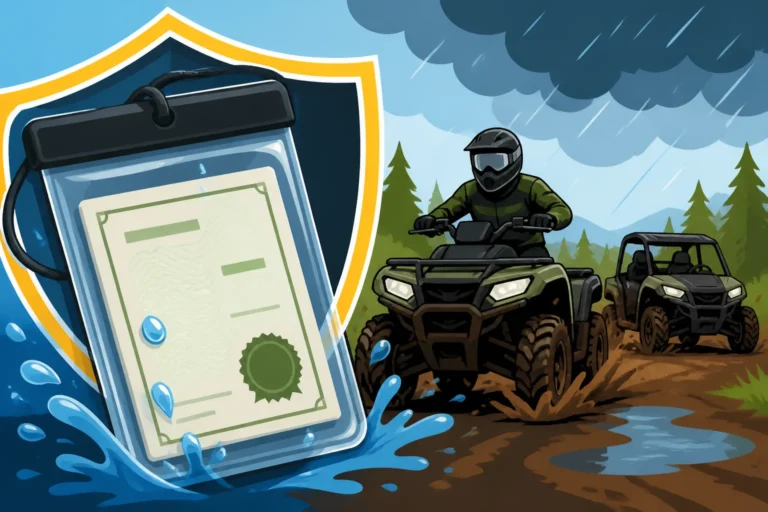
Think of it like carrying your driver's license when you're driving a car – it's proof that you're operating a legal and insured vehicle. An enforcement officer (whether it's an RCMP officer, a conservation officer, or a municipal by-law officer) has the authority to ask you for these documents. [What an Officer Can Ask to See in Manitoba] If you can't produce them, you could face a ticket. To protect your documents from the harsh winter elements, consider investing in a small, waterproof pouch that can be securely stored on your snowmobile or within your riding gear. Keeping these critical papers dry and accessible will save you a lot of grief should you ever be asked to present them.
Renewing Your Snowmobile Registration
Unlike some jurisdictions where ORV registration is a standalone process, in Manitoba, your snowmobile registration is typically tied to your existing Autopac policy. This means that when your annual Autopac insurance renewal comes due for your car or truck, your snowmobile registration usually renews at the same time. [Manitoba Registration Renews With Your Autopac Policy] This can be a convenience, as it consolidates your insurance paperwork.
When you renew, the annual registration fee and, yes, that $25 trails fee will be reapplied. [Manitoba Trails Fee Collected With Registration] MPI will send you a renewal notice, outlining the costs and what steps you need to take. It's crucial not to let your registration lapse. An unregistered snowmobile is an uninsured snowmobile, and operating it on any public land (even a ditch or a frozen lake) is illegal and could lead to significant fines and liability if an incident occurs. Make it a habit to check your renewal dates and ensure everything is up to date before the snow flies. If you're ever unsure about your renewal status, a quick call or visit to your Autopac agent can clarify everything.
Common Snowmobile Registration Exemptions and Misconceptions
Despite the clear rules, there are always areas where confusion can creep in, especially when it comes to exemptions or interpreting the nuances of the law. Snowmobile riders, in particular, often wonder about specific situations that might seem to bypass the registration requirement. Let's clear up some of those common points of misunderstanding.
Riding on Private Land and Other Exemptions
The most significant and often cited exemption from registration is when you're operating a snowmobile exclusively on private land that you own or occupy, and you have consent from the landowner. [Manitoba Machines Used Only on Your Own Land] So, if you're just tooling around your own acreage or a friend's farm with their explicit permission, you generally don't need to register your snowmobile. However, the moment you leave that private property – even to cross a municipal road allowance, venture onto Crown land, or briefly ride on a public right-of-way to get to another private parcel – your snowmobile needs to be registered and plated.
There are also a few very specific, limited exemptions for certain groups. For instance, commercial fishers might be exempt when operating their machines in connection with their fishing business, and licensed trappers can sometimes be exempt when operating within their registered trapline district. [Manitoba Licensed Trapper Exemption] These are narrow exemptions, however, and do not apply to recreational riding. A common misconception is that if you're "just going from my cabin to the lake" or "just crossing the road," you're exempt. In nearly all these scenarios, you're interacting with public property or road allowances, meaning registration is indeed required.
The Trails Fee and Snopass Confusion
One area that consistently causes a bit of head-scratching for snowmobile riders is the difference between the mandatory $25 trails fee and the voluntary Snopass. When you register your snowmobile, you are required to pay a $25 trails fee. [Why Manitoba Adds $25 to Every ORV Registration] This fee is collected by MPI and goes into a provincial fund managed by the Manitoba Off-Road Vehicle Association (MOVA). This fund is used to provide grants for the development, maintenance, and signage of the broader ORV trail network across Manitoba, benefiting all types of off-road vehicle users.
The important clarification here is that the trails fee is not a Snopass. The Snopass is a separate, annual permit required by Snowmobilers of Manitoba (Snoman Inc.) to access groomed snowmobile trails maintained by various snowmobile clubs across the province. [Manitoba Snopass Is for Snowmobiles Only] While both contribute to trail systems, they are distinct. You could register your snowmobile and pay the trails fee, but still not be legally allowed on a Snoman-groomed trail without purchasing a separate Snopass. Conversely, buying a Snopass doesn't exempt you from the provincial registration requirement. For visitors, it's worth noting that if your snowmobile is registered in your home province or state, you typically don't pay Manitoba's trails fee, though you would still need to follow all operating rules. [Does a Visiting Rider Have to Register in Manitoba?]
Here's a quick look at the documents you'll want to have ready for your visit to an Autopac agent:
| Document Type | New Snowmobile (Dealer Purchase) | Used Snowmobile (Private Sale) | Inherited/Gifted Snowmobile |
|---|---|---|---|
| Proof of Identity | Valid Government-Issued Photo ID | Valid Government-Issued Photo ID | Valid Government-Issued Photo ID |
| Proof of Age | Required if under 18 (e.g., birth certificate) | Required if under 18 (e.g., birth certificate) | Required if under 18 (e.g., birth certificate) |
| Parental Consent | Required if owner is 16-18 | Required if owner is 16-18 | Required if owner is 16-18 |
| Proof of Ownership | Dealer Bill of Sale | Signed Bill of Sale (Seller & Buyer) | Will/Grant of Probate / Statutory Declaration / Gift Letter |
| Previous Registration | Not applicable | Previous owner's registration certificate (transfer section) | Previous owner's registration certificate (if available) |
| VIN Verification | Verified by dealer | Buyer verifies against machine and bill of sale | Verified against machine and ownership document |
Disclaimer
This article is for general informational purposes only and does not constitute professional advice. Laws, prices and regulations vary by location and change over time. Consult a qualified professional for guidance on your specific situation.