Equipment That Must Not Throw Sparks
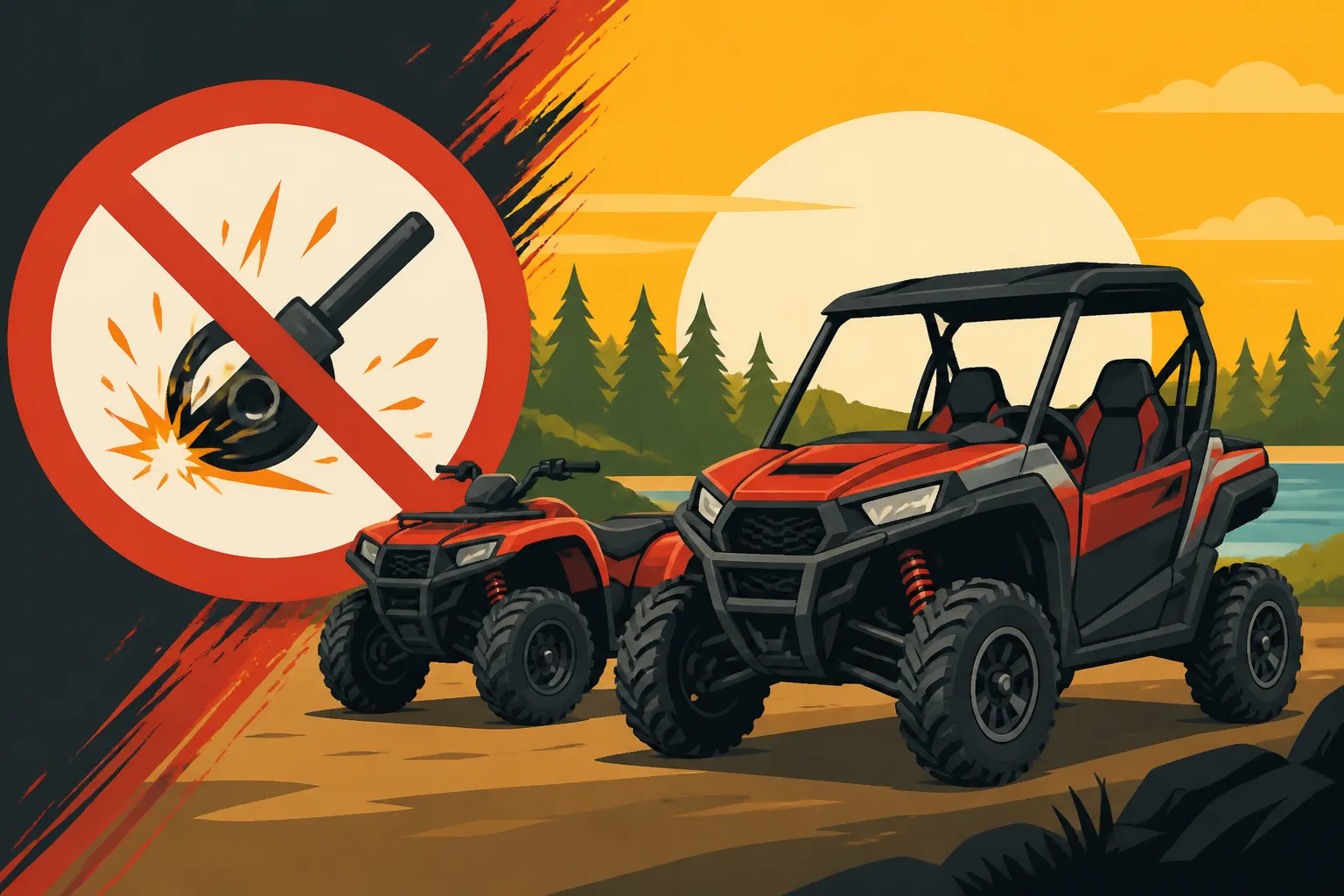
A spark arrester can be easy to overlook until a machine is due for a ride or an inspection. In Manitoba, it is part of the required safety equipment for off-road vehicles. Here’s what that means for an ATV or UTV, how to check the exhaust setup, and what to confirm before heading out.
What Manitoba requires
According to the Manitoba Government, spark arresters are required safety equipment on off-road vehicles. Mufflers are also required. These are separate requirements: a muffler reduces exhaust noise, while a spark arrester is intended to limit sparks escaping through the exhaust. Having one does not automatically mean the other is present or working.
The practical takeaway is to treat the spark arrester as a required part of the machine’s exhaust system, not as an optional accessory. If you are unsure whether your machine has one, check the owner’s manual or ask a qualified service provider to identify the exhaust components. For the regulation and equipment details, see Manitoba Spark Arrester Requirements and Why a Spark Arrester Is Required All Year.
| Equipment or item | What to check | Manitoba requirement |
|---|---|---|
| Spark arrester | Confirm it is present and suitable for the exhaust setup | Required safety equipment, according to the Manitoba Government |
| Muffler | Confirm the exhaust system includes a muffler | Required for off-road vehicles, according to the Manitoba Government |
| Headlights and taillights | Check that both are present and working | Part of minimum safety equipment requirements, according to the Manitoba Government |
| Helmet | Wear one when operating the machine | Required, according to the Manitoba Government |
| Seat belt | Use it if the machine is equipped with one | Required on applicable off-road vehicles, according to the Manitoba Government |
| Registration and plate | Confirm the machine is registered and plated | Required, according to the Manitoba Government |
A spark arrester is not a substitute for the rest of the required equipment. The Manitoba Government also lists headlights and taillights as part of minimum safety equipment, and requires helmets when operating an off-road vehicle. Seat belts are required on applicable vehicles. A pre-ride check should consider the whole machine, not just the exhaust.
Registration and plating are required too, according to the Manitoba Government. That requirement is separate from equipment compliance: having current registration does not establish that a spark arrester is installed, and an installed arrester does not replace registration. For the registration basics, see Manitoba ORV Registration Through MPI and Manitoba Equipment Checks by Officers.
How to check the exhaust setup
Start by identifying the machine’s original exhaust arrangement. The owner’s manual, service documentation, or a qualified mechanic can help establish what components belong on the model. This is especially useful if the machine is used, has been repaired, or has aftermarket exhaust parts. Do not rely on appearance alone: an exhaust component that looks substantial may not be a spark arrester.
Check the exhaust outlet and the parts attached to it for obvious damage, looseness, missing pieces, or signs that the system has been altered. If something is cracked, unusually loud, visibly incomplete, or different from the manufacturer’s documented setup, pause and get it assessed before riding. A quick visual check cannot confirm every internal component is present or functioning, so ask a service provider if you cannot tell.
Be cautious with replacement and aftermarket parts
A replacement muffler and a spark arrester are not interchangeable terms. When sourcing parts, confirm that the specific component is compatible with the machine and exhaust system, and that it meets the applicable requirements. A product description or a general claim that a part is “for ATV use” is not enough to establish that it is the right part for your vehicle.
If you are considering an online listing, including one on Amazon, compare the part details with the machine’s make, model, and service information before ordering. When the listing does not clearly identify the fitment or spark-arresting function, check with a dealer or qualified mechanic instead. Keep any product documentation with your maintenance records, but do not treat paperwork as proof that an incorrectly fitted or damaged part is compliant.
Avoid removing or bypassing an arrester to change sound or exhaust flow. If a modification has already been made, have the setup inspected and corrected as needed before riding. The goal is a complete, properly fitted exhaust system, not simply a machine that starts and runs.
Include regular maintenance in the check
A spark arrester can become damaged, clogged, loose, or compromised during use and repairs. Follow the maintenance instructions for the particular machine rather than using a generic schedule. If the exhaust has been serviced, the machine has suffered an impact, or you notice a change in noise or performance, have the system checked.
When cleaning or servicing exhaust parts, let the machine cool and follow the manufacturer’s safety instructions. Exhaust components can remain hot after the engine is shut off. If you are not comfortable removing or inspecting parts, leave that work to a qualified technician.
Before riding: a practical equipment check
A short pre-ride routine can help catch missing equipment and obvious damage before you leave home. It cannot replace professional inspection or confirm compliance in every case, but it gives you a sensible starting point.
- Look over the exhaust system for missing parts, damage, loose fittings, or signs of modification.
- Confirm the spark arrester and muffler are present. If you cannot identify them, consult the owner’s manual or a service provider.
- Check headlights and taillights, which the Manitoba Government includes in minimum safety equipment requirements. See Manitoba Lighting Requirements on a Machine for related details.
- Check that the helmet is available and in usable condition. The Manitoba Government requires a helmet when operating an off-road vehicle.
- If the machine has a seat belt, check that it is usable and plan to wear it; the Manitoba Government requires seat belts on applicable off-road vehicles.
- Confirm registration and plating are in order, as required by the Manitoba Government.
- Review the intended route and any current restrictions before loading the machine.
If an inspection raises a question about whether the exhaust is complete, do not guess. Contact a service provider or confirm the requirement with the appropriate official source. It is easier to resolve a parts or fitment question before a ride than at a trailhead or during an equipment check.
Where you ride still matters
Having the required equipment does not grant access to every trail, park, or stretch of land. Manitoba’s park guidance limits off-road vehicles to designated routes within provincial parks. Check the route’s current status before you travel; closures and access conditions can change. For planning, see Manitoba Trail Conditions Before You Haul and Manitoba Provincial Park Machine Rules.
The Manitoba Government identifies Duck Mountain Provincial Park as a signature destination for off-road vehicle riders. Its Mossberry Trail spans 30 kilometres and accommodates off-road vehicles alongside other activities, according to Environment and Climate Change Manitoba. Three backcountry campsites along remote lakes allow multi-day riding, fishing, and camping in the Duck Mountains, according to the same department. Those details make route planning and respecting other trail users part of responsible riding, alongside keeping the machine’s safety equipment in order.
For other places to ride, Environment and Climate Change Manitoba directs readers to ATVMB for additional riding areas. Before setting out, confirm that the route is open and permitted for your machine. A spark arrester does not override a park restriction, a closure, or land-access requirements.
It also helps to think about exhaust equipment in the context of fire prevention. A spark arrester is required safety equipment, but it should not be treated as a guarantee that riding is safe or permitted under every condition. Keep the exhaust system maintained, follow posted restrictions, and check for current fire-related rules before a trip. See Manitoba Wildfire Season Rules for Riders and Manitoba Fire Season Riding Restrictions for more on planning around restrictions.
The simplest decision rule is straightforward: if the spark arrester is missing, damaged, or uncertain, get the setup checked before riding. Confirm the rest of the required equipment at the same time, then check that your route is open and appropriate for an off-road vehicle.
Sources
- Manitoba Government — Manitoba Laws (checked November 3, 2026)
- Environment and Climate Change — Parks and Protected Spaces | Environment and Climate Change | Province of Manitoba (checked November 3, 2026)
Disclaimer
This article is for general informational purposes only and does not constitute professional advice. Laws, prices and regulations vary by location and change over time. Consult a qualified professional for guidance on your specific situation.