Seat Belts and Passenger Limits on a Manitoba UTV
Navigating the world of off-road vehicles in Manitoba can sometimes feel like trying to solve a puzzle while riding a bucking bronco – especially when it comes to understanding the rules around passenger limits and seat belts on your UTV. It’s a common frustration for riders who just want to enjoy the trails safely with friends and family, only to be left wondering if they’re truly compliant with the law. This guide aims to clear up that confusion, diving deep into what Manitoba regulations say about carrying passengers and using seat belts in your Side-by-Side.
Understanding Manitoba's UTV Passenger Regulations
When you look at a modern Utility Task Vehicle (UTV), or Side-by-Side (SxS) as they're often called, it's easy to see why they've become so popular. With comfortable bucket seats, steering wheels, and often a little cargo box in the back, they feel a lot like a compact car, but built for the rugged outdoors. This very familiarity, however, can sometimes lead to misunderstandings about how many people you can legally and safely carry, and where they should be seated. Manitoba has clear rules, rooted in safety, that dictate these limits.
The "As Designed" Principle
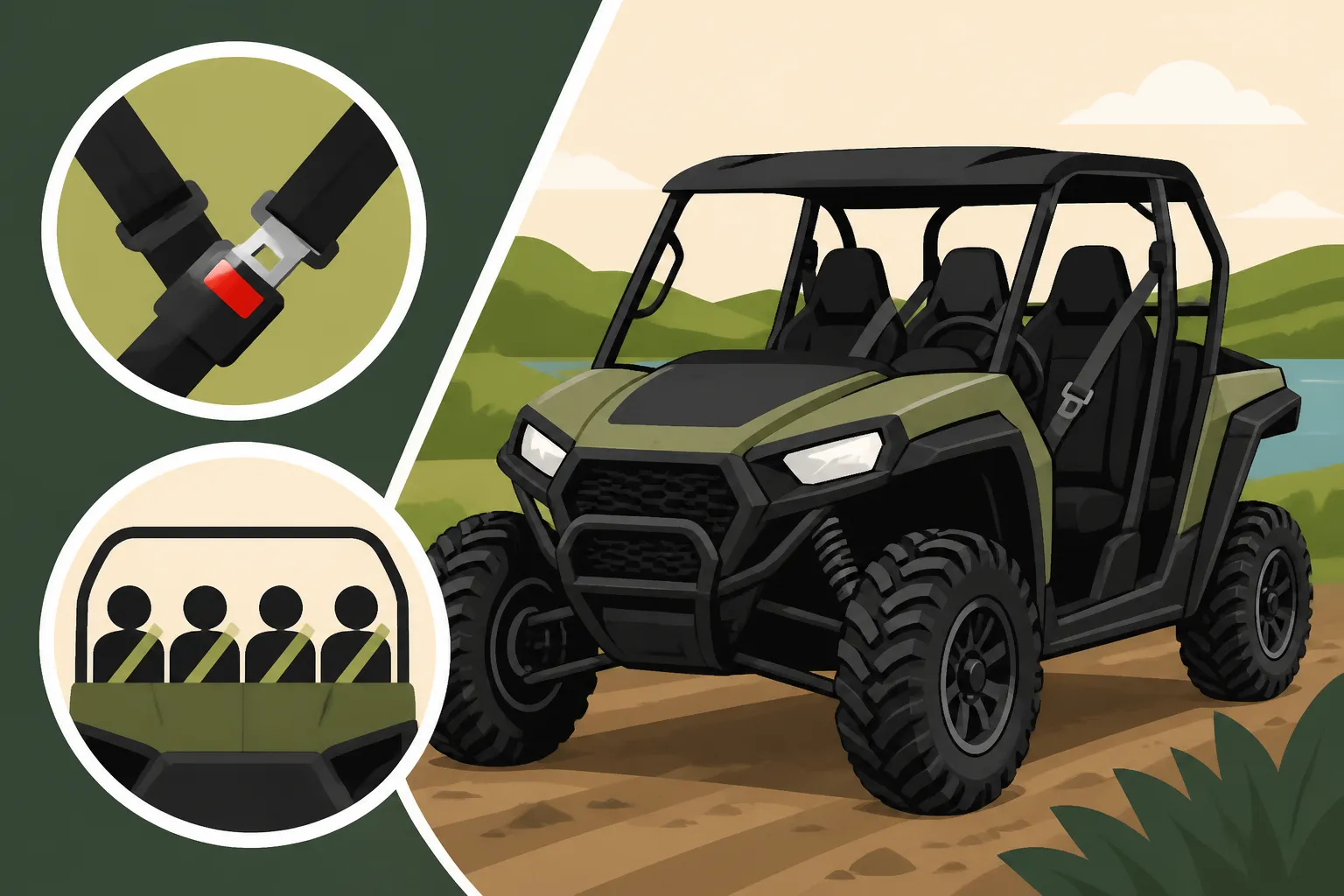
At the heart of Manitoba's UTV passenger rules is a very straightforward concept: your UTV must only carry as many passengers as it was originally designed for by the manufacturer. This isn't a suggestion; it's a legal requirement. Think about it this way: when an engineer designs a UTV, they carefully calculate factors like weight distribution, suspension load, braking capacity, and the strength of the roll-over protection structure (ROPS) for a specific number of occupants. Exceeding these design parameters compromises the vehicle's stability, handling, and ultimately, its safety. If you have a UTV with two factory seats and two seat belts, it's designed for two people – an operator and one passenger. If it has four seats and four belts, then four people. It's really that simple, even if it feels restrictive when you have a bigger group. This principle is succinctly captured by the rule that states [Passengers Only as Designed].
Pushing beyond these limits not only risks a fine but, more importantly, puts everyone in the vehicle at greater danger. In the event of an unexpected turn, a sudden stop, or especially a rollover, an overloaded UTV is far more likely to become unstable. The added weight also puts undue stress on mechanical components, potentially leading to premature wear or failure of brakes, suspension, and even the engine. For many riders, the convenience of a UTV means they often carry more than just themselves and a single passenger, but understanding and adhering to this core principle is crucial for both legal compliance and personal safety.
The Role of Manufacturer Specifications
So, how do you know exactly what your UTV was designed for? The most reliable source of information is always your owner's manual. This often-overlooked document contains a wealth of critical details, including the maximum number of occupants your specific model is built to safely accommodate. Manufacturers also typically stamp or sticker this information directly on the vehicle itself, usually near the driver's door, on the dash, or within the cargo bed. These specifications aren't arbitrary; they're the result of rigorous testing and engineering.
If you don't have your owner's manual or can't find the sticker, a quick visit to the manufacturer's website for your specific make and model can usually provide the necessary details. Online resources, often found in the support or specifications section, will clearly outline seating capacity. It's really important not to guess or assume that because there's "room" for another person, it's safe or legal. A machine designed for two might physically hold three smaller people, but that doesn't make it legal or safe. Always defer to the manufacturer's stated capacity; it's the definitive word on your UTV's limits.
Penalties for Overloading
Manitoba takes UTV safety seriously, and that includes ensuring machines aren't overloaded with passengers. If an enforcement officer pulls you over and discovers you're carrying more people than your UTV was designed for, you could be facing a significant fine under the Off-Road Vehicles Act. These penalties are designed to be a deterrent, emphasizing the seriousness of operating a vehicle outside its safe design parameters. It's not just a slap on the wrist; it can hit your wallet pretty hard.
Beyond the immediate financial hit, there are broader implications. Operating an overloaded vehicle could be seen as "careless operation," which carries even steeper penalties, including higher fines and potentially even legal action in severe cases, especially if an accident occurs. [Manitoba Careless Operation Penalties] are no joke. Furthermore, if you're involved in an accident while your UTV is overloaded, your insurance coverage could be jeopardized. Most insurance policies have clauses that limit or deny coverage if the vehicle was being operated illegally or negligently. This means you could be personally liable for damages, injuries, and medical costs, which can quickly spiral into hundreds of thousands of dollars. The small convenience of carrying an extra person simply isn't worth the immense risks and potential legal and financial repercussions.
Seat Belt Requirements for UTVs in Manitoba
One of the key distinctions between older ATVs and modern UTVs is the inclusion of factory-installed seat belts. These are not merely for comfort or a nice-to-have feature; they are integral to the UTV's safety system, especially when combined with a robust Roll-Over Protection Structure (ROPS). Manitoba's regulations are very clear about their use.
Mandatory Use of Fitted Seat Belts
In Manitoba, if your UTV comes equipped with seat belts from the factory, it is mandatory for both the operator and all passengers to wear them whenever the vehicle is in motion. This rule is absolute, with very few exceptions. It mirrors the common-sense requirement we have for cars and trucks on public roads, recognizing that a UTV operator and passengers are contained within a cab or a similar structure that offers a level of protection. The seat belt is designed to keep you inside that protective zone during sudden movements, bumps, or rollovers. The law is quite specific: [Seat Belts Where the Maker Fitted Them].
Failing to wear a fitted seat belt can result in a fine for each unbuckled occupant. An enforcement officer conducting [Manitoba Equipment Checks by Officers] will definitely be looking to ensure everyone is properly restrained. Many riders mistakenly believe that because they are off-road and moving slowly, seat belts aren't as critical. However, UTVs can encounter uneven terrain, sudden obstacles, or unexpected shifts in weight that can easily eject an unbuckled occupant. Ejection from a moving UTV, even at low speeds, can lead to severe injuries or fatalities, especially if you get pinned under the machine or hit a solid object. The seat belt is your first line of defense.
Factory-Installed vs. Aftermarket Belts
Most modern UTVs come from the factory with either three-point automotive-style seat belts or, increasingly, four-point harnesses. These factory systems are rigorously tested to meet specific safety standards and work in conjunction with the vehicle's ROPS. They are designed to manage crash forces and keep occupants secure in their seats. For the vast majority of riders, these factory belts are perfectly adequate and are what the law considers standard.
However, some riders choose to upgrade their UTVs with aftermarket seat belts or harnesses for various reasons, such as enhanced safety for competitive riding, better comfort, or a more secure fit for different body types. Brands like SuperATV offer a wide range of aftermarket harnesses, from four-point to even five-point systems, which can provide superior restraint compared to standard three-point belts. If you're considering an upgrade, ensure that any aftermarket belts or harnesses you install are designed for UTV use, are properly installed according to the manufacturer's instructions, and are securely anchored to the UTV's frame. While the law mandates using fitted seat belts, it generally doesn't specify the type (e.g., three-point vs. four-point), as long as they are functional and used correctly. The key is that if a restraint system is present, it must be used.
Exemptions and Exceptions
When it comes to seat belts on UTVs in Manitoba, the list of exemptions is incredibly short, almost non-existent for typical recreational use. Unlike helmet laws, which have specific exemptions for activities like farming, fishing, hunting, and trapping under certain conditions, seat belt requirements for UTVs are much more stringent. If your UTV has a seat belt, you are generally expected to wear it. The main distinction often made in the Off-Road Vehicles Act itself is between UTVs and traditional ATVs. Many older ATVs (quads) were never designed with seat belts, as the operator's posture and method of control are different, relying on shifting body weight. For these machines, helmet use is the primary safety requirement.
For UTVs, however, the design inherently includes seats and often a cab-like structure, making seat belts a fundamental safety feature. There are no blanket exemptions for specific activities like farming or working on private land if the UTV is equipped with belts. The rationale is simple: a UTV is designed to be operated with occupants belted in, regardless of the task or location. Trying to find a loophole in this rule is not only legally risky but, more importantly, a gamble with your personal safety and that of your passengers. So, assume that if your UTV has a seat belt, it must be worn.
Safety Considerations Beyond the Law
While legal compliance is essential, true safety on the trails and worksites goes beyond just ticking boxes on a regulation checklist. For UTVs, with their unique design and capabilities, there are several crucial safety considerations that every operator should internalize, ensuring not just legality, but maximum protection for all occupants.
The Importance of Roll-Over Protection Structures (ROPS)
The Roll-Over Protection Structure (ROPS) is perhaps the most defining safety feature of a UTV, differentiating it significantly from an ATV. It's the sturdy cage-like framework that surrounds the occupant compartment, designed to protect riders in the event of a rollover. Without a ROPS, a UTV would be little more than a powerful, open-air machine, and rollovers would almost certainly be catastrophic. The ROPS creates a survival space, and the seat belts (or harnesses) are designed to keep you securely within that space. These two features work in tandem: the ROPS prevents the vehicle from crushing you, and the seat belt prevents you from being ejected from the safety of the ROPS.
Many riders, especially those pushing their UTVs to their limits on challenging terrain, consider upgrading their ROPS. While factory ROPS meet stringent safety standards, some aftermarket options offer enhanced protection or additional features like integrated grab handles and accessory mounts. However, any modification to a ROPS should be done by a qualified professional using components designed for the specific UTV, as improper modifications can weaken the structure. For instance, SuperATV offers various roll cage components and accessories that can enhance the utility and perceived safety of a UTV, but it's vital to ensure any changes maintain or improve the structural integrity.
Child Passenger Safety
Carrying children in a UTV requires extra vigilance and adherence to specific guidelines, both legal and best practice. Manitoba has [Manitoba Rules for a Child Passenger] that dictate minimum age and supervision requirements, but parents should always prioritize safety above all else. For instance, while a 12-year-old might be legally allowed to operate an ORV under supervision in some circumstances, riding as a passenger in a UTV comes with its own considerations. Children must always occupy a designated seating position, wear a properly fitted seat belt or harness, and be able to reach the floor with their feet to brace themselves.
For very young children, standard UTV seat belts might not provide an optimal fit, as they are designed for adult body sizes. In such cases, parents should explore options like booster seats specifically designed for UTVs or aftermarket harnesses that can be adjusted for smaller occupants. Never allow a child to stand up, kneel on the seat, or ride unrestrained in a UTV. Their smaller size makes them particularly vulnerable to ejection or injury during sudden movements. Always ensure the child is mature enough to understand and follow safety instructions.
Maintaining Your UTV's Safety Features
Like any mechanical system, a UTV's safety features require regular inspection and maintenance to ensure they remain fully effective. This isn't just about passing an officer's check; it's about guaranteeing your protection every time you ride.
Here's what to keep an eye on:
- Seat Belts/Harnesses: Regularly check the webbing for fraying, cuts, or tears. Ensure buckles latch securely and release smoothly. Inspect the anchor points for any signs of rust or looseness. If your UTV has retractable belts, make sure they retract properly and don't get stuck.
- ROPS: Visually inspect the roll cage for any cracks, bends, or damage, especially after any impact or incident. Check all bolts and welds to ensure they are secure. Any damage to the ROPS should be addressed immediately by a qualified technician, as its integrity is paramount.
- Doors/Nets: If your UTV has doors or side nets, ensure they are in good working order, latch securely, and show no signs of tearing or damage. These are crucial for preventing limbs from extending outside the vehicle during a dynamic event.
Regular cleaning, especially after muddy or dusty rides, can also help preserve the life of your safety components. Ignoring these checks is like willingly riding with compromised airbags in your car – a risk no one should take.
Common Misconceptions and Real-World Scenarios
The unique nature of UTVs, bridging the gap between recreational vehicles and work machines, often leads to misunderstandings about how rules apply. Many riders operate under assumptions that, while seemingly logical, don't align with Manitoba's regulations. Let's tackle some of the most common ones.
"It's Just a Short Ride"
This is perhaps one of the most dangerous assumptions made by UTV riders: "We're just going a few hundred feet to the fishing spot," or "It's just a quick trip down the trail to the cabin." The thought process is that for such a short distance or low speed, the risk of an incident is minimal, so strict adherence to passenger limits or seat belt use can be relaxed. This couldn't be further from the truth. The vast majority of accidents, injuries, and even fatalities occur precisely during these "short, low-speed" trips, often close to home or camp.
Think about it: when you're relaxed and feel "safe," you might be less vigilant. A hidden rock, an unexpected ditch, a sudden swerve to avoid a branch, or even just a tire catching an uneven edge can all lead to a rollover or ejection, even at 10 km/h. An unbuckled passenger, especially a child, is at extreme risk. Officers enforcing [Manitoba Equipment Checks by Officers] don't differentiate between a long journey and a short hop; the rules apply whenever the machine is in operation. This misconception is a prime example of [Manitoba Rules Riders Get Wrong]. Every single time you start the engine, every single occupant must be buckled in and riding in a designated seat. There are no "short ride" exemptions.
Carrying Extra Passengers in the Box/Cargo Area
Another prevalent and incredibly hazardous practice is allowing individuals, particularly children, to ride in the cargo box or dump bed of a UTV. While these areas are convenient for hauling gear, they are absolutely not designed for passengers. There are no seats, no seat belts, and no protection from ejection. In the event of a sudden stop, a bump, or a rollover, anyone in the cargo box will almost certainly be thrown from the vehicle, often with dire consequences.
Manitoba's regulations are very clear on this: passengers must occupy designated seating positions equipped with safety restraints. The cargo area is for cargo. Even if you're only carrying tools or hunting gear, allowing a person to ride back there is a direct violation of safety protocols and the law. This practice is extremely dangerous and could lead to severe injury, legal charges, and undoubtedly, issues with any insurance claims.
The "Farm Exemption" Myth for Passenger Limits
Many UTV owners who use their machines for agricultural purposes are aware of certain exemptions in Manitoba's Off-Road Vehicles Act, particularly concerning helmet use. For example, [Manitoba Farming and Fishing Helmet Exemptions] exist under specific conditions. This sometimes leads to the mistaken belief that similar exemptions apply to passenger limits and seat belt use in UTVs used on farms.
However, the "farm exemption" for helmet use generally does not extend to an exemption for passenger limits or seat belt use in UTVs. If your UTV has seat belts and designated seating for a specific number of occupants, those rules apply whether you're working on a field, checking fences, or hauling feed. The safety principles behind limiting passengers and requiring seat belts (stability, protection in a rollover, preventing ejection) remain just as critical on a farm as they do on a recreational trail. While some older, purpose-built farm equipment might operate under different rules, a modern UTV, even when used on a farm, is still subject to the "as designed" principle for passenger capacity and the mandatory use of fitted seat belts. Always consult the specific wording of the act or an Autopac agent for clarity on any exemptions [Manitoba Autopac Agents and ORV Registration].
Upgrading Your UTV for Enhanced Safety
For many UTV owners, the desire for safety goes beyond merely meeting the minimum legal requirements. They want to enhance their machine's protective capabilities, especially if they ride challenging trails, carry precious cargo (like kids!), or simply want greater peace of mind. The aftermarket industry offers a wealth of options for improving UTV safety, from basic upgrades to comprehensive overhauls.
Aftermarket Seat Belts and Harnesses
While factory seat belts are designed to provide adequate protection, many riders find that aftermarket harnesses offer superior security and comfort, particularly in demanding off-road conditions. Three-point seat belts, like those found in cars, are good, but a four-point or five-point harness holds the rider much more securely in their seat, preventing them from being jostled around or sliding out during aggressive maneuvers, sharp turns, or unexpected bumps. This enhanced restraint reduces the risk of injury from impacting interior surfaces of the UTV or being partially ejected.
Brands like SuperATV are well-known for their range of aftermarket UTV harnesses. When choosing an aftermarket harness, look for reputable brands and ensure proper installation. The harnesses should be securely anchored to the UTV's frame or an approved aftermarket seat base, and they should be adjustable to fit all regular occupants snugly. While installing an aftermarket harness is a modification, it's generally seen as a safety enhancement, as long as it's done correctly and doesn't interfere with other safety systems. This is an investment that directly contributes to rider protection.
Adding Passenger Seating (Legally)
Sometimes, the desire to carry more passengers is legitimate, especially for large families or group outings. However, simply bolting an extra seat into the cargo box is both illegal and incredibly dangerous. If you truly need to increase your UTV's passenger capacity, it must be done with kits specifically designed for this purpose, and often requires modifications that can affect the UTV's original certification. Most commonly, this involves purchasing and installing a professionally engineered rear-seat kit that includes an additional ROPS extension, proper seating, and integrated seat belts.
These kits are designed to maintain the structural integrity of the vehicle and provide a safe, belted seating position. They are typically engineered to distribute weight properly and often come with all necessary hardware and instructions. However, it's crucial to confirm that such modifications are compliant with local regulations and that they don't void any warranties or compromise the vehicle's safety ratings. Always consult with a reputable UTV dealer or a certified mechanic before undertaking significant structural modifications to add passenger seating. [Manitoba Plate Mounting by Machine Type] covers other modifications for different machines.
Roll Cage and Door Enhancements
Beyond seat belts, other enhancements can significantly boost a UTV's safety. The roll cage, as discussed, is paramount. While factory cages are strong, some riders opt for heavier-duty aftermarket roll cages or cage extensions for added protection, especially if they frequently encounter extreme terrain or engage in competitive events. These can offer increased rigidity and impact resistance.
Doors are another area where upgrades can make a big difference. Many stock UTVs come with half-doors or nets, which are good for keeping some debris out and limbs in, but full doors offer a higher level of containment and protection from impacts. Companies like SuperATV produce various door styles, including full aluminum doors and suicide doors, which can dramatically improve occupant safety by providing a robust barrier between the rider and the outside environment, particularly in side impacts or rollovers. Similarly, adding full Lexan or metal windshields and rear panels can protect occupants from flying debris, branches, and the elements, further contributing to overall safety. These investments are about creating a more secure cabin environment for everyone onboard.
Comparing Legal Requirements and Best Practices for UTV Passengers
To make it easier to understand, let's look at the basic legal requirements versus some universally recommended best practices for UTV passenger safety in Manitoba. While the law sets the minimum standard, striving for best practices will always lead to a safer and more enjoyable riding experience.
| Feature | Legal Requirement (Manitoba) | Best Practice (Recommended) |
|---|---|---|
| Passenger Limit | Must not exceed manufacturer's "as designed" capacity. | Adhere strictly to manufacturer's capacity; avoid overloading. |
| Seating Location | All passengers must occupy a designated seating position. | All passengers in designated seats, facing forward. Never in cargo area. |
| Seat Belt Use | Mandatory use of all fitted seat belts for all occupants. | Always wear properly adjusted seat belts/harnesses; consider aftermarket harnesses for better security. |
| Child Passengers | Must meet age requirements; in designated seat with proper restraint. | Ensure child is mature, able to follow directions, and fits properly in restraints (e.g., booster seat if needed). |
| Roll-Over Protection | Factory ROPS must be intact and undamaged. | Regularly inspect ROPS; consider enhanced aftermarket roll cages for extreme riding. |
| Doors/Nets | If fitted, must be functional. | Ensure functional; consider full doors for enhanced containment and protection. |
| Driver's Licence | Operator must hold appropriate licence for highway crossings. | Operator should be experienced and comfortable with terrain and machine. |
Disclaimer
This article is for general informational purposes only and does not constitute professional advice. Laws, prices and regulations vary by location and change over time. Consult a qualified professional for guidance on your specific situation.