Manitoba Safety Course Cost
Manitoba ATV and UTV riders may find safety courses useful, but working out the cost can be confusing when providers offer different formats and content. The key point: training is voluntary, and a course fee is separate from registration, insurance and any park or club requirements.
What a Manitoba ATV safety course costs
There is no single province-wide price for an ATV or UTV safety course. Providers set their own fees, and the amount can depend on the course format, how much instruction is included, and whether it is offered to an individual or a group. Ask the provider for its current cost before you register.
A course may be classroom-based, online, hands-on, or a combination. These formats are not automatically interchangeable: an online course may focus on knowledge, while in-person instruction can include practice with controls and riding techniques. Check what the fee covers rather than comparing prices alone. For example, ask whether the quoted amount includes learning materials, assessment, practical instruction or a certificate of completion.
| Cost factor | What to check with the provider |
|---|---|
| Course format | Is it online, in person, hands-on, or a combination? |
| Instruction included | Does the course include practical riding instruction or classroom learning only? |
| Materials and assessment | Are materials, tests or an assessment included in the quoted fee? |
| Group or private booking | Does the provider price individual and group sessions differently? |
| Certificate or record | What proof of completion, if any, will you receive? |
| Cancellation terms | Can you reschedule, and are fees refundable if plans change? |
It is sensible to compare the course content as well as the fee. A lower-cost option may suit someone who wants an introduction to basic safety concepts, while a rider looking for guided practice may prefer a course with hands-on instruction. If several family members are considering training, ask whether the provider offers a group session and how it is priced.
Training is voluntary in Manitoba. Riders do not need to complete an ATV safety course simply to meet a province-wide legal course requirement. For the distinction between training and legal obligations, see No Law Requires an ATV Safety Course and Manitoba Training Is Voluntary for Everyone.
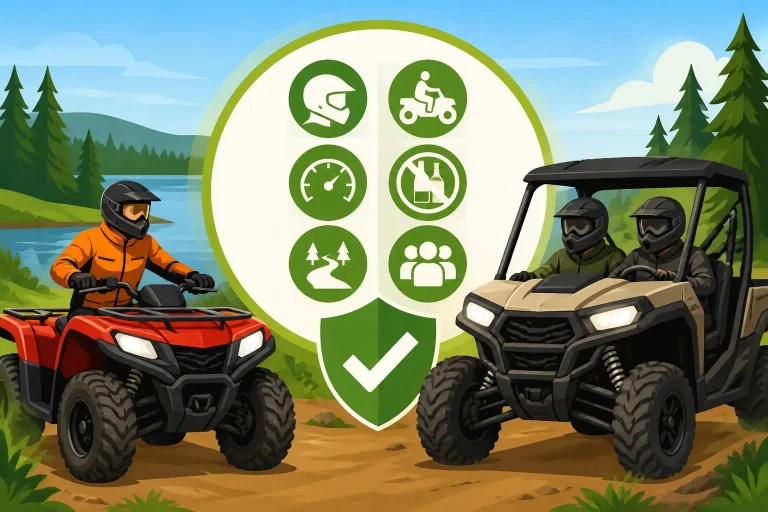
That does not mean training has no value. A course can help a new rider understand controls, protective equipment, terrain hazards, passenger limits and safe decision-making. The benefit depends on the course and the rider’s needs. A short online lesson may help someone review concepts, but it cannot provide the same experience as supervised practice on the machine.
If a provider describes its course as “required,” ask who requires it and for what purpose. A training requirement set by an employer, a club, a landowner or an organized event is different from a general provincial requirement to ride an ATV or UTV. Get the requirement in writing if it affects whether you can participate.
What the course fee does and does not cover
A safety course is not a permit or a substitute for the rules that apply to a ride. Course fees are usually paid to the training provider for instruction or course materials. Registration, insurance, park permits and club-related requirements are separate matters, each with its own rules and costs.
For example, an ATV or UTV may need registration even if it is used on a particular kind of property or trail. Taking a course does not register the machine or provide its registration documents. Review Manitoba ORV Registration Through MPI if you need to understand that separate process.
Similarly, a course does not provide insurance. Manitoba has insurance requirements for off-road machines, and the policy details are distinct from a training provider’s certificate. A course completion document should not be treated as proof of insurance; see Manitoba ATV Insurance Requirements for the insurance side.
A park permit is also different. Whether a permit is needed depends on where and how you plan to ride. Course completion alone does not authorize access to a provincial park or a club trail. Check the rules for your specific destination, including any local restrictions or closures.
| Requirement or expense | What it relates to | Does a safety course replace it? |
|---|---|---|
| Safety course | Instruction and rider knowledge | Not applicable |
| Machine registration | Identifying and registering an eligible machine | No |
| Insurance | Required coverage and any optional protection | No |
| Park permit | Access or vehicle use under park rules | No |
| Club or event requirement | Conditions set by an organizer or club | Only if that organizer accepts the course as meeting its requirement |
This separation matters when budgeting. If you are comparing two course options, compare their training value and total course fee, but do not count that fee as covering registration, insurance or access permits. For a broader view of riding costs and obligations, check the relevant rules for the machine and destination before setting out.
How to choose a course that fits your needs
Start by deciding what you want from the course. A first-time rider may want basic instruction on starting, stopping, turning, braking, terrain and protective gear. Someone who already rides may want a refresher or a course focused on a particular machine or work setting. A parent arranging training for a young rider should also confirm that the content and supervision are appropriate for the rider’s age and experience.
The provider matters as much as the format. Manitoba has different training options, so compare providers directly rather than assuming every course has the same curriculum or price. Manitoba Safety Course Providers is a useful place to start. Ask each provider:
- What machines does the course cover: ATVs, UTVs, or both?
- Is instruction practical, classroom-based, online, or mixed?
- Is the course intended for beginners, experienced riders, youth, or workplace groups?
- What safety topics and riding skills are covered?
- What equipment should participants bring?
- Is a machine supplied, or must participants bring their own?
- What is included in the fee, and are there additional costs?
- What proof of completion is provided?
- Does the course have an assessment, and what happens if a participant needs more practice?
- What are the cancellation, rescheduling and refund terms?
A certificate can be useful as a record of training, but do not assume it is a government licence or a universal pass for every riding area. If an employer, club, landowner or event organizer asks for proof, confirm what kind of proof it accepts before paying for a course. One organization may want a particular course or practical component, while another may simply recommend training.
For riders travelling from outside Manitoba, a course certificate does not replace the need to check the rules that apply to visitors. Registration and operating requirements can depend on the rider’s home jurisdiction and the Manitoba location where they plan to ride. Review Manitoba Visitors and Operating Rules and Manitoba Visitors Registered at Home if you are planning a visit.
Value matters more than the lowest fee
A useful course should be clear about what participants will learn and how the instruction is delivered. Before choosing the cheapest option, consider whether it includes the parts you actually need. For a new rider, supervised practice may be more valuable than a certificate earned without any time on a machine. For an experienced operator, a focused refresher may be enough.
Also consider practical details that affect the real cost of attending. A course in another community may involve travel, time away from work or arranging transport for a machine. An online option may be convenient but may not include hands-on coaching. Ask about all of this when comparing providers so the quoted fee does not give a misleading picture.
Training and the rules for young riders
Parents sometimes look for a safety course because they assume a child needs a certificate before riding. Manitoba does not make a safety-course certificate a general legal requirement for youth riders. That does not remove the age, supervision or operating rules that apply to young people.
A training provider may set its own age limits or require an adult to attend, so check those conditions before enrolling a child. Also make sure the course matches the machine the child will use. A youth quad and a large utility ATV differ in size and handling, and instruction should not encourage a rider to use a machine that is unsuitable for their ability.
The legal rules for young riders are separate from course enrolment. Review Manitoba ATV Age Requirements and the rules for the rider’s specific age, such as Manitoba Rules for a 14-Year-Old Rider. If the rider needs supervision, a course does not replace that supervision or change where the young person may operate the machine.
A sensible plan is to use training as one part of preparation:
- Confirm the rider’s age-related operating and supervision rules.
- Choose a machine appropriate for the rider and follow the manufacturer’s age guidance.
- Ask a provider whether its course is suitable for the rider’s age and experience.
- Practise in a permitted, controlled area with appropriate supervision.
- Check registration, insurance, equipment and destination rules before the first ride.
A course can help a young rider build habits, but safe riding still depends on ongoing supervision, suitable equipment and good judgment. An adult should not treat course completion as proof that a child can ride independently or handle every trail condition.
How to budget and verify the details
Because course providers set their own fees and arrangements, the most reliable way to find the current cost is to contact the provider directly. Ask for the full amount payable and a written description of what it includes. If a provider lists a fee online, confirm that it still applies to the date and format you are considering.
When asking for a quote, explain who will take the course, what kind of machine they ride and whether they need practical instruction. This helps the provider recommend a suitable option rather than quoting a course that does not match your goal. If you are booking for a group, ask whether the group format changes the schedule, instruction time or fee.
Before paying, check:
- Whether the course covers the machine you intend to ride.
- Whether the format includes the level of instruction you want.
- Whether materials, assessment and proof of completion are included.
- Whether you need to bring protective equipment or a machine.
- Whether travel or other expenses will add to the total.
- What happens if the course is cancelled or you cannot attend.
- Whether a particular employer, club or event will accept the course.
Then keep the course record with your other riding documents, but carry the documents actually required for the ride. A training certificate does not take the place of a registration certificate or insurance proof. For more on documents riders may need to carry, see Carrying Your Registration Card on Every Ride.
The practical takeaway is straightforward: Manitoba does not require every ATV or UTV rider to take a safety course, and there is no single province-wide course price. Costs depend on the provider and the training offered. Compare the instruction, confirm the current fee directly, and treat training as a separate choice from registration, insurance and riding permissions.
Disclaimer
This article is for general informational purposes only and does not constitute professional advice. Laws, prices and regulations vary by location and change over time. Consult a qualified professional for guidance on your specific situation.