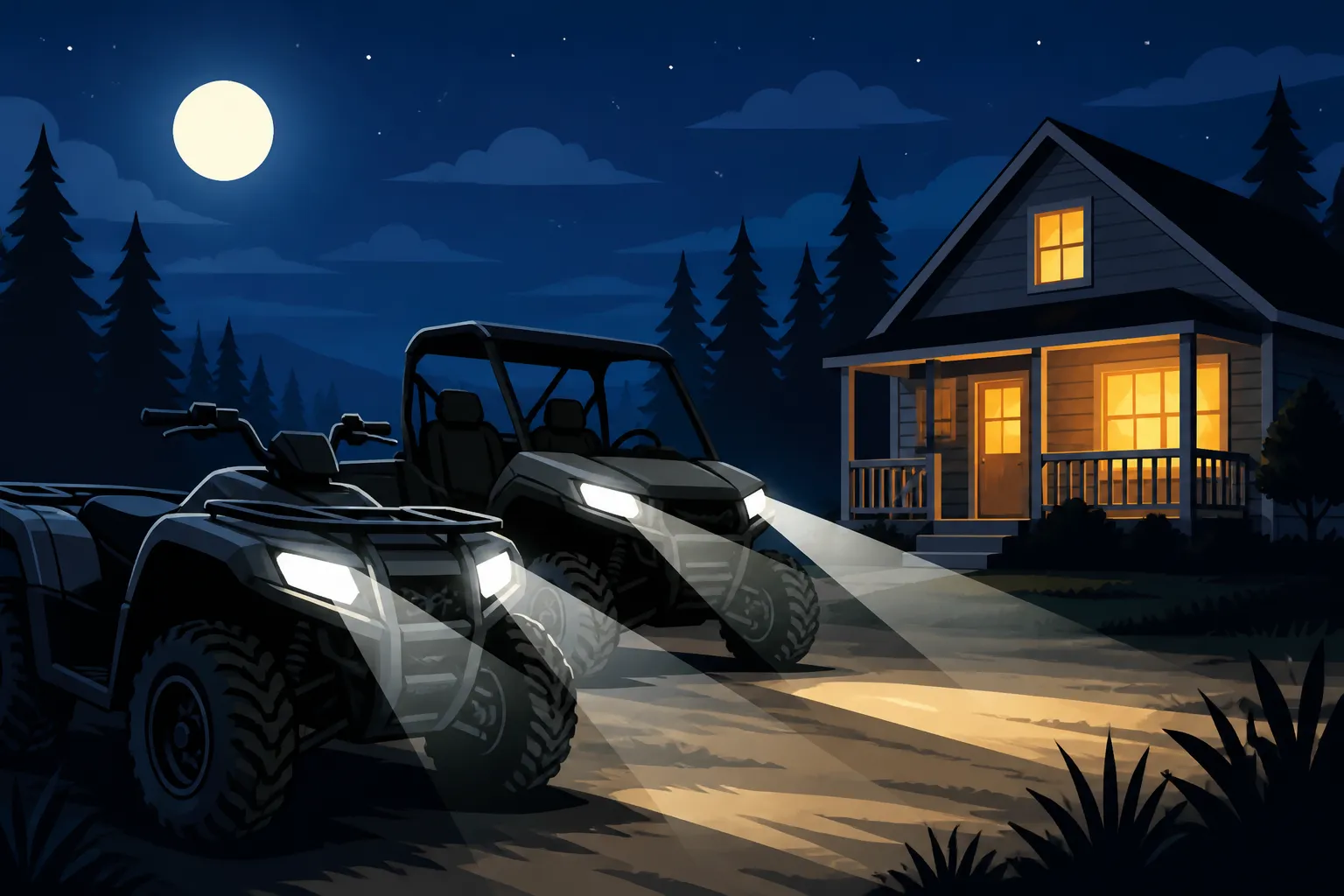
30 Metres From a House at Night
It's frustrating when you just want to enjoy a peaceful ride, whether it's an early morning start to beat the heat or a late evening cruise under the stars, only to realize there are specific rules about how close you can get to someone's home. Nobody wants to unintentionally disturb their neighbours or, even worse, run afoul of the law. This guide is all about demystifying the "30-metre dwelling rule" for ATV and UTV riders in Manitoba, helping you understand what it means, why it's there, and how to stay compliant so your ride stays fun and worry-free.
Understanding the 30-Metre Dwelling Rule in Manitoba
Manitoba's regulations for off-road vehicles (ORVs) are designed to balance the enjoyment of our province's incredible landscapes with the peace and safety of its residents. One of the key aspects of this balance, particularly for those of us who enjoy riding during the quieter hours, is the 30-metre dwelling rule. It's not just a suggestion; it's a specific legal requirement that all riders need to be aware of.
What Exactly Does "30 Metres From a Dwelling" Mean?
Let's break down this often-misunderstood rule. When the law talks about a "dwelling," it's pretty broad. We're not just talking about permanent residences in a town or city. This term extends to cottages, cabins, hunting shacks, or any structure where people might be living or sleeping, even temporarily. So, that cozy cabin tucked away beside what seems like a remote trail? Yes, that counts.
The "30 metres" refers to the minimum distance you must maintain between your running ORV and any part of that dwelling. Think of it as a protective bubble around someone's home. You can't be operating your ATV or UTV within that 30-metre radius during specific hours. How far is 30 metres? It's roughly the length of two full-sized school buses parked end-to-end. It’s farther than you might initially think when you’re cruising along a treeline or a ditch. This isn't just about avoiding contact; it's about minimizing disturbance.
The critical piece often overlooked in the main topic is the timeframe this rule applies. This particular restriction isn't a 24/7 dictate. It specifically prohibits operating an ORV within 30 metres of a dwelling between midnight and 7 a.m. This is the province's way of ensuring that residents can enjoy uninterrupted sleep and peace during the night and early morning hours. So, while you might be able to ride closer during the day, once the clock strikes midnight and until the sun starts to properly wake everyone up at 7 a.m., that 30-metre buffer zone is strictly enforced. It's about respecting sleep and quiet hours, no matter how remote the dwelling might seem.
Why This Rule Exists: Noise, Safety, and Respect
At its heart, this rule is about preventing noise pollution and ensuring public safety, especially during those quiet hours when people are most likely to be sleeping. Picture this: you're trying to get some rest after a long week, and suddenly, the distinct hum (or roar!) of an ORV echoes through the night. Even if it's brief, that noise can be incredibly disruptive, not just for adults but especially for families with young children or those who are light sleepers. Many residents, particularly in rural or recreational areas, choose those locations specifically for the peace and quiet. This rule helps protect that.
Beyond noise, there are safety considerations. Operating any vehicle in the dark comes with inherent risks, and residential areas often have unpredictable elements – children, pets, driveways, or unexpected obstacles. The rule implicitly encourages riders to avoid these areas during low visibility hours, reducing the chance of accidents or near-misses. Even if your machine is equipped with powerful [Manitoba Lighting Requirements on a Machine], the ability to see is not the only factor; the ability to be seen and heard by residents is also a concern.
Ultimately, the 30-metre dwelling rule is a social contract. It promotes good neighbour relations and helps prevent conflicts between ORV enthusiasts and property owners. When riders adhere to these rules, it fosters a sense of respect and responsible recreation, which is vital for maintaining access to trails and riding areas throughout the province. Ignoring it can lead to residents pushing for tighter restrictions, which none of us want. It’s about being considerate so that everyone can enjoy their slice of Manitoba.
Practical Implications for Nighttime Riding
Understanding the rule is one thing, but integrating it into your actual riding habits is where the rubber meets the road – or, in our case, the tire meets the trail. Nighttime riding offers a unique sense of adventure and tranquility, but it demands extra diligence to ensure you're compliant with regulations like the 30-metre dwelling rule.
Planning Your Route: Avoiding Residential Zones After Dark
For any ride, planning is key, but for a night ride, it becomes absolutely essential. You can't just wing it, especially if you're venturing into an unfamiliar area. Before you even load up your ATV or UTV, you should be looking at maps – detailed paper maps or a reliable GPS app on your phone or mounted device. Your goal is to identify any areas with dwellings, whether they're permanent homes, seasonal cottages, or even remote hunting cabins. These structures often pop up in unexpected places, even deep in what seems like wilderness.
When you're planning, try to plot a route that actively avoids these zones between midnight and 7 a.m. This might mean adding a few extra kilometres to your loop or choosing a different trail system altogether for your nighttime excursions. Remember, even if you’re riding on a perfectly legal trail, if that trail skirts within 30 metres of a dwelling during the restricted hours, you’re in violation. It’s not about where you’re riding, but how close you are to a residence.
Having a robust navigation system can be a huge help here. Many riders use dedicated GPS units or apps on their smartphones, often ruggedized and mounted securely. Products from brands like SuperATV, for instance, offer various mounting solutions and accessories that can help you keep your navigation tools visible and charged. This allows you to monitor your location in real-time, helping you steer clear of known residential clusters. Planning ahead saves you from having to make sudden, potentially unsafe, decisions on the trail in the dark.
What to Do If You Encounter a Dwelling Within the Zone
Despite the best planning, sometimes you might find yourself in a situation where you unexpectedly encounter a dwelling within the 30-metre buffer during the prohibited hours. Maybe your map wasn't quite up to date, or you took a wrong turn, or perhaps a new cabin has sprung up. What do you do in that moment?
The safest and most compliant action is to immediately stop your machine and shut off the engine. If possible and safe to do so, dismount and walk your ATV or UTV until you are well beyond the 30-metre zone. This clearly demonstrates that you are no longer "operating" the vehicle within the prohibited area and are actively trying to comply with the rule. This is particularly important for those more remote, rustic cabins that might not show up on every map. You'd be surprised where people set up temporary living quarters.
It's crucial to understand that ignorance of a dwelling's presence is generally not a valid excuse if you are caught violating the rule. The onus is on the operator to know the regulations and their surroundings. That's why pre-ride scouting and using reliable mapping tools are so vital. Think of it like this: if you can see a light on in the distance, or even just recognize the outline of a structure, assume it's a dwelling and maintain your distance. Sometimes, the best accessory isn't on your machine, but in your preparation. Things like powerful LED light bars or spot lights from companies like SuperATV can significantly improve your visibility at night, helping you spot these dwellings from a greater distance and allowing you more time to adjust your route or take evasive action before you're too close.
Enforcement, Penalties, and General Night Riding Advice
Knowing the rules and how to apply them practically is paramount. But what happens if you don't? And what else should you consider when you're out riding after dark in Manitoba? Let's delve into the consequences of non-compliance and some broader tips for safe and respectful night riding.
Who Enforces the Rule and What Are the Consequences?
In Manitoba, several authorities have the power to enforce ORV regulations, including the 30-metre dwelling rule. You could encounter the Royal Canadian Mounted Police (RCMP), local municipal law enforcement, or Conservation Officers. These officers are often out patrolling, especially in areas known for ORV activity, and they take noise complaints from residents seriously.
If you're caught operating your ORV within 30 metres of a dwelling between midnight and 7 a.m., you could face a fine. While specific amounts can change, these penalties are designed to be a significant deterrent. It’s not just a slap on the wrist. Beyond the immediate financial hit, repeated violations or particularly egregious behaviour could lead to more severe consequences, potentially impacting your riding privileges. Remember, the general penalty under the ORV Act can be substantial, and if your actions are deemed "careless operation," the penalties can climb even higher, as detailed in [Manitoba Careless Operation Penalties]. This is why simple courtesy and adherence to the rule can save you a lot of headache and money.
Furthermore, ignoring these rules can lead to community backlash. When residents are repeatedly disturbed, they tend to vocalize their concerns to their municipal councils, often leading to stricter local by-laws or even outright bans in certain areas. This means less access for all riders. Understanding [Manitoba Municipal By-Law Powers] can help you appreciate how local communities can impact where and when you can ride.
Broader Night Riding Considerations in Manitoba
Beyond the specific 30-metre rule, night riding in Manitoba comes with its own set of challenges and responsibilities. Safety should always be your top priority. Visibility is drastically reduced, so slowing down, being extra vigilant for wildlife, and making sure your machine's lighting system is fully functional are critical. This means not just headlights and taillights, but also any auxiliary lighting that enhances your ability to see and be seen. Investing in high-quality lighting from brands like SuperATV can make a significant difference in your safety and comfort after dark.
You also need to ensure you're carrying all the necessary documentation. Officers can and do perform checks, even in remote areas. This includes having your [Manitoba Registration Cards Carried at All Times] and proof of [Manitoba Insurance Proof on the Trail]. If you're a younger rider, make sure you understand [Manitoba ATV Age Requirements] and any supervision rules that might apply to you, especially when riding after dark.
Finally, always be mindful of local conditions and specific by-laws. Some municipalities might have additional restrictions on ORV use, including noise ordinances or curfews that extend beyond the provincial 30-metre rule. Before heading out, especially into a new area, it's a good practice to quickly check for any local regulations that might impact your ride. Remember, responsible riding is about more than just following the law; it's about being a good ambassador for the ORV community. By being considerate, prepared, and informed, we can all continue to enjoy the incredible riding opportunities Manitoba has to offer, day or night.
Here’s a quick summary of key considerations for night riding near dwellings:
| Aspect | Rule/Best Practice | Importance |
|---|---|---|
| Dwelling Proximity | Maintain at least 30 metres (approx. 2 bus lengths) distance from any dwelling (house, cabin, etc.). | Legal requirement, avoids fines, respects residents' peace. |
| Time Restriction | The 30-metre rule applies strictly between midnight and 7 a.m. | Prevents noise disturbance during sleep hours. |
| Route Planning | Pre-plan your night routes to identify and actively avoid residential zones and isolated dwellings. Use maps/GPS. | Proactive compliance, prevents unexpected encounters, safer riding. |
| Unexpected Encounter | If you unexpectedly come within 30 metres of a dwelling during restricted hours, stop, shut off engine, and walk your machine past the zone if safe. | Immediate compliance, demonstrates intent, minimizes disturbance. |
| Noise Levels | Even outside the 30-metre rule, be mindful of excessive noise, especially in quiet areas. Consider quieter exhaust systems or riding practices. | Good neighbour relations, prevents complaints, promotes positive ORV image. |
| Visibility & Lighting | Ensure your ORV has adequate headlights, taillights, and potentially auxiliary lighting (e.g., from SuperATV) for safe navigation and to spot dwellings from afar. | Safety for yourself and others, allows for early detection of dwellings. |
| Documentation | Always carry your valid registration card and proof of insurance. | Legal requirement, avoids fines during checks. |
| Local By-Laws | Check municipal or local government district by-laws for any additional restrictions on ORV use in the areas you plan to ride. | Local rules can be stricter; ensures full compliance. |
| Wildlife Awareness | Be extra cautious of wildlife crossings at night; they are more active and harder to see. | Enhances rider safety and prevents accidents. |
| Impaired Operation | Never operate an ORV under the influence of alcohol or cannabis, regardless of the time of day. [Manitoba Cannabis Rules for Riders] | Strict legal requirement, prevents accidents and severe penalties. |
Disclaimer
This article is for general informational purposes only and does not constitute professional advice. Laws, prices and regulations vary by location and change over time. Consult a qualified professional for guidance on your specific situation.