Manitoba Trails for Kids
A family ride can sound simple until you’re trying to find a Manitoba trail that suits a young rider, fits your machine, and is actually open when you arrive. The safest approach is to match the route to your child’s experience, confirm the rules for operators and passengers, and check access conditions before loading the trailer. This guide walks you through those decisions.
What makes a Manitoba ATV trail suitable for kids
Look beyond the trail name
A trail described as scenic or family-friendly can still have conditions that are tough for a new rider. Consider its surface, width, visibility, mud, loose rock, hills, water crossings, and how easy it is to turn around. A wide, familiar route with a clear exit may be a better first ride than a longer loop with changing terrain.
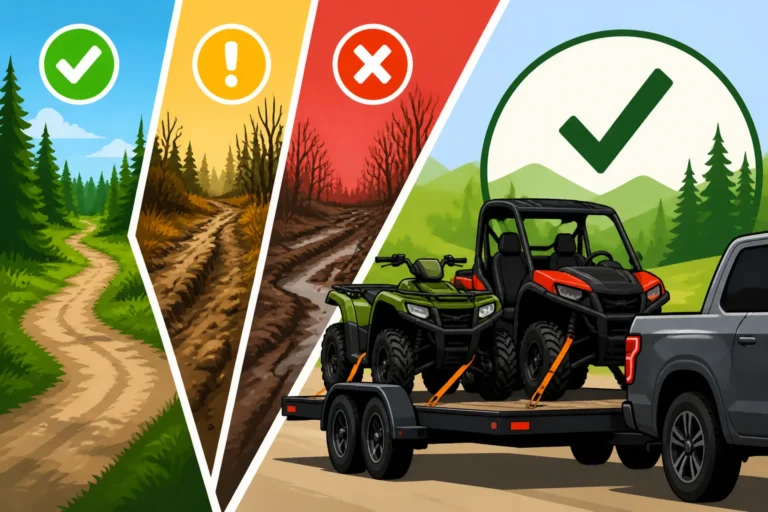
Manitoba conditions can shift quickly. A route that feels easy after a dry spell may become rutted or boggy after rain, while standing water and muskeg can be hard to judge from a map. Ask a local club or trail contact about the specific section you plan to ride, not just the general area.
Think about the whole outing, too. A child may be ready for a short ride but not for hours in the seat, a long haul to the trailhead, or a route with no convenient place to stop. For a first trip, plan a modest outing with a simple turnaround point. You can always extend the ride if everyone is comfortable.
Use a simple suitability check
Before choosing a route, compare the trail and the child’s abilities. The goal is not to prove that a young rider can handle difficult terrain; it is to make the ride predictable enough that they can practise good habits and enjoy the day.
| What to check | More suitable for a newer young rider | A reason to reconsider |
|---|---|---|
| Surface | Firm, relatively even ground | Deep ruts, loose rock, mud or muskeg |
| Route | Short, straightforward route with a clear return | Long loop with few safe places to turn around |
| Sightlines | Open areas where riders can see ahead | Blind bends, steep crests or dense brush |
| Traffic | Quiet route with room for machines to pass | Crowded or narrow shared corridor |
| Conditions | Recent local confirmation that the route is rideable | Heavy rain, closures or uncertain access |
| Support | Adult supervision and a clear group plan | Child expected to keep up without close oversight |
This is a practical screening tool, not a legal definition of a children’s trail. The machine, the rider’s experience, and the day’s conditions all matter. A child who is confident on a flat practice area may still need a cautious introduction to a narrow trail with oncoming traffic.
For a wider overview of route types and access, see [Manitoba ATV Trails: Club Ground and Crown Land]. If you’re looking for an easier starting point, [Best Manitoba ATV Trails for Beginners] can help you think about beginner-friendly route features, but still confirm the current conditions locally.
Treat trail access as a separate question
A trail being visible on a map does not automatically mean it is open to ATVs or UTVs. In Manitoba parks, machines may be restricted to designated routes, and access rules can differ between areas. Club trails may cross land with their own restrictions, so confirm that the route is open to your machine and that you have permission to use it.
This is especially important when a family plan includes a park road, a campsite, or an informal connector between two trails. A route that looks convenient on a screen may cross private land, a restricted area, or a section that is not open to motorized travel. Review [Manitoba Parks Allow Machines on Designated Routes Only] before treating a park map as permission to ride.
Map apps can help you prepare, but they are planning aids rather than proof of access. Some riders use onX Offroad to review route lines and terrain before a trip. Check the app’s map details against official park information, local club updates, signs at the trailhead, and any applicable municipal rules. If those sources conflict, pause and clarify access before unloading.
Rules and safety when children ride
Check the rules for the child and the machine
A child’s age is only one part of deciding whether they may operate an off-road vehicle. The relevant rules can depend on the rider’s age, the machine, supervision, where the ride takes place, and the type of licence the young person holds. Don’t assume that a child who can operate a youth quad on private property may automatically ride the same way on a public trail.
Review [Manitoba ATV Age Requirements] and [Manitoba Riders Under 14 Need Supervision] before planning a ride. If the child is near an age threshold, check the specific requirements rather than relying on a general rule of thumb. Keep supervision close enough to be meaningful, and choose a pace that allows the adult to respond quickly if the child stops, gets stuck, or becomes uncomfortable.
The manufacturer’s age recommendation matters for fit and control, but it does not replace Manitoba’s legal requirements. A machine that is too large, heavy, or powerful for a young rider can be difficult to steer or stop, even if the child is eager to try it. Be honest about their strength, reach, coordination, and experience—not just whether their feet can touch the ground.
For additional guidance on operating and passenger rules, see [Manitoba Rules for a Child Passenger]. A child riding as a passenger and a child operating a machine are different situations, so check the rules that apply to the role they will actually have.
Make helmets and fit part of the plan
A helmet should fit securely and be suitable for off-road riding. It should not wobble, slide over the eyes, or pinch in a way that makes the child want to remove it. Check the accepted standards and requirements in [Manitoba Helmet Law] before the ride, and make sure every rider and passenger follows the rules that apply to them.
Do a quick equipment check before leaving home. Confirm that the child can reach the controls comfortably, understands how to stop, and can communicate with the adult rider. Gloves, sturdy footwear, eye protection, and clothing suited to the weather make a long day more manageable. A chilly morning in the bush can feel very different from a warm afternoon in the driveway.
The machine also needs to fit the child’s role. If they are a passenger, use only a machine designed for passengers and follow its seating and restraint requirements. Don’t carry a child in a position that leaves them unable to hold on securely or puts them at risk of contacting hot or moving parts.
Set clear rules before the engine starts
Children do better when the expectations are simple and repeated before the ride. Agree on a following distance, a signal for stopping, what to do if the group gets separated, and whether anyone may pass another rider. Keep the group small enough that the supervising adult can see what is happening.
On a shared trail, slow down around other users and leave room to pass safely. Stop in a visible place rather than around a blind corner. Explain that a rider should not race to catch up if the group stretches out; the adult at the back can close the gap or the group can regroup at a planned stopping point.
A first family ride is a good time to practise these habits on easy ground. If the child is tired, frustrated, or riding beyond their comfort level, shorten the outing. A calm return to the trailhead is a better outcome than pushing on because the route was meant to be longer.
For more on sharing a route considerately, read [Manitoba Trail Etiquette Locals Expect]. If you’re organizing several families, [Manitoba Group Ride Planning] can help you build a clearer plan for regrouping and supervision.
Planning a family ride in Manitoba
Choose a route and verify it before hauling
Start with the child’s ability and the group’s experience, then choose a route that leaves room for an easy return. Before you load the trailer, check whether the trail is open, whether the machine type is allowed, and whether recent conditions have changed. A club or local contact may know about washouts, soft sections, seasonal restrictions, or trail work that is not obvious from a general map.
onX Offroad can be useful for looking over route options as part of your planning. Use it to help orient yourself, not as the final word on legal access or current closures. Compare the route with official information and local updates, and look for signs at the trailhead when you arrive. If the route appears to cross land with unclear access, don’t assume that a mapped line means permission.
A little preparation can prevent the familiar family-trip frustration of driving a long way only to discover that the planned route is unsuitable or closed. [Manitoba Trail Conditions Before You Haul] is a useful next read when you’re deciding whether to make the trip.
Pack for comfort and an early turnaround
Bring water, snacks, basic first aid supplies, and clothing layers. Children can become cold or overheated before adults notice, especially when the group is moving at different speeds. Build in breaks and check in with the young rider rather than waiting for them to say they are tired.
Keep the day’s plan flexible. If the route is rougher than expected, the child is uneasy, or the weather turns, head back. Tell another responsible adult where you plan to ride and when you expect to return. In areas with limited cell coverage, plan how the group will manage a breakdown or separation before setting out.
A practical family checklist includes:
- Confirm the route is open and suitable for your machine.
- Check the child’s operating or passenger requirements.
- Inspect the machine, helmet, and protective gear.
- Agree on hand signals, following distance, and regrouping points.
- Carry water, snacks, first aid supplies, and weather-appropriate layers.
- Set a turnaround point and be willing to shorten the ride.
Keep the first outing low-pressure
A young rider’s first trail experience should be about confidence, not distance. Let them get used to the machine and the group’s pace. Stop while they are still enjoying the ride instead of waiting until fatigue turns the last stretch into a struggle.
If you have more than one child, don’t assume they should ride the same route or machine. Their experience, comfort, and physical ability may differ. A shorter route for one child is not a failure; it is a sensible way to help them build skills at their own pace.
When you get back, talk about what felt easy and what felt difficult. That conversation can guide your next choice: perhaps the same route in better conditions, a slightly longer loop, or more practice before trying rougher terrain. A measured start makes it easier for the whole family to look forward to riding again.
Common mistakes families can avoid
Assuming a map means permission
A line on a screen can be useful, but it doesn’t settle whether a machine is allowed on that land. Parks, club routes, private property, Crown land, and municipal areas can have different rules. Verify access for the particular route, not just the region.
This is where a tool such as onX Offroad can support trip planning while still leaving the access decision to reliable local and official information. Check signs, closures, and land permissions, and don’t continue if the route’s status is unclear.
Choosing a route for the adults
Adults may be comfortable with a longer loop, but children can tire faster and may find noise, mud, or rough ground stressful. Plan around the least experienced rider. A route that seems short to an adult can feel long to a child who is concentrating on every bump and turn.
Before setting off, be willing to change the plan. If the child is struggling to steer, keep pace, or stay comfortable, stop and reassess. Turning back early is a normal part of responsible family riding.
Treating supervision as a formality
An adult following far behind may not be able to help quickly if a young rider makes a mistake. Supervision should fit the child’s age, ability, and the terrain. Keep visual contact where required, set a controlled pace, and avoid spreading the group across a long stretch of trail.
Rules and trail conditions can vary by location, so check the requirements that apply to your specific ride. A family outing works best when the adults have already agreed on who is supervising each child and what to do if someone needs help.
Disclaimer
This article is for general informational purposes only and does not constitute professional advice. Laws, prices and regulations vary by location and change over time. Consult a qualified professional for guidance on your specific situation.