Manitoba Snopass Is for Snowmobiles Only
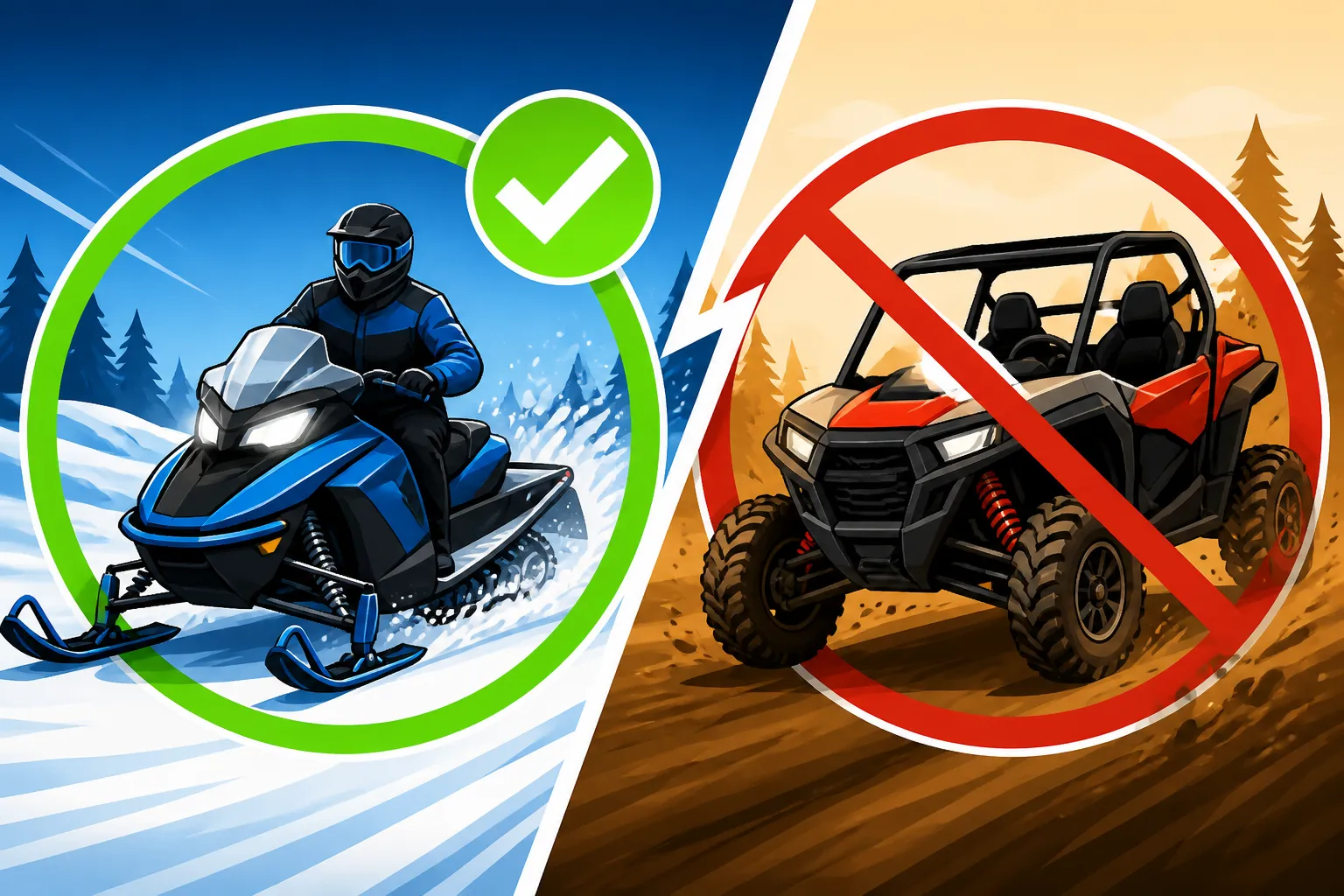
Manitoba’s Snopass is for snowmobiles, not ATVs or UTVs. That distinction matters when you are planning a ride: a snowmobile trail pass does not replace the paperwork, permissions or park requirements that may apply to an off-road machine. Here’s how to tell which rules apply before you unload.
What Snopass covers and what it does not
Snopass is associated with snowmobile trail use in Manitoba. It is not a general off-road vehicle permit, and buying one does not authorize an ATV or UTV to use a snowmobile trail. A quad, side-by-side and snowmobile may share a storage shed or even part of a route, but they do not automatically share the same access rules.
The practical rule is to match the document to both the machine and the place you intend to ride. A Snopass is relevant to a snowmobile and the snowmobile trail system it applies to. An ATV or UTV rider should instead check registration, insurance, land access, local rules and any park or event requirements that apply to that ride.
| What you are riding or doing | What to check |
|---|---|
| Snowmobile on a snowmobile trail | Snopass requirements and trail status |
| ATV or UTV on a club trail | Registration, insurance, club or land-access rules, and trail-specific permissions |
| ATV or UTV in a provincial park | Whether machines are allowed on a designated route and whether a park vehicle permit is required |
| ATV or UTV on private land | The owner’s permission and any applicable operating rules |
| ATV or UTV in a group event | Whether the organizer needs a permit and what participants must carry |
| Out-of-province machine | Home registration and insurance requirements, plus Manitoba operating rules |
A common misunderstanding is that a pass linked to a trail organization must cover every motorized machine on that trail. It may not. A groomed snowmobile route is not automatically an ATV route, and the presence of an ATV track in the snow does not prove that ATVs are allowed there. Check the trail owner or manager’s current rules before riding.
The same goes for a Snopass displayed on a trailer or carried in a truck. It does not transfer from the snowmobile to an ATV simply because both machines are going to the same staging area. The permit is not a general admission ticket to ride any off-road vehicle anywhere in Manitoba.
For more background on how the two systems differ, see Manitoba Snopass Is for Snowmobiles Only—but for the specific questions of where a Snopass may be accepted or how it applies to a quad, Manitoba Snopass Reciprocity With Saskatchewan and Manitoba Snopass Rules for Quads are useful related topics. Reciprocity is about snowmobile arrangements, not a blanket ATV or UTV pass.
What ATV and UTV riders need to check instead
There is no single Snopass-style pass that automatically gives ATV and UTV riders permission to ride every Manitoba trail. Instead, several separate requirements may matter at once. Registration and insurance relate to the machine’s legal status. Land permission and route rules determine where you may ride. Park permits and event permits may apply to particular places or activities.
Registration and insurance
Start with the machine’s registration status. Manitoba ORV registration is handled separately from Snopass, and an ATV or UTV rider should not assume a snowmobile pass covers registration obligations. Learn the basic process in Manitoba ORV Registration Through MPI or use How to Register an ATV in Manitoba if you are registering a quad.
Registration is not the same as permission to ride a particular route. A registered machine can still be prohibited from a trail, park, road or piece of land. Likewise, permission from a landowner does not necessarily settle registration or insurance requirements. Treat these as different checks, not substitutes for one another.
Insurance is another separate question. Check what your registration includes and what coverage is required for your use. If you are visiting from outside Manitoba, do not assume that a Snopass or a trail organization’s rules settle your insurance obligations. Manitoba Insurance Rules for Visitors explains the visitor-specific issue, while Manitoba Visitors and Operating Rules covers the wider point: visitors still need to follow the operating rules that apply in Manitoba.
Trail and land access
Before you head out, identify who manages the route. It might be a club, a park, a municipality, a private landowner or another land manager. A route shown on a map is not automatically open to every machine, and a snowmobile trail map is not proof that an ATV or UTV is allowed on the same corridor.
Manitoba’s ATV trail network is a mix of club-managed routes and other riding areas. Access can differ by location, season and machine type. Start with Manitoba ATV Trails: Club Ground and Crown Land and Manitoba Club Trails and Who Maintains Them if you need to understand who controls access. Then check current information directly with the club or land manager for the route you plan to use.
On public land, public access does not always mean unrestricted motorized access. A route may be closed to vehicles, limited to certain uses or subject to temporary restrictions. On private land, get permission from the person who has authority to give it. On a Crown lease, the leaseholder’s rights can affect access; see Manitoba Crown Lease Access Rules before assuming a mapped route is open.
Park and event permits
Provincial parks have their own rules. A vehicle permit for a park is separate from Snopass and does not, by itself, open every park trail to ATVs or UTVs. Machines may be allowed only on designated routes, and some parks may have no suitable ORV route. Check both the park’s vehicle-permit requirements and the route restrictions before driving in.
A group ride may also trigger an event-permit question. That is not the same as buying a personal trail pass. If you are organizing a large ride, a club event or a gathering at a park, ask the relevant park office or land manager what authorization is needed. The organizer should confirm the rules rather than assuming that each participant’s registration or club membership covers the event.
How to plan a ride without relying on the wrong pass
Use a short, repeatable check before every trip. It prevents the most common mistake: arriving with one kind of permit and discovering that the machine, trail or activity requires something else.
- Identify the machine. Confirm whether you are riding a snowmobile, ATV or UTV. Do not use a snowmobile permit as evidence of ATV or UTV access.
- Name the exact route. A region or trail system may include routes with different rules. Check the specific segment, not just the general area.
- Find the route manager. Look for the club, park, municipality, landowner or other authority responsible for access.
- Confirm machine access. Ask whether your type of machine is allowed and whether the route is open for the season and conditions.
- Check your paperwork. Confirm registration, insurance and any required documents for your machine and your status as a resident or visitor.
- Check additional permits. Ask whether a park vehicle permit, special event permit or other location-specific authorization applies.
- Check for temporary closures. Weather, fire risk, maintenance, sensitive ground or other conditions can change access after you have planned the trip.
- Carry the documents you may need. Keep required registration and insurance information available while riding, and follow any instructions from the trail manager.
If a trail map shows a snowmobile route, treat it as a starting point for a question, not as permission for a quad. Contact the trail organization and ask plainly: “Is this segment open to ATVs or UTVs, and what does a rider need to carry?” That specific question is more useful than asking whether the trail is “open,” because the answer may depend on the machine.
For a route in a provincial park, ask the park office or check the park’s current official information. For a club trail, contact the club that maintains or manages access. For a municipal road or local route, check the local authority’s rules. If an answer is unclear, get the name of the route or land manager and confirm with them rather than relying on an old map, a social post or a sign seen from the trail.
Keep useful details with your trip plan: the route name, the manager’s contact information, current access notes and where you will unload. Some riders keep digital maps on a phone and carry a paper backup. A waterproof document pouch can help protect registration papers and a small map; Amazon is one place riders sometimes look for basic pouches, but choose one that seals reliably and fits your documents. The important part is being able to access the information when you need it, not where you bought the pouch.
Visiting riders and reciprocity
If you are bringing an ATV or UTV from another province or the United States, keep the questions separate. First, determine whether your home registration and insurance satisfy the requirements for your machine. Then check Manitoba’s operating rules and the access rules for each route. A snowmobile pass does not resolve either question for an ATV or UTV.
Reciprocity can be easy to misread. An arrangement that recognizes a snowmobile permit from another jurisdiction does not necessarily create an equivalent ATV trail pass, nor does it mean a visiting quad can ride every trail. The label “reciprocity” usually refers to a specific arrangement between systems. Confirm which machines and routes it covers.
Visitors should also distinguish between documentation and access. Having valid paperwork for a machine does not grant permission to ride private land, a closed trail or a route restricted to snowmobiles. In the other direction, an invitation from a local rider does not automatically establish that your registration or insurance is sufficient. Check both sides before the trip.
If you are a resident who owns both a snowmobile and an ATV, keep the paperwork for each machine separate. A Snopass associated with your snowmobile does not become a second-machine permit for your quad. Similarly, an ATV registration does not provide snowmobile trail access. If you are uncertain which costs or documents apply to the ATV, Manitoba Registration Compared to Saskatchewan may help with cross-border context, but verify current requirements with the appropriate official source or trail manager.
A practical way to avoid confusion is to make a two-column checklist for a mixed-machine weekend:
| Snowmobile trip | ATV or UTV trip |
|---|---|
| Confirm Snopass requirements for the snowmobile route | Confirm ATV or UTV access for the exact route |
| Check snowmobile trail conditions and closures | Check club, landowner, park or municipal rules |
| Carry the snowmobile’s required documents | Carry the ATV or UTV’s required documents |
| Check any snowmobile-specific reciprocity | Check visitor registration and insurance separately |
| Do not infer ATV access from a snowmobile map | Do not treat Snopass as an ATV permit |
If you are packing gear for both kinds of riding, label documents by machine so nobody mistakes one pass or registration card for another. A small folder or separate waterproof sleeves can make this easier. Amazon listings include document organizers and map cases, but check dimensions and closure design before ordering; a case that does not fit the papers or stay shut is not useful on a wet ride.
Common mistakes and a sensible final check
The most frequent mistake is treating a visible trail, a trail map or a permit as proof of universal access. Those things answer different questions. A pass may be valid for one machine type. A map may show a route without showing every restriction. A registration card may establish that a machine is registered without granting access to the land you are crossing.
Other avoidable errors include:
- Assuming that an ATV can use a snowmobile trail because the trail is packed or shared in appearance.
- Assuming that a provincial park vehicle permit authorizes riding any route inside the park.
- Treating membership in a club as permission to use every trail in the region.
- Assuming a visiting rider’s home paperwork automatically meets every Manitoba requirement.
- Relying on a previous season’s access information without checking for closures or changes.
- Carrying a Snopass in the truck and assuming it covers the quad on the trailer.
- Confusing a registration-related trail funding charge with a trail access pass.
Before leaving home, make sure your plan answers four questions: Is the machine properly documented? Is this type of machine permitted on this exact route? Do you need a separate park or event permit? Is the route open today? If any answer is uncertain, resolve it before unloading.
When calling a club or land manager, give them the machine type, the route name, your intended date and whether you are visiting from outside Manitoba. That makes it easier for them to give a useful answer. If the person you reach cannot confirm the rule, ask who manages the route or which official office can.
The main takeaway is simple: Snopass is for snowmobile trail use, not a general pass for Manitoba’s ATVs and UTVs. For an off-road machine, check registration and insurance, then confirm access with whoever manages the land or route. A few minutes of checking can save a long drive to a trail you cannot legally ride.
Disclaimer
This article is for general informational purposes only and does not constitute professional advice. Laws, prices and regulations vary by location and change over time. Consult a qualified professional for guidance on your specific situation.