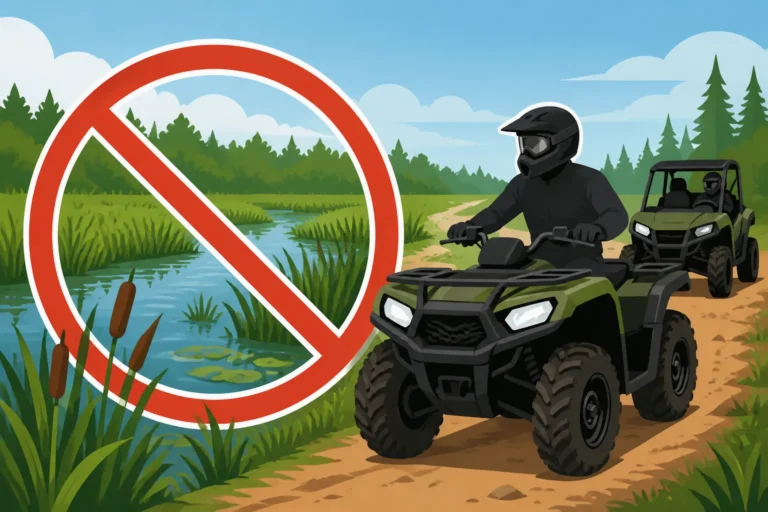
Manitoba Riding Areas With Group Space
A Manitoba group ride can go sideways before anyone reaches the trail: trucks and trailers arrive together, parking fills quickly, and riders discover the route is narrower or busier than expected. This guide explains how to find suitable group staging areas, compare Manitoba riding regions, and plan a ride that respects local access, trail conditions, and other trail users.
What makes a riding area work for a group
Staging space is different from trail space
A trail may be a good fit for a group once everyone is riding, yet a poor choice for meeting and unloading. Staging means the practical area where people can park tow vehicles, position trailers, unload machines, gather for instructions, and leave without blocking other visitors. A wide trail does not necessarily mean there is enough room at its entrance for several trucks and trailers.
Think through the arrival in real terms. If a dozen riders are coming from different towns, they may not pull in as one tidy convoy. Some drivers will need space to turn around, while others may be unloading at a different pace. A suitable meeting point needs enough room for vehicles to manoeuvre without forcing anyone to back into traffic or park across an access route.
Also separate the meeting point from the ride route. A staging area might be on public land, at a club trailhead, or at another location where access is specifically allowed. Do not assume that an open-looking clearing, roadside pull-off, or nearby field is available for group parking. Check with the trail club, land manager, municipality, or property owner as appropriate before relying on it.
For a closer look at planning arrival and parking, see [Manitoba Trailheads With Trailer Parking] and [Where to Stage a Big Manitoba Group]. Those details matter especially when some riders are bringing long trailers or arriving in larger tow vehicles.
Match the group to the riding area
“Group friendly” is not a single trail rating. A family ride with a few machines has different needs from a club outing with many riders, mixed experience levels, and multiple trailers. Consider how many machines will be on the ride, whether riders are comfortable on the same terrain, and whether the route allows people to regroup safely without blocking the trail.
A large group also affects the experience of other people using the corridor. Shared trails may have hikers, horseback riders, snowmobilers, or other motorized users, depending on the location and conditions. A group that can ride in smaller, spaced-out sections is generally easier to manage than one long line that occupies a narrow trail. Review [Manitoba Group Size on a Club Trail] and [Manitoba Trail Etiquette Locals Expect] before setting the format.
The best choice may be to split a large gathering into smaller ride groups, each with a lead and sweep rider. That does not mean everyone has to meet somewhere different. It means the group can use the same agreed staging point while keeping the moving traffic on the trail more manageable. Include this approach in [Manitoba Group Ride Planning], particularly if some riders are new to the area.
Manitoba riding areas to investigate for group outings
Eastman and Woodridge
Eastman is a practical region to investigate for a group ride, particularly for riders coming from communities in southeastern Manitoba. The area includes club riding opportunities associated with Woodridge and the Sandilands. Before choosing a trailhead, ask the relevant local club or land manager about access, parking arrangements, route suitability, and any conditions that could affect a group’s plan.
Woodridge can be a useful starting point for research because it is associated with local club trails, but do not treat the community name as confirmation that a particular lot or access point can accommodate your entire group. Confirm where riders are expected to unload and whether the meeting spot is intended for trail users. If several vehicles are arriving, ask whether the group should stagger its arrival or use another approved gathering point.
A local club can often help you avoid a frustrating mismatch between the group and the route. Ask about trail width, difficult sections, shared-use areas, and recent changes before hauling machines from Winnipeg, Steinbach, or farther away. Use [Manitoba Eastman Riding Areas] and [Manitoba's Whistle Pig Rail Trail] as starting points for researching the region, then confirm the details with local contacts.
Agassiz and the Lac du Bonnet area
The Agassiz trail system and riding around Lac du Bonnet may be worth investigating for groups looking at central and southeastern Manitoba options. The region has named club trail routes, including the Agassiz Trail through the Agassiz Forest Range. That makes it important to check the route’s current condition and permitted use rather than assuming every nearby road, forest track, or open area is part of the trail network.
For a group, ask specifically about the trailhead rather than only asking whether the trail is open. Find out where tow vehicles can park, how much room there is to unload, whether there are restrictions on gathering, and whether the route is suitable for the least experienced rider in your group. Those questions help prevent the familiar scene of half the group waiting in a narrow access area while the rest tries to find somewhere to turn around.
If you are considering a longer outing, research whether riders can safely regroup along the route without blocking other users. The [Agassiz Trail Through the Agassiz Forest Range] and [Riding From Lac du Bonnet] pages can help you identify areas to investigate. Treat any map app, including onX Offroad, as a planning aid rather than proof that a road or trail is open to your group. Confirm access and conditions with the club or relevant land manager.
Duck Mountain and the Mossberry Trail
Duck Mountain is a well-known Manitoba riding destination, and the Mossberry Trail is one route groups may consider. Its setting can make it appealing for a day out or a more extended trip, but popularity and scenic surroundings do not guarantee that a particular trailhead has space for a large convoy. Confirm the staging arrangement, route access, and current conditions before committing to a date.
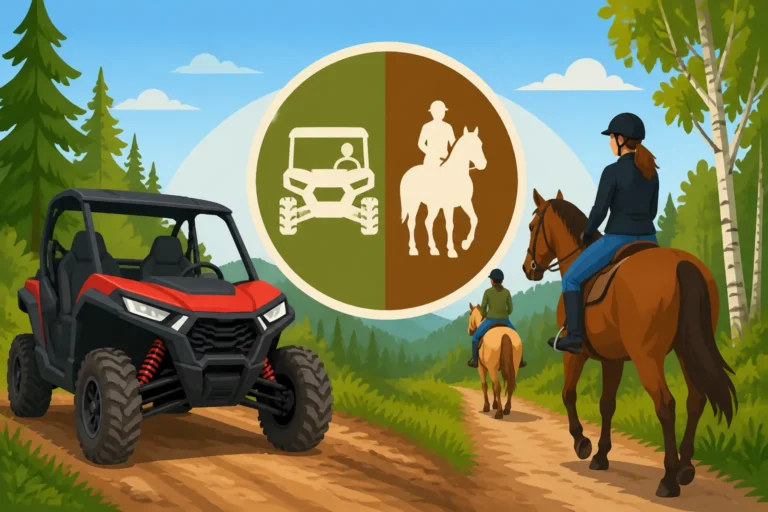
The Mossberry corridor is shared with other trail users in places, so group size and riding style matter. A large group should plan its spacing, agree on stopping points, and avoid turning a narrow section into a long stationary queue. If the group includes newer riders, ask about the route’s difficulty and whether there are sections where a slower pace or regrouping plan will be needed.
Look into [Duck Mountain's Mossberry Trail in Manitoba] and [Mossberry Trail Shares Ground With Horses and Hikers] while building your plan. If you are considering an overnight ride, investigate the location and rules for any planned stop or campsite separately; do not assume that a trail route automatically allows camping or provides a group campsite.
| Area to investigate | Why a group might consider it | What to confirm before travelling |
|---|---|---|
| Woodridge and Sandilands | Eastman-area club riding may suit riders coming from southeastern Manitoba | Approved staging location, trailer space, route conditions, and local access guidance |
| Agassiz Forest Range | A named club trail gives the group a defined route to research | Current route status, trailhead capacity, shared use, and group suitability |
| Lac du Bonnet area | A possible base for riders planning a regional outing | Where to unload, where vehicles may park, and which routes are open to the group |
| Duck Mountain and Mossberry Trail | A destination to consider for a day ride or a longer trip | Trailhead arrangements, shared-use etiquette, current conditions, and overnight permissions |
| Porcupine Forest area | A northern and western option to research with local club guidance | Exact access point, route status, staging space, and travel logistics |
| Snow Lake area | A northern riding option for groups prepared to plan around distance | Local guidance, fuel and communication planning, access, and suitable meeting space |
These are places to investigate, not promises of available group parking or guaranteed access. For additional regional ideas, see [Manitoba Riding Areas Reachable in a Day] and [Manitoba Trailheads With Trailer Parking].
How to confirm a group can use the space
Ask specific questions before you load
A general question such as “Can we ride there?” may not get you the information a group actually needs. Contact the local club or land manager with the number of machines, number of tow vehicles, approximate arrival time, and the kind of ride you intend to have. Be clear if the group includes children, beginners, side-by-sides, or riders who may need extra time to unload.
Ask where the group is allowed to meet and whether the proposed parking area can accommodate trailers. Check whether the access point is shared with other users, whether there are seasonal restrictions, and whether the club recommends a particular route for your group’s ability level. If an event is organized or particularly large, ask whether any additional permission or permit requirements apply. See [Manitoba Special Event Permits] for a related starting point, and confirm the rules that apply to your specific outing.
It also helps to ask what has changed recently. A route that was suitable last season may be affected by weather, maintenance, a temporary closure, or local access concerns. Review [Manitoba Trail Conditions Before You Haul] before departure and check again close to the ride date. That second check can save a long drive with a trailer if the group’s planned access is no longer suitable.
Use maps to plan, then verify access
A digital map can help your group compare distances, identify possible routes, and coordinate where people will meet. Apps such as onX Offroad may be useful during the planning stage, especially when riders are comparing route options or trying to keep everyone oriented. However, a line shown on a map is not, by itself, confirmation that the route is open, legal for your machine, or appropriate for a large group.
Use mapping tools to prepare questions, not to replace them. If an app suggests an access road or connection, confirm that it is an authorized route and that your group can use it. Keep a second navigation option available, such as a saved offline map or a paper map, because cell service can be inconsistent in rural and northern areas. [Manitoba Trail Apps and Maps] offers another useful reference for planning.
Before the ride, send everyone the same meeting location, arrival instructions, route plan, and contingency arrangements. Tell riders where to park and unload, how the group will divide if needed, and what to do if someone arrives late or loses contact. A map pin without written instructions can still lead to confusion when a group is spread across multiple vehicles.
A practical plan for ride day
Organize arrivals and departures
Set a clear arrival window and identify one person to coordinate parking. If space is limited, stagger arrivals rather than having every truck and trailer reach the entrance at once. Make sure the coordinator knows where vehicles are permitted to park and does not direct drivers onto private land or into an area that blocks access for others.
Before unloading, give the group a short briefing away from the active trail entrance. Cover the route, expected pace, regrouping points, hand signals or communication methods, and the plan if someone has a mechanical problem. Ask riders to check that their machines are ready before moving off. These small steps reduce the chances of a group stopping abruptly in a narrow section to sort out details that could have been handled at the staging area.
Plan the end of the ride, too. A group that returns at different times can create congestion if everyone tries to load at once. Agree on a return procedure, keep the access route clear, and leave the meeting area tidy. For broader access considerations, read [Manitoba ATV Trails: Club Ground and Crown Land] and confirm the rules that apply to the land and route you are using.
Keep the ride comfortable for mixed abilities
A group ride is only enjoyable if the pace works for more than the fastest riders. Choose a route based on the least experienced participant and the capabilities of the machines, not on the most confident rider’s preferred speed. If the group has a wide range of experience, divide into smaller groups with their own lead and sweep riders, then choose agreed meeting points.
Build in more time than the route distance alone suggests. Riders may need breaks, weather may slow progress, and a stuck or disabled machine can hold up the entire outing. Leave room in the schedule for regrouping rather than treating every stop as lost time. A relaxed plan is usually safer and more enjoyable than a group trying to make up time on the trail.
Finally, be willing to change the plan. If the parking area is too crowded, conditions are poor, or the route does not suit the group, pause and choose another approved option. The best Manitoba riding area for a group is not necessarily the one with the biggest reputation; it is the one where access, staging, route conditions, and the group’s abilities all line up.
Disclaimer
This article is for general informational purposes only and does not constitute professional advice. Laws, prices and regulations vary by location and change over time. Consult a qualified professional for guidance on your specific situation.