Manitoba Registration Before Your First Ride
It’s a common scenario: you’ve just acquired that shiny new (or new-to-you) all-terrain vehicle (ATV) or utility terrain vehicle (UTV), and the open trails of Manitoba are calling your name. You’re itching to hit the bush or explore the backcountry. But before you even think about loading it onto a trailer or starting the engine, there’s a crucial step many riders overlook or underestimate: registration. Skipping this vital process can lead to fines, headaches, and a whole lot of disappointment, not to mention putting you at a disadvantage if you ever need to prove ownership. This guide will walk you through everything you need to know about getting your off-road vehicle properly registered in Manitoba before your very first ride, helping you avoid those pitfalls and get to the fun faster and with peace of mind.
Why Getting Your ORV Registered Is Crucial Before You Ride
Let's be real, nobody loves paperwork, and sometimes the thought of another bureaucratic step can feel like a buzzkill when all you want to do is ride. However, when it comes to off-road vehicles in Manitoba, registration isn't just a suggestion; it's a legal requirement with significant implications for your safety, your wallet, and your ability to enjoy the trails and rural areas of our beautiful province. Understanding the "why" behind it can make the "how" a lot less frustrating.
Understanding Manitoba's Mandatory Registration Rule
Many new ORV owners mistakenly believe that registration is only necessary if you plan to ride on designated trails or Crown land. "I'm just going to use it on my own property," they might say, or "I'll only ride it out in the middle of nowhere where nobody will see me." Unfortunately, that's a common misconception that can land you in hot water. In Manitoba, the Off-Road Vehicles Act is quite clear: if your ORV is being operated anywhere in the province, it needs to be registered. This isn't just about trail systems; it applies to virtually all public and private lands, even if you’re just crossing a short distance on a municipal road shoulder to get to another field. There's really no escaping it, unless you fall into a very specific exemption category (which we'll touch on later). This means whether you're planning a weekend trip to Duck Mountain Provincial Park or just zipping around your acreage, that plate needs to be affixed, and you need to have your registration card with you. It’s about accountability and ensuring that all ORVs operating in Manitoba can be identified. You can dive deeper into this topic by reading [Registration Applies Everywhere, Not Just on a Trail].
Think of it like car insurance and registration; you wouldn't drive your car without it, right? The same principle applies here. Manitoba Public Insurance (MPI), through its extensive network of Autopac agents, is the body responsible for handling ORV registrations. They're the ones who issue your single registration plate and manage the associated fees. This integrated system means that along with registration, you're also acquiring basic third-party liability insurance, which is a critical piece of protection should you ever be involved in an accident. While the basic coverage might not protect your machine from theft or damage, it's a foundation that prevents you from being solely responsible for damages or injuries you might cause to others while operating your ORV.
The Manitoba Off-Road Trails Fee: More Than Just a Surcharge
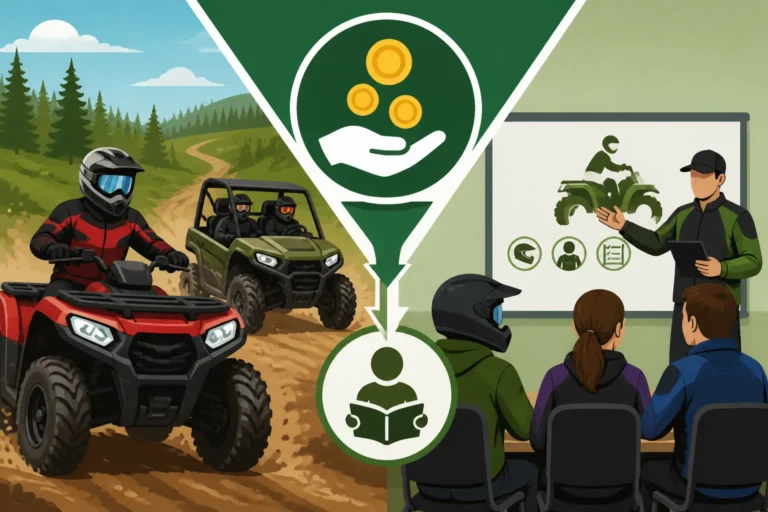
As part of your ORV registration, you'll notice an additional charge: the Manitoba Off-Road Trails Fee. For some, this might seem like just another tax or a hidden cost, but it serves a very important purpose for the entire ORV community in the province. Since April 2024, this fee has been a standard part of every ORV registration. It's a non-refundable charge that goes directly into supporting the development, maintenance, and enhancement of Manitoba’s extensive network of off-road trails.
This means that the money collected isn't just disappearing into a general fund. It's actively used to grant funds to ATV clubs, snowmobile associations, and other organizations that volunteer their time and effort to build and maintain the very trails you want to ride. This covers everything from clearing brush and grading surfaces to installing signage and repairing damage. It also helps fund rider education programs, which are vital for promoting safe and responsible riding habits across the province. So, while it's an extra cost, it's also an investment in the future of our riding areas and helps ensure that there are safe, well-maintained places for everyone to enjoy their machines. It's a collective contribution to a shared resource, and it helps solidify the relationship between riders and the land we enjoy. For a detailed breakdown of this charge, check out [The $25 Trails Fee Added to Every Registration].
What Happens If You Ride Unregistered
The consequences of riding an unregistered ORV in Manitoba are significant and definitely something you want to avoid. It’s not just a slap on the wrist; you could be looking at substantial fines and other complications. Law enforcement officers, including RCMP, local police, and Conservation Officers, have the authority to pull over ORV operators and ask for proof of registration. If you’re found operating a machine that isn’t properly registered, you could face fines for operating an unregistered vehicle, and potentially for not having the required basic insurance coverage that comes with registration.
Beyond the immediate financial hit, there are other repercussions. If your ORV is involved in an accident and it’s unregistered, any basic third-party liability coverage that would normally come with registration might be null and void. This means you could be personally liable for significant costs related to property damage or personal injury to others, which could easily run into tens or even hundreds of thousands of dollars. Imagine having to pay out of pocket for medical bills or vehicle repairs because you skipped a relatively simple registration process. Furthermore, in some cases, an unregistered ORV could be impounded, adding towing and storage fees to your growing list of expenses. It simply isn't worth the risk. Getting it registered is a small price to pay for peace of mind and legal operation.
Your Go-To Guide for Registering a New or Used ORV
Alright, you're convinced: registration is a must. Now, let's get down to the practical steps of how you actually get your ATV or UTV registered in Manitoba. The process is fairly straightforward, but like any official procedure, it requires the right documents and a visit to the right place. Don't worry, it's not as daunting as it might seem.
Documents You'll Need to Bring to Your Autopac Agent
The key to a smooth registration experience is preparation. Before you head out, gather all the necessary paperwork. This will save you a frustrating trip home to retrieve a forgotten document. Here’s a checklist of what you'll typically need:
- Proof of Ownership: This is the most critical document.
- For a new ORV: You'll need the New Vehicle Information Statement (NVIS) provided by the dealership. This document certifies that the vehicle is new and has never been registered before.
- For a used ORV: You'll need a signed Bill of Sale. This document needs to clearly state the seller's and buyer's information, the sale price, the date of sale, and most importantly, the Vehicle Identification Number (VIN) of the ORV. If you’re dealing with a private sale, make sure the bill of sale is complete and accurate. Resources like LawDepot offer templates for bills of sale that can help ensure all the necessary information is included, making your registration process smoother. If for some reason you don't have a traditional bill of sale, or it's an older machine with less paperwork, the process can get a bit trickier, so you might want to look into [Manitoba Registration Without a Bill of Sale] for guidance.
- Identification: Bring a valid form of personal identification, such as a driver's license or Manitoba Identification Card. This verifies your identity as the new owner.
- Proof of Age: If you are between 16 and 18 years old, you will also need to provide proof of age, like a birth certificate, and if applicable, parental consent. We'll discuss age requirements more in a later section.
- Payment: Be ready to pay the registration fees, the mandatory $25 trails fee, and any applicable Provincial Sales Tax (RST) on the purchase price if you bought it from a private seller.
Having these documents neatly organized will make your visit to the Autopac agent quick and efficient.
The Autopac Office Experience: What to Expect
Once you have all your documents in hand, your next stop is any authorized Autopac agent. These agents are scattered throughout Manitoba, making it convenient to find one close to you, whether you're in Winnipeg, Brandon, or a smaller community. You can find a list of agents on the Manitoba Public Insurance website, or simply look for "Autopac" in your local directory.
When you arrive, inform the agent that you wish to register an off-road vehicle. They will guide you through the process, reviewing your documents, entering the ORV's details into the system, and calculating the fees. They will cross-reference the VIN on your documents with their system to ensure the vehicle isn't stolen or has any other flags. This is also where you'll pay your registration fees and the trails fee. If you purchased the ORV privately, they will also collect the Provincial Sales Tax (RST) based on the purchase price or the assessed book value of the machine, whichever is higher. Be prepared for them to ask about the odometer reading (if applicable) and other specific details about the machine. For more on what to expect during this interaction, read [Manitoba Autopac Agents and ORV Registration].
Securing Your Plate and Carrying Your Registration Card
After all the paperwork is completed and fees are paid, the Autopac agent will issue you a registration plate and a registration card. Unlike some other jurisdictions, Manitoba issues only one plate per machine, not two. This plate needs to be securely affixed to your ORV where it is clearly visible. For quads and side-by-sides, this typically means the rear of the machine. For dirt bikes, it's usually mounted on the front. [One Plate Per Machine, Front or Rear] provides more detail on mounting specifics. Make sure it's mounted in a way that it won't easily fall off or get obscured by mud or brush during your rides.
The registration card is equally important. This small card contains vital information about your ORV and its registration. You must carry this card with you whenever you are operating your ORV. This means having it on your person, or securely stored on the machine, in a waterproof bag if possible, to protect it from the elements. If a law enforcement officer asks for proof of registration, this card is what you present. Failing to produce it can lead to fines, even if your machine is technically registered. It’s part of responsible riding. Always keep it dry and accessible. For further details on this requirement, refer to [Carrying Your Registration Card on Every Ride].
Navigating Special Registration Situations
While the basic registration process is fairly uniform, life often throws us curveballs, and ORV ownership is no exception. There are specific scenarios that might require a slightly different approach or extra considerations. Understanding these can prevent delays and confusion.
Registering an ORV from a Private Seller or Out of Province
This is where things can get a little nuanced, especially with proof of ownership and taxes.
Private Sales: When you buy a used ORV from a private seller in Manitoba, the process of transferring ownership is critical. The seller should provide you with a properly filled out and signed Bill of Sale. It's often helpful to use a standard template, which you can find through services like LawDepot, to ensure all necessary fields (like the VIN, sale price, and signatures) are present. The seller must sign over the transfer section of their existing registration certificate to you. When you go to the Autopac agent, you'll present this Bill of Sale and the signed-over registration certificate. As mentioned, the agent will collect Provincial Sales Tax (RST) from you on the purchase price, or the assessed fair market value if the purchase price seems unusually low. If you're looking for more details on this, [Manitoba Transfer of Ownership Rules] is a great resource.
Out-of-Province Purchases: If you bought your ORV from outside Manitoba, say from a dealer in Saskatchewan or a private seller in Minnesota, you'll need slightly different documentation. For a dealer purchase, you'll usually have an invoice and a manufacturer's certificate of origin. For a private sale, a detailed Bill of Sale is paramount. If the machine is coming from the United States, you'll also need to have gone through the import process and have your customs forms (such as a CBP Form 7501) ready, as MPI will require proof that customs duties and taxes have been paid. For new residents moving into Manitoba with an ORV already owned and registered elsewhere, you’ll be registering it as a new resident. The process is similar, but you’ll typically need your out-of-province registration and proof of ownership. [Manitoba Registration for a New Resident] has specific guidance for this situation.
Age Requirements and Parental Consent for Young Riders
Manitoba has specific age restrictions and requirements for ORV operators, and these directly impact registration for younger owners.
- Age 16 and Over: To register an ORV in your own name, you must be at least 16 years old. If you're 16, you can register a machine in your name, but if you're under 18, you'll need parental consent. This means a parent or legal guardian must accompany you to the Autopac agent and sign a consent form. They will essentially be giving permission for you to own and operate the ORV. This is a crucial step that ensures young riders have the necessary support and oversight. More information on this can be found in [Manitoba Registration Age of 16] and [Manitoba Parental Consent From 16 to 18].
- Under 16: If a rider is under 16, they cannot register an ORV in their own name. The machine must be registered in the name of an adult (e.g., a parent or guardian) who will then be legally responsible for the machine and its operation by the minor. This emphasizes adult supervision and responsibility for younger riders who are still developing their skills and judgment.
It’s important to remember that these age requirements for registration are separate from the operating age restrictions, which dictate who can ride what type of machine and where, often requiring adult supervision for younger operators.
When You Might Be Exempt from Registration
While the general rule is "if you ride it, register it," Manitoba does offer a few specific exemptions. These are not common for the average recreational rider, but they are worth noting:
- Private Property Exemption: The most commonly misunderstood exemption. An ORV does not need to be registered IF it is operated exclusively on private land owned or occupied by the ORV owner. This means if you never take your ORV off your own farm, acreage, or private hunting land, you don't technically need to register it. However, the moment you even cross a public ditch or road, or venture onto Crown land or a club trail, the exemption no longer applies. Most riders will eventually take their machine off their own land, making this exemption impractical for many.
- Commercial Use Exemptions: Certain commercial operations, such as licensed trappers operating within their registered trapline district or commercial fishers using their ORV directly for their fishing business, may qualify for an exemption.
- Remote Communities: Residents of designated "remote communities" (those without year-round all-weather road access) may also have specific exemptions for operating within their community.
- Government/Military: ORVs owned and operated by certain government agencies (like the Department of National Defence) are typically exempt.
It's absolutely critical to understand that these exemptions are very specific and narrow. If you believe you qualify for an exemption, you should always verify the exact requirements with an Autopac agent or by consulting the Off-Road Vehicles Act itself. Relying on hearsay can lead to significant penalties. For a more exhaustive list and explanation, refer to [Manitoba Registration Exemptions Explained]. Most recreational riders will find that they do not qualify for any of these, and therefore, registration is mandatory.
By taking the time to understand these rules and gather your documents, you'll be well on your way to enjoying the vast and beautiful landscapes of Manitoba on your ATV or UTV, legally and safely.
Summary of Registration Requirements
To help you keep track of what you need, here's a quick reference table outlining the key documents and considerations for common registration scenarios.
| Scenario | Key Documents Required | Key Actions / Considerations |
|---|---|---|
| New ORV (Dealer Purchase) | New Vehicle Information Statement (NVIS) | Provided by the dealer. Autopac agent collects RST. Dealer may handle registration as part of sale. |
| Used ORV (Private Sale) | Signed Bill of Sale, Seller's Registration Certificate | Ensure VIN matches. Sellers must sign over transfer section. Autopac agent collects RST based on sale price or assessed value. Services like LawDepot can provide Bill of Sale templates for clarity. |
| Out-of-Province ORV | Invoice/Bill of Sale, Previous Registration (if any) | If from US, customs import forms (e.g., CBP Form 7501) are mandatory. MPI verifies ownership and collects applicable RST. |
| New Manitoba Resident | Out-of-Province Registration, Proof of Ownership | Register machine soon after moving to Manitoba. |
| ORV Owner Aged 16-17 | Personal ID, Proof of Age (e.g., birth certificate) | Parent/guardian must accompany owner to Autopac agent and provide written consent for registration. |
| Exemptions | Varies by exemption type | Generally, if used exclusively on owner's private land, or for specific commercial/remote community uses. Verify eligibility carefully – most recreational riders are NOT exempt. |
| All Scenarios | Valid Personal ID, Payment for Fees | Always bring your Manitoba ID/Driver's License. Be prepared to pay registration fees, the $25 trails fee, and any applicable RST. Always carry your registration card and ensure the plate is visible once issued. |
Disclaimer
This article is for general informational purposes only and does not constitute professional advice. Laws, prices and regulations vary by location and change over time. Consult a qualified professional for guidance on your specific situation.