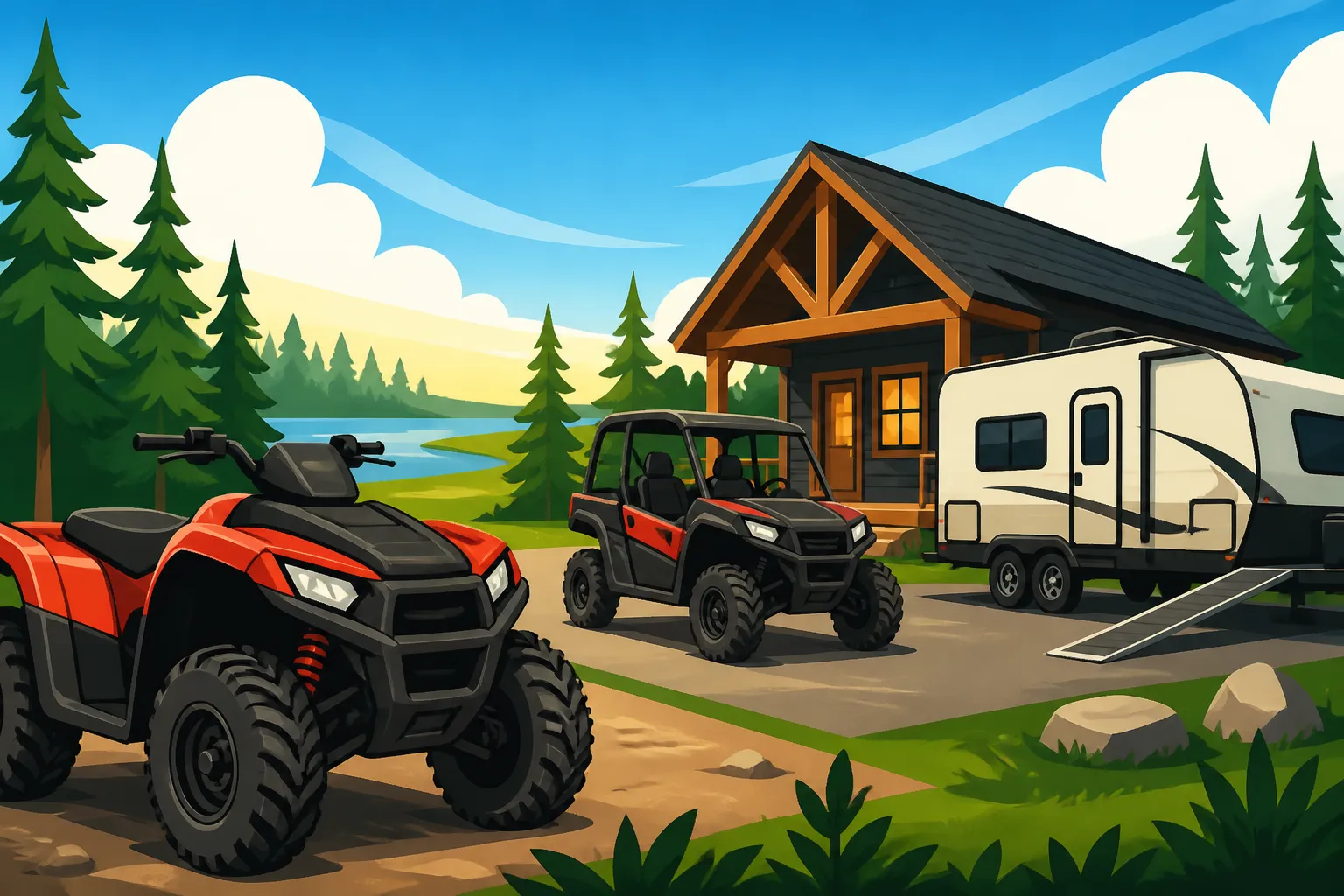
Manitoba Lodging That Welcomes Trailers
Finding a place to sleep is only half the challenge when you’re hauling an ATV or UTV around Manitoba. A narrow entrance, nowhere to turn around, or a trailer left in an exposed lot can derail an otherwise great weekend. This guide explains how to choose trailer-friendly lodging, plan around riding areas, and confirm the details before you leave home.
Choose a Manitoba base that fits your ride
A lodging listing may say it welcomes trailers, but that phrase can mean anything from a roomy campground site to permission to park a small utility trailer beside a motel. Before booking, match the property to your trailer, towing vehicle, machine, and riding plans.
Start with the riding region, not the room
Think about how much time you want to spend driving between your bed, your trailer, and the trails. A base near Steinbach or Piney may suit a Sandilands-area weekend, while riders heading toward Duck Mountain may look around Dauphin or the park’s surrounding communities. For Interlake riding, Gimli and nearby communities can be useful starting points. The right choice depends on your intended route and where you can legally ride.
Don’t assume that a nearby trail is open to every kind of machine or that lodging provides direct trail access. Club trails, provincial park routes, Crown land, and private land have different access arrangements. A hotel close to a forest or trailhead is not necessarily connected to a legal ATV route. Check the riding area’s current access information, local rules, and closures before making a reservation.
It can help to sketch out the day in three parts: where the machine is stored overnight, where the trailer is parked while you ride, and how you’ll get from the property to a permitted staging area. If that last leg means towing along busy roads or crossing land without permission, choose a different base or plan to haul the machine to an appropriate trailhead. [Manitoba ATV Trails: Club Ground and Crown Land] is a useful topic to read alongside your lodging plans.
Look beyond “trailer parking”
When a property says it accommodates trailers, ask what that means in practice. A long trailer needs room not only to sit, but also to enter, turn, and leave without blocking other guests. A tight lot can be especially awkward if you arrive after dark, if other vehicles are parked along the access lane, or if you have to reverse around a bend.
Describe your setup clearly when you call: approximate trailer length, whether it is enclosed or open, the towing vehicle, and whether the ATV or UTV will stay loaded overnight. Ask whether you can park the truck and trailer together, whether there is a separate overflow area, and whether the trailer can remain there after you unload. If you need electrical service, confirm that the outlet is suitable for your equipment rather than assuming a standard campsite plug will meet your needs.
| What to confirm | Why it matters | A practical question |
|---|---|---|
| Total parking length | The truck and trailer may not fit in one space | “Can my vehicle and trailer stay connected overnight?” |
| Turning and backing room | A narrow entrance can make arrival stressful | “Is there room to turn around without backing onto the road?” |
| Overnight security | A loaded trailer may contain valuable equipment | “Where would the trailer be parked, and who can access that area?” |
| Unloading space | You may need room to inspect or unload the machine | “Can I unload on the property, and where?” |
| Power and water | Useful for some setups, but not guaranteed | “What hookups are available at the site I would book?” |
| Arrival timing | A late check-in can complicate parking | “Will someone be available to direct me to the trailer area?” |
Save the name of the person who confirmed the arrangement and, if possible, ask for the parking instructions in writing. That small step can prevent the frustrating situation of arriving with a loaded trailer only to discover the space described online is already full or too short.
Confirm trailer and machine logistics before booking
A successful riding weekend depends on more than a place to sleep. You’ll want a clear plan for parking, unloading, securing your gear, and reaching a legal route without creating a problem for the property or nearby residents.
Ask about storage, security, and unloading
A fenced area, locked storage, or well-lit parking spot can offer peace of mind, but don’t treat any of these as guaranteed unless the property confirms them. Ask whether the trailer can be left hitched overnight, whether you may remove the machine from the trailer on-site, and whether there is a designated area for equipment. If you have a UTV with a cab, add-ons, or bulky gear, explain that too; the property may have space for a small quad trailer but not a wide side-by-side setup.
Keep valuables out of sight and bring the security gear you normally use, such as a hitch lock or machine lock. Ask about the property’s rules before using a chain, wheel chock, fuel container, or wash equipment. Some hosts may be comfortable with a quick inspection and cleanup; others may not allow washing machines or handling fuel on the premises.
If you’re staying at a cabin or campground rather than a conventional hotel, confirm the exact site layout. A site can be suitable for a tent or passenger vehicle but still lack the length or turning room for a truck and trailer. For accommodation ideas tied to riding regions, [Manitoba Cabins Near a Riding Area] is a relevant companion topic. Treat any property description as a starting point, then verify the details directly.
Plan your route from the property to the trailhead
Before you reserve, check where you can unload and whether the route between the property and your chosen staging area is legal for your machine. Riders sometimes assume that a short ride along a shoulder, ditch, town street, or access road is permitted because it seems convenient. That assumption can lead to a ticket or conflict with local residents. Manitoba’s operating rules and municipal by-laws matter even when the lodging owner is happy to host riders.
If the property is not beside a legal route, plan to transport the machine to a suitable trailhead and leave the truck and trailer where parking is permitted. Confirm that the trailhead has space for your rig and that the route is open to your machine type. [Manitoba Trailheads With Trailer Parking] can help you think through the staging side of the trip, while [Manitoba ORV Road Rules Explained] is useful if your plan involves public roads or roadside travel.
Map apps can help you understand the area, but don’t treat a line on a map as permission to ride. onX Offroad can be useful for reviewing routes and planning around a region, but check the relevant local club, park, land manager, or municipality for access and closure details. Use [Manitoba Crown Land Riding Explained] as a reminder that Crown land does not automatically mean unrestricted riding, especially where leases, sensitive areas, or other restrictions apply.
Match lodging to your trip and riding style
The best place to stay depends on whether you’re planning a quick day ride, a family weekend, or several days exploring a larger area. A little advance planning can make the difference between spending the weekend riding and spending it troubleshooting parking.
For a weekend trip, keep the plan manageable
For a two-night getaway, pick one riding region and avoid trying to squeeze in distant trail systems. If you’re travelling from Winnipeg, the Eastman region may be easier to reach than a northern destination. Riders based closer to Brandon may prefer to explore Westman options. Your actual choice should depend on confirmed trail access, accommodation, and the weather—not just the shortest route on a map. [Manitoba Riding Near Winnipeg] and [Manitoba Riding Near Brandon] can help narrow the search by starting point.
Call the lodging property before committing to a non-refundable reservation. Explain your dates, trailer setup, number of machines, and likely arrival time. Then contact the relevant trail club or land manager to confirm where to unload and which routes are open. If you’re planning a longer stay, [Manitoba Weekend Riding Itineraries] can help you structure the trip without overloading each day.
Leave some slack in the schedule. A slow drive with a trailer, a fuel stop, a weather delay, or a muddy trail can all shift your plans. Choosing lodging that lets you arrive, park, and unload without rushing is often worth more than shaving a few kilometres off the drive.
For a longer ride, plan around services and conditions
When you’re staying several nights, consider what you’ll need beyond a parking space: fuel, groceries, a place to eat, cell coverage, and a route back to the trailer if weather turns. Don’t assume that fuel is available directly at a remote trailhead or that phone service will be reliable throughout the ride. Ask the lodging host what services are nearby, then confirm operating details independently before you set out. [Manitoba Riding Areas With Fuel Nearby] offers a useful planning angle.
Trail conditions can change after rain, during fire restrictions, or when land managers close an area. Check conditions close to departure and again before unloading. A route that looked appealing when you booked may be unsuitable after heavy rain or unavailable because of a closure. [Manitoba Trail Conditions Before You Haul] is worth reviewing before you tow a long distance.
For navigation, onX Offroad may help you organize route ideas and keep track of your plan, but carry a backup such as an offline map or paper map in areas with weak service. Tell someone where you expect to ride and when you plan to return. If your lodging host has local knowledge, use it for practical questions—such as road access or where trailers commonly stage—but verify riding permission with the appropriate authority.
A simple booking checklist for trailer-friendly lodging
Before paying a deposit, work through the details in one conversation. It’s easier to ask an extra question at home than to discover a problem after a long tow.
- Describe the complete setup. Give the property the approximate length and width of your truck and trailer, and say whether the machine will remain loaded.
- Confirm the parking arrangement. Ask where the rig will go, whether it can stay connected, and whether the space is reserved for your booking.
- Check manoeuvring space. Ask about entrances, tight turns, backing requirements, low branches, gates, and any steep or soft surfaces.
- Set expectations for unloading. Confirm whether you can unload on-site and whether the property has restrictions on machine use, cleaning, fuel, or maintenance.
- Ask about security without assuming a guarantee. Find out whether parking is lit, monitored, gated, or simply an open lot, then bring appropriate locks.
- Verify the ride separately. Confirm the trailhead, machine access, current conditions, and local rules with the club, park, municipality, or land manager.
- Save the details. Keep the reservation information and written parking confirmation accessible when you arrive.
- Have a backup. Identify another permitted staging location or a second lodging option in case the first plan falls through.
A good host will usually appreciate knowing what you’re bringing. Being specific helps them give you a realistic answer and gives you a chance to find another place before the trip if the setup won’t fit. When you arrive, park only where you were directed, keep noise and machine use considerate, and leave the site as clean as you found it. That’s good trail etiquette—and it makes it more likely that riders will continue to be welcome.
Disclaimer
This article is for general informational purposes only and does not constitute professional advice. Laws, prices and regulations vary by location and change over time. Consult a qualified professional for guidance on your specific situation.