A Bill of Sale From a Manitoba Neighbour
So, you've found the perfect off-road machine right here in Manitoba, maybe from a buddy, a family member, or even just a neighbour down the road. It's exciting, isn't it? But then the question hits you: how do you actually make it yours in the eyes of the law, especially when it comes to registration? The answer, more often than not, revolves around a proper bill of sale. This guide is here to walk you through exactly why that document is so crucial, what needs to be in it, and how it fits into getting your new ATV or UTV registered in Manitoba, all without the confusion of a handshake deal.
Why a Bill of Sale Is Absolutely Crucial for Registration in Manitoba
Buying an off-road vehicle from a private seller, like a neighbour, is a pretty common way to get into the sport or upgrade your ride. It feels friendly and straightforward. However, when it comes to the official stuff – like registering your new quad or side-by-side with Manitoba Public Insurance (MPI) – you absolutely cannot skip the bill of sale. It’s more than just a formality; it’s the legal foundation of your ownership.
The Legal Backbone of Your Ownership Claim
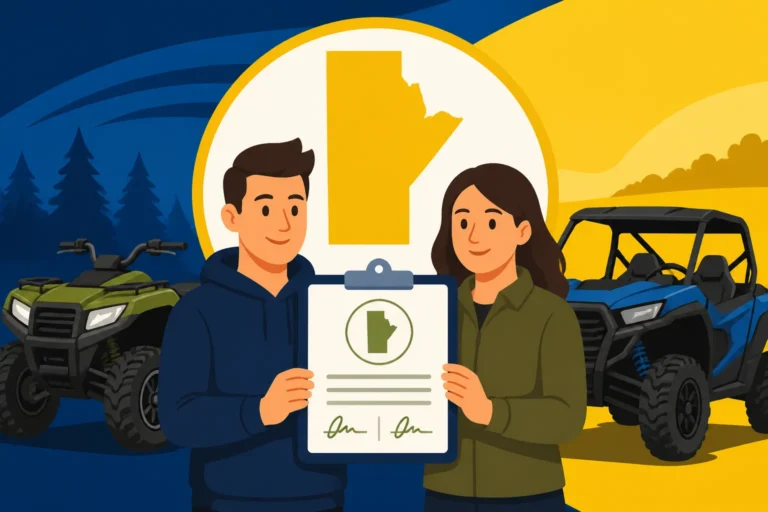
Think of a bill of sale as your machine's birth certificate, but for its ownership. Without it, you’re essentially saying, "I just have this machine now," which doesn't sit well with the official processes. MPI needs concrete proof that you are the legitimate owner of the off-road vehicle you’re trying to register. This document clearly states that the previous owner transferred ownership to you, preventing any future disputes or legal headaches.
Imagine this scenario: you've bought a fantastic side-by-side from your neighbour, paid cash, shook hands, and he even helped you load it onto your trailer. You go to register it, and the Autopac agent asks for the bill of sale. You explain it was just a verbal agreement. Suddenly, you're stuck. Without that paper trail, MPI can't confirm the transfer of ownership, and you can't get that plate. Your new machine is literally dead in the water for legal riding.
A proper bill of sale serves as irrefutable evidence that a transaction occurred, who the parties involved were, and what item was exchanged. It protects both you and the seller. For you, it proves you didn't just 'find' the machine; for the seller, it proves they legally divested themselves of it, transferring all future responsibility to you. This might seem overly formal for a friendly transaction, but it's essential for peace of mind and legal compliance.
Beyond Just a Receipt: What a Bill of Sale Does
While a bill of sale certainly acts as a receipt, its function goes far beyond simply acknowledging payment. It’s a legally binding contract that outlines the terms of the sale, detailing the specific off-road vehicle being sold, its condition, and the agreed-upon price. This last point, the purchase price, is particularly important here in Manitoba, because it directly impacts the Retail Sales Tax (RST) you’ll need to pay.
When you register your machine, MPI acts as an agent for the provincial government, collecting the necessary RST. The bill of sale is the primary document they use to determine the taxable value of your purchase. [Manitoba RST Collected at Registration] is a standard part of the process, and an accurate bill of sale ensures you pay the correct amount, avoiding any surprises or accusations of under-declaring. If the stated price is unusually low, MPI might even refer to independent valuation guides to assess a fair market value for tax purposes, so honesty is always the best policy.
Furthermore, a comprehensive bill of sale protects you from unexpected claims down the line. What if your neighbour later claims they never received full payment, or that you took something that wasn't part of the deal? A signed and dated bill of sale, detailing the full purchase price and the items included in the sale, provides clear documentation to counter such claims. It's a simple step that saves a lot of potential stress and legal hassle.
The Difference Between Buying from a Dealer and a Neighbour
When you purchase an ATV or UTV from a licensed dealer, the process for proving ownership is typically streamlined. Dealers provide official sales agreements, invoices, and often handle the initial registration paperwork themselves. They are experts in ensuring all the correct documentation is in place for a seamless transfer of ownership and tax collection. You sign, you pay, and they take care of the rest, providing you with a tidy package of documents ready for your records.
However, when you buy from a private seller, like a neighbour, the responsibility shifts entirely to you and the seller to create these crucial documents. There's no dealership paperwork to fall back on. This is where a little proactivity goes a long way. You can't just rely on the seller to know all the ins and outs of what MPI requires; as the buyer, it's in your best interest to ensure a proper bill of sale is drafted and completed.
The key takeaway here is that while the friendly, informal nature of a neighbour-to-neighbour sale is appealing, the legal requirements for registration are exactly the same as if you bought it from a showroom. MPI doesn't differentiate between the two; they just need the proper documentation to process your [Manitoba ORV Registration Through MPI]. Taking the time to get a proper bill of sale ensures your private transaction is just as legally sound as a dealer purchase.
Crafting Your Bill of Sale: Essential Elements for a Smooth Manitoba Registration
So, you understand why you need a bill of sale. Now, let’s talk about what needs to be in it. This isn't just a scribble on a napkin; it's a critical legal document. Getting the details right will save you a lot of grief at the Autopac counter.
Key Information Every Bill of Sale Needs
A robust bill of sale should leave no room for ambiguity. It needs to clearly identify who is selling, who is buying, and exactly what is being sold. Start with the basics: the full legal names and current addresses of both the seller and the buyer, along with their contact information like phone numbers. This establishes the parties involved in the transaction.
Next, you need to meticulously describe the off-road vehicle itself. This includes the make (e.g., Polaris, Can-Am), the specific model (e.g., Sportsman 570, Maverick X3), the year of manufacture, and critically, the Vehicle Identification Number (VIN). The VIN is the unique identifier for your machine, much like a serial number, and it must match the machine exactly. A good bill of sale will also include the odometer or hour meter reading at the time of sale, if applicable, which can be useful for tracking mileage and condition.
Finally, the bill of sale needs to state the purchase price clearly, the date of the sale, and the method of payment. Was it cash? E-transfer? Cheque? All these details paint a complete picture of the transaction. Utilizing a reputable template, perhaps one found on a service like LawDepot, can be incredibly helpful here. These templates are designed to prompt you for all the necessary fields, ensuring nothing important gets overlooked. Imagine going to MPI and realizing your bill of sale is missing the VIN—that’s an instant refusal, no matter how friendly your neighbour is.
The Importance of a Clear and Accurate VIN
The Vehicle Identification Number (VIN) is arguably the single most important piece of information on your bill of sale, second only to the proof of purchase itself. This unique 17-character code identifies your specific off-road vehicle globally. It’s what MPI uses to track ownership, connect the machine to your registration, and ensure there’s no mix-up with another similar vehicle. Without a correct VIN, your bill of sale is essentially useless for registration purposes.
When you're buying a machine, take the time to physically locate the VIN on the ATV or UTV itself. It’s typically stamped into the frame, often near the steering column, on a frame rail, or under the seat. Compare this number character by character to what’s written on the bill of sale. Do not rely on memory or what the seller tells you it is without checking. Errors, even seemingly minor ones like a misread letter or number, can cause significant delays and headaches when you try to register. [Matching the VIN to the Bill of Sale] is a non-negotiable step.
A mismatched or incorrect VIN can raise red flags for MPI, potentially suggesting the machine is stolen, has been altered, or that the bill of sale is fraudulent. In the worst-case scenario, you could find yourself with a machine you legally can't register and own, even if you paid for it in good faith. This simple verification step is your best defence against such unfortunate possibilities and ensures your registration process is smooth.
Signatures, Dates, and Witnesses: Making It Official
Once all the pertinent information about the parties and the machine has been filled in, the bill of sale needs to be properly executed to be legally binding and accepted by MPI. This means both the buyer and the seller must sign the document. Their signatures affirm that they agree to the terms outlined in the bill of sale and acknowledge the transfer of ownership. A missing signature from either party will render the document incomplete and unacceptable for registration.
The date of sale is equally important. This date establishes when the ownership officially transferred from the seller to the buyer. This is relevant for calculating provincial sales tax and also for any grace periods related to registration. [Manitoba Transfer of Ownership Rules] generally outline timelines for new owners to register their machines. Make sure the date is clear, unambiguous, and matches when the transaction actually occurred.
For an added layer of protection and verification, especially for higher-value machines or if you're unfamiliar with the seller, consider having a disinterested third-party witness the signing of the bill of sale. This witness should also sign and print their name, providing an extra assurance of authenticity. While not strictly required by MPI for every private sale, it can certainly help if any disputes arise later. Many comprehensive templates, like those offered by LawDepot, include spaces for witness signatures precisely for this reason, providing an extra layer of legal robustness to your transaction.
Common Pitfalls and How to Avoid Them When Buying from a Neighbour
Even with the best intentions, buying an off-road machine from a neighbour can have its hidden snags. The familiarity and trust inherent in a neighbourly relationship can sometimes lead people to skip crucial steps, which can cause significant problems down the line. It's vital to protect yourself by being aware of these common pitfalls.
The "Handshake Deal" Trap
It's tempting, especially when you trust your neighbour, to seal the deal with nothing more than a handshake and a transfer of cash. It feels good, it feels neighbourly, and it seems simple. However, for anything of significant value like an ATV or UTV, a handshake deal is a recipe for potential disaster when it comes to official processes. While it might feel "official" between two people, it has no legal standing when you try to register the machine with MPI.
Manitoba Public Insurance needs a written, tangible record of the transaction. A verbal agreement simply isn't enough to prove a change of ownership. You'll arrive at the Autopac agent’s office, excited to get your new plate, only to be turned away because you lack the fundamental proof of purchase. This isn't just an inconvenience; it can mean you can't legally operate your machine on trails or any public lands until you jump through extra hoops to prove ownership. Trying to register a machine [Manitoba Registration Without a Bill of Sale] can become a protracted and frustrating experience, often requiring affidavits or other less common forms of proof, which are far more complex than a simple bill of sale.
Even if you have the best relationship with your neighbour, insist on a proper, written bill of sale. It protects both of you. It prevents misunderstandings about the price, the condition of the machine, or the exact date of the sale. A simple document can preserve your friendship and ensure your new machine can hit the trails without legal delays.
Verifying Ownership and Liens
Just because you’re buying from a neighbour doesn’t mean you should skip the due diligence of verifying ownership and checking for liens. People move, circumstances change, and sometimes a machine might be registered in one name but financed by another. Always ask the seller for their current registration certificate. This document will show who the legally registered owner is, and you should ensure that name matches the seller on your bill of sale. If it doesn't, that's a major red flag, and you'll need a clear explanation and documentation to prove the seller has the right to transfer ownership.
Even more critical is checking for any outstanding liens on the machine. A lien means that another party (often a bank, credit union, or finance company) has a legal claim to the machine because it was used as collateral for a loan. If you buy a machine with an active lien, that lien can follow the machine, and the lender could repossess it from you, even though you paid your neighbour for it! This is a terrifying scenario that is easily avoidable.
You can often request a lien search through a provincial registry or by using an online service that specializes in vehicle history reports. While this might seem like an extra step for a neighbourly transaction, it’s a crucial one for your financial protection. If you find [A Lien on a Financed Manitoba Machine], ensure the seller pays off the lien and provides you with a release document before you finalize the purchase and hand over your money. Never assume a friendly face means a clear title.
Handling "As Is" Sales and Condition Disclosures
Most private sales of used off-road vehicles in Manitoba are conducted "as is." This term means you are buying the machine in its current condition, with no warranties or guarantees from the seller regarding its future performance or any hidden defects. Once you hand over the money, any issues that arise with the machine are generally your responsibility. Your neighbour isn't obligated to fix something that breaks a week after you've bought it.
Given this, a thorough inspection of the ATV or UTV before purchase is paramount. Don't be shy; ask to ride it, check the fluids, test the brakes, look for leaks, and inspect the tires and suspension. If you're not mechanically inclined, consider paying a trusted mechanic to perform a pre-purchase inspection. This small investment can save you from costly repairs down the road.
If the machine has any known issues, and you and your neighbour are transparent about them, it's a good practice to mention these defects directly on the bill of sale itself or in an attached addendum. While the sale is "as is," documenting known issues provides an extra layer of clarity for both parties. Comprehensive bill of sale templates, such as those you can find on LawDepot, often have sections where you can note the general condition of the item or list specific disclosures, ensuring that even friendly private sales are as transparent as possible and protecting both parties. Don't just accept a machine at face value; kick the tires, ask questions, and document what you learn. This proactive approach is particularly important for avoiding problems with [Manitoba Machines With No Paperwork] where the history might be even less clear.
The Registration Process with Your New Bill of Sale
You've done your due diligence, drafted a comprehensive bill of sale, and now you're ready to make your new off-road machine officially yours! The final step is to head to your local Autopac agent to complete the registration. This process is usually quite straightforward once you have all your ducks in a row.
What to Bring to Your Autopac Agent
When you visit an Autopac agent to register your newly acquired ATV or UTV, you'll need to come prepared with a few key documents. First and foremost, you'll need that properly completed bill of sale from your neighbour. This document is the cornerstone of your registration application, proving your purchase and ownership. Ensure it's original, legible, and contains all the details we discussed earlier, especially the VIN, sale price, and both parties' signatures.
In addition to the bill of sale, you'll need a valid form of personal identification, such as your Manitoba driver's license or another government-issued ID. The Autopac agent needs to confirm your identity as the new owner. It's also helpful if the seller has provided you with their previous registration certificate, though this isn't strictly necessary if your bill of sale is robust. The agent will use these documents to accurately input your information and the machine's details into the provincial system. [Manitoba Autopac Agents and ORV Registration] are your one-stop shop for these services, trained to guide you through the process efficiently.
Make sure you bring all your documents neatly organized. A little preparation goes a long way in making your visit quick and hassle-free. The agent will review everything, enter the machine's details, confirm the ownership transfer, and prepare your new registration certificate and plate.
Calculating and Paying Retail Sales Tax (RST)
One of the critical functions an Autopac agent performs during registration is the collection of provincial Retail Sales Tax (RST). In Manitoba, off-road vehicles are subject to RST, which is calculated based on the purchase price stated on your bill of sale. This is why having an accurate purchase price on your bill of sale is so important; it's the figure the agent will use for tax calculation.
It's important to understand that MPI uses the greater of the purchase price or the average wholesale value (often referred to as "book value") to calculate the RST. So, even if your neighbour gave you a "deal" and you paid significantly less than the machine's market value, MPI might still tax you based on that higher book value to prevent under-declaration. [Manitoba's 7 Percent RST on a Machine] is the rate, and it's applied before the federal GST is added on top. The agent will clearly outline the total amount of tax due, and you'll pay this directly at the time of registration.
This process ensures that all off-road vehicle sales, whether new from a dealer or used from a private seller, contribute fairly to provincial revenues. Don't be surprised by this cost; it's a standard part of registering any vehicle in Manitoba. Be prepared to pay this amount when you register, as it's required before your registration can be finalized.
Understanding Your New Registration and Plate
Once all the paperwork is processed and the fees and taxes are paid, you’ll walk out with your new off-road vehicle registration certificate and your shiny new licence plate. The registration certificate is a vital document that proves your machine is legally registered in Manitoba. It contains all the pertinent details about your ATV or UTV, including the VIN, your name as the owner, and the expiry date of the registration.
It is absolutely crucial that you [Carrying Your Registration Card on Every Ride]. Law enforcement officials, conservation officers, and even park staff can request to see this document at any time. Think of it like your driver’s license for your machine – you need to have it with you. Keep it safe from the elements, perhaps in a waterproof pouch, but always accessible.
You will also receive one licence plate for your machine. Unlike cars that get two, [Manitoba Issues One Plate, Not Two] for off-road vehicles. Make sure you mount this plate securely and visibly on your ATV or UTV, following the specific mounting guidelines for your machine type. This plate is your machine’s official identifier. With your new registration certificate in hand and plate properly mounted, you are now officially ready to explore Manitoba’s trails and backroads with peace of mind.
Disclaimer
This article is for general informational purposes only and does not constitute professional advice. Laws, prices and regulations vary by location and change over time. Consult a qualified professional for guidance on your specific situation.