Manitoba Has No ATV Trail Pass
A rider planning a weekend near Duck Mountain or the Eastman trails can easily assume a separate ATV trail pass is required. Manitoba’s system is different: there is no province-wide ATV trail pass to buy, but registration, trail access, park permits, land permission and local rules still matter. This guide explains what you may need before unloading your quad or side-by-side.
What “no ATV trail pass” means in Manitoba
There is no province-wide pass for riding ATV trails
Manitoba does not have a general ATV trail pass that riders must buy for each ride, day or trail network. That can make trip planning feel simpler, especially if you have ridden in a province where a trail pass is part of the usual checklist. But “no trail pass” does not mean that every trail is open or that paperwork is unnecessary.
The key distinction is between paying for access to a trail network and meeting other requirements that apply to your machine or destination. A registered ATV may still be barred from a particular route, and a machine that is allowed on a designated park route may still need to meet the park’s entry and operating rules.
That difference matters when you are planning a trip from Winnipeg, Brandon, Steinbach or farther north. Before you haul a machine to a trailhead, check the route, the land manager’s instructions and any local restrictions. Manitoba Has No ATV Trail Pass is a useful starting point for understanding the distinction, but the trail’s own access rules are what determine whether you can ride there.
Registration and trail access are separate questions
Registration is about the machine and its legal status. Trail access is about where you intend to ride and whether that land is open to your machine. Neither answer automatically supplies the other: having registration documents does not grant permission to cross private land, and finding a trail open to riders does not remove registration obligations.
For a Manitoba-registered off-road vehicle, a trails fee is collected as part of registration. That fee is not a ticket to a particular trail, a daily trail pass or permission to enter every park. It is part of the province’s registration system, and the money is associated with trail-related funding. Manitoba’s Off-Road Trails Fee Explained and Manitoba Trails Fee Collected With Registration cover that distinction in more detail.
A practical example: you register your quad, carry the registration certificate and drive to a club trail. You still need to confirm the trail is open, follow the club’s access conditions and respect closures. If the route crosses a lease, private property or a provincial park, additional permissions or rules may apply.
What Manitoba ATV and UTV riders may need instead
Registration is not a trail pass
Most riders should begin by asking whether their machine must be registered, rather than searching for a trail-pass checkout page. Registration requirements depend on the machine, the rider’s circumstances and any applicable exemption. Do not assume that a quad used only on a farm, at a cabin or on private land is automatically exempt; the details matter.
Keep the registration certificate with you when riding. It is easy to leave it in a truck glove box or at home, particularly when the ride starts at a cabin rather than a formal staging area. A protected document sleeve can help keep the certificate readable after a dusty or wet day. Some riders look for a simple weather-resistant pouch at an outdoor retailer or on Amazon, but the important point is that the document stays available and legible.
If you have just bought a used machine, check the ownership and registration paperwork before heading out. A bill of sale, transfer information and the machine’s VIN may all be relevant when you register it. Manitoba Registration Before Your First Ride is a useful checklist for avoiding a preventable paperwork delay.
The registration trails fee is not charged like a day pass
The registration-related trails fee is different from a pass that is bought for a specific trail or riding day. It is collected with registration, rather than at each trailhead. That means riders should not expect to pay a separate province-wide trail admission charge every time they go out, but they should still budget for the costs attached to their machine and destination.
The fee also does not mean the province maintains every route or guarantees that a trail will be open. Local clubs, landowners and public agencies may have different roles in maintaining routes, managing access and posting closures. A trail can be muddy, damaged, temporarily closed or unsuitable for your machine even when your registration is valid.
For a second machine, do not assume that one registration payment or one document covers every ATV or UTV you own. Registration is tied to the machine, and the associated requirements should be checked for each vehicle. For background on how the trails funding is handled, see Where Manitoba’s Off-Road Trails Fee Actually Goes.
Your home registration may matter if you are visiting
Visitors often bring a machine registered in another province or state and wonder whether Manitoba requires them to buy a local trail pass. Manitoba does not have a province-wide ATV trail pass for visitors to purchase. A visitor’s home registration and insurance may be relevant, but the rider must still meet Manitoba’s operating rules while riding here.
Do not treat the visitor exemption as permission to ignore your home requirements. Make sure the machine’s registration is valid where it is normally registered, and carry proof as required. Manitoba rules about road crossings, helmets, age, equipment and permitted riding areas can apply even when the machine has out-of-province plates.
A rider coming from Saskatchewan, Ontario, Minnesota or North Dakota should check both sides of the trip: the home jurisdiction’s registration and insurance requirements, plus Manitoba’s rules for visiting machines and local access. Manitoba Visitors Registered at Home explains why a visitor generally does not buy a Manitoba trails fee while still needing to follow the rules that apply in Manitoba.
A quick comparison of fees, permits and permissions
The phrase “trail pass” often gets used loosely, which is why riders can end up looking for the wrong document. Use this comparison to identify what you actually need to check.
| Item | What it generally relates to | Is it a province-wide ATV trail pass? | What to check |
|---|---|---|---|
| ATV or UTV registration | The machine’s registration and associated requirements | No | Whether the machine must be registered, what documents to carry and whether an exemption applies |
| Off-road trails fee | A fee collected with applicable registration | No | Whether it applies to your registration and how it is described in the current rules |
| Club membership or club fees | Participation in or support for a specific club | No | Whether membership is optional, what it covers and whether a particular ride has conditions |
| Provincial park vehicle permit | Vehicle entry or use requirements at a provincial park | No | Which vehicle needs a permit, where it must be displayed and the park’s rules |
| Special event permit | An organized ride or event, where required | No | Whether the event organizer has obtained the necessary authorization |
| Landowner or lease-holder permission | Access to private land or certain leased land | No | Who controls access and whether permission has been granted |
| Local by-law or closure condition | Rules for a municipality, community or specific route | No | Whether the route is open to off-road vehicles and any local restrictions |
The table is a sorting tool, not a substitute for checking the rules for your exact ride. For example, you may have current registration and still need permission to cross land, or a park permit for the vehicle bringing your machine into a park.
Provincial parks, clubs and organized rides
Provincial park permits are not ATV trail passes
Manitoba provincial parks have their own entry and use requirements. A park vehicle permit is not the same as a province-wide ATV trail pass, and having one does not mean that an ATV may ride anywhere inside the park. Routes for off-road machines can be limited to designated areas, and some parks may have no route open to ORVs at all.
This catches people out when they arrive with a truck and trailer, pay or display the required park permit, and assume the ATV is therefore cleared to ride. The permit and machine rules answer different questions. Check whether the park allows the machine, which routes are designated, and whether temporary closures or seasonal restrictions apply. Manitoba Park Vehicle Permits and Manitoba Provincial Park Machine Rules address those separate parts of a park visit.
If you plan a ride in Duck Mountain Provincial Park or another park area, check the official park information before you leave. Do not rely on an old map, a social media post or a route someone remembers from a previous season. Access can change, and a route shown for hiking, cycling or snowmobiling is not automatically open to ATVs.
Club trails can have their own conditions
A club may maintain, map or promote riding routes, but that does not turn its trail into a province-wide pass system. The club’s access arrangements may involve membership, landowner agreements, route-specific etiquette or temporary closures. Those conditions vary, so contact the relevant club or check its current trail information before setting off.
Think of club membership as a relationship with a particular organization, not as a universal licence to ride every Manitoba trail. Some clubs welcome non-members on certain routes; others may have conditions or events that are intended for members. A club may also ask riders to avoid a section because of wet ground, maintenance work, hunting activity or a landowner’s request.
If the practical question is whether your group can use a specific route, ask the club directly rather than guessing based on a map symbol. Manitoba Club Affiliation Fees Explained can help distinguish club affiliation from a rider buying a trail pass. Also check Manitoba Trail Conditions Before You Haul before making a long drive with a trailer.
Organized events may need separate authorization
A casual ride with friends and an organized public event are not always treated the same way. An event organizer may need to arrange permits, land access, insurance or other approvals. Riders should not assume that because a route is normally open, a large organized ride can use it without extra coordination.
If you are joining an event, ask the organizer what approvals have been handled and what participants must bring. This is especially sensible when the event uses multiple routes, crosses different types of land or expects a large group to arrive together. The permit responsibility may belong to the organizer, but that does not remove your responsibility to follow the event instructions.
If you are organizing a group ride yourself, plan ahead. Confirm route access, check whether an event permit is required, and make sure participants understand the rules before they unload. Manitoba Special Event Permits is relevant when a ride is organized rather than simply a few friends meeting for an outing.
Checking whether a trail is actually open to you
Start with the land manager and the route
Before leaving home, identify who manages the route you want to ride. A named trail may run through club land, Crown land, a provincial park, private property or a combination of areas. Each segment can have its own access conditions, so a trail name alone is not enough to establish that the whole route is open.
Look for current maps, closure notices and trailhead signs. If a route passes through a community or municipal area, local rules may affect where an off-road vehicle can travel. If it crosses a lease or private property, the permission of the person controlling access may be needed. Do not treat a visible path, tire tracks or an online map as proof of permission.
This is where a quick phone call can save a frustrating day. Ask the club, park office, municipality or landholder the specific question: “Is this route open to an ATV or UTV this weekend, and are there any conditions?” A clear answer is more useful than arriving at a gate and discovering that the route is closed or permission was never granted.
Look for closures and seasonal restrictions
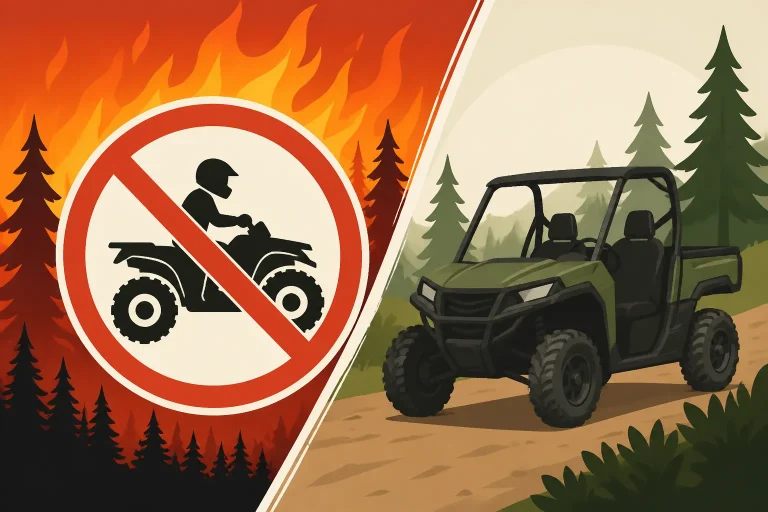
A trail that was open on your last visit may not be open now. Wet conditions can make a route vulnerable to rutting, and fire restrictions or land-management decisions can close areas temporarily. Wildlife, hunting activity, maintenance work and local concerns can also affect access.
Before a longer ride, check the latest trail or area notice, then look again on the day you travel if conditions are changeable. This is particularly important when planning in remote areas, where a closure discovered at the trailhead can mean a substantial return trip. Keep a backup plan that uses a route you have confirmed is open, rather than improvising onto an unapproved track.
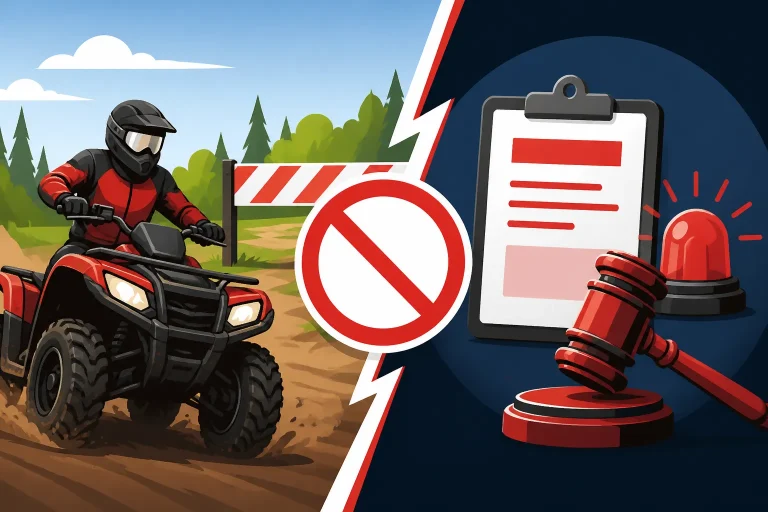
When in doubt, turn around. Riding around a barrier or taking an unmarked bypass can damage land, violate access conditions and create trouble for other riders. A short delay is better than making a temporary closure permanent by leaving a mess or ignoring a land manager’s instructions.
Respect access permission even when there is no fee
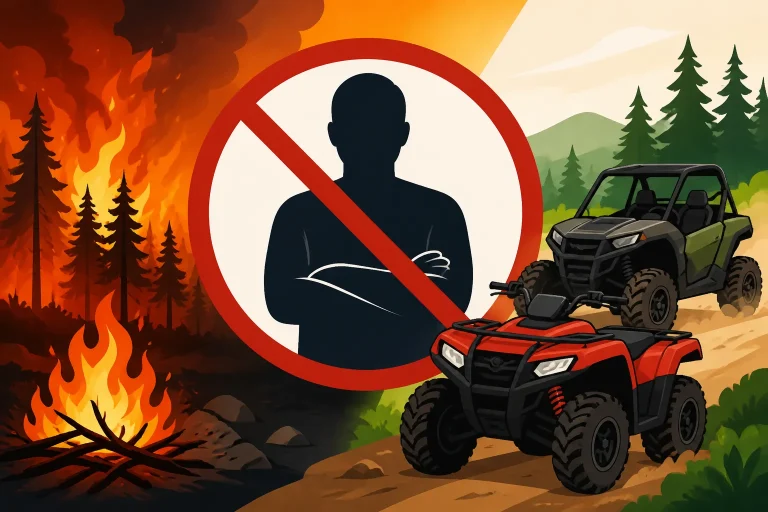
“No pass required” is not the same as “no permission required.” Private land remains private, and some Crown land areas have conditions or restrictions. A Crown lease may be occupied or managed by a lease-holder, and access may depend on that person’s consent. Be especially careful around crops, livestock, buildings, gates and sensitive ground.
If you are unsure who controls the land, do not assume that a public map settles the question. Ask the club or relevant office for guidance, or contact the landholder when that is the appropriate route. Keep permission specific: confirm where you may ride, whether a group is allowed, and whether the permission applies on the date you plan to visit.
Avoid leaving gates open, disturbing livestock or riding through standing crops. These actions can harm relationships between riders and landowners, even if the machine was otherwise registered and the group believed the route was accessible. Good access habits help keep routes available for everyone.
What to carry and check before riding
Keep registration and ownership documents protected
Carry the documents required for your machine and be prepared to show them if asked by an officer. The registration certificate should be readable and accessible, not buried under tools or left in a vehicle parked several kilometres from the trail. A waterproof sleeve or small document pouch can be a practical fix for riders who travel through rain, mud or snow.
A rider who has just bought a machine should check that the registration and ownership details are in order before relying on it for a weekend trip. Compare the VIN on the machine with the paperwork, and make sure any transfer information is complete. If something does not match, sort it out before the ride rather than hoping no one will ask.
If you are assembling a basic document kit, Amazon is one possible place riders look for a weather-resistant sleeve, though a local outdoor shop or an item you already own may work just as well. Choose something that keeps paper dry and does not obscure the information when you need to read it.
Check the machine, safety equipment and route details
A trail pass question is only one part of a safe ride plan. Confirm that your machine is suitable for the route, that required equipment is working and that riders have the safety gear they need. The route’s terrain and weather matter: a machine that handles a maintained gravel trail comfortably may struggle in muskeg, deep mud or a narrow, rocky section.
For an ATV or UTV ride, consider fuel, a first-aid kit, water, basic tools, a charged phone or radio where appropriate, and a map that does not rely entirely on cellular service. A waterproof pouch can also keep a printed map or emergency contact details usable. If you are buying a simple storage pouch or compact organizer, Amazon may offer options, but check dimensions and closures so it suits the items you actually carry.
Tell someone where you are going and when you expect to return, especially for a remote ride. Group leaders should agree on a pace, regrouping points and what to do if a machine breaks down. Those small preparations matter more than carrying an unnecessary trail pass that Manitoba does not require.
Confirm the requirements for the exact vehicle and riders
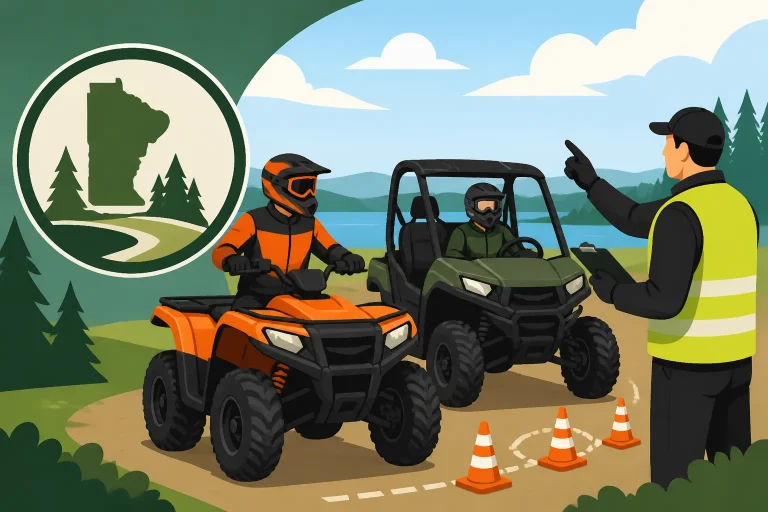
An ATV and a side-by-side may raise different questions about passenger capacity, seat belts, helmets and permitted routes. Check the manufacturer’s intended passenger design and the rules that apply to the machine. Do not add passengers beyond the seating positions provided or assume that a UTV’s cab makes every safety requirement disappear.
Age also matters. Young riders may face supervision or age-related restrictions, and a parent’s presence does not necessarily remove every limit. If children are joining the trip, check their eligibility, the machine’s size and the route’s difficulty rather than relying only on a manufacturer’s age label.
Visitors need to pay attention to Manitoba’s operating rules, too. A valid out-of-province registration does not exempt a rider from Manitoba rules about helmets, crossings, roadways, lighting or where off-road vehicles may operate. Before the group leaves the staging area, make sure everyone understands the route and the basic safety plan.
Common misconceptions that cause problems
“I paid the trails fee, so every trail is open”
The trails fee is connected to registration, not universal access. It does not unlock a park route, override a club closure or provide permission to cross private land. This is one of the most important distinctions for a new Manitoba rider to understand.
A rider may have paid all the expected registration costs and still be at the wrong trailhead, on a closed route or in an area where access is restricted. Conversely, a visitor may not pay Manitoba’s registration trails fee but still be allowed to ride when their home registration is valid and the route is open to visiting machines.
The safer habit is to treat registration, access and destination permits as separate checklist items. Confirm each one independently instead of assuming that one payment settles every question.
“No trail pass means no costs”
There may be no province-wide ATV trail pass, but owning and riding a machine can still involve registration, insurance, club membership, park permits, event costs, fuel, maintenance and transportation. Which of those apply depends on the machine, route, rider and destination.
The costs can also arise at different points. Registration-related charges are handled through the registration process; park permits relate to park entry; club fees relate to a particular organization; and an event may have its own arrangements. Keep those categories separate when budgeting, so you do not mistake one charge for another.
If someone tells you that Manitoba has “no fees,” ask what they mean. They may mean no daily trail pass, not that registration or destination requirements are free. A precise question prevents an avoidable surprise at a service counter or park entrance.
“A trail shown online must be legal”
Maps are useful planning tools, but they can be old, incomplete or designed for a different activity. A line on a map may show a hiking route, a snowmobile corridor, a fire guard or a track that crosses land where ATV access is not allowed. A map also may not show a temporary closure.
Use maps alongside current information from the club, park, municipality or land manager. If there is a conflict between an old map and a current closure notice or posted sign, follow the current restriction. Do not create a new route around a closed section.
When travelling to an unfamiliar region, save or carry the information you need before leaving an area with reliable service. Amazon and other retailers offer map cases and small organizers, but no accessory replaces a current route check or permission from the people responsible for the land.
A simple pre-ride checklist
Before you load the machine
- Confirm whether the ATV or UTV must be registered and make sure its documents are current.
- Check that the registration certificate and ownership information match the machine.
- Identify the exact trail, trailhead and land manager.
- Confirm the route is open to your type of machine on the day you plan to ride.
- Check whether the destination is in a provincial park and whether a park vehicle permit or other entry requirement applies.
- Ask about private land, Crown lease access or local by-laws if the route crosses those areas.
- If joining an organized ride, confirm that the organizer has handled any required event permissions.
- Pack safety equipment, a first-aid kit, water, tools and a way to navigate if phone service is unavailable.
Doing these checks before loading is far less frustrating than finding out at the trailhead that the route is closed or the paperwork is at home. It also gives you time to choose another destination if the first option is unavailable.
At the trailhead
Read posted signs before unloading. Signs may explain closures, permitted uses, speed restrictions, seasonal conditions or sensitive areas to avoid. If the sign conflicts with what you expected from an online map, do not proceed until you have clarified the route.
Keep the group together and make sure every rider understands where the route goes and where it ends. In a mixed group, do not assume that everyone has the same experience level or has read the rules. A short discussion about crossings, stopping points and emergency plans can prevent confusion once the machines are moving.
If the route is muddy, damaged or crowded, ride conservatively. Avoid widening the trail to get around a boggy section, and do not ride through vegetation or onto land that is not part of the approved route. Responsible choices protect access and make future rides easier for everyone.
Before planning your next trip
Keep a short record of useful contacts, current maps and the places where you confirmed access. That makes repeat trips simpler, but do not assume last season’s information remains valid. Recheck route status, park rules and land access each time, especially after storms, during fire restrictions or when the trail is known to be seasonally sensitive.
For a visitor, keep home registration and insurance documents available, then check Manitoba’s operating rules for the area. For a Manitoba owner, treat registration and the trails fee as one part of the plan, not as a substitute for route permission. Either way, the central question is not “Where do I buy a trail pass?” but “Is this machine properly documented, and is this particular route open to me?”
Disclaimer
This article is for general informational purposes only and does not constitute professional advice. Laws, prices and regulations vary by location and change over time. Consult a qualified professional for guidance on your specific situation.