Trailering East on a Provincial Road
A ride east of Winnipeg can look straightforward on a map, but towing an ATV or UTV adds its own problems: a trailer that sways at highway speed, a turnoff that comes up sooner than expected, or a trailhead with nowhere to park. This guide covers how to plan the drive, secure your machine, and arrive ready to ride in Manitoba’s Eastman region.
Plan the Eastbound Route Before You Hitch Up
Pick the trailhead first, then choose the highway
“Heading east” can mean several different trips. You might be towing toward a riding area near Steinbach, looking for a route around Lac du Bonnet, or travelling farther into the Whiteshell area. The best highway depends on the specific trailhead, where you are starting, and whether your trailer can comfortably manage the approach roads.
Start with the destination’s exact staging or parking location—not just the name of a nearby town. A map pin for a community centre or campground may be several kilometres from the actual trail access. Confirm the entrance, parking area, and any posted directions through the riding area or club responsible for that location. Manitoba Eastman Riding Areas can help you narrow down the broader region, while Riding Out of Steinbach is useful when Steinbach is part of your plan.
Once you know the destination, plan the route from your driveway to the trailer parking area. From Winnipeg, eastbound travel may involve a provincial highway followed by a turn onto a smaller highway or local road. Don’t assume the most direct route is the easiest one to tow. A slightly longer drive on roads that suit your truck and trailer may be less stressful than navigating a tight turn, rough shoulder, or unfamiliar gravel approach.
Check conditions and access close to departure
A route that was comfortable last month may be a poor choice after heavy rain, roadwork, or seasonal restrictions. Before leaving, check provincial road information and local updates, then look for current trail and access notices. If the final kilometres include gravel, expect slower travel and give yourself extra time. Dust can reduce visibility, while washboard and potholes can unsettle a loaded trailer and loosen gear that seemed secure at home.
Trail conditions matter even when your vehicle will stay on the highway. A muddy or closed trail may mean changing your destination after you’ve already hauled the machine across the region. Manitoba Trail Conditions Before You Haul is a useful planning topic to review before committing to a particular trailhead. Confirm whether the area is open to the kind of riding you intend to do, and whether there are separate restrictions for parking, access roads, or designated routes.
A mapping app such as onX Offroad can help you understand the surrounding area and keep your planned route visible while travelling. Treat app information as a planning aid, not as permission to drive or ride anywhere shown on a map. Confirm access with the land manager, club, or other responsible authority, and obey posted signs and closures. This is particularly important when a line on a screen appears to connect a public road to a trail: it may cross private property, a lease, or an area where motorized travel is not permitted.
Give yourself time for the final approach
The last part of a tow can be harder than the highway portion. You may be looking for a trailhead sign while managing a long vehicle combination, following a gravel road, or trying not to block traffic as you slow down. Save the destination in advance, review the approach before you set off, and decide where you can safely pull over if you need to check directions.
Do not rely on mobile service being available at every trailhead or along every stretch of rural road. Download or save the information you need before leaving town, and keep a written note of the entrance or turnoff if the route is unfamiliar. onX Offroad can be one layer of that plan, but carry a second option—such as an offline map or printed directions—rather than assuming your phone will have a signal when you need it.
Prepare the Trailer and Load the Machine Carefully
Check the towing setup before departure
A trailer that is appropriate for one ATV may not be suitable for a heavier side-by-side, especially once you account for fuel, accessories, spare gear, and any other cargo. Check the towing and payload limits for your vehicle, the trailer’s capacity, and the machine’s transport requirements. If you are unsure how the combined weight is distributed, get qualified help rather than relying on how the trailer looks while parked.
Before every trip, inspect the hitch connection, safety chains, electrical connection, tires, and lights. Confirm that the trailer sits level when attached and that its coupler is secured correctly. Check tire condition and inflation according to the relevant equipment guidance, and look for obvious damage or loose components. A quick light check with another person can catch a dead signal before you reach a busy highway.
The trailer itself also needs to meet applicable requirements for road use. Registration, plates, lighting, and other equipment rules may depend on the trailer and its use, so check the requirements rather than assuming the ATV’s registration covers the trailer. For a starting point, see Trailers and Their Own Plates in Manitoba. If you are unsure about a particular setup, ask a qualified service counter or the relevant Manitoba authority before heading out.
Load and tie down the ATV or UTV
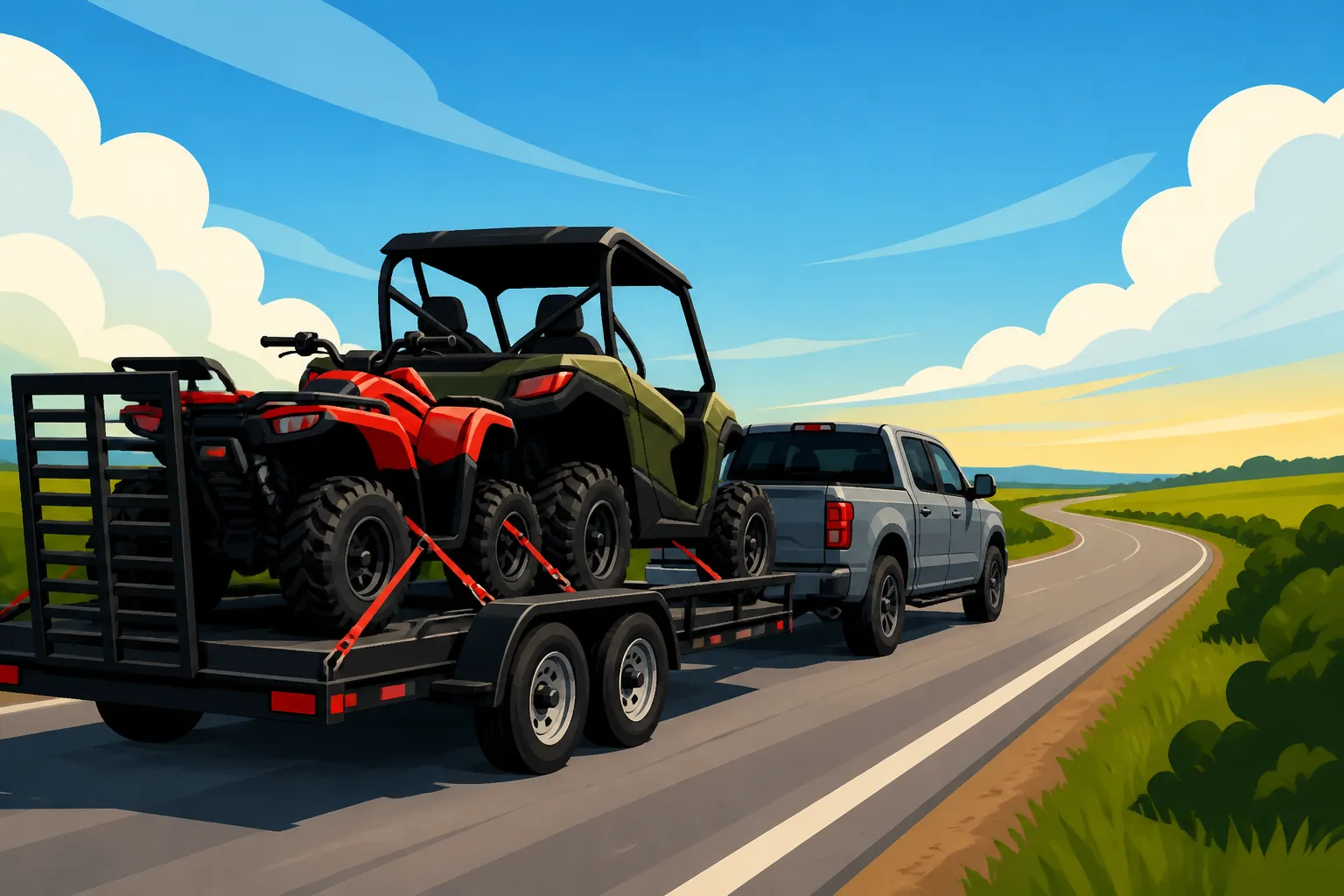
Park on firm, level ground and use a ramp designed for the machine and trailer. Keep bystanders clear of the loading path, move slowly, and avoid making sudden steering or braking corrections on the ramp. If the trailer has a winch or another loading aid, use it as intended. A machine that feels unstable during loading should not be hurried onto the deck.
Position the machine so that the load is balanced and secure, following the trailer and vehicle manufacturers’ guidance. Use suitable tie-down points on the machine and trailer. Straps should be in good condition, attached securely, and tightened enough to prevent the machine from shifting without damaging components. Avoid fastening to parts that are not intended to take a tie-down load, and make sure loose strap ends cannot flap against the machine or road.
After securing the load, push and check the machine from several directions to look for movement. Then walk around the trailer and inspect each strap, ramp, latch, and accessory. Recheck the tie-downs after the first short stretch of travel, and again whenever you stop. If the straps have loosened or the machine has shifted, fix the problem before continuing.
| Before towing east | What to check | Why it matters |
|---|---|---|
| Tow vehicle and trailer | Capacity, hitch connection, chains, tires, lights | Helps identify an unsafe setup before highway travel |
| ATV or UTV | Weight, loading method, secure tie-down points | Reduces the chance of movement or damage |
| Route | Turnoffs, road conditions, final approach | Helps avoid rushed manoeuvres and unsuitable roads |
| Trailhead | Access, parking, current closures | Prevents arriving at an unusable or restricted location |
| Paperwork and permits | Trailer requirements and any site-specific permits | Avoids assuming one document covers every part of the trip |
Pack for the drive as well as the ride
It is easy to focus on helmets, fuel, and riding gear and forget the towing-day basics. Bring gloves suitable for handling straps, a tire gauge, a flashlight, drinking water, and the tools needed for small, safe adjustments. Keep essentials accessible in the tow vehicle rather than buried beneath the machine or inside a locked storage box.
Secure all equipment so it cannot slide, bounce out, or obstruct your view. A fuel container, cooler, ramps, and tool bag can all become a problem if they are loose. Keep heavy items properly distributed and secured, and do not overload the trailer with gear simply because there is space left on the deck.
A little planning can also make the return trip easier. Leave room to stow muddy equipment without letting it interfere with lights, the plate, or visibility. If you expect to bring back wet or dirty gear, pack a tarp or suitable storage containers and consider how you will secure them before the ride begins.
Arrive Safely and Use the Trailhead Properly
Park without blocking the access point
When you reach the trailhead, slow down early and follow posted instructions. A parking area can be busy with trucks, trailers, riders unloading, and people moving between vehicles. Do not stop in the roadway or across an entrance while you decide where to go. If you need to check a map, pull into a safe place first.
Before unloading, look for signs about designated parking, permitted routes, closures, and local rules. Do not assume that a wide shoulder, cleared patch, or nearby open area is approved trailer parking. Manitoba Trailheads With Trailer Parking can help with planning, but conditions and available space can vary by location. When in doubt, contact the relevant club or land manager before the trip.
Once parked, make sure the vehicle and trailer do not block emergency access or the turning room other drivers need. Keep ramps and equipment within your parking space, and put everything away before moving the truck. If the area is full, do not create a second row that traps other vehicles or pushes trailers onto a road.
Separate the road trip from the off-road ride
Towing an ATV or UTV on a provincial road is different from operating the machine on that road. Keep the off-road machine secured on the trailer until you reach a lawful place to unload, and do not use a shoulder or roadside area as a shortcut to a trail. The rules for operating an off-road vehicle are separate from the rules for towing it, and a route visible on a map does not establish that riding there is allowed.
Before unloading, check that the machine’s registration and required documents are in order for the planned ride. Make sure the operator knows which routes are open and what local restrictions apply. Manitoba Park Vehicle Permits is relevant if your destination involves a provincial park, but a permit for a park vehicle does not automatically mean an ATV or UTV can travel on every road or area within that park. Confirm the rules for the specific site and designated route.
If your ride will take place on a club trail or other managed route, follow signs and any instructions provided at the trailhead. Keep the unloading area clear, use designated access points, and avoid riding through parking areas faster than necessary. Manitoba Trail Etiquette Locals Expect offers helpful background on being considerate around other riders and trail users.
Build a route plan that works without perfect signal
A good navigation plan is more than a line from Winnipeg to a trail. Save the trailhead location, identify the key road turns, and note a backup stopping point where you can safely regroup. Share the plan with someone who is not riding with you, especially if you are travelling into an unfamiliar area or expect limited service.
You can use onX Offroad as one reference for organizing route information, but compare what you see with official road notices, trailhead signs, and local access information. If the app shows a route or connection that looks uncertain, pause and verify it before following it. This avoids the common frustration of reaching a gate, a private access point, or a road that is unsuitable for a loaded trailer.
For a group trip, make sure every driver has the destination and knows the meeting point. If one vehicle gets separated, a clearly named parking area is much easier to coordinate than “the trail entrance somewhere past the turn.” Manitoba Trail Apps and Maps can help you think through navigation options, but it is still wise to save essential details offline and keep a backup plan.
A Simple Pre-Trip Routine for an Eastbound Ride
The evening before departure, confirm the trailhead is open, review the road approach, and check that your towing vehicle and trailer are ready. Load the machine on level ground, secure it carefully, and make a full walk-around inspection. Save directions and access details before you leave, rather than trying to sort them out from the roadside.
On the day of the trip, allow extra time for slower travel, fuel or rest stops, and the final approach. Stop safely if you need to check the trailer or navigation, and recheck the load after the first part of the drive. At the destination, follow posted parking and riding instructions, unload without blocking other users, and keep the machine off roads and areas where it is not permitted.
A little extra preparation can spare you the most aggravating kind of trail-day delay: arriving with a perfectly good machine but nowhere safe or lawful to unload it. Plan around the actual trailhead, treat maps as aids rather than permission, and make the trailer part of the trip plan—not an afterthought.
Disclaimer
This article is for general informational purposes only and does not constitute professional advice. Laws, prices and regulations vary by location and change over time. Consult a qualified professional for guidance on your specific situation.