Crops and Gated Rangeland to Avoid
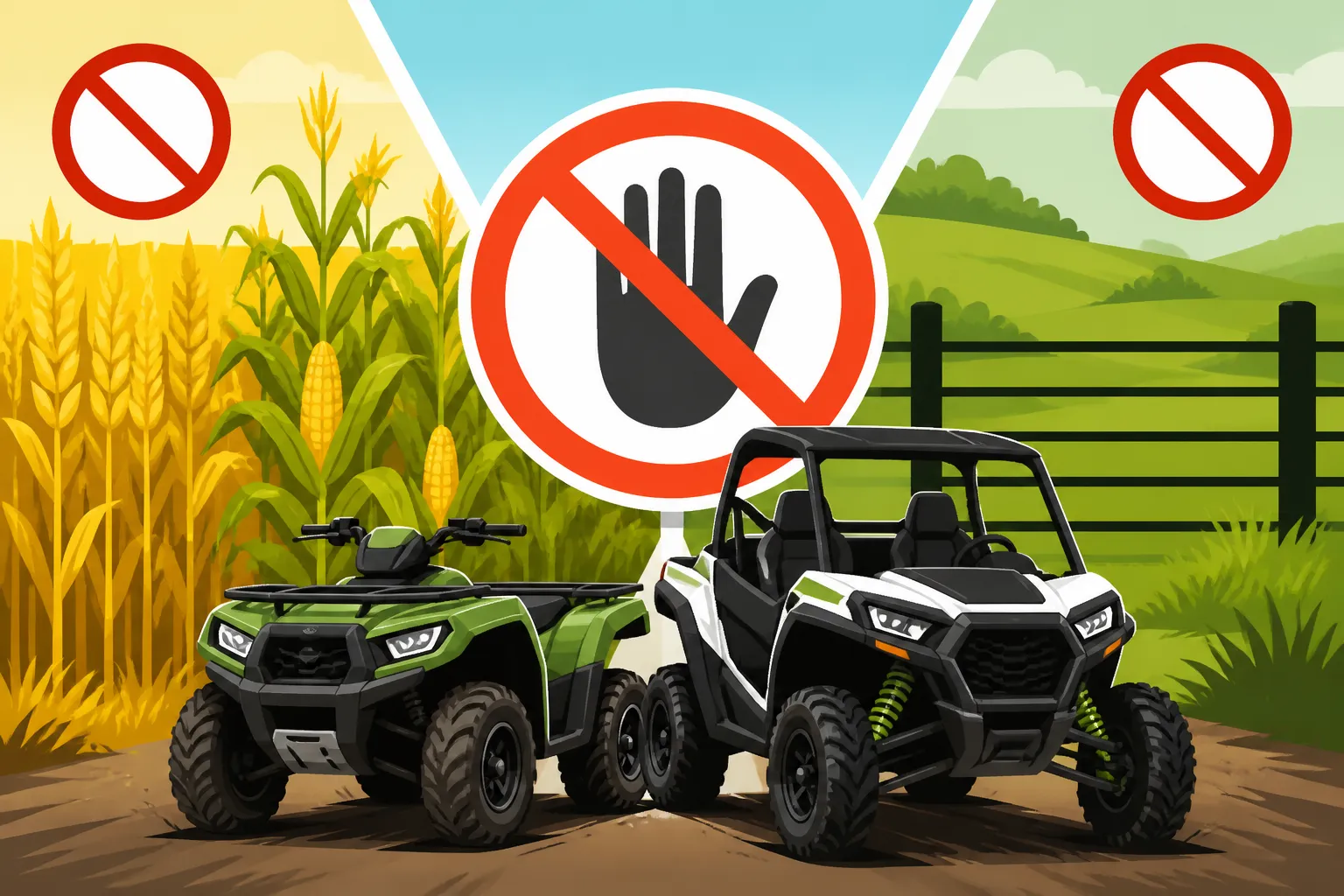
A mapped line can look like a tempting shortcut across a Manitoba field, but a trail on a screen does not automatically give you permission to ride there. Crops, pasture and gated rangeland can be private or under an agricultural lease, and even brief crossings can damage land or disturb livestock. This guide explains how to recognize these areas, check access and choose a responsible route.
Why crops and gated rangeland are off-limits without permission
A visible trail is not proof of access
A track on an app, an old tire mark or a worn path through grass can be misleading. It may be a farm access lane, a route used by a leaseholder, or a track that was once open but is no longer authorized. A line on a map helps with planning; it does not establish that riders have the right to use the land.
That distinction matters across Manitoba, where a route might pass through private property, Crown land, land held under an agricultural lease, or a mix of all three. Riding on Crown land is not automatically allowed everywhere, and an agricultural lease can give an occupier important rights over the leased area. Before entering uncertain land, check the access rules and ask the person with authority to grant permission. The guides Manitoba Crown Land Riding Explained and Manitoba Crown Lease Access Rules offer more detail on those distinctions.
This can be frustrating when your navigation app appears to show a continuous route and you discover a gate or cultivated field at the last minute. Treat that moment as a reason to pause, not as a challenge to find a way through. If you cannot confirm that the route is open to your machine, turn around and use a known, permitted route instead.
Crops include more than a field of tall plants
It is easy to identify a field of standing grain as agricultural land. It is less obvious when a field has been harvested, freshly seeded, cut for hay or left fallow. Those conditions do not make it a recreational riding area. Tires can rut soft soil, crush young plants, damage drainage, disturb field edges and leave marks that affect later farm work.
Even riding along the edge can cause trouble. A machine may slip into a seeded area, widen an existing track or damage a ditch or field entrance. In wet conditions, a single pass can leave deep ruts that are difficult to repair. From the rider’s seat, the ground may look firm; underneath, it may be saturated or newly worked.
The practical rule is simple: stay off cultivated and agricultural land unless you have direct permission from the landholder or authorized occupier. This includes harvested fields and farm tracks when you do not know who uses them or whether riding is allowed. For more on the basic access principle, see Manitoba Private Land Permission and Crops and Gated Rangeland Off Limits.
Rangeland can be working land even when it looks open
Pasture and rangeland may look like broad, empty stretches of grass, especially from a road or trail. But the land may be supporting livestock, protecting forage, or being managed as part of a grazing operation. A fence, cattle guard, gate, water trough or salt block can be a sign that the area is being actively used, even if no animals are visible at that moment.
Livestock can react unpredictably to a noisy approaching machine. Animals may bunch together, run into fences, scatter away from water or become separated from a herd. A rider may not see the consequences immediately, but a stressed or displaced animal can create extra work and risk for the person responsible for the land.
Do not assume rangeland is available because it has no crops, buildings or obvious signs of ownership. If it is part of a Crown lease, ask the leaseholder before entering. Consent From a Crown Lease Holder explains why the person managing leased land matters when you are checking access.
How to assess a route before you ride
Check the ground, boundaries and access information
Before loading your ATV or UTV, look at the route as a whole. Identify trailheads, public roads, known club trails and any sections that appear to pass through farmland, pasture or leased land. If a route seems to depend on crossing a field or passing through a gate, do not leave the access question until you arrive.
Use a map as one planning tool, not as a substitute for permission. For example, onX Offroad can help you review a route and notice where it appears to meet a property boundary or agricultural area. That is useful for spotting questions early, but a mapped boundary or track should not be treated as confirmation that riding is permitted. Cross-check with appropriate local information and contact the landholder, leaseholder, trail club or relevant land-management office when access is unclear.
Also check for temporary changes. A route that was passable on an earlier trip may now be closed because of farm work, wet ground, grazing arrangements, fire conditions or a local restriction. Manitoba Trail Conditions Before You Haul is a helpful reminder to check a route before making the drive to the trailhead.
| What you notice | What it may mean | A responsible next step |
|---|---|---|
| Standing crops, stubble or fresh seeding | Agricultural land that may be private or leased | Stay off unless you have permission |
| Fences, cattle guards or livestock equipment | Active grazing or livestock management | Do not cross or interfere; confirm access first |
| A closed or locked gate | Access is restricted or controlled | Do not bypass it; turn around and verify with the authorized person |
| An open gate with no trail information | Access is still uncertain | Do not assume it is open to recreational riders |
| A track shown on a navigation app | A mapped route or recorded track, not necessarily an authorized trail | Confirm access independently |
| Wet, soft or newly worked ground | High risk of rutting and land damage | Avoid the area and choose a suitable permitted route |
Ask the right person before entering
If you are unsure who controls the land, ask before riding rather than relying on a guess. Depending on the location, the appropriate contact might be a private landholder, an agricultural leaseholder, a local trail club, a municipal office or a land-management office. If one contact cannot confirm access, ask who can.
Be specific. Explain where you want to ride, what kind of machine you will use, whether you are travelling alone or in a group, and whether you need to cross a gate or agricultural area. A broad question like “Can we ride around here?” may be difficult to answer. A clear description of the route makes it easier for the person to identify any limits.
If you receive permission, make sure you understand its boundaries. Permission to cross one access lane is not necessarily permission to explore surrounding pasture or take a different route on the way back. Ask whether gates should be left open or closed, whether livestock are present, and whether there are dates or conditions when riding is not suitable. Permission should come from someone with authority over the land, not simply from another rider who says the area is usually fine.
What to do at a gate, fence or field edge
Treat a gate as a boundary, not an invitation
A gate is a clear sign to stop and assess access. A gate standing open does not necessarily mean recreational riders may enter. It might have been left open for farm equipment, livestock movement or another authorized user. Likewise, seeing tire tracks beyond a gate does not tell you who made them or whether those riders had permission.
Never squeeze around a gate, lift a machine over a fence, drive through a gap or cut a new path to get around a barrier. These actions can damage property and may put you or your machine in danger. If the gate is locked or marked as restricted, do not attempt to open, climb or bypass it. Turn around and seek another route.
If you have explicit permission to pass through a gate, follow the instructions you were given. Ask whether you should leave it as you found it or close it behind you. The wrong choice can let livestock escape or block an authorized route, so do not rely on a universal rule. If you arrive and the gate’s condition has changed, or animals are near it, stop and contact the person who granted access if possible.
Protect fences, livestock and field entrances
Fences and gates are working infrastructure. Do not push a machine against a fence, use it as a turning point or park where farm equipment needs to pass. A damaged fence can let animals onto a road or into a neighbouring field, creating a problem that goes well beyond the ride.
If you see livestock, slow down well before reaching them. Avoid revving, sudden acceleration, tight turns or attempts to ride between animals. Do not chase, herd or approach them for a closer look. If there is no clear, safe, permitted way past, stop at a distance and turn back. If your group is large, keep the machines together and quiet rather than surrounding animals from different directions.
Give farm operations room, too. A tractor, truck or other equipment may appear with little warning, and the operator may have limited visibility. Do not block field entrances or narrow access lanes, and never assume an agricultural track is a public trail just because it is wide enough for your ATV or UTV.
Safer alternatives when a route crosses agricultural land
Choose established, authorized riding routes
The best alternative to an uncertain shortcut is a route with access you can confirm. Manitoba has club trails and designated riding areas, but conditions and access can vary. Follow trail signs and club guidance, and do not continue if a route appears to enter land that is not clearly open to riders. Manitoba Club Trails and Who Maintains Them can help explain why local trail information matters, while Manitoba Trail Etiquette Locals Expect covers responsible behaviour once you are on a shared route.
A navigation app can still be useful for planning alternatives. You can use onX Offroad to review a proposed route before departure and notice where it may cross fields, fenced land or an uncertain boundary. If a section looks questionable, plan a different route before you arrive. Keep in mind that an app is a planning aid, not the authority that grants access.
Carry a second option in case a trail is closed or conditions change. A paper map or offline map can help when cell coverage is poor, but it does not override a closure or access restriction. If a route cannot be confirmed, the safest choice is to stay on the known trail and avoid improvising across agricultural land.
Turn back early and avoid making a bad situation worse
Turning around can feel inconvenient, especially after hauling your machine a long distance. Still, a short delay is better than damaging crops, disturbing livestock or getting stuck in soft ground. Do not continue just because you can see the trail on the other side of a field. The fact that a route looks short does not make the crossing acceptable.
If you realize you have entered land without permission, stop as soon as you can do so safely. Do not drive farther to look for a way out or create a wider track while turning around. Retrace your route carefully if that is safe, avoid crops and animals, and contact the landholder or authorized occupier to explain what happened. If you have caused damage, be honest and cooperate on next steps.
For future rides, note the location privately and revise your route plan so you do not repeat the mistake. You can also tell your riding group why the route was unsuitable. A quick conversation before the next outing can prevent someone else from assuming a field track or open gate is a public connection.
Build a simple access check into every ride plan
A few minutes of preparation can prevent an awkward encounter at a gate or a costly mistake in a field. Before departure, confirm that the route is intended for off-road machines, check for closures, identify any areas that may be privately owned or leased, and get permission where necessary. If the route depends on an uncertain crossing, choose another one.
During the ride, watch for signs that the land use has changed. New fencing, fresh crops, livestock, equipment, warning signs or a closed gate are reasons to stop and reassess. Do not assume that a route remains open because it was passable last season. Respect for working land is part of responsible riding, just like staying on the trail and leaving gates and property as directed.
A little caution protects the land, the people who depend on it and future access for riders. When crops or gated rangeland are in the way, the right choice is not to find a clever way through. It is to confirm permission or turn around.
Disclaimer
This article is for general informational purposes only and does not constitute professional advice. Laws, prices and regulations vary by location and change over time. Consult a qualified professional for guidance on your specific situation.