Manitoba Rules for a Visiting North Dakota Rider
Riding your off-road vehicle across the border from North Dakota into Manitoba for a weekend of adventure can be an incredibly exciting prospect. You've heard about our vast wilderness, incredible trails, and friendly communities, and you're ready to explore. However, the rules for operating ATVs and UTVs can differ significantly between states and provinces, and showing up unprepared can quickly turn a fun trip into a frustrating one, potentially even leading to fines or legal issues. This guide is here to walk you through everything a visiting North Dakota rider needs to know to ensure your Manitoba riding experience is safe, legal, and truly enjoyable.
Understanding Manitoba's Registration Requirements for Visitors
One of the first things riders from out of province or state often wonder about is registration. You’ve got your machine properly registered back home in North Dakota, so does that mean you need to go through the whole process again in Manitoba? It’s a valid concern, and thankfully, for most recreational visitors, the answer is usually no.
The "Registered at Home" Principle
Manitoba generally operates on a principle of reciprocity when it comes to off-road vehicle registration for visitors. What this means is that if your ATV or UTV is legally registered and plated in your home state of North Dakota, Manitoba will recognize that registration for the duration of your visit. You don't need to get a separate Manitoba plate or go through the provincial registration process just to ride our trails or access our wilderness. This is a common and helpful [Manitoba Non-Resident Registration Exemption] that makes cross-border riding much more accessible.
However, this isn't a free pass for unregistered machines. You still need to comply with North Dakota's registration laws. If your machine isn't registered back home, it won't be considered legally registered here either. So, before you even load up the trailer, double-check your North Dakota registration to make sure it's current and valid. Remember, you're expected to carry proof of this registration with you whenever you're operating the machine in Manitoba, just as you would back home. This document confirms your right to operate the vehicle and is one of the key pieces of paper an officer might ask to see.
When Manitoba Registration Is Needed
While most recreational visitors are covered by their North Dakota registration, there are a few specific scenarios where a visiting rider might actually need to get a Manitoba registration. The most common situation is if you decide to become a resident of Manitoba. If you move here, even if you keep your North Dakota ties, your machine would then be subject to Manitoba's registration requirements. At that point, you'd need to go through the full process of registering your off-road vehicle with Manitoba Public Insurance (MPI), just like any local resident.
Another less common, but still important, scenario could arise if you're using your machine for commercial purposes within Manitoba. While recreational use is typically exempt, specific commercial operations might have different rules. It's always best to clarify with the appropriate provincial authorities if your visit involves more than just personal trail riding. For the vast majority of tourists simply enjoying our beautiful province, your North Dakota registration will suffice.
Why Visitors Don't Pay the Trails Fee
Manitoba has a unique system where every off-road vehicle registered in the province pays a dedicated trails fee. This fee helps fund the development and maintenance of our extensive trail network, supporting clubs and organizations that keep our trails rideable and enjoyable. However, as a visiting North Dakota rider, you are not required to pay this additional trails fee.
This is because the trails fee is intrinsically linked to Manitoba's provincial registration process. Since your machine is registered in North Dakota and not in Manitoba, you won't be assessed this fee. It's a perk for visitors, meaning you can enjoy the fruits of this funding without directly contributing to it, at least not through your registration. This detail is often a relief for riders who are already budgeting for travel expenses. So, when you're looking at the overall cost of a trip, you can factor out that specific provincial charge.
Insurance and Licensing for North Dakota Riders in Manitoba
Just like back home, operating an ATV or UTV in Manitoba requires proper insurance and a valid driver's licence. The good news is that your North Dakota credentials are generally recognized, but there are some critical nuances you need to be aware of.
Your North Dakota Insurance Policy
When you bring your off-road vehicle to Manitoba, your existing North Dakota insurance policy is what will provide your coverage. Manitoba requires all off-road vehicles operating within the province to have at least basic third-party liability insurance. This covers damages or injuries you might cause to other people or their property while operating your machine. The coverage you carry in North Dakota is generally considered sufficient, as long as it meets or exceeds Manitoba's minimum liability requirements.
It's crucial to confirm with your North Dakota insurance provider that your policy extends coverage to Canada, specifically Manitoba, for off-road vehicle use. Most reputable insurance companies offer coverage that extends across the border, but it's always wise to double-check before you leave. You don't want to be caught in an accident and discover your policy doesn't cover out-of-country incidents. Keep your proof of insurance, whether it's a physical card or digital copy, with you at all times when riding. Just like your registration, an officer may ask for it during a routine check. This is an important part of [Manitoba Insurance Rules for Visitors].
Driver's Licence Requirements
Operating an off-road vehicle in Manitoba requires a valid driver's licence. For a North Dakota visitor, this means your valid North Dakota driver's licence is perfectly acceptable. You don't need a special "ORV permit" or any additional Manitoba-specific licence.
However, the class of licence you hold is important, especially if you plan to cross any roadways (which we'll get into more detail on shortly). To cross a provincial road or highway, you must hold a valid Class 1, 2, 3, 4, or 5 driver's licence. This means that if you only hold a learner's permit (like a Class 5L), you generally won't be permitted to cross public roads. Make sure the licence you carry is current and that you meet the age requirements for operating a machine of your size and type. For instance, while some youth restrictions might be slightly different, Manitoba has [Manitoba Age Tiers for Young Riders] that apply to everyone, visitors included. For most adult riders with a standard licence, you'll be all set.
Operating Rules: What Changes (and What Doesn't) in Manitoba
This is where North Dakota riders will likely find the biggest differences compared to what they're used to back home. Manitoba has very specific and often strict rules about where and how off-road vehicles can be operated, particularly when it comes to public roads and associated areas. It's not uncommon for visitors to be surprised by these distinctions, so paying close attention here can save you a lot of trouble. Our [Manitoba Visitors and Operating Rules] are quite clear.
Roadways and Ditches: A Major Difference
First and foremost, a critical rule to embed in your mind is that Manitoba generally bans riding ATVs and UTVs on paved roadways. This is a significant departure from some areas in North Dakota where road riding might be permitted on certain secondary roads. In Manitoba, unless a municipality has a specific by-law that opens a particular street, you should assume all roads are off-limits. This includes shoulders, medians, and sidewalks. [Manitoba Bans Riding on Roadways] is a serious rule, and it's enforced.
Ditch riding is another area with very specific rules. While you might be accustomed to riding ditches freely in North Dakota, Manitoba has strict [Manitoba Ditch Riding Rules]. Here are the key points:
- Only the right-hand ditch: You may only operate your ORV in the ditch on the right-hand side of the roadway, in the same direction as traffic flow.
- Two-wheel drive restriction: Four-wheel drive off-road vehicles (like most ATVs and UTVs) are generally not permitted to operate in ditches on most provincial roads. This rule is often misunderstood but is crucial. The ditch riding privilege is typically reserved for two-wheel drive ORVs (like dirt bikes) or specifically for agricultural purposes with proper signage. Most UTVs, even a high-performance SuperATV model, would fall under the four-wheel drive restriction for ditches on provincial roads.
- Crossing roadways: When you need to cross a paved road, there are specific [Manitoba Crossing Rules at 5 Metres and 3 Kilometres]. You must approach the crossing at a right angle, stop, yield to all traffic, and ensure a clear view. Crossings are permitted only at intersections where your view is unobstructed, or at least 3 kilometres from the nearest intersection if no suitable intersection crossing is available. You also need a valid driver's licence (not a learner's permit) to cross.
These rules are designed for safety and to minimize conflict with highway traffic. Ignoring them can lead to significant fines. Always plan your routes using designated trails or private land where you have permission, and assume public roads and most ditches are off-limits for your UTV or ATV.
Helmet and Age Regulations
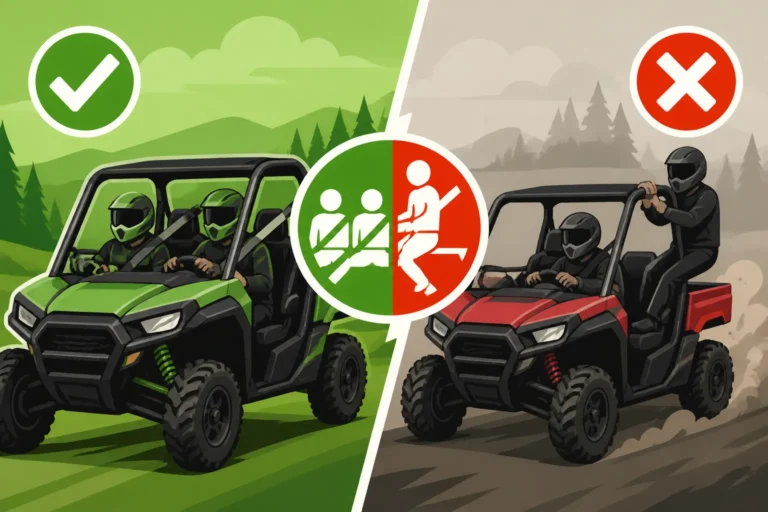
Manitoba has a mandatory [Manitoba Helmet Law and Its Exemptions] for all operators and passengers of off-road vehicles. This means you and any passenger must wear an approved helmet whenever the machine is in operation. The helmet must meet specific safety standards (such as Snell or FMVSS). This rule applies universally, regardless of your home state. There are very limited exemptions, primarily for specific agricultural or trapping activities, or if your machine has an approved roll-over protective structure (ROPS) and you're wearing a seatbelt. If your SuperATV is equipped with a ROPS and seatbelts, you might fall under that specific exemption. Always err on the side of caution and wear a helmet.
Age requirements are also in place for riders. Manitoba has a tiered system that dictates who can operate what type of machine and where. While your North Dakota age might qualify you for certain privileges back home, you must adhere to Manitoba's rules while here. For example:
- Riders under 14 require adult supervision and can only ride on private land or designated trails under specific conditions.
- Riders 14 and over may operate unsupervised in certain areas, but road crossing rules are stricter for those without a full licence.
- Riders 16 and over with a full Class 5 (or equivalent North Dakota) licence generally have the most flexibility, but still must follow all operating rules.
If you're travelling with younger riders, it's vital to understand [Manitoba Rules for a 14-Year-Old Rider] and other age groups to ensure everyone is riding legally and safely.
Carrying Documentation
This cannot be stressed enough: Always carry your relevant documents when riding. This includes your valid North Dakota driver's licence, your North Dakota off-road vehicle registration, and proof of your North Dakota insurance policy. An officer on patrol, whether it's RCMP, a conservation officer, or a municipal enforcement officer, has the authority to stop you and ask to see these documents. [Manitoba Registration Cards Carried at All Times] is a rule that applies to everyone, visitors included. Having them readily accessible, perhaps in a waterproof pouch, will make any interaction smooth and quick.
Essential Equipment and Trail Etiquette
Beyond the legalities of registration, insurance, and operating rules, there are practical considerations for equipment and a strong emphasis on trail etiquette that North Dakota riders should be aware of.
Machine Requirements
Manitoba has specific equipment requirements for off-road vehicles. All machines must be equipped with:
- Lights: Headlights and tail lights are required if you're operating between half an hour before sunset and half an hour after sunrise, or at any time when visibility is limited to less than 60 metres. Make sure your lights are functioning and properly aimed.
- Brakes: Your machine must have fully functional brakes.
- Muffler and Spark Arrester: A muffler that effectively limits engine noise and a spark arrester in good working order are mandatory. Spark arresters are critical for preventing wildfires, especially during our dry seasons. [Manitoba Spark Arrester Requirements] are year-round.
- Tires: Tires must be in good condition.
- Safety features: Seat belts (if equipped) and roll-over protection (if designed for it) should be functional. If your SuperATV machine came with these features from the factory, ensure they are maintained.
When you're out on the trails, especially in remote areas, having some basic recovery gear is also a smart move. A small tool kit, a winch (if your machine doesn't have one, consider an aftermarket addition), and a first-aid kit can be invaluable. [Manitoba Equipment Checks by Officers] can occur, so ensure your machine is up to par.
Respecting the Land and Fellow Riders
Manitoba prides itself on its beautiful natural landscapes, and respecting the environment is paramount. Always "Tread Lightly" and practice responsible riding. This includes:
- Private Land: Never ride on private property without explicit permission from the landowner. [Manitoba Trespass Law for Riders] is strictly enforced.
- Crown Land: Much of Manitoba's wilderness is Crown Land. While many areas are open to ORV use, there can be restrictions or sensitive areas to avoid. Always check for local rules and closures, especially during wildfire season. You'll want to understand [Manitoba Crown Land Access Rules] before venturing too far.
- Designated Trails: Stick to designated trails. Going off-trail can damage fragile ecosystems, disturb wildlife, and is often illegal. Many of our trails are maintained by volunteer clubs, so respect their hard work.
- Noise and Speed: Be mindful of noise, especially near dwellings or campgrounds. Reduce your speed when passing others on the trail, and always yield to hikers and horseback riders.
- Garbage: Pack out everything you pack in. Leave no trace.
- Wildlife: Give wildlife a wide berth. Do not chase or harass animals.
By following these guidelines, you'll not only avoid potential penalties but also ensure that Manitoba's trails remain enjoyable for everyone, including future North Dakota visitors.
Key Differences for North Dakota Riders: A Quick Reference
To help you quickly grasp the most significant differences, here's a comparison table outlining some common practices or assumptions a North Dakota rider might have, versus the reality of Manitoba's rules.
| Feature / Rule | Common North Dakota Practice (May Vary by County/State Law) | Manitoba ORV Rule (Provincial Level) |
|---|---|---|
| Registration | Required in ND, often state-specific plates. | ND registration accepted for visitors. No Manitoba plate needed for tourists. |
| Trails Fee | Varies; some states have trail permits or passes. | Not required for non-resident visitors. |
| Road Riding | Permitted on many secondary roads, gravel roads, or shoulders in some areas. | Generally banned on all paved roadways, shoulders, medians, and sidewalks. |
| Ditch Riding | Often permitted widely in most ditches. | Restricted: Only right-hand ditch, same direction as traffic. 4×4 vehicles often restricted from ditches on provincial roads. |
| Road Crossings | May be permitted with less stringent rules. | Strict rules: At right angles, stop, yield, clear view. Must have full driver's licence. |
| Helmet Law | Varies by age, sometimes optional for adults in certain situations. | Mandatory for all operators and passengers, with very limited exemptions (e.g., approved ROPS with seatbelt). |
| Insurance | Required, minimum liability. | ND insurance accepted, but verify it extends to Canada. Basic liability is mandatory. |
| Carrying Docs | Often required, but sometimes less strictly enforced in certain contexts. | Mandatory to carry valid licence, registration, and proof of insurance at all times. |
| Spark Arrester | Required, often seasonally or in specific areas. | Required year-round for all ORVs. |
Disclaimer
This article is for general informational purposes only and does not constitute professional advice. Laws, prices and regulations vary by location and change over time. Consult a qualified professional for guidance on your specific situation.