Manitoba Crossing Rules at 5 Metres and 3 Kilometres
We’ve all been there: you’re out on a fantastic ride in rural Manitoba, enjoying the open air and the thrill of your ATV or UTV, when suddenly you reach a paved road. It’s frustrating because you know you can’t just cruise down the highway, but you need to get to the other side to continue your adventure. The rules around crossing public roadways in Manitoba can feel a bit like a confusing maze, especially when you start hearing about specific distances like "5 metres" and "3 kilometres." This guide is here to untangle those exact requirements, explain the logic behind them, and give you the confidence to navigate these crossings safely and legally, without second-guessing yourself or risking a ticket.
Understanding the Manitoba ORV Act and Road Rules
Manitoba’s landscape is a paradise for off-road enthusiasts, offering everything from dense forests to wide-open plains. But this varied terrain often means our trails intersect with the public road network, leading to situations where ORV riders need to interact with vehicles on paved or gravel roads. It’s a delicate balance between allowing access for recreational riding and ensuring public safety for everyone using shared infrastructure.
Why Road Rules Exist for Off-Road Machines
Imagine the chaos if ATVs and UTVs were allowed to zoom across any road, any time, without rules. That's simply not a safe scenario for anyone. The rules for off-road vehicles on or near public roads exist primarily to protect lives – both those of ORV operators and conventional vehicle drivers and passengers. Off-road machines, by their very nature and design, are not built for highway speeds, predictable handling on pavement, or the same level of visibility as cars and trucks. They typically lack turn signals, their tires are designed for traction in mud, not grip on asphalt, and their braking distances can be different.
Beyond safety, these rules also help protect our road infrastructure. Allowing heavy, knobby-tired machines to constantly traverse sensitive road surfaces could lead to premature wear and tear, costing taxpayers more in maintenance and repairs. So, while it might feel like a hassle, these regulations are a critical component of responsible riding and community well-being. They're about integrating ORV use into the existing transport system with as little friction and risk as possible.
The Province-Wide Ban on Roadways
Let’s get one thing crystal clear right from the start: the Manitoba Off-Road Vehicles Act generally prohibits riding an ORV on a roadway. This isn't just a suggestion; it's a fundamental principle of ORV operation in the province. A "roadway" includes the paved or graded portion of a highway, typically where cars and trucks drive. This means you can't use your ATV or UTV as a means of transportation along a provincial highway or even a municipal street unless very specific conditions or exemptions apply. [Manitoba Bans Riding on Roadways]
The ban exists because ORVs are classified differently than traditional vehicles. They don't meet the same safety standards for on-road use, and their presence on active roadways can create significant hazards. The intent of the Act is to keep these machines where they belong – off-road, on designated trails, or in areas where their use is explicitly permitted, such as ditches under specific conditions. Understanding this baseline prohibition is crucial before we even talk about crossing, as it frames the entire discussion: crossing is a very specific, limited exception to the general rule of not being on the road.
What "Crossing" Truly Means for an ORV Rider
So, if you can't ride on a roadway, what does "crossing" actually entail? It means traversing the shortest possible distance across the travelled portion of a road, from one side to the other, to continue your journey on an off-road path or ditch. It's a temporary, direct, and swift maneuver, not an opportunity to travel down the road for any distance, even a short one.
Think of it like a pedestrian crossing a busy street: you don't walk along the street, you cross it directly. For an ORV, this means entering the roadway only for the time it takes to get from the shoulder on one side to the shoulder on the other. It implies a clear, observable path, executed with the utmost caution and attention to traffic. This strict interpretation is vital because any deviation – driving along the shoulder, making a turn, or travelling an unnecessary distance on the pavement – can be considered a violation of the Act, potentially leading to fines and compromising safety.
The Cornerstone Rule: Crossing at Designated Distances
This is where the specific numbers come into play, and it’s often the source of most confusion for riders. The Manitoba ORV Act is quite precise about where you can make these necessary road crossings. It’s not just about finding any convenient spot; it's about finding a legal and safe spot, which often means adhering to specific distance requirements relative to intersections.
The 5-Metre Rule: Crossing Near an Intersection
The primary rule, and often the safest, is that an ORV operator may cross a roadway within 5 metres of an intersection. This means if you're approaching an intersection, you should be looking to cross the main road at a point very close to where the side roads meet. [Manitoba Crossings Need a Clear View]
Why 5 metres? This specific distance is designed for several safety reasons. Firstly, it leverages the inherent predictability of traffic flow at intersections. Drivers are generally more alert, slower, and expecting potential turning vehicles or pedestrians around intersections. By crossing here, your presence is more likely to be anticipated. Secondly, crossing within 5 metres often provides clearer sightlines, especially if the intersection is well-maintained and doesn't have overgrown vegetation blocking views. You can more easily see oncoming traffic, and conventional vehicles have a better chance of seeing you.
Consider a scenario: you’re on a trail that brings you to a rural highway. You see a side road intersecting the highway just ahead. The safest and most compliant place to cross the highway would be immediately adjacent to that intersection, within that 5-metre window. This positions you in an area where drivers are already making observations for their turns or through-traffic, reducing the element of surprise. It also helps to prevent random crossings mid-block, which are far more dangerous and unpredictable for all road users.
The 3-Kilometre Rule: The Nearest Safe Opportunity
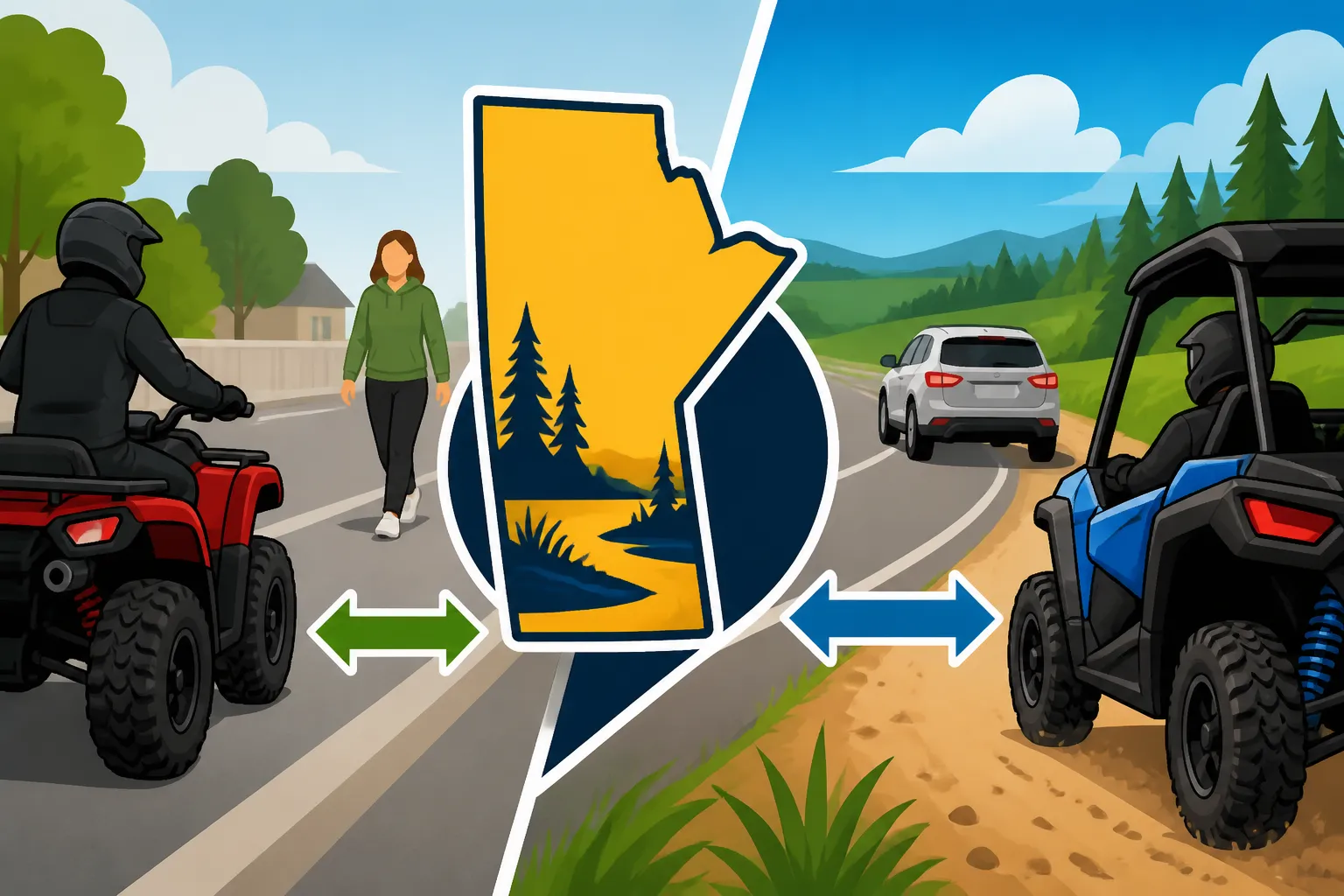
What if there's no intersection within 5 metres, or the terrain at an intersection makes a crossing impossible or unsafe? This is where the 3-kilometre rule comes into play. If you cannot cross within 5 metres of an intersection, the Act states you must then cross the roadway at the nearest safe opportunity, provided it is at least 3 kilometres from the nearest intersection. Manitoba Crossing Rules at 5 Metres and 3 Kilometres
This rule might seem counter-intuitive at first. Why would you be required to be far from an intersection if the 5-metre rule emphasizes being close? The logic here is about managing different types of risk. If you can't cross safely right at an intersection, the next best option is to be so far away from an intersection that you're in a stretch of road where drivers are less likely to be engaging in complex maneuvers like turning, accelerating from a stop, or merging. In these longer stretches, drivers might be at a more consistent speed, and their focus might be more straightforward, potentially making your crossing less of a surprise if you've taken all other precautions.
Practically, this means you can’t just stop anywhere between intersections and cross. You need to identify a spot where you have excellent visibility in both directions and ensure that this spot is a significant distance from any road junctions. The challenge here is finding such a spot that is truly "safe" and precisely 3 kilometres or more from an intersection, especially in areas with varying terrain or limited visibility. It puts a greater onus on the rider to scout ahead, use good judgment, and prioritize safety above all else. This rule is often less ideal than the 5-metre rule, but it acknowledges the reality that not all trail networks perfectly align with intersection locations.
Why These Specific Numbers?
The selection of 5 metres and 3 kilometres isn't arbitrary; it reflects a legislative attempt to balance rider access with public safety. The 5-metre rule encourages crossings where traffic is expected to be more attentive due to the dynamics of an intersection. It provides a structured, predictable point of interaction between ORVs and conventional traffic. The proximity to the intersection ensures that the crossing isn't happening in a high-speed, unexpected mid-block scenario.
On the other hand, the 3-kilometre rule addresses situations where an intersection crossing isn't feasible. By requiring a substantial distance from an intersection, the intent is to avoid the intermediate zones where drivers might still be reacting to or preparing for intersection maneuvers, but where the focused attention of being at the intersection has diminished. It pushes the crossing further into open stretches of road, theoretically where traffic flow is more stable. This helps to reduce the unpredictability of ORV interactions with larger vehicles, aiming for scenarios where all parties have ample time to see and react to each other.
These specific parameters are a uniquely Manitoban approach to ORV road rules, reflecting a careful consideration of the province's road network, traffic patterns, and the needs of its large off-road riding community. They aim to create a predictable framework, minimizing the element of surprise that is so often a factor in accidents involving different types of vehicles.
Prerequisites for a Legal Road Crossing
Just knowing where to cross isn't enough; there are also crucial requirements for who can cross and how they must execute the crossing. These prerequisites are fundamental to ensuring that any interaction with a public roadway is done responsibly and safely.
The Driver's Licence Requirement
One of the most important rules is that the operator of an ORV crossing a roadway must hold a valid driver's licence. This isn't just a recommendation; it's a legal requirement. It ensures that anyone making this potentially risky maneuver has demonstrated a basic understanding of road rules, traffic signs, and safe driving practices, as assessed through the licensing process. [Manitoba Crossings Need a Driver's Licence]
This means that a learner's permit is generally not sufficient for this maneuver. While a learner's permit allows supervised driving, the act of crossing a roadway on an ORV is a moment of independent judgment and quick decision-making, which requires the full competency of a licensed driver. [A Learner's Permit Will Not Let You Cross] The province wants to ensure that the individual piloting the ORV across a busy road has passed the necessary tests to operate a motor vehicle and understands the immense responsibility that comes with sharing space, however briefly, with other traffic. If you're riding with younger family members who might operate an ORV off-road, it's vital to remember that they cannot cross a public road until they obtain a full driver's licence.
Stopping and Yielding Before Crossing
Before you even think about entering the travelled portion of a roadway, two non-negotiable actions are required: stopping and yielding. You must bring your ORV to a complete stop at the edge of the roadway (or the shoulder, if present) before proceeding. This isn't a "slow down and look" situation; it's a full, unequivocal stop. [Stopping and Yielding Before You Cross a Highway]
Once stopped, you must then yield the right-of-way to all traffic on the roadway. This means waiting until the road is clear in both directions, or until all approaching vehicles are far enough away that your crossing will not impede their flow or create any need for them to brake or swerve. You cannot assume drivers will slow down for you or predict your intentions. The onus is entirely on the ORV operator to ensure the crossing can be executed without creating a hazard. This rule is designed to prevent collisions by ensuring that ORVs never unexpectedly enter the path of faster-moving vehicles on a highway. It requires patience and a clear assessment of the traffic situation before you even attempt to move onto the pavement.
One Machine at a Time: The Group Crossing Rule
For those of us who love riding in groups, this rule is particularly important: when crossing a roadway, only one ORV may cross at a time. This is a critical safety measure that prevents a chain reaction of risk. [Manitoba Crossings One Machine at a Time]
Imagine a group of four quads trying to cross a two-lane highway simultaneously. If the lead rider misjudges a gap or stalls, the riders behind them could be in serious trouble, blocking the road and creating an even greater hazard. By requiring single-file crossing, it allows each rider to independently assess the traffic, stop, yield, and execute their crossing without relying on the judgment or actions of the rider ahead. It provides a brief window for the road to clear between each crossing.
When riding with a group, this means the lead rider will stop, assess, cross, and then signal for the next rider to proceed. Communication within the group, whether through hand signals, helmet comms, or simply observing the leader, is essential. It requires discipline and coordination, but it drastically reduces the risk of multiple machines being exposed to traffic simultaneously. It's about minimizing the footprint of ORV activity on the road at any given moment, making it easier for conventional vehicle drivers to react safely.
Practical Considerations and Safety Tips for Crossings
Beyond the letter of the law, there are many practical steps you can take to make your road crossings safer and less stressful. These aren't just good ideas; they're vital habits for any responsible ORV rider in Manitoba.
Visibility is Key: Ensuring a Clear View
Before attempting any crossing, your number one priority should be visibility. You need to ensure you have a clear, unobstructed view of the roadway in both directions, and equally important, that conventional vehicle drivers can see you. [Manitoba Crossings Need a Clear View]
Factors like hills, sharp curves, dense vegetation, or even parked vehicles can severely limit sightlines. If you can’t see clearly, or if you suspect you might be obscured from an approaching driver’s view, do not cross. Find a different, safer spot, even if it means backtracking a bit. Consider adding accessories to your machine to boost your visibility. For instance, some riders opt for bright flags mounted high on their ORVs, especially when riding in areas with varied terrain or limited sightlines. SuperATV offers a range of high-quality mirrors and flag mounts that can improve your field of vision and make your presence more noticeable to others. Brighter LED lights, even during the day, can also make a significant difference in being seen. Remember, on a highway, every fraction of a second counts for reaction time.
Machine Readiness: Lights and Awareness
Your machine itself needs to be ready for the momentary demands of a road crossing. This means ensuring all your lights are fully functional. While you might not typically use headlights during the day on the trail, activating them for a road crossing, even in bright sunshine, significantly increases your visibility to oncoming traffic. [Manitoba Lighting Requirements on a Machine] A malfunctioning headlight or taillight could be the difference between being seen and being missed.
Beyond lights, ensure your ORV is mechanically sound. The last thing you want is to stall in the middle of a busy highway. Regularly check your battery, fuel levels, and general engine health. During the crossing itself, your full attention must be on the roadway and traffic. Avoid distractions from your passengers, phone, or anything else. This is a moment that demands 100% of your focus to execute safely and efficiently. A well-maintained machine and an alert operator are your best defense against accidents during a crossing.
Assessing Road and Traffic Conditions
Before you commit to a crossing, take a moment to assess the current road and traffic conditions. This isn't just about looking for approaching cars; it's about understanding the entire environment.
- Traffic Speed and Density: Are vehicles travelling at high speeds? Is there a constant stream of traffic, or are there clear, manageable gaps? It's much easier to cross a quiet rural road than a busy highway during rush hour.
- Road Surface: Is the road wet, icy, gravel, or smooth pavement? Your ORV tires will behave differently on each surface. Knobby tires designed for mud and dirt can have reduced traction on wet asphalt, affecting your braking and acceleration. Gravel roads can kick up dust, impairing visibility.
- Weather Conditions: Fog, heavy rain, or glare from the sun can dramatically reduce visibility for both you and other drivers. If conditions are poor, it's often best to wait for an improvement or find an alternative route, even if it means a longer ride.
Your decision-making process should always prioritize safety. If you have any doubt about whether you can cross safely and without impeding traffic, do not cross. Wait for a clearer opportunity, or consider if there’s another route that avoids the crossing altogether. There's no shame in exercising caution; it’s a sign of a responsible rider.
Common Mistakes and Misconceptions About Crossing Rules
Even experienced riders can sometimes make mistakes or operate under misconceptions when it comes to road crossings. These are not just minor oversights; they can have serious consequences. Let's clear up some of the most common pitfalls.
Assuming All Intersections Are Equal
A frequent mistake is the assumption that "intersection" simply means "anywhere two roads meet," and therefore any intersection is a permissible crossing point. However, the 5-metre rule is specific, and safety considerations should always override a rigid interpretation. Some intersections might have poor sightlines, blind corners, or be incredibly busy.
The rule isn't just about proximity to an intersection; it's about making a safe crossing. An uncontrolled rural intersection with a clear view is very different from a complex, signalized intersection in a built-up area. While the Act specifies the distances, it implicitly requires the operator to use good judgment. Blindly adhering to "within 5 metres" at an intersection where visibility is zero due to a hill or dense brush is not safe and could still lead to a ticket for careless operation. Always prioritize the ability to see and be seen over strict adherence to the measurement if safety is compromised.
The "Quick Dash" Mentality
Another dangerous misconception is the "quick dash" mentality, where riders believe that if they just gun it and get across the road as fast as possible, they'll be safe and legal. This couldn't be further from the truth. The Act requires you to stop and yield, meaning you must wait until the roadway is clear, not just until there's a small gap you think you can squeeze through.
Attempting a "quick dash" often involves failing to stop, failing to yield, and misjudging the speed of oncoming traffic. This dramatically increases the risk of a collision. Furthermore, even if you make it across without an accident, an officer observing such a maneuver could issue a citation for failing to stop, failing to yield, or even careless operation, which carries significant penalties. Your ORV might be capable of rapid acceleration, but that doesn't make it legal or safe to dart into traffic. Patience and a clear assessment are always paramount.
Group Riding Errors During Crossings
As mentioned, the rule is one machine at a time. However, in the excitement of a group ride, riders sometimes forget this or misunderstand the intent. It's easy for group members to fall into the habit of following too closely or assuming that because the lead rider crossed, the path is clear for everyone.
This can lead to multiple machines being on the roadway simultaneously, creating a much larger and more complex hazard for conventional traffic. If a vehicle approaches just as the second or third ORV is crossing, they may not have enough time to react safely. Riders in a group need to have a clear communication strategy – whether it's the leader signaling when the next rider can go, or each rider independently verifying a clear path before proceeding. There's no group exemption to the stop and yield rule, nor to the one-at-a-time rule. Disciplined, staggered crossings are the only safe and legal way for a group to navigate a roadway.
What Happens If You Don't Follow the Rules?
The rules for crossing roadways are not just guidelines; they are legally binding requirements under the Manitoba Off-Road Vehicles Act. Failing to adhere to them can have serious consequences, ranging from financial penalties to severe safety risks.
Legal Penalties for Improper Crossings
If an officer observes you making an improper roadway crossing – perhaps failing to stop, failing to yield, or not adhering to the 5-metre or 3-kilometre distance rules – you could face significant legal penalties. These typically include fines, which can quickly add up. [Manitoba Ticket Costs for Riders] Depending on the specific infraction, you might receive a ticket with a set fine, or in more severe cases, be charged with a more serious offense like careless operation.
Careless operation, for example, can carry a much higher financial penalty and potentially more severe consequences, especially if it involves putting others at risk. These tickets are not just a minor inconvenience; they reflect a breach of public safety regulations. While the immediate impact is often financial, repeated infractions or severe violations could potentially lead to other legal ramifications. It's far better to spend a few extra moments ensuring a safe and legal crossing than to face a ticket or worse.
Safety Risks and Accident Consequences
The most critical consequence of ignoring crossing rules is the safety risk. ORVs are robust machines, but they offer minimal protection in a collision with a full-sized vehicle. An accident involving an ORV and a car or truck on a roadway can result in devastating injuries or fatalities for the ORV operator and passengers. The speed differential, the size difference, and the lack of protective enclosures on most ORVs make them extremely vulnerable.
Beyond personal injury, there are significant property damage implications. Your ORV could be totaled, and you could be held liable for damages to the other vehicle. Financially, this can be ruinous. While basic Manitoba ORV registration does include some third-party liability coverage, it often does not cover injuries to yourself or damage to your own machine in all circumstances, and basic coverage may not be sufficient for severe accidents. [Manitoba Insurance Included With Registration], [Manitoba's Liability Coverage Requirement] You might find yourself in a situation where you're not only dealing with physical recovery but also a mountain of medical bills and vehicle repair costs, potentially without full insurance coverage. [Manitoba Basic Registration Does Not Cover Theft]
Impact on the Riding Community
Every time an ORV rider acts irresponsibly, it reflects poorly on the entire riding community. A single egregious act of unsafe crossing can fuel negative public perception and reinforce stereotypes about ORV users being reckless or disrespectful of road rules. This negative perception can have real-world consequences, such as increased scrutiny from law enforcement, stricter legislation, or even the closure of valuable trails due to public complaints or safety concerns.
Organized ORV clubs and associations work tirelessly to promote responsible riding and advocate for trail access. When individuals ignore basic safety rules like crossing regulations, it undermines these efforts and makes it harder for the community to gain public and government support. Responsible riding, including meticulous adherence to crossing rules, is not just about your personal safety and legal compliance; it's about being a good ambassador for the sport and preserving access for future generations of riders.
Beyond Crossing: Other ORV Road Rules to Keep in Mind
While this guide focuses on the specific crossing rules, it’s important to remember that they are just one piece of a larger puzzle when it comes to ORV interaction with public roads in Manitoba. A responsible rider needs to be aware of the full spectrum of regulations.
Ditch Riding Regulations
Many riders utilize road ditches to travel between trails or access different areas. However, ditch riding also comes with its own strict set of rules. For instance, in most cases, you must travel in the ditch to the right of the roadway and in the same direction as traffic. [Manitoba Ditch Riding Rules], [The Only Legal Ditch Is on Your Right] There are also rules about which types of ORVs can use ditches and specific restrictions on where and when ditch riding is allowed. Understanding these rules is crucial, as ditch riding is a common activity that is often misunderstood. Improper ditch riding can also lead to fines and safety risks, just like improper road crossings.
Agricultural Shoulder Use
Manitoba's ORV Act provides a very specific and limited exception for agricultural purposes on road shoulders. This means that a farmer, when operating an ORV primarily for farming activities, may be permitted to use the shoulder of a provincial road for limited distances. [Manitoba's Agricultural Shoulder Exception]
It's vital to understand that this is not a general allowance for recreational riders. You cannot use the agricultural shoulder exemption as a loophole to travel along a highway shoulder with your recreational quad. This exception is narrowly defined to support the agricultural industry and typically requires the ORV to be equipped with a slow-moving vehicle sign and operated under specific conditions. Misinterpreting this rule can lead to fines and put you at risk.
Municipal By-Laws and Local Variations
While the provincial Off-Road Vehicles Act sets the overarching framework, municipalities in Manitoba have the power to enact their own by-laws regarding ORV use within their specific jurisdictions. [Manitoba Municipal By-Law Powers] This means that the rules for crossing, ditch riding, or even where you can operate an ORV might vary from one town or rural municipality to another.
For example, a rural municipality might have a by-law that opens certain local roads to ORV use for specific seasons or purposes, which would override the general provincial ban on roadways. Conversely, a particular town might have stricter rules, prohibiting ORVs entirely within its municipal boundaries. Before you head out on a ride, especially if you're exploring a new area, it's always a good idea to check the specific by-laws of the local government district, rural municipality, or town council. A quick call to their office or a check of their website can save you a lot of trouble and ensure you're riding legally and respectfully.
Summary of Road Crossing Rules for ORVs in Manitoba
To help consolidate the key information, here’s a quick overview of the most critical aspects of ORV road crossing rules in Manitoba:
| Rule Category | Specific Requirement | Important Implication |
|---|---|---|
| General Principle | ORVs generally banned from riding on roadways. | Crossing is a strictly temporary, direct exception; not for travelling along the road. |
| Crossing Location | 5-Metre Rule: Cross within 5m of an intersection. | Best option for visibility and predictability; drivers are more alert near intersections. |
| 3-Kilometre Rule: Cross 3km+ from nearest intersection if 5m isn't feasible/safe. | For long stretches of road; choose a spot with excellent clear views. Requires more rider judgment. | |
| Operator Licence | Must hold a valid driver's licence. | Learner's permits are generally insufficient; ensures operator knows road rules. |
| Pre-Crossing Action | Stop and Yield: Come to a complete stop; yield to all traffic. | The ORV operator is solely responsible for ensuring the crossing is safe and does not impede traffic. |
| Group Crossing | One Machine at a Time: Each ORV crosses individually. | Prevents multiple machines from being exposed to traffic; requires clear communication within the group. |
| Visibility | Ensure clear sightlines in both directions. | Prioritize safety over strict adherence to distance if visibility is poor (e.g., hills, curves). Consider high-viz gear. |
| Machine Readiness | Working lights, good mechanical condition. | Use headlights even during the day; avoid stalling on the road; stay focused. |
| Local By-Laws | Check municipal by-laws for local variations. | Rules can differ by town/RM; always verify before riding in a new area. |
This article is for general informational purposes only and does not constitute professional advice. Laws, prices and regulations vary by location and change over time. Consult a qualified professional for guidance on your specific situation.