Getting a Burning Permit for a Campfire
A campfire on an ATV trip may seem simple, but Manitoba rules depend on where you stop, what kind of fire you plan to have and whether restrictions are in effect. A burning permit is not a universal pass to light a fire. Check the rules for your exact location before you travel, and confirm again before lighting.
First, work out whether you need a burning permit
A permit for open burning and permission to have a contained campfire are not necessarily the same thing. A campfire in an approved firepit at a provincial campsite may be treated differently from a fire built on private land, Crown land or an informal backcountry site. The type of fire and the location both matter.
Start by identifying the land you plan to use. A campsite in a provincial park, a private campground, a club trail staging area and a remote Crown land site can each have different rules. Municipalities and local governments may also set restrictions within their boundaries. Do not assume that one permit or one set of rules applies across all of Manitoba.
Next, describe the fire accurately when you ask about permission. A small fire contained in a designated firepit is different from a larger burn pile or a fire used to clear brush. If you want to burn brush, debris or other material, ask specifically about an open-burning permit rather than describing it simply as a campfire.
Before relying on a permit, check whether a fire restriction or area closure is in effect. A permit does not automatically cancel a ban or restriction. When conditions are dry or wildfire risk is high, rules may limit or prohibit fires even where they would normally be allowed. For current updates, see Manitoba Fire Ban Lookups and Checking the Fire Restrictions Map From Your Phone.
| Your planned fire | What to check first |
|---|---|
| Campfire in a designated campground firepit | Ask the campground or park whether fires are allowed and whether restrictions affect the site |
| Campfire on private land | Confirm the landowner’s permission and check municipal and provincial restrictions |
| Campfire on Crown land | Confirm that you may use the site and have a fire there; a permit does not grant land access |
| Brush or debris burn | Ask the responsible authority about an open-burning permit and any conditions |
| Fire at an informal trail or lakeside stop | Confirm both land access and fire rules; do not assume a nearby trail makes the site available for camping |
For a provincial campsite, review Using an Approved Firepit at a Provincial Campsite. If your route crosses or ends on Crown land, [Manitoba Crown Land Access Rules] can help you separate access permission from fire permission. For private land, get the owner’s consent as well as checking the fire rules; see Manitoba Private Land Permission.
How to find the right authority and request permission
There may not be one permit process that covers every fire and every location. The right contact depends on who manages the land and what you intend to burn. Begin with the site manager, landowner or local authority, then ask whether another provincial or local office must approve the fire.
If you are at a provincial park, ask the park office or campground staff whether the firepit may be used and what restrictions apply. At a private campground, contact the operator. On private property, ask the owner and check the local rules. For a proposed burn on Crown land or an open burn, ask the responsible provincial or local authority which office handles that location and what application process applies. The details in Manitoba Burning Permit Rules are a useful starting point, but confirm the current requirements for your specific site.
When you make the inquiry, give the authority enough detail to answer the right question:
- Give the exact location. Provide the campground, land description, nearby road or trail, or other information that makes the site easy to identify.
- Explain the type of fire. Say whether it is a small campfire in an established pit, a portable fire container or a larger open burn.
- Describe what you plan to burn. Do not assume that permission for a campfire also allows brush, construction waste or other material.
- Give your intended dates. Restrictions can change, so make clear when you expect to have the fire and ask how to check conditions again before then.
- Ask about conditions. Find out whether there are limits on where the fire may be set, how it must be contained, what supervision is required and how it must be put out.
- Ask what proof to keep. If a permit or written approval is issued, confirm how to carry or display it and whether it applies only to a particular place or period.
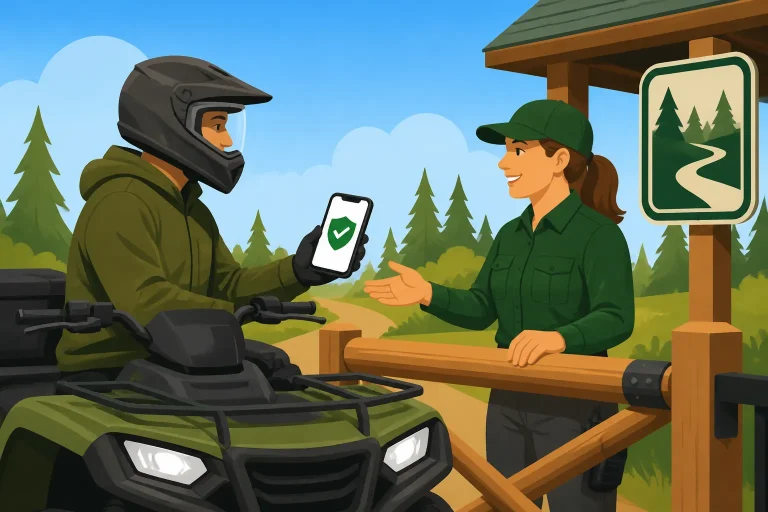
Keep the answer with your trip information. If approval is written, save it somewhere accessible offline as well as on your phone. If the authority tells you that a permit is not needed for a particular kind of campfire, note who gave you the information and when, then check for later restrictions before lighting.
A permit or approval is specific to its terms. Do not treat it as permission to move the fire to another site, change the type of burn or continue burning after restrictions change. If anything about the plan changes, check again.
What ATV and UTV riders should check before a campfire
Riders may reach places where a campground office, cell service or clear sign is not close at hand. That makes pre-trip checking important. It also makes it easy to confuse permission to ride through an area with permission to stop, camp or build a fire there. Those are separate questions.
Before setting out, identify where you intend to camp and who manages the land. Check that you are allowed to stop overnight, that the route is open and that a fire is permitted at the site. Trail access alone does not establish camping rights or fire permission. For a broader trip plan, review Manitoba Area Closures During Fire Season and check the applicable trail or park information as well.
Carry a way to check current restrictions. If you lose cell service, do not assume that yesterday’s conditions still apply. Check before leaving coverage, ask a campground or local office where possible, and have a no-fire plan in case restrictions change. A camp stove may also be subject to rules, so verify that it is permitted rather than assuming it is exempt.
A few practical habits reduce both risk and confusion:
- Use only the fire area or firepit designated for the site.
- Keep the fire small and attended, and have water or another suitable way to extinguish it close by.
- Do not leave until the fire is completely out and cold to the touch.
- Avoid lighting a fire in windy or unusually dry conditions, even if you believe the site normally allows one.
- Do not burn prohibited materials or leave debris behind.
- Follow any posted instructions and stop if a restriction takes effect.
A permit is not a substitute for safe fire handling. Wind can carry embers beyond a pit, and a fire that appears controlled can spread into dry grass, leaves or brush. If you cannot keep the fire contained and put it out fully, do not light it.
Common permit mistakes and a simple decision process
The most common mistake is asking only, “Do I need a burning permit?” That question can produce an incomplete answer if the person responding does not know whether you mean a contained campfire at a managed campsite or an open burn on a different kind of land. Give the location and describe the fire so the answer fits your plan.
Other mistakes include treating a permit as a guarantee that a fire is allowed during a restriction, assuming a trail grants access to nearby land, and relying on old information. A permit might cover only a particular site or kind of burn. Local rules may apply alongside provincial restrictions. When the rules are unclear, the safer choice is to postpone the fire and ask the relevant authority.
Use this decision process before lighting:
- Identify the land and site manager. Do not rely on a map pin or trail sign alone.
- Confirm you may stop or camp there. Fire permission does not grant land access.
- Describe the fire and material. A contained campfire and an open burn may have different requirements.
- Ask whether a permit or other approval is required. Confirm any conditions and how long the approval applies.
- Check restrictions immediately before lighting. A prior approval may not allow a fire during a current ban or closure.
- Choose not to light if you cannot confirm. A stove or a no-fire evening is better than guessing.
If you have questions about a particular location, ask the person or office responsible for that land. For a provincial park, contact the park; for private property, contact the owner and relevant local authority; for Crown land or open burning, confirm which office handles the area. Keep the answer specific to the site, date and type of fire you are planning.
Disclaimer
This article is for general informational purposes only and does not constitute professional advice. Laws, prices and regulations vary by location and change over time. Consult a qualified professional for guidance on your specific situation.