Money Flowing to Trail Grants
A trail fee can feel abstract when you pay it with registration and never see where it goes. In Manitoba, the money is intended to support off-road vehicle trail maintenance and development, rider education, and repairs to public land affected by riding. Here’s how that funding model works, what it can support, and how riders can check the details before planning a trip.
How Manitoba’s trail-grant funding works
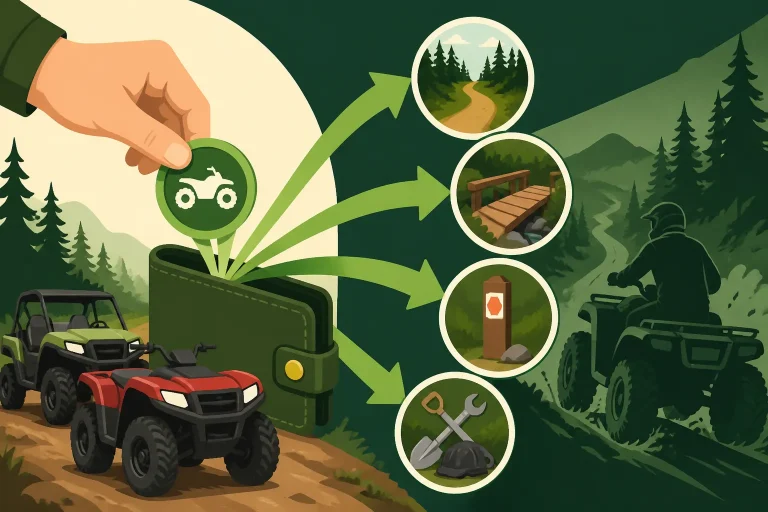
Manitoba’s Off-Road Vehicle Land and Trail Rehabilitation Grant is tied to an annual fee collected through off-road vehicle registration. The funding description from Manitoba Environment and Climate Change says revenue from the fee is allocated to trail maintenance and development, safety education and training, and restoration of public land impacted by off-road vehicle use.
That means the money is not described simply as a charge for riding a particular trail on a particular day. It is collected through registration and then directed toward broader off-road vehicle trail and land needs. For the distinction between registration-based fees and a trail pass, see Manitoba Has No ATV Trail Pass.
The policy has been described through legislation and government funding information. As of November 2026, Manitoba Government described a proposed annual fee of $25 for registered off-road vehicles, collected by Manitoba Public Insurance. The same proposal would not apply to off-road vehicles exempt from registration under the Drivers and Vehicles Act. Manitoba Environment and Climate Change describes the grant funding model as drawing on an annual fee collected by Manitoba Public Insurance.
Because the fee is connected to registration, riders should not assume that they can avoid it by choosing not to use a trail. The important practical distinction is whether the vehicle is registered or falls within an exemption, not simply whether its owner plans to ride a funded route. For a closer look at how the fee is described, see Manitoba’s Off-Road Trails Fee Explained and Why Every Registration Includes a $25 Trails Fee.
| Funding point | What it means for riders |
|---|---|
| Fee collected with registration | The funding model connects revenue to registered off-road vehicles rather than a ticket for each trail visit. |
| Trails and infrastructure | Grant funding can support maintenance and development of off-road vehicle trails. |
| Rider education and training | Revenue is also intended to support safety education and training programs. |
| Public-land restoration | Funding can help restore public land affected by off-road vehicle use. |
| Registration exemptions | The proposed fee would not apply to off-road vehicles exempt from registration under the Drivers and Vehicles Act. |
The fee does not mean that every registered rider is guaranteed a specific improvement near home. Grant funding is intended to serve trail and land needs across Manitoba, and the materials do not promise that each contribution will return to the same region or trail where a rider uses a machine. That broader allocation is worth keeping in mind when asking what the money supports.
For a fuller breakdown of the funding categories, Where Your $25 Trails Fee Actually Goes covers the same question from the rider’s point of view.
What the grant funding is meant to support
The funding description names three broad purposes. They are related, but they solve different problems: keeping routes usable, helping riders make safer decisions, and repairing land affected by vehicle use.
Trail maintenance and development
Trail maintenance can involve work that keeps established routes usable and reduces the risk that small problems grow into larger ones. Development can support additional or improved trail infrastructure. The specific work depends on local needs and approved projects; the funding description does not promise that every trail will receive the same type or amount of work.
In Manitoba, trail networks are managed with involvement from Snowmobilers of Manitoba Inc. and the All-Terrain Vehicle Association of Manitoba. Manitoba Government says the organizations are involved in managing more than 13,000 kilometres of trail. A province-wide network of that scale makes coordination important: trail conditions, access, maintenance needs, and the users sharing each route can vary significantly from place to place.
The grant model is intended to contribute to trail work, but it is not a guarantee that every route will be open or maintained to a particular standard. Riders still need to check local conditions and access rules before unloading. Trails Fee Money Spent on Trail Maintenance Grants focuses on how grant support relates to the practical work of maintaining routes.
Safety education and training
A trail can be well maintained and still present hazards. Riders need to understand safe operation, equipment requirements, and how to share routes responsibly. Manitoba Environment and Climate Change says fee revenue supports safety education and training programs, making rider preparation a separate part of the funding purpose rather than an incidental benefit of trail construction.
This matters for both new and experienced riders. A machine may be familiar, but route conditions, visibility, other trail users, and equipment needs can change from one ride to another. Training and education can help people make safer choices before they enter a trail system.
The funding description does not establish a particular course requirement or promise that every rider will receive training through the grant. For more on the educational purpose, see Trails Fee Money Funding Rider Education Programmes. Riders should still confirm the current rules that apply to their machine and planned route.
Restoration of affected public land
Off-road riding can affect land beyond the trail surface. The grant funding model includes restoration of public lands impacted by ORV use, so the intended work is not limited to building or maintaining routes. Repairing affected land is a distinct goal, especially where vehicle use has damaged ground or disturbed an area.
That does not mean every public area is open to riding, or that grant funding makes unauthorized use acceptable. Manitoba Environment and Climate Change says off-road vehicles are strictly limited to designated routes within provincial parks. A rider should follow the route designation and any local access restrictions, even when a park or surrounding area is known as a riding destination.
For more detail on this part of the funding purpose, see Trails Fee Money Repairing Land Damaged by Riders. The practical takeaway is simple: restoration funding is meant to address impacts, not to provide permission to create them.
What riders can reasonably expect on the ground
Grant funding is easier to understand when connected to real riding areas, but it helps to separate general program goals from promises about a particular trail. A grant program can support trail work and education without guaranteeing that a route will be open on the day you arrive or that a specific improvement will happen in your preferred area.
Duck Mountain Provincial Park is highlighted by Environment and Climate Change as a signature destination for off-road vehicle riders. The Mossberry Trail spans 30 kilometres and accommodates off-road vehicles alongside other activities, according to Environment and Climate Change. The area also has three backcountry campsites beside remote lakes, offering options for multi-day riding, fishing, and camping.
Those examples show why investment in trails can have value beyond the trail surface itself. Riders may use routes to reach recreation areas, while other visitors share parts of the landscape. Trail maintenance, clear route information, rider education, and care for affected land all contribute to a more workable shared-use experience. But the existence of a grant program does not itself confirm current conditions, closures, or permitted routes.
Before a trip, check current trail information and park rules. Manitoba Environment and Climate Change has listed closures in provincial parks for reasons such as road closures, landslides, fallen trees, and construction. Conditions and notices can change, so an old trip report or a map alone may not be enough to confirm access. Manitoba Environment and Climate Change also points riders to ATVMB for additional riding areas in Manitoba.
A useful way to think about grant results is to look for practical signs rather than expecting a direct rebate or a guaranteed project. Depending on local work, visible outcomes might include maintained trail surfaces, improved route infrastructure, better information for riders, safety education, or restoration work. The funding description does not promise that all of these will appear at every trail or in every riding season.
For an overview of program information and other Manitoba trail support, see Manitoba Trail Grant Programmes. When comparing a trail that appears on a map with a trail that is open and suitable for your machine, current local information matters more than the funding model alone.
How to follow the funding and plan responsibly
Riders do not need to manage a grant application to make informed decisions about the fee. They can still ask clear questions about how the program works, where projects are happening, and what rules apply to a planned ride.
Ask specific questions about results
A broad question such as “Where does the fee go?” may lead to a general description of program goals. More focused questions can help clarify what the funding supports and how riders can find current details:
- Which types of trail, education, or restoration work does the program support?
- Where can riders find information about funded projects?
- Who manages the trail network in the area they plan to ride?
- Is the route currently open, and are there local restrictions?
- What safety or equipment rules apply to that machine and location?
The funding model identifies broad categories, but readers should not assume it publishes a complete project-by-project accounting in the same place as registration information. Check current information from Manitoba Environment and Climate Change, Manitoba Public Insurance, or the relevant trail organization for the question at hand.
For additional context on how a registration-linked fee differs from buying permission to use a trail, Paying the Trails Fee Without Using a Trail may help. A fee’s purpose and a rider’s access permission are separate issues.
Keep registration, equipment, and access rules separate
Trail funding does not replace the requirements for operating an off-road vehicle. Manitoba Government requires off-road vehicles to be registered and plated. Minimum safety equipment requirements include headlights and taillights, mufflers, and spark arresters. Helmets are required when operating an off-road vehicle, and seat belts are required on applicable vehicles.
The operating rules also cover cannabis: transporting cannabis in or on an off-road vehicle is regulated, and consumption in or on an off-road vehicle is prohibited, according to Manitoba Government. These requirements are separate from questions about how grant money is allocated. A funded trail is not an exemption from registration, equipment, or operating rules.
Park access has its own limits, too. Off-road vehicles are restricted to designated routes within provincial parks, according to Environment and Climate Change. A general map, an old trail description, or the fact that a trail network receives maintenance support should not be treated as confirmation that every nearby route is open to motorized use.
Use trail information before you travel
Before hauling a machine, confirm that the route is open and that your vehicle type is allowed. Look for current notices from the park or trail manager, and check whether the route is shared with other users. If a route is closed or its status is unclear, do not assume a grant-funded trail is still available.
The best way to understand “money flowing to trail grants” is to keep the parts distinct: the annual fee is collected through registration under the described funding model; grant revenue is intended to support trail maintenance and development, safety education and training, and restoration of public land; and riders remain responsible for confirming registration, equipment, access, and operating rules. For related background, Manitoba’s Off-Road Trails Fee Explained and Where Your $25 Trails Fee Actually Goes examine the fee and its intended uses in more detail.
Sources
- Manitoba Government — Province of Manitoba | News Releases | Manitoba Government Introduces Off-Road Trails Safety and Maintenance Act (checked November 3, 2026)
- Environment and Climate Change — Parks and Protected Spaces | Environment and Climate Change | Province of Manitoba (checked November 3, 2026)
Disclaimer
This article is for general informational purposes only and does not constitute professional advice. Laws, prices and regulations vary by location and change over time. Consult a qualified professional for guidance on your specific situation.