Manitoba Group Size on a Club Trail
A large group ride on a Manitoba club trail can raise two different questions: how many machines the trail can handle, and whether the ride needs approval as an organized event. There is no single group-size answer that settles both. Check the club’s rules, confirm the land manager’s requirements and plan the ride so the group can travel safely without blocking the trail.
There Is No One Group Limit for Every Club Trail
A group’s size does not, by itself, tell you whether riding is allowed. A club trail may cross land with different owners or managers, and the club’s permission to use a route can come with conditions. Clubs may also have their own expectations for member rides, organized outings or busy trail sections.
That means you should not assume either that a large group is always permitted or that a particular number is a universal maximum. Check with the club responsible for the route before inviting riders, especially if the ride is open to the public, advertised, guided or expected to draw a crowd. The club can explain which rules apply to its trail and whether another land manager needs to be contacted. For background on how clubs and trail responsibilities fit together, see Manitoba Club Trails and Who Maintains Them.
It also helps to separate a casual group ride from an organized event. A few friends riding together may be treated differently from a planned gathering with a route, a meeting point, promotion, a schedule or a large number of participants. The label you use is not decisive: calling something a “club ride” does not automatically make permit requirements disappear.
Manitoba’s special-event guidance flags organized group rides of ten or more as requiring a permit in relevant situations. That does not mean every group that reaches ten machines is automatically barred from every club trail. It means the organizer should check whether the ride, location and land status trigger a special-event permit. Read Groups of Ten Need a Special Event Permit alongside the more general Manitoba Special Event Permit Steps, then confirm the answer with the responsible club or land manager.
| Situation | What to check before riding |
|---|---|
| A few friends riding a club trail | The club’s access rules, current trail conditions and any local restrictions |
| A club-organized ride | Whether the club has approved the date, route and expected attendance |
| An advertised ride open to others | Whether it counts as an organized event and needs a permit or land-manager approval |
| A ride with ten or more participants | Whether the special-event requirements apply to that location and event |
| A route crossing more than one type of land | Permission and restrictions for each section, not just the trailhead |
If you cannot get a clear answer, delay public promotion or reduce the scope of the ride until you have confirmation. An event permit, where required, is not a substitute for permission to use every part of a route.
What Changes When a Ride Is Organized
A ride can become more than a casual outing when someone takes responsibility for bringing participants together. Examples include publishing an invitation, setting a meeting time and trail route, collecting registrations, arranging a group start or promoting the ride through a club. Those features do not prove that a permit is required in every case, but they are good reasons to ask before the event takes place.
The relevant threshold is not necessarily a simple count of machines at one moment. Ask whether the requirement is based on people, vehicles, the event’s organization, the location or another factor. A group of riders arriving independently may raise different questions from an organizer assembling them for a scheduled ride. Get the current interpretation from the appropriate authority rather than relying on assumptions or an old event flyer.
When asking, give the club or land manager enough information to assess the plan:
- Identify the trail system and planned route, including any known land crossings.
- Describe whether the ride is private, club-only or open to the public.
- Give the expected number of people and machines, including likely late additions.
- Explain the date, meeting point, start time and approximate duration.
- Ask whether written permission, a permit, insurance documentation or other conditions are needed.
- Keep the response and any approval with the ride organizer.
A special-event permit is a separate issue from ordinary access to a trail. The organizer may need to satisfy event requirements while the club or land manager still controls whether the route can be used. For example, an approved event does not necessarily override a closure, a club restriction or a requirement to obtain permission for a particular section.
If the plan changes, check again. A smaller private ride can turn into a larger public gathering after an online post gets shared. Weather or trail damage can also force a route change onto land with different access conditions. A permit or approval for one plan may not automatically cover a different date, route or attendance level.
For clubs, it is useful to designate one person to make the enquiries and keep a copy of the response. Participants should know whom to contact rather than each assuming another rider handled the paperwork. Manitoba Club Insurance Requirements can also help organizers identify the separate insurance questions they should raise with their club. Insurance does not replace access permission or a permit.
Choosing a Safe and Manageable Group Size
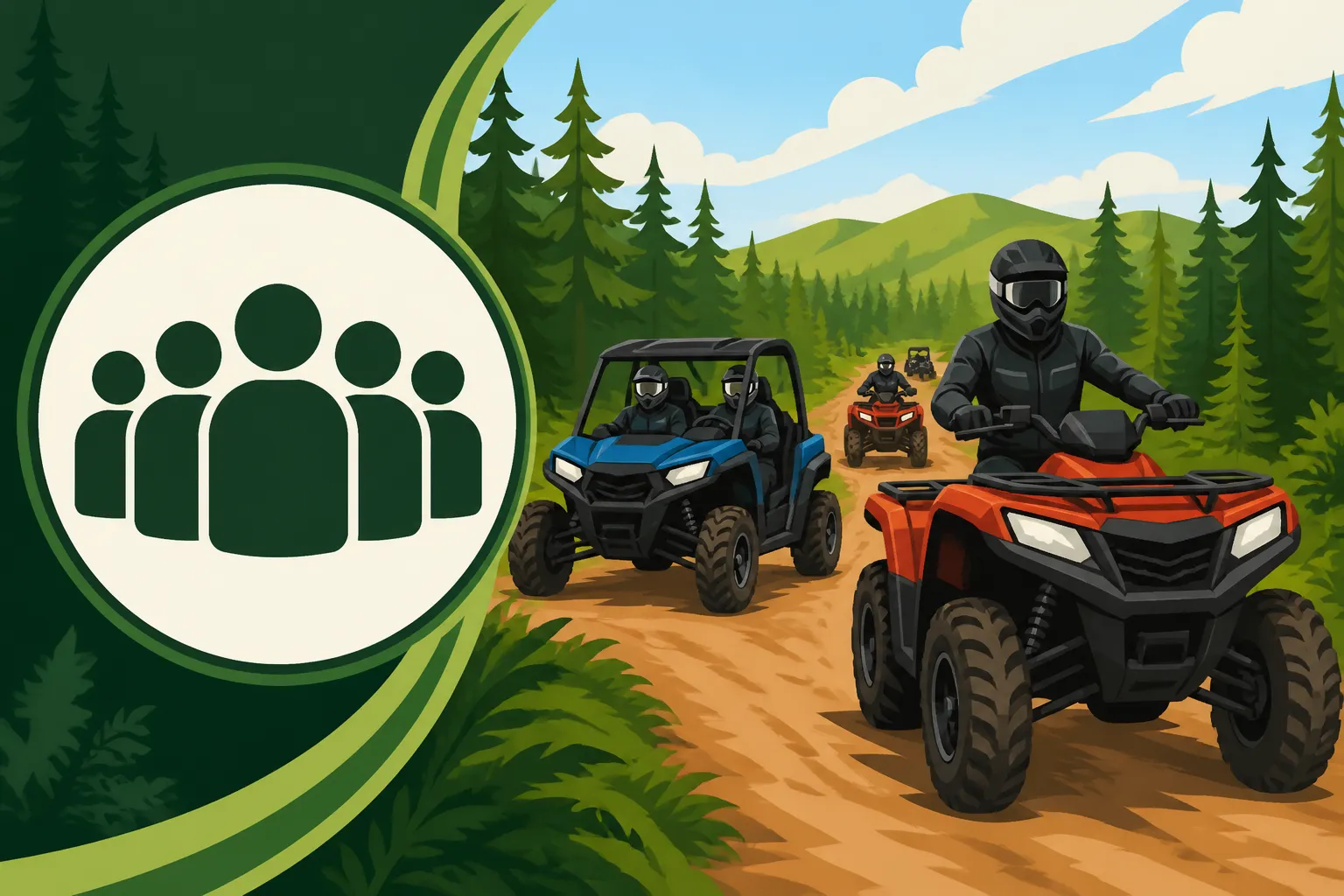
Even when a ride is permitted, the largest group you can assemble is not necessarily the best group to take onto a narrow or remote trail. A long line of machines can stretch out of sight, make it harder to notice a breakdown and cause delays at intersections or difficult sections. Dust, mud and limited passing space can make the experience unpleasant for other trail users.
Trail conditions matter as much as the number of riders. A route that works for a small group on firm ground may be slow or vulnerable to damage when it is wet, soft or rutted. Narrow corridors and single-track sections can be especially challenging for a large, mixed-ability group. Check Manitoba Trail Difficulty Ratings and Manitoba Trail Conditions Before You Haul when planning a route and deciding whether to divide the ride.
A practical alternative to one large moving group is to split participants into smaller riding groups. This can improve spacing and make it easier for each leader to keep track of their riders. But splitting a group is a safety and trail-management choice, not a way to avoid an event requirement. If the outing is organized as one event, ask whether the permit rules still apply to the full gathering.
Before departure, set expectations for pace, spacing, stopping points and what to do if someone falls behind. Use a lead rider who knows the route and a sweep rider who stays with the last machine. Agree that the group will stop at safe, predetermined points rather than leaving a slower rider to catch up alone. For more planning ideas, see Manitoba Group Ride Planning.
A useful headcount includes more than the number of machines. Confirm how many people are riding, whether any machines carry passengers and whether every vehicle has a responsible operator. A rider who turns back, a mechanical problem or a delayed arrival can change the group’s shape, so establish a simple way to account for everyone at stops.
| Planning question | Why it matters |
|---|---|
| Can the route accommodate the whole group? | Narrow or difficult sections may become slow and congested |
| Are riders at similar experience levels? | A large difference in skill can create long gaps and missed turns |
| Is there room to stop safely? | A group should not block the trail while waiting or regrouping |
| Does the route have reliable communication coverage? | Remote sections may make it difficult to contact help |
| Is the surface vulnerable to damage? | A large group can magnify the effect of riding on soft or wet ground |
| Who is responsible for the headcount? | A named organizer can check that no one is left behind |
Trail etiquette remains important whether the group is small or large. Keep machines moving in a controlled line, avoid blocking intersections and pull off only where it is safe and permitted. Be considerate of other trail users, and do not assume a group ride has priority over people travelling in the opposite direction. See Manitoba Trail Etiquette Locals Expect for more on sharing club corridors.
A Before-You-Go Check for Organizers
A short confirmation before the ride can prevent confusion at the trailhead. Start with the club that maintains or administers the route. Ask about member access, non-member participation, group-size expectations and any restrictions for the chosen date. If the route crosses land managed by someone else, ask whether the club’s permission covers that section or whether separate approval is needed.
Next, describe the event honestly. If you have invited a large group, posted a public notice or set up an organized start, say so. Ask whether special-event requirements apply, including when the expected attendance reaches ten or more. Do not rely on another club’s past event as proof that your ride has the same permissions; the trail, organizer, land status and event plan may differ.
Check trail status close to departure, not only when planning begins. A closure or temporary restriction can change where you may ride, and an alternate route might have different access conditions. If the approved route is no longer available, get confirmation before redirecting participants. Manitoba Trail Conditions Before You Haul is useful for checking the route before towing machines to a trailhead.
A written checklist can keep the practical details straight:
- Club approval or access confirmation
- Any event permit or land-manager permission that applies
- Confirmed route and current trail status
- Expected participants and a plan for handling extra arrivals
- Lead and sweep riders
- Agreed stops, pace and regrouping procedure
- A method to account for all riders at the end
If you are a participant rather than the organizer, ask whether the ride has been approved and whether there are any restrictions you need to follow. You can also check that your machine and documents are ready before setting out. A group invitation is not proof that the organizer has permission to use every part of a trail.
The safest approach is to treat group size as two separate decisions: first, confirm that the planned ride is allowed and whether a permit is required; then choose a group arrangement the trail and riders can handle. Club confirmation, realistic attendance estimates and a plan for keeping the group together are more useful than relying on a supposed province-wide maximum.
Disclaimer
This article is for general informational purposes only and does not constitute professional advice. Laws, prices and regulations vary by location and change over time. Consult a qualified professional for guidance on your specific situation.