Rules That Differ Between Two Provincial Parks
Planning an ATV or UTV ride in two Manitoba provincial parks can mean dealing with two different sets of practical rules. A registration or permit that gets you into one park may not make every route legal, and a trail open on one visit may be closed on another. Compare route access, closures, permits and local notices before you haul your machine.
Why rules can differ from park to park
A provincial park is not automatically open for off-road riding. Manitoba parks allow machines only on routes designated for that use, and the permitted routes and current conditions can differ between parks. A route shown on an old map, mentioned in a riding group or visible on the ground is not enough to confirm that riding is allowed there.
That distinction matters because riders often use “park access” to mean several different things: permission to enter the park, permission to bring a machine, and permission to ride a particular route. These are separate questions. You may be able to enter a park and still have no legal route for your ATV or UTV.
Start with the park’s own information rather than assuming its rules match another destination. Look for the current park map, notices and route descriptions. If the information is unclear, contact the park office or the appropriate park authority before travelling. Manitoba Provincial Park Machine Rules explains the broader issue, while Manitoba Parks Allow Machines on Designated Routes Only focuses on why route designation matters.
Differences between two parks can include:
- Whether a designated route is available for off-road machines
- Which routes are open to ATVs, UTVs or particular machine types
- Whether a route is temporarily closed or subject to seasonal restrictions
- Where machines may be unloaded, staged or parked
- What permits are needed for vehicles entering the park
- Whether camping or other facilities are accessible by the route you plan to ride
These are practical points to verify, not a reason to assume that every park has a unique rule for every issue. Some requirements may be consistent across the provincial park system, while the allowed routes, closures and local instructions differ. The safest approach is to confirm both the general requirements and the details for each park you plan to visit.
It also helps to separate park permission from machine registration. Manitoba registration and its associated requirements do not, by themselves, authorize travel on every park road or trail. Likewise, paying a park vehicle permit does not necessarily give you permission to ride your machine wherever you choose. Manitoba Has No ATV Trail Pass explains why a general trail pass is not a substitute for checking access rules.
What to compare between two parks
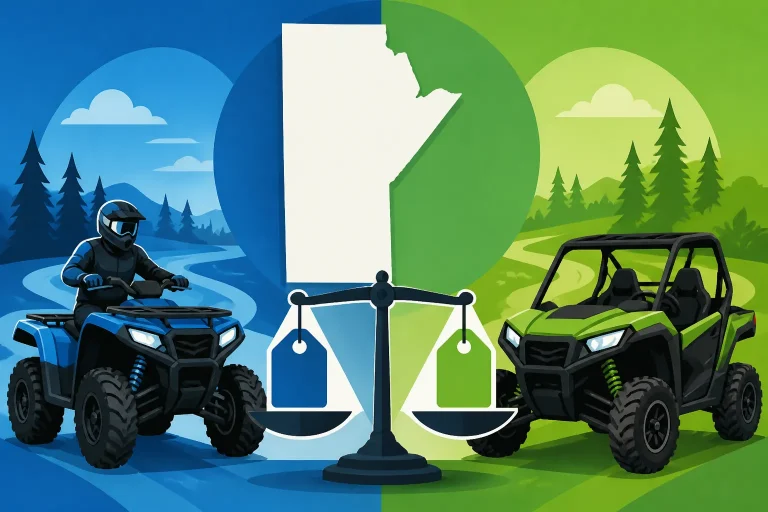
Make a side-by-side comparison before you load the trailer. This turns a vague question—“Can we ride there?”—into a practical checklist.
| What to check | Park A | Park B | Why it matters |
|---|---|---|---|
| Designated machine routes | Confirm the route and where it begins | Confirm separately; do not assume the same network | A park may have no suitable route for your planned ride |
| Machine types allowed | Check for restrictions or route-specific notices | Check independently | A route suitable for one machine may not suit another |
| Current closures | Review current notices before leaving | Review current notices before leaving | Fire, weather, maintenance or other conditions can affect access |
| Vehicle permits | Check which vehicles need a permit and how to obtain it | Verify the same details separately | A permit for one vehicle or visit may not cover another |
| Staging and parking | Confirm where to unload and leave the tow vehicle | Check the designated area and parking instructions | An informal pullout may not be an approved staging area |
| Camping and facilities | Check whether your planned route reaches the facility | Confirm route and facility access | Park access does not guarantee machine access to every facility |
| Local instructions | Read signs and notices at the site | Read signs and notices at the site | On-site restrictions can clarify or change what is practical |
Confirm the route, not just the destination
Find the actual route you intend to ride and identify its start and end points. Check whether it is an approved route for off-road machines, whether the machine type is allowed and whether any connection you need crosses a restricted area. A map that shows a road or trail does not necessarily show that it is open to ATVs or UTVs.
Look for the current version of the park’s route information. Printed maps, saved screenshots and third-party navigation apps can be useful for orientation, but they may not include a new closure or a current restriction. Use Manitoba Park Trail Conditions Pages and Manitoba Trail Conditions Before You Haul as starting points for checking conditions, then follow the current information provided for the specific park.
Check permits for the vehicles in your group
Do not treat a permit as a blanket authorization for every vehicle. Ask which vehicles need a park vehicle permit, whether the permit applies to the tow vehicle or another vehicle, how it must be displayed and whether a separate permit is required for another visit or vehicle. Park-permit rules and options can change, so verify current details with the official park information. Does One Park Permit Cover Every Provincial Park? is useful when planning visits to multiple parks, and Manitoba Park Permit Expiry can help clarify timing questions.
Keep park permits distinct from ORV registration. Registration establishes the machine’s status under Manitoba’s registration rules; park access is a separate matter. For an overview of the registration side, see Manitoba ORV Registration Through MPI. Carry the required registration documents as well as any park permit or proof the park requires. Neither document should be assumed to replace the other.
Check for closures and local instructions
A route that was open during a previous visit may be closed when you return. Closures can be temporary, and conditions can change because of fire risk, damage, maintenance or other operational needs. Check close to departure, not only when you first plan the trip.
At the park, read signs before unloading and again where routes branch or conditions change. If a sign appears to conflict with a map or an older notice, do not ride through on the assumption that the map is still right. Pause and ask park staff or use the current official contact information to resolve the uncertainty.
How to verify access before you go
Use the same process for each park. It takes less time than reaching a trailhead and discovering that the route is closed or unsuitable.
- Name the exact park and planned riding area. “We’re going to a provincial park” is not specific enough. Identify the park, the intended entrance or staging area and the route you hope to ride.
- Find the current park information. Check official maps, park notices and route descriptions. Look for explicit information about off-road machines rather than relying on a general park map.
- Confirm your machine is covered by the route information. If the notice is unclear about ATVs, UTVs or your machine configuration, ask before setting out. Do not infer permission from the route’s width or appearance.
- Review closures and conditions close to the trip. A route can become unavailable after you have planned the visit. Check again before leaving and follow any signs posted at the park.
- Ask about park permits for each vehicle. Confirm whether the tow vehicle, machine or another vehicle needs a park permit, and how the permit must be handled. If you are visiting more than one park, ask whether the same permit arrangement applies to both.
- Confirm staging and parking. Identify an appropriate unloading and parking location. Do not assume that a wide shoulder or an unmarked access point is approved for trailers.
- Save the information and carry what you need. Keep a usable map and any required registration or permit documents available. Mobile service may not be reliable where you ride.
- Follow the signs on site. If the route or a sign differs from what you expected, stop and confirm the current instruction before continuing.
If you cannot get a clear answer about a route, choose another route that is explicitly identified as open or postpone the ride. A trip plan should not depend on guessing that a path is permitted.
Common planning mistakes when visiting two parks
The first common mistake is assuming that a rule that worked at one park automatically applies at another. Even if the same park permit arrangements apply, the second park may have a different designated route, different access points or a current closure. Verify the riding area park by park.
The second is relying only on a general map or an app. Maps help with navigation, but a line on a screen does not necessarily establish legal access. Compare it with current park information and posted signs. This is especially important when a route appears to connect two recreation areas or follows a road, utility corridor or other visible track.
The third is treating a trail fee, registration or permit as universal permission. These serve different purposes. Manitoba ORV registration is not a pass to ride all park routes, and a park vehicle permit is not a substitute for route approval. Make sure you understand what each document covers before you leave home.
The fourth is planning around facilities without checking how you can reach them. A campground, beach, picnic area or parking area may be open to visitors but not accessible to off-road machines. Plan where the machine can legally travel and where it must remain parked. If a ride depends on using a campground or other facility, confirm access with the park.
The fifth is treating an old trip report as current authority. A friend may describe a route that was open on their visit, but that does not confirm its status for yours. Conditions and notices change. Use other riders’ reports as leads, then check official information.
Finally, avoid assuming that a route is open because another kind of vehicle uses it. A road or trail may be available to cars, service vehicles, hikers or bicycles without being open to ATVs and UTVs. When the park’s route information does not clearly include your machine, ask before riding.
A reliable comparison is simple: confirm the designated route, machine access, current closures, permit requirements and staging arrangements for each park. Keep the answers separate in your trip plan, and recheck them before departure. That gives you a better chance of arriving with a legal route and a workable plan, rather than relying on what was allowed somewhere else.
Disclaimer
This article is for general informational purposes only and does not constitute professional advice. Laws, prices and regulations vary by location and change over time. Consult a qualified professional for guidance on your specific situation.