Manitoba Bear Encounters While Riding
A bear on a Manitoba trail can turn a relaxed ride into a tense few minutes, especially when the bush is thick, the group is spread out, or cell service has disappeared. This guide explains how to lower the chance of an encounter, what to do if you see a bear, and how to plan an ATV or UTV ride when bear activity is possible.
Prepare for Bear Country Before You Ride
Check the area and conditions
Bears can be encountered across Manitoba’s forested riding areas, including regions around Duck Mountain, the Porcupine Forest, Belair Forest and Sandilands. Seeing one does not necessarily mean a trail is unsafe, but local conditions matter. Food availability, weather, recent sightings and the amount of human activity can all affect where bears are moving.
Before heading out, check for notices from the park, land manager, local riding club or community responsible for the area. A club may know about a recent sighting near a trailhead or a section of trail that riders have been asked to avoid. Review [Manitoba Trail Conditions Before You Haul] and look for closures or advisories that apply to your exact riding area, not just the nearest town.
If your route crosses a provincial park or other managed land, confirm which routes are open to off-road vehicles. A map showing a road or trail does not automatically mean it is legal or suitable for riding. Local access rules and temporary closures can change the route you should take, so read signs at the trailhead and check with the relevant office if anything is unclear.
Pack so you can respond quickly
Carry bear deterrent where the rider can reach it without digging through a pack or opening a storage box. If you choose bear spray, learn how it works before the ride, check its instructions, and keep it secured in a place that allows quick access. A product buried under rain gear is unlikely to help in a sudden encounter. Bear spray is a precaution, not a guarantee, and it does not replace distance, awareness or a safe exit.
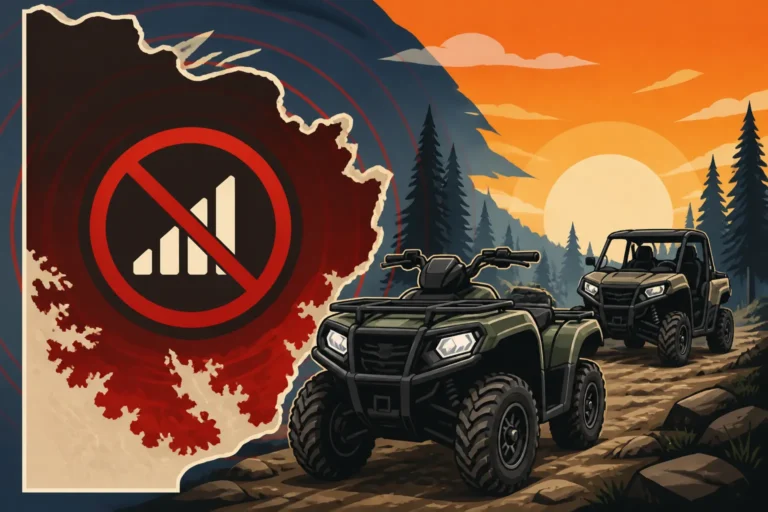
Bring a first-aid kit, a way to communicate in an emergency, and enough water and food for an unexpected delay. In some northern riding areas, cell service can be unreliable or absent, so agree on what the group will do if someone becomes separated or a machine breaks down. [Cell Dead Zones in Northern Manitoba] is worth reviewing when planning a ride beyond reliable coverage.
A navigation app such as onX Offroad can be one part of route planning, but do not depend on a phone alone in remote country. Download or otherwise prepare the information you need before leaving coverage, carry a backup map if practical, and make sure everyone understands the planned route. [Manitoba Trail Apps and Maps] can help you think through mapping options and the importance of having a backup.
Use a simple group plan
Before unloading, tell everyone the route, the expected turnaround point and what to do if the group stops unexpectedly. Keep riders close enough to communicate, especially through dense bush, around blind corners and near creek crossings where engine noise can mask sounds. A very long gap between machines makes it harder for the group to notice a bear, warn the rider behind, or respond together.
Agree on a signal to stop the group and a separate signal for a hazard. If one rider sees a bear, the goal is to stop people from riding toward it, not to create a noisy rush of machines. A quick, calm message such as “bear ahead, stop here” is more useful than a series of confusing shouts or hand gestures.
| Before the ride | Why it matters | Practical check |
|---|---|---|
| Check local notices | Recent activity or closures may affect your route | Ask the local club, park office or land manager |
| Plan navigation | Trails can be easy to miss in dense bush | Save route information and carry a backup |
| Set a regroup plan | Riders may become separated around corners | Choose clear stops and a turnaround point |
| Carry deterrent accessibly | A buried canister is difficult to reach quickly | Practice locating it while wearing your riding gear |
| Manage food and garbage | Strong smells can attract wildlife | Keep food secured and pack all waste out |
Reduce the Chances of a Close Encounter
Make your group easier to notice
ATVs and UTVs are noisy, but engine sound does not guarantee a bear will move away. Wind, terrain and thick vegetation can limit how far sound carries. Ride at a pace that gives you time to react, and be especially alert where visibility narrows, such as around blind bends, dense willow, creek banks and berry patches.
Riding together helps the group stay aware of what is ahead and behind. Avoid racing, spreading out over a long distance or surprising other trail users. A controlled pace also makes it easier to stop without skidding or startling a bear with a sudden burst of acceleration. For broader shared-trail practices, see [Manitoba Trail Etiquette Locals Expect].
Keep food and garbage from becoming attractants
A snack wrapper, open cooler or bag of garbage can leave a strong scent around a staging area or campsite. Keep food and scented items secured when they are not in use, and do not leave scraps behind at a trailhead. If you stop for lunch, gather every wrapper and leftover before riding on. Never feed a bear, whether deliberately or by leaving food accessible.
If your ride includes an overnight stop, find out what food-storage rules apply at that location and follow posted instructions. Keep the cooking and food area orderly, and dispose of waste only where permitted. [Manitoba Campgrounds Near a Trailhead] can help with trip planning, but always check the rules for the specific campground or site you intend to use.
Pay attention to what the trail is telling you
Tracks, fresh scat, overturned logs or a strong animal smell can be signs that wildlife has been nearby. They do not tell you exactly where a bear is now, but they are a reason to become more attentive and avoid lingering. If you see fresh signs in a tight, brushy section, consider turning around or choosing another route rather than pushing through simply because the trail is on your planned itinerary.
Also notice how the group is functioning. If riders are tired, distracted, rushing to reach camp or unable to communicate, it may be a poor time to continue into a remote stretch. A shorter ride is frustrating when you have hauled a machine a long way, but a deliberate turnaround is often the safer choice. [Manitoba Wildlife on the Trail] offers broader context for sharing riding areas with wildlife.
What to Do When You See a Bear
Stop and give it room
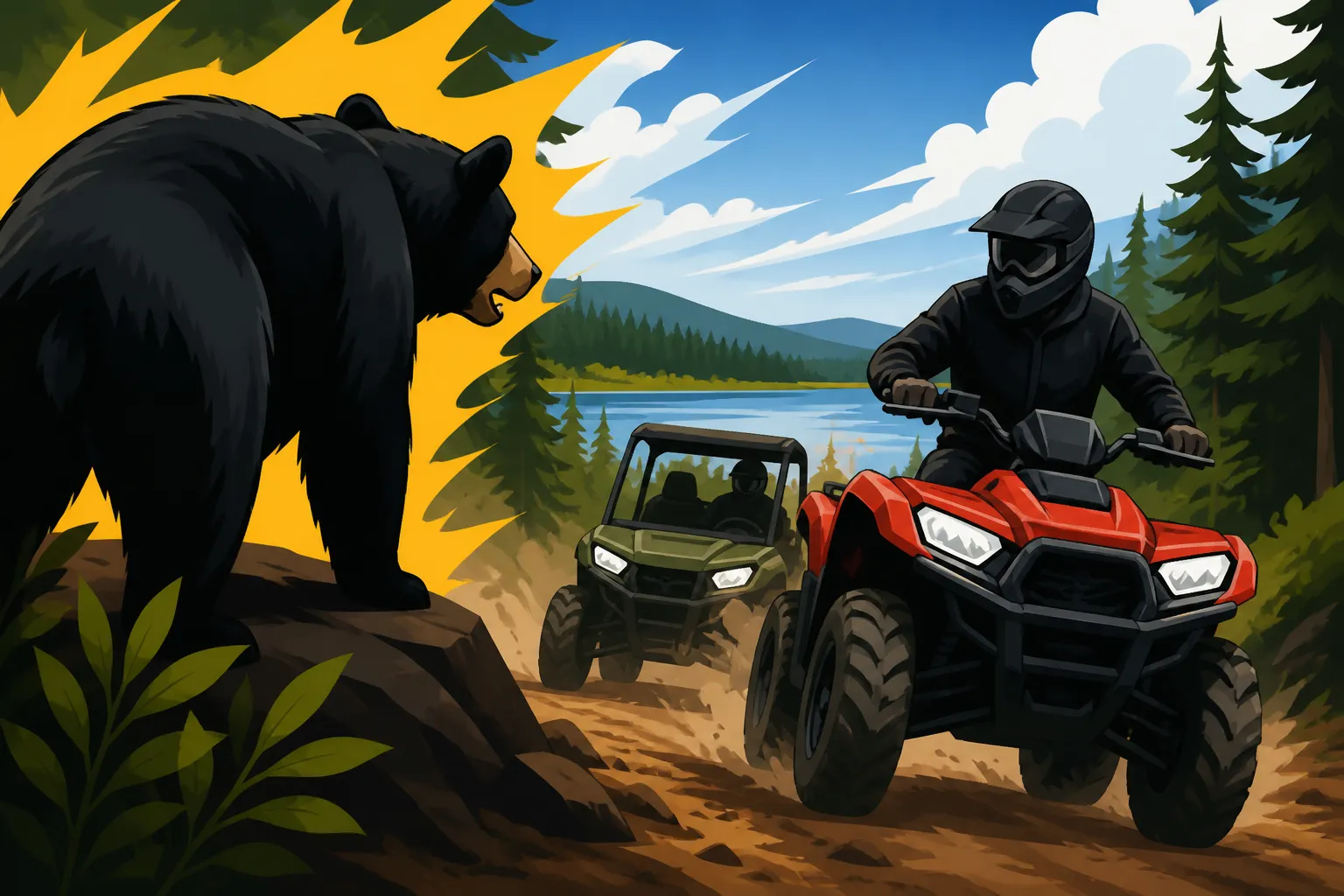
If you spot a bear, stop at a safe distance and alert the group. Do not ride closer to get a better look, surround it, follow it or block its route away from you. A bear may be trying to reach food, water or cover, and giving it room to leave is usually the most sensible first response.
Keep the group together and speak calmly so riders know what is happening. Avoid sudden movements, shouting or revving engines to provoke a reaction. If the bear has not noticed you, do not try to get closer. Quietly increase the distance or leave the area by a clear route, without passing near the animal.
A bear beside the trail can be hard to judge from an ATV seat. Do not assume the machine makes you safe or that you can simply accelerate past. The vehicle may be noisy and exposed, and a close pass can leave little room to react. If the bear is blocking the route, wait at a distance or turn around when it is safe to do so.
Do not approach cubs or a feeding bear
A bear with cubs needs extra space. Do not move between an adult and cubs, and do not try to approach or photograph them. If the cubs are near the trail, stay back and leave the area by a safe route. An adult bear that feels its young are threatened can react defensively.
Give a bear that is feeding, resting or lingering near a carcass a wide berth. Do not try to chase it away from the trail with an ATV or UTV. If there is no clear way around without getting close, turn back and report the location to the appropriate local authority or land manager when you can.
Use deterrent only as a last line of protection
If a bear comes closer, focus on creating distance without making a sudden approach or trying to squeeze past it. Keep the group together, keep the deterrent accessible and follow its instructions if it becomes necessary to use it. Wind and distance can affect how well a deterrent works, so do not treat it as a substitute for leaving the area when you have a safe opportunity.
Bear behaviour can vary, and a frightened rider may not have time to sort out every signal. Do not try to interpret a bear’s posture by moving closer. If the animal makes contact or the situation becomes an immediate emergency, prioritize protecting people and follow established bear-safety guidance for the species and circumstances. Once the group is safe, contact emergency services or local authorities if anyone is injured, a bear is behaving unusually, or there is an ongoing risk to other trail users.
After an Encounter and When to Change Plans
Regroup before continuing
Once the bear has moved away and the group is at a safe distance, stop somewhere clear and check that every rider is present and uninjured. Make sure no one is shaken, separated or missing equipment. A close encounter can leave riders flustered, and continuing immediately may lead to a navigation mistake or a second risky decision.
Talk through what happened and decide whether to turn around, take another route or end the ride. Consider the bear’s location, the visibility ahead, the group’s experience and whether a safe alternative exists. If the bear remains near the route or the group cannot pass without approaching it, do not force the crossing.
Report serious or repeated sightings
A brief sighting at a distance may not require an emergency call, but a bear that is injured, repeatedly approaching people, lingering around a busy trailhead or creating an immediate hazard should be reported to the relevant park office, land manager or local authority. If someone is hurt or in immediate danger, contact emergency services as soon as possible. In remote places, use the communication method arranged before departure.
When reporting, provide a useful location rather than a vague description. Note the trail or road name, nearest junction, direction of travel and any recognizable landmark. A prepared route from a navigation tool such as onX Offroad may help you describe where you are, but share only the location information you can confirm. Keep the report factual: what you saw, when you saw it, how close the bear came and whether it appeared injured or was approaching people.
Let the encounter change the ride
Riders sometimes feel pressure to finish a loop because the machines are already unloaded or the group has travelled a long way. That pressure is understandable, but a bear encounter is a good reason to reassess rather than stick rigidly to the original plan. A different route, an earlier return or a postponed ride may be the better call if the area feels unsafe or local officials have issued a warning.
Use the experience to improve the next outing. Consider whether the group was too spread out, whether food was left exposed, whether the route had enough backup options and whether communication worked in the bush. Check [Manitoba Riding Season Month by Month] when choosing timing and planning for changing conditions, and review [Manitoba Group Ride Planning] if you are organizing a larger group.
Disclaimer
This article is for general informational purposes only and does not constitute professional advice. Laws, prices and regulations vary by location and change over time. Consult a qualified professional for guidance on your specific situation.