Stopping and Yielding Before You Cross a Highway
That feeling, when you're deep in the Manitoba backcountry, the engine humming, dust or snow flying, and suddenly you realize a paved highway is cutting right through your path. It's a common scenario for many of us who love exploring on our ATVs and UTVs. While it might seem like a quick dash across is no big deal, highway crossings are actually one of the most critical moments of any ride, legally and for your own safety. This guide is here to walk you through the non-negotiable rules and best practices for stopping and yielding before you cross a highway in Manitoba, ensuring your adventure stays on track and safe.
Why Stopping and Yielding Before a Highway Crossing is Non-Negotiable
Let's be real, nobody wants to spend their precious riding time dealing with police or, worse, an accident. The rules around highway crossings for off-road vehicles aren't there to annoy you; they're there to protect your life and the lives of others. It’s about more than just common sense; it’s enshrined in law for a very good reason.
The Legal Mandate for ORV Operators
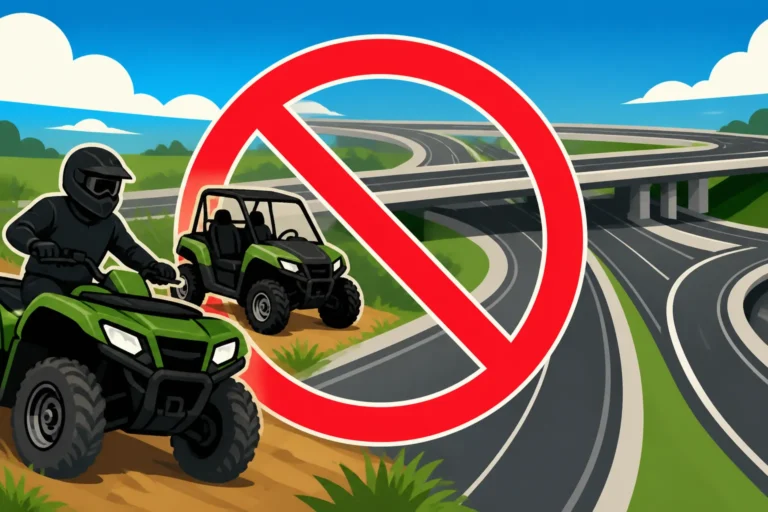
In Manitoba, the Off-Road Vehicles Act (ORVA) is pretty clear: your ATV or UTV generally isn't meant for paved roadways. Because of this, any time you need to traverse a highway to get from one section of trail or ditch to another, it's considered a special circumstance, and specific rules apply. You can't just treat a highway like another part of the trail. It's a fundamental difference in how these machines are supposed to be operated. [Manitoba Bans Riding on Roadways] is an important piece of legislation to remember here; it highlights why crossings are such a distinct activity.
These legal requirements aren't just boilerplate; they reflect the inherent danger of mixing off-road vehicles with high-speed highway traffic. Imagine a large transport truck barreling down the highway at 100 km/h. Its driver is expecting cars, not a quad popping out from a ditch. The Act specifically outlines that you must stop and yield to all traffic, giving the right of way to vehicles on the highway. This isn't a suggestion; it's a mandatory step that carries legal weight and serious consequences if ignored.
Failing to adhere to these crossing rules isn't just a minor infraction. It's a clear violation of the ORVA, and enforcement officers, including the RCMP and conservation officers, are well aware of these regulations. They understand the risks involved and take these rules seriously. So, when you approach a highway, remember it’s not just about courtesy; it’s about meeting a legal obligation that keeps you compliant and prevents unwanted attention from law enforcement.
Prioritizing Everyone's Safety
Beyond the legal aspect, safety is, without a doubt, the paramount reason for strictly adhering to stop and yield rules at highway crossings. Highways are designed for vehicles moving at much higher speeds, and they inherently demand quick reactions and excellent visibility. An ATV or UTV, by its very nature, is smaller, slower, and often less visible to motorists who aren't expecting off-road traffic. This creates a dangerous disparity that can lead to catastrophic results if not handled with extreme caution.
Think about the physics for a moment. A car traveling at 100 km/h covers approximately 28 meters per second. That means in just a few seconds, an oncoming vehicle can close a significant distance. From your vantage point on an ORV, especially if you're pulling out of a treeline or a deep ditch, judging the speed and distance of highway traffic can be incredibly challenging. What looks like a clear gap might actually be a rapidly diminishing window of opportunity, and miscalculating can put you directly in harm's way.
Moreover, motorists on highways often have limited peripheral vision or might be momentarily distracted. They're not actively scanning the ditches for off-road vehicles, making your sudden appearance even more hazardous. By coming to a complete stop and thoroughly yielding, you're not just giving yourself time to assess the situation accurately; you're also giving highway drivers a chance to see you and react if necessary. It’s about creating the safest possible scenario for everyone sharing the road, even if your interaction with that road is only fleeting.
The Step-by-Step Guide to a Safe Highway Crossing
So, you've reached a highway, and you know you need to cross. How do you do it correctly, safely, and legally? It's not rocket science, but it does require a methodical approach. Skipping steps or rushing can turn a simple crossing into a serious incident.
Choosing the Right Crossing Point
First things first, you can't just pick any random spot along a highway to cross. The Off-Road Vehicles Act sets out specific requirements for where a crossing is permitted. This isn't just about convenience; it's about maximizing visibility for both you and oncoming highway traffic. Attempting to cross in an unmarked or unsuitable location can immediately put you in violation of the law and, more importantly, put your life at risk.
The law typically requires crossings to be made at or within a certain distance of an intersection, or if not at an intersection, where there's an unobstructed view for a considerable distance in both directions. For instance, [Manitoba Crossing Rules at 5 Metres and 3 Kilometres] specifies that you should cross within 5 metres of an intersection, or if there's no intersection, you should cross at least 3 kilometres from the nearest one. These distances are designed to ensure you and highway motorists have enough time to see each other and react. Trying to cross over a blind hill, around a sharp curve, or where dense foliage obstructs your view is extremely dangerous and strictly prohibited.
Always prioritize a location where you have a clear, expansive view of the highway in both directions, and where highway traffic can clearly see you. This "clear view" is absolutely paramount, as stated in [Manitoba Crossings Need a Clear View]. If you don't feel confident in the visibility, don't cross there. It's always better to backtrack a bit and find a safer, legal spot, even if it adds a few extra minutes to your ride. Your safety is worth the detour.
Executing the "Stop, Look, Listen, Proceed" Protocol
Once you’ve identified a safe and legal crossing point, it’s time to put the "Stop, Look, Listen, Proceed" method into action. This isn't just a childhood lesson for pedestrians; it's a vital safety protocol for ORV operators at highway crossings. Each step is crucial and builds upon the last, ensuring you’ve done everything possible to mitigate risk.
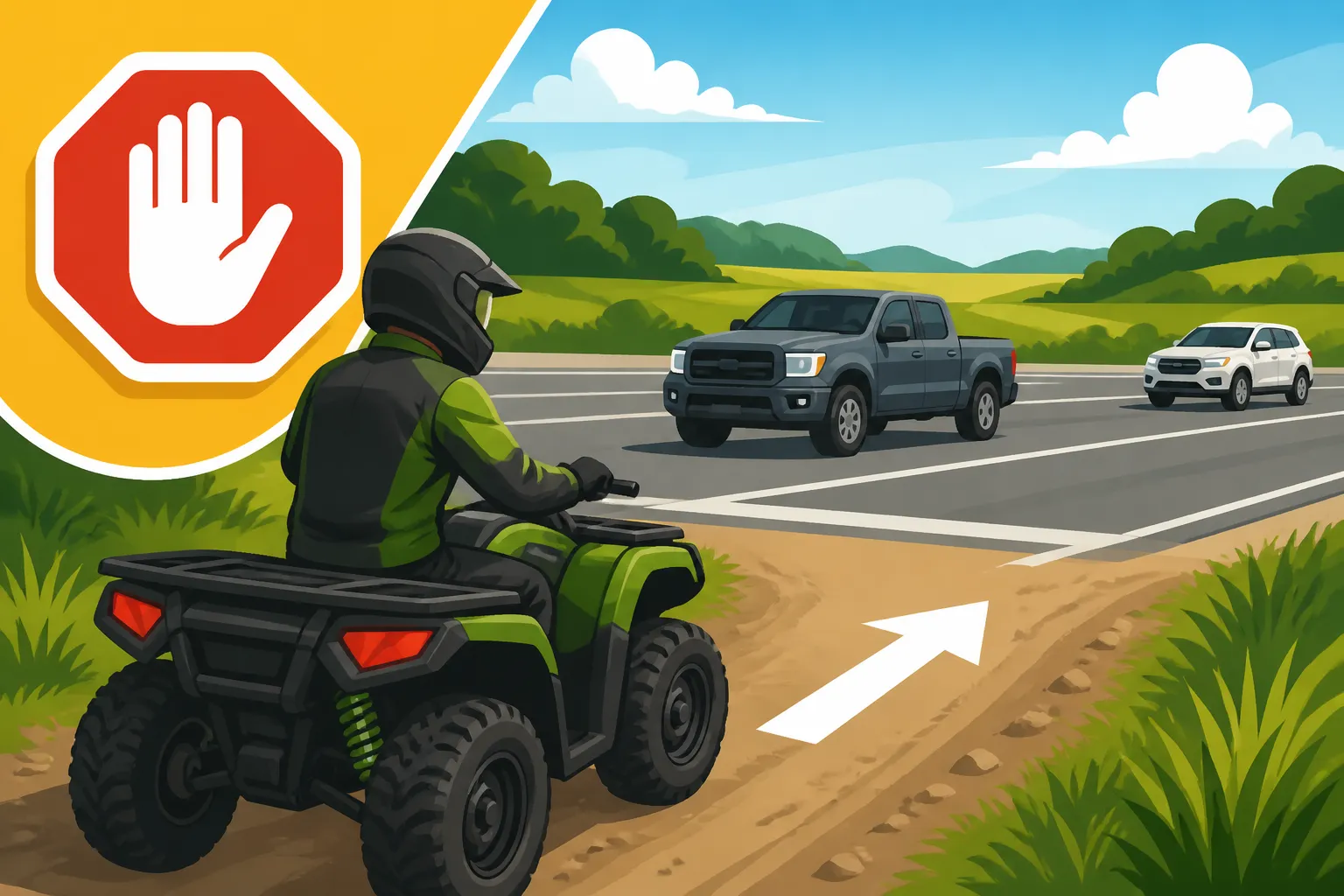
STOP: This is your first and most critical action. You must come to a complete, absolute stop before your machine enters the traveled portion of the highway. Don't roll, don't hesitate with your tires on the asphalt. Position your machine safely off the highway, where you have the best possible view of traffic without obstructing it. This pause allows you to fully disengage from the momentum of your ride and focus entirely on the highway environment. It also gives you a stable platform from which to make your observations.
LOOK: Once stopped, actively scan the highway in both directions. Don't just give a quick glance. Turn your head fully to the left, then fully to the right, and repeat. Look for both approaching and receding traffic, paying special attention to vehicles that might be signaling a turn if you're near an intersection. Remember, vehicles move fast on highways, so you need to be absolutely certain that there's enough clear space for you to cross entirely without impeding traffic flow. It's not enough to think it's clear; you need to know it's clear.
LISTEN: Sometimes, you can hear a vehicle before you see it, especially large trucks or fast-moving traffic. With your engine idling, or even turned off for a moment if it’s particularly loud, listen for the sounds of approaching vehicles. This is especially helpful if there's a slight curve or elevation that partially obscures your view. The combination of sight and sound gives you the most comprehensive understanding of the traffic situation. It's a small extra step that can make a huge difference in your safety assessment.
PROCEED: Only when you are absolutely, 100% confident that the way is clear and safe, then and only then, proceed directly across the highway. Do so in a straight line, at a 90-degree angle to the road. This minimizes the time your machine is exposed to highway traffic. Do not dawdle, weave, or attempt to travel along the highway for any distance. Your goal is to get from one side to the other as efficiently and directly as possible. Speed up just enough to make a swift crossing, but maintain control. Remember, [Manitoba Crossings One Machine at a Time] if you're with a group.
Navigating Group Crossings
Riding with a group is one of the best parts of the ORV experience, but it adds a layer of complexity to highway crossings. It might be tempting for everyone to just follow the leader in a line, but this is incredibly dangerous and a clear violation of Manitoba's ORV rules. The law is very specific for a reason: group crossings increase the risk exponentially.
The critical rule to remember for groups is that each machine must cross individually. There's no "convoy" system allowed across a highway. The lead rider will execute the "Stop, Look, Listen, Proceed" protocol described above, ensuring they have an ample, safe window to cross entirely. Once the lead rider is safely on the other side, they should stop in a safe location and signal to the next rider that the coast is clear for that rider's individual crossing.
This process is then repeated for every single machine in the group. Each rider is individually responsible for ensuring their own safe passage, even if the lead rider has given a signal. This means that every rider must still come to a complete stop, look, and listen before they proceed. It requires patience and discipline from everyone involved. Trying to rush multiple machines across at once creates a long, unpredictable obstruction on the highway, dramatically increasing the risk of a collision and putting the entire group in jeopardy. Clear communication and a shared understanding of this protocol are vital for any group ride that involves highway crossings.
Common Misunderstandings and the Real Consequences
Even with clear rules, it's easy to fall into traps of thinking that can put you at risk. Sometimes, riders develop habits or hold onto misconceptions that compromise their safety and legal standing. It’s crucial to dispel these myths and understand the very real implications of ignoring the rules.
Debunking the "Quick Dash" Myth
One of the most dangerous myths among some riders is the idea that a "quick dash" across the highway is sufficient. This usually involves slowing down, perhaps rolling to a near stop, and then quickly accelerating across what seems like a clear gap in traffic. The reasoning often goes, "I saw an opening, and I can make it fast." This mentality is incredibly risky and goes against every principle of safe highway crossing.
The problem with the "quick dash" is rooted in human perception and the unforgiving nature of highway speeds. From an ORV, especially one that has just emerged from a ditch or treeline, your ability to accurately judge the speed and closing distance of an oncoming vehicle is significantly impaired. What appears to be a safe two-second gap for your crossing might, in reality, be less than a second once that truck or car is upon you. You simply don't have the same visibility or context as a driver already on the highway, nor do you have the same acceleration capabilities as most highway vehicles.
Furthermore, a "quick dash" often bypasses the critical "look and listen" steps with the necessary thoroughness. You might be focused solely on the immediate gap, missing a second vehicle or misjudging a turn signal. This hurried approach leaves no margin for error, and on a highway, even a small error can have catastrophic consequences. The law demands a full stop and a complete yield for a reason: it’s about ensuring an undeniable window of safety, not just hoping for the best in a fleeting moment.
Penalties for Non-Compliance
Ignoring the legal requirements for stopping and yielding at highway crossings isn't just a matter of poor judgment; it carries real, tangible penalties under Manitoba law. These aren't just slaps on the wrist; they can significantly impact your wallet, your machine, and your freedom to ride. Law enforcement agencies in Manitoba are well-versed in the Off-Road Vehicles Act and are empowered to enforce its provisions vigorously.
If you're caught failing to stop and yield, you can expect to receive a significant fine. While I can't give specific dollar amounts, understand that these penalties are designed to be a strong deterrent. Beyond the immediate fine, repeated offenses or particularly egregious violations can lead to further legal action, including potential court appearances. In some severe cases, especially if your actions are deemed reckless or put others at extreme risk, your off-road vehicle could even be impounded. That means a hefty towing bill, impound fees, and the headache of recovering your machine, all on top of any fines.
Perhaps even more critically, consider the insurance implications. Your basic [Manitoba Insurance Included With Registration] provides a certain level of third-party liability coverage. However, if you are involved in an accident while operating your ORV illegally – such as failing to stop and yield at a highway crossing – your insurance provider could deny coverage for damages or injuries. This means you could be personally liable for tens of thousands, or even hundreds of thousands of dollars in damages to other vehicles, property, and, most devastatingly, for injuries to individuals. Remember, [Why Basic Manitoba ORV Coverage Skips Injuries] highlights that basic coverage doesn't even cover your own injuries. If you cause an accident through negligence, you could be facing a financial nightmare that far outweighs any convenience you gained by rushing a crossing.
Practical Tips for a Smoother, Safer Ride Across Highways
Beyond knowing the rules, there are some practical steps you can take to make every highway crossing as safe and stress-free as possible. A little planning and preparation go a long way in ensuring your ride is enjoyable from start to finish.
Planning Your Route with Crossings in Mind
One of the easiest ways to ensure safe highway crossings is to plan them out before you even hit the trail. Don't leave it to chance or impromptu decisions when you're already in the moment. Just like you'd plan your fuel stops or scenic overlooks, consider where the highways intersect your route.
Before you head out, pull up your maps – whether it's a physical map, a GPS device, or a mobile app. Look for your intended route and identify all the highway crossing points. Evaluate these points: do they appear to offer good visibility? Are they near intersections where rules might be more clearly defined? Many local ATV clubs, like those whose trails are found on [Manitoba ATV Trail Map Downloads], often mark designated crossing points or provide specific advice for navigating their areas. Pay attention to these resources, as they’re designed with local knowledge in mind.
If you find a section of your planned route with a particularly tricky or blind highway crossing, consider an alternative path. It’s always better to take a slight detour on a known safe route than to face an unknown, potentially dangerous crossing. Pre-ride planning gives you the mental advantage and allows you to approach each crossing with confidence, rather than anxiety or surprise.
Maximizing Visibility for Other Motorists
When you're operating an ORV near a highway, you need to be proactive about making yourself as visible as possible to motorists. Remember, they aren't expecting you, and your machine is smaller and lower than most highway vehicles. Every little bit of added visibility can literally save your life.
Start with your gear. Brightly colored helmets, jackets, or vests are not just a fashion statement; they’re a critical safety feature. Fluorescent colors (like lime green or orange) stand out significantly, especially in varying light conditions. Consider adding reflective tape to your helmet and machine, particularly if there's any chance you might be riding near dusk, dawn, or in adverse weather. Even in broad daylight, reflective material catches the eye. You can find robust reflective kits for ORVs through brands like SuperATV that are designed to withstand the elements and keep you seen.
Next, ensure your machine's lighting is in perfect working order. This includes your headlights and taillights. Even during the day, having your lights on can make a huge difference in how quickly and easily a motorist spots you. For night riding, bright lights are non-negotiable, and [Manitoba Lighting Requirements on a Machine] dictates certain standards. Beyond that, consider using clear, unambiguous hand signals when approaching a crossing to indicate your intentions, especially if you're turning or stopping. The more signals you can give to approaching traffic, the better.
Carrying Your Essentials
This might seem like a basic point, but it's worth reiterating, especially when dealing with areas like highway crossings where law enforcement might be present. In Manitoba, you are legally required to carry specific documents with you whenever you operate your off-road vehicle. Forgetting these can turn a simple interaction with an officer into a hassle, even if you’re doing everything else right.
Firstly, you absolutely must have your ORV's registration card with you. This is your proof that the machine is legally registered in Manitoba. As emphasized in [Manitoba Registration Cards Carried at All Times], it's not enough for your machine to be registered; you need the physical card on your person or in the machine. This document proves ownership and compliance with provincial registration laws.
Secondly, you need proof of insurance. While your basic liability coverage is usually tied to your registration, having that proof readily available is essential. If an officer asks to see your papers, as outlined in [What an Officer Can Ask to See in Manitoba], you need to produce them without delay. My advice? Get a small, waterproof pouch or a secure, watertight compartment on your machine. Keep your registration card, proof of insurance, and perhaps your driver's license (if you have one and it's required for your crossing type) in there. This keeps them safe from the elements and ensures they are always accessible, which means a smoother, quicker interaction if you're ever stopped.
Table: Safe vs. Risky Highway Crossing Practices
To summarize and highlight the differences, here’s a quick comparison of safe, legal practices versus risky, illegal approaches to crossing a highway on your ORV.
| Aspect | Safe & Legal Practice | Risky & Illegal Practice |
|---|---|---|
| Approach | Reduce speed well in advance, be ready to stop completely. | Approach at speed, assume you have priority or can quickly pass. |
| Stop Position | Come to a full, complete stop before entering the roadway. | Inch onto the highway, or stop with part of machine on the pavement. |
| Observation | Thoroughly look both ways, actively listen for traffic (engine off if needed). | Quick glance, rely on peripheral vision, don't actively listen. |
| Clearance Judgment | Cross only when the path is completely clear and offers ample time. | Cross in marginal gaps, misjudging vehicle speeds or distances. |
| Crossing Direction | Proceed straight across (90-degree angle) without hesitation. | Cross diagonally, attempting to "blend in" or ride along the shoulder. |
| Group Protocol | Each rider crosses individually, confirming clearance for their own passage. | All riders follow in a line, creating a single, extended obstruction. |
| Visibility | Wear bright clothing, ensure lights are functional, use hand signals. | Wear dark clothing, unlit machine, no signals, assume you are seen. |
| Outcome | Safe passage, legal compliance, minimal risk of collision or penalties. | High risk of collision, serious injury, significant fines, legal liability. |
Disclaimer
This article is for general informational purposes only and does not constitute professional advice. Laws, prices and regulations vary by location and change over time. Consult a qualified professional for guidance on your specific situation.