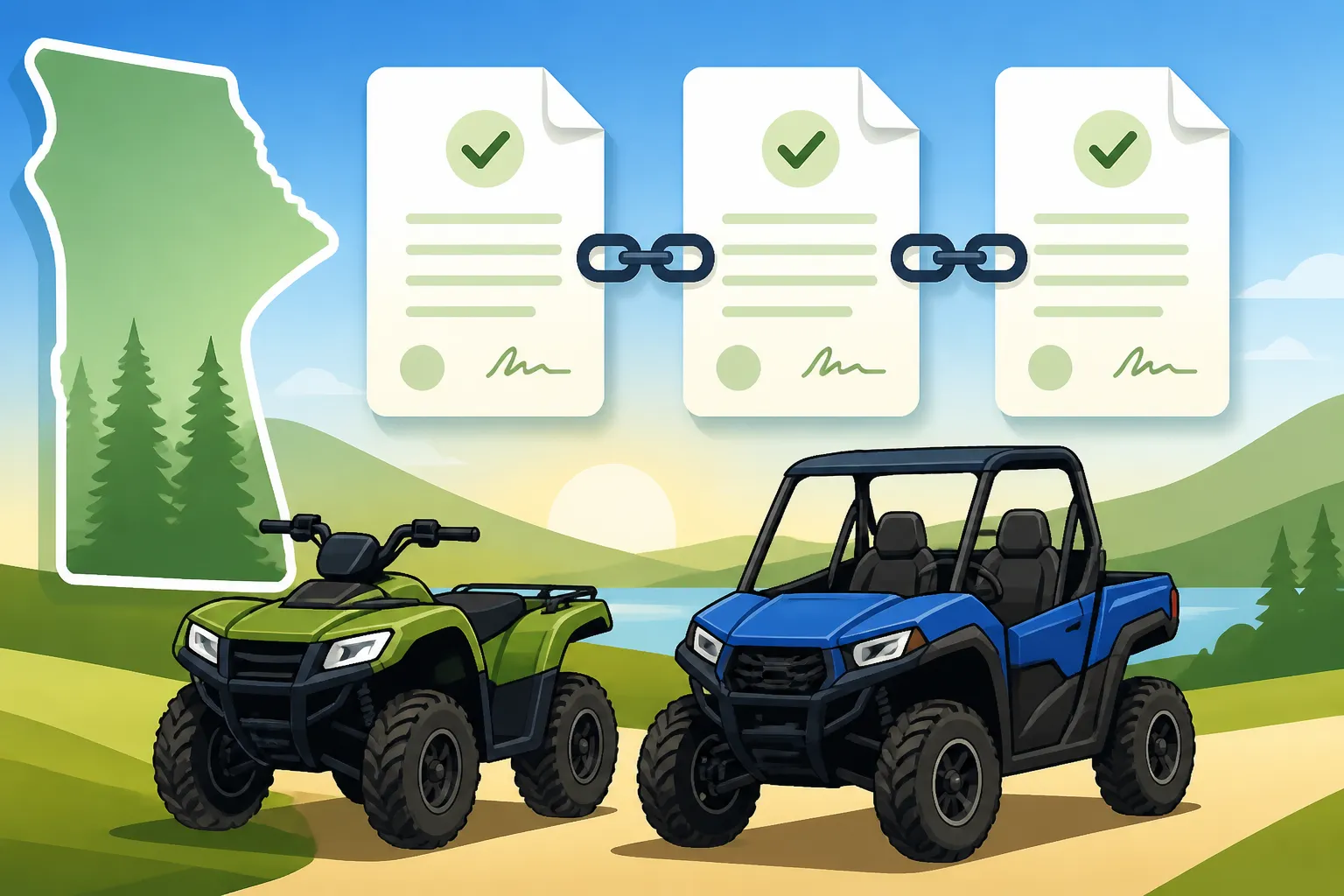
A Chain of Bills of Sale in Manitoba
You’ve just found the perfect used ATV or UTV in Manitoba, a gem you can’t wait to hit the trails with. But then you get to the paperwork, and instead of one clean bill of sale, you’re handed a stack – a ‘chain’ of bills of sale, stretching back through several previous owners. This can feel daunting, making you wonder if you’ll ever get your machine registered. This guide will walk you through exactly what a chain of bills of sale means in Manitoba, why it happens, and how to navigate this often-confusing process to get your machine legally registered with MPI.
Understanding the "Chain of Bills of Sale" Phenomenon in Manitoba
Picture this: you've been searching for just the right off-road vehicle. You finally find it, maybe on a local classifieds site or through a friend of a friend. You meet the seller, shake hands, agree on a price, and they hand you a bill of sale. Great, right? But then, they also hand you the bill of sale they got when they bought it, and perhaps even the one before that. Suddenly, you're holding a small stack of paper, each document linking to the next like a paper trail of ownership. This, my friend, is what we affectionately (or sometimes not so affectionately) call a "chain of bills of sale."
Why This Chain Forms in the First Place
You might be asking yourself, "Why don't people just register their machines properly?" It's a valid question, and honestly, there are a few common reasons this happens in our beautiful province.
Firstly, many owners in Manitoba don't always register their off-road vehicles right after purchase. Sometimes, they intend to, but life gets busy, and it falls by the wayside. Other times, they might only use their machine on private property, like their own farm or cabin land, and mistakenly believe that means they don't need to go through the official registration process. There's a common misconception that if you're not riding on public trails or roads, you're exempt from registration, but the rules are much broader than that. While there are some exemptions, like the [Manitoba Own-Property Registration Exemption], for many, skipping registration just creates a headache for future owners.
Secondly, machines are often bought and sold quickly, sometimes informally, between friends, family, or neighbours. In these casual transactions, the focus might be on getting the keys and the cash exchanged, with less attention paid to the rigorous documentation needed for an MPI registration. A friend might sell their quad to another friend, who then sells it to you, and somewhere along the line, no one bothered to officially register it in their own name with MPI. Each sale simply adds another link to the paper chain.
Thirdly, a previous owner might not even have had the original bill of sale themselves when they purchased the machine. Maybe it was a gift, an inheritance, or they bought it from someone who had also skipped registration. This creates a break in the chain right from the start, and every subsequent sale just builds upon that existing gap. MPI, as the registering body, needs a clear, unbroken path of ownership to ensure the machine isn't stolen and that all applicable taxes and fees are collected. Your bill of sale only proves you bought it from the last person, but MPI needs to know who sold it to them, and to them before that, going all the way back to the first registered owner or even the dealership. It's about establishing legitimate title.
Essential Documents for Your Chain of Ownership
When you're dealing with a chain of bills of sale, the quality and completeness of each document are absolutely critical. Think of each bill of sale as a link in a chain; if one link is weak or missing, the whole chain is compromised.
What Makes a "Good" Bill of Sale?
Ideally, every bill of sale in your stack should be as complete and clear as possible. A good bill of sale isn't just a scribble on a napkin. It’s a formal document that proves the transfer of ownership from one specific person to another. Here’s what MPI agents are really looking for on each document:
- Full Names and Contact Information: This includes the complete legal names, addresses, and ideally, phone numbers for both the buyer and the seller. This helps MPI verify the identities of all parties in the transaction.
- Date of Sale: The exact date the transaction took place. This is crucial for tracking the timeline of ownership.
- Machine Details: This is non-negotiable. Every bill of sale must clearly list the make, model, year, and most importantly, the Vehicle Identification Number (VIN) of the ATV or UTV. The VIN is the unique identifier for the machine, like a serial number, and it must match across all documents and, of course, on the machine itself.
- Purchase Price: The agreed-upon selling price. This is important not just for your records, but also for MPI to calculate the applicable retail sales tax (RST).
- Signatures of Both Parties: Both the buyer and the seller should sign and date the bill of sale. This signifies their agreement to the terms of the sale and the transfer of ownership. Without signatures, a document is just a piece of paper, not a legal transfer.
If you ever find yourself needing to create a bill of sale, whether you’re the buyer or seller, using a template can be a lifesaver. Reputable platforms like LawDepot offer easy-to-use templates that ensure you include all the necessary information, reducing the chances of future headaches. It's far better to have a proper, typed document than a hastily scrawled note.
Gathering All the Links in the Chain
When you’re presenting a chain of bills of sale to MPI, you need to bring all of them. This means every single document that shows the transfer of ownership from the original owner (or the last registered owner) right up to your purchase. This often goes back several transactions, not just the one immediately preceding yours.
The VIN is truly the anchor here. Every bill of sale must have the correct VIN, and this VIN must match the one physically located on the off-road vehicle. MPI will carefully check this. If there’s any discrepancy in the VIN on one of the documents, or if it doesn’t match the machine, that's a huge red flag that will likely halt your registration process until it's resolved. Sometimes, particularly with older machines, a bill of sale might be handwritten and a bit messy, or even faded. While MPI prefers clean, typed documents, a legible handwritten [A Bill of Sale From a Manitoba Neighbour] can still be accepted, as long as it contains all the essential information and is clearly readable. It's always best to keep the original copies of these documents, as photocopies can sometimes be questioned.
Navigating Missing Links and Tricky Situations
This is often where the real anxiety sets in. What do you do if one of those crucial links in the chain of ownership is missing? Maybe a previous owner simply lost their bill of sale, or perhaps the transaction was so informal that no formal document was ever created. This isn't just a minor inconvenience; a missing link can create a significant hurdle, potentially preventing you from registering your ATV or UTV in Manitoba.
The Nightmare of a Missing Bill of Sale
MPI needs continuity. They need to see a clear, unbroken line of ownership from the point the machine was last registered or sold new, right up to you. If there's a gap – a missing bill of sale between two previous owners – it effectively breaks the chain, and MPI can't easily confirm who legitimately owned the machine at that point, or that it wasn't acquired illegally. This is when the registration process can grind to a halt.
In such challenging situations, MPI might accept a statutory declaration, also known as an affidavit, to help bridge the gap. A statutory declaration is a formal, legal statement made under oath or affirmation, declaring certain facts to be true. In this context, the previous owner whose bill of sale is missing would need to sign a statutory declaration, confirming that they owned the machine, how they acquired it, and to whom they sold it (the next person in your chain). This document needs to clearly state the VIN, the machine details, and all parties involved in that specific transaction.
The challenge here is often practical. You would ideally need each seller in the missing part of the chain to sign such a declaration, confirming their ownership and sale to the next person. If these previous owners are difficult to track down, or if they're unwilling to cooperate (which, let's be honest, can happen), obtaining these declarations can be incredibly difficult, if not impossible. Websites like LawDepot can provide templates for statutory declarations, but getting them filled out and properly witnessed by a Commissioner for Oaths or a Notary Public is still a task.
When a Previous Owner is Unreachable or Unwilling
This is truly a frustrating scenario. If a previous owner is unreachable, or if they simply refuse to sign a statutory declaration, you're in a tough spot. MPI’s primary concern is preventing fraud and ensuring proper ownership. Without that missing link, whether it's a bill of sale or an affidavit, they can't confidently complete the transfer.
In some rare cases, if the machine is very old and has been unregistered for an extended period, or if there's a unique circumstance, MPI might have an alternative process. However, for most modern ATVs and UTVs, an unbroken chain of documentation or supporting affidavits is usually required. If you're dealing with [Manitoba Machines With No Paperwork] at all, the process becomes even more complicated and might involve specialized procedures to prove ownership.
You might be asked for other forms of corroborating evidence, like bank statements or cancelled cheques that prove a monetary transaction. However, these are generally used to support an existing (but perhaps incomplete) claim, not to replace a completely missing link in the chain. They are rarely a substitute for the actual transfer of ownership document.
Valuation for Tax Purposes
Beyond proving ownership, the chain of bills of sale also plays a role in how MPI assesses the retail sales tax (RST) you’ll need to pay. In Manitoba, RST is collected on the purchase price of the off-road vehicle. When you present your chain of bills, MPI will typically look at your bill of sale to determine the purchase price.
However, if your bill of sale shows a purchase price that seems unusually low for the type of machine, MPI has the right to assess the tax based on the machine's fair market value using recognized guides like the [Manitoba Blue Book Values for ORVs]. So, even if you got a "deal" or bought it from a family member for a nominal amount, you might still be taxed on a higher, more realistic valuation. The chain of bills confirms the legitimate transfers, but your final bill of sale and the machine's market value are what determine the tax you pay.
Registering Your ORV with MPI Using a Chain of Bills of Sale
So, you've done your best to gather every document, chase down every signature, and you're ready to face the music at MPI. This step can feel like navigating a maze, but being prepared and knowing what to expect will make the process much smoother.
Your Visit to an Autopac Agent
The first, and most crucial, step is to visit an Autopac agent. These are the folks who handle all vehicle registrations, including off-road vehicles, in Manitoba. You can find them in many communities across the province. When you go, bring absolutely everything you have:
- All bills of sale (originals, if possible): Every single link in your chain, meticulously organized.
- Any statutory declarations: If you had to get these to fill in gaps, bring them.
- Your personal identification: A valid driver's license or other government-issued ID.
- Proof of age: If you're 16-18, you'll need parental consent and proof of your age.
- Proof of address: A utility bill or similar document can be helpful.
Be prepared to explain the chain of ownership clearly, tracing it from the earliest document you have right up to your purchase. The agent will carefully review each document. They’ll input the information into their system and perform a VIN check to ensure the machine hasn’t been reported stolen and that the VIN on your documents matches the one on the actual ORV. This is where attention to detail really pays off. Remember, the agents at [Manitoba Autopac Agents and ORV Registration] are there to help, but they also have strict rules to follow.
What MPI Is Looking For
When an Autopac agent reviews your chain of bills of sale, they're essentially playing detective. Their main objectives are:
- Legitimate Transfer of Ownership: They need to see a clear, legal progression from one owner to the next. Each document must show a valid transfer.
- Consistency in VIN and Machine Description: The Vehicle Identification Number (VIN) must be consistent across all bills of sale. Any discrepancies will raise a red flag. The make, model, and year of the machine should also match on every document.
- No Red Flags: Agents are trained to look for anything suspicious. This could include unusually low pricing on a bill of sale, missing signatures, or documents that appear altered or incomplete. Such issues will trigger further investigation.
This process is all part of [Manitoba Transfer of Ownership Rules]. MPI wants to ensure that when they issue you a registration, they are doing so for a machine that you rightfully own, protecting both you and any future buyers.
Potential Delays and What to Expect
Let’s be realistic: registering an ORV with a complicated chain of bills of sale is often not a quick, in-and-out visit. Be prepared for potential delays. The Autopac agent might need to consult with a supervisor, particularly if there are any ambiguities or missing pieces in your chain. They might even need to contact previous owners to verify information, which can add significant time to the process.
Patience is key here. It can be frustrating, especially when you’re eager to get out and ride, but understand that the agents are just doing their job to ensure everything is legitimate. It's not uncommon for the [Manitoba Registration Processing Time] to be a bit longer in these complex cases. You might even be asked to provide additional information or return on another day if further verification is required.
Your Goal: New Registration Certificate and Plate
Once all the documents have been reviewed, verified, and approved, you're in the home stretch! You'll then pay the applicable registration fee, which, in Manitoba, includes the [Why Manitoba Adds $25 to Every ORV Registration] trail fee that goes towards maintaining our province’s fantastic trail system. You’ll also pay the retail sales tax (RST) on your purchase.
After payment, you’ll be issued your very own registration certificate and the single license plate for your machine. Yes, in Manitoba, we only get [Manitoba Issues One Plate, Not Two], and you’ll need to mount it in a visible location on your ORV. With your new registration in hand, you’re finally ready to legally hit the trails! Just remember the crucial step of [Carrying Your Registration Card on Every Ride] – it’s a requirement, and you could face fines if you’re caught without it. Getting your machine properly registered through [Manitoba ORV Registration Through MPI] is the legal gateway to enjoying our province's amazing backcountry.
Here's a quick overview of common documents and what they mean for your registration journey:
| Document Type | Purpose | Key Information Needed | What if it's missing? |
|---|---|---|---|
| Bill of Sale | Proof of purchase and transfer of ownership | Buyer/Seller names, addresses, date, VIN, price, signatures | MPI may require affidavits or further investigation. |
| Statutory Declaration | Formal statement under oath, often used for missing BoS | Declarant's ID, statement of ownership/sale, VIN, machine details | Can help bridge gaps but requires all parties to sign (if possible). |
| Previous Registration | Proof of prior legal registration | VIN, previous owner's name, expiry date | Helpful for tracing ownership, but not a substitute for a BoS chain. |
Even with a chain of bills of sale, a straightforward registration process can sometimes feel like trying to register [Manitoba Registration Without a Bill of Sale], but with a little persistence and all your documents in order, you'll get there.
Disclaimer
This article is for general informational purposes only and does not constitute professional advice. Laws, prices and regulations vary by location and change over time. Consult a qualified professional for guidance on your specific situation.