Manitoba Own-Property Registration Exemption
It's a common thought for many Manitoban off-road vehicle enthusiasts: "If I'm just riding on my own land, do I really need to register my quad or side-by-side?" This is a perfectly valid question, and the good news is, there actually is an exemption for machines used exclusively on private property. However, it's not as simple as it sounds, and there are very specific conditions that must be met to avoid running afoul of the law. This guide will walk you through the nuances of Manitoba's own-property registration exemption, helping you understand when it applies, when it absolutely doesn't, and what you need to consider to stay compliant and safe.
Understanding Manitoba's General Registration Rule
Before we dive into the exceptions, it’s crucial to grasp the general rule regarding off-road vehicle (ORV) registration in Manitoba. The provincial government, through Manitoba Public Insurance (MPI), requires most ORVs to be registered, and for good reason – it helps track ownership, ensures a basic level of liability, and funds important trail infrastructure.
The Expectation: Registration is the Norm
For the vast majority of riders, the expectation is that their ATV, UTV, dirt bike, or snowmobile will be registered. This isn't just about trail riding or crossing highways; it's about operating the machine anywhere that isn't explicitly your own private, isolated land. Many people mistakenly believe that if they're not on a designated trail or public road, they're fine without a plate. This simply isn't true. The rules around [Manitoba Requires Registration in Any Location] are quite broad, meaning that if you're operating your machine in most places in the province, registration is a must.
If you’re caught operating an unregistered ORV where registration is required, you could face fines and other penalties. It’s not just a slap on the wrist; the authorities take this seriously. Think about it: without registration, there's no official record of the machine, and no basic insurance coverage. This means if you're involved in an accident, even a minor one, the complications can quickly escalate. Many riders only realize the scope of this requirement when they're pulled over by a conservation officer or RCMP, often when they least expect it, perhaps just driving from a friend's house down a rural road. This is why understanding [Manitoba ORV Registration Through MPI] is so vital for every owner.
Why the Own-Property Exemption Exists
So, if registration is the norm, why does this specific exemption for "own property" exist? The underlying logic is quite straightforward: if an ORV is never going to interact with public infrastructure, public land, or other members of the public, the provincial government doesn't see the need to mandate its registration. It’s about limiting the regulatory burden where there’s no public interest at stake.
Imagine a farmer using a quad solely within the confines of their vast, privately owned fields, or someone with a large, forested property using a side-by-side to clear brush. In these scenarios, as long as the machine never leaves that private property—not even to cross a public road or drive a ditch—it’s considered a purely private activity. The machine isn't contributing to wear and tear on public trails, isn't involved in road traffic, and its operation doesn't directly impact the public realm. This exemption acknowledges that not all ORV use is recreational or involves public spaces. It recognizes that some machines are purely tools for private land management or private recreation.
Defining "Own Property" for ORV Use
The crux of this exemption lies in a very precise definition of "own property." It's not a fuzzy concept; there are clear boundaries, both literal and legal, that must be respected.
What Qualifies as Your Property?
When we talk about "your property" in the context of this exemption, we're primarily referring to land that you hold the deed to, or land that you are legally leasing. This could be your residential acreage, a large farm, a private woodlot, or a cottage property. The key is that you have clear, exclusive rights to occupy and use that land.
For instance, if you own a quarter section of farmland in rural Manitoba, any riding you do within the boundaries of that quarter section, without ever touching a public road allowance, ditch, or neighbouring property, would fall under this definition. This also extends to land held under a formal lease agreement, such as a Crown land lease where you have exclusive rights to a certain parcel. However, even with Crown land, you need to be very careful. General access to [Manitoba Crown Land Access Rules] is common, but operating an unregistered ORV only applies if you have exclusive rights to that specific parcel, often under a lease or permit that restricts public access. If it's general Crown land that anyone can access, the exemption doesn't apply. It's about clear, legally defined boundaries and exclusive use. You can't just assume a remote patch of Crown land is "yours" for this purpose.
Adjacent Properties and Shared Access
Here’s where it gets tricky, and where many riders accidentally void their exemption. What if your property abuts a neighbour's, and you frequently ride across each other's land? Or what if there’s a shared driveway or access road that technically isn’t part of your deeded property?
The moment your ORV crosses your legal property line onto land that is not exclusively yours—even if it's a neighbour's property with their permission, or a communal access road—you potentially lose the "own property" exemption. Why? Because that other property, even if privately owned, is not your "own property." If you regularly ride on a neighbour's land, both of you should have your machines registered, or at the very least, have a robust written agreement in place. For formalizing such agreements, resources like LawDepot can be incredibly helpful for creating land use agreements, ensuring that permission is clearly documented and understood, which might offer some legal recourse should an issue arise, though it doesn't bypass registration requirements for shared access.
Consider a scenario where you own a large property, but the only access road to it crosses a small strip of land owned by the municipality, or even a neighbour. If your ORV touches that strip, even for a few metres, you’re no longer exclusively on your "own property" and therefore, your machine needs to be registered. This is where the exemption becomes very narrow. It means literally never leaving your defined boundaries.
Strict Limitations of the Own-Property Exemption
This exemption is not a free pass to operate your ORV unregistered just because you mainly use it on your land. The limitations are rigid and often catch riders by surprise. Understanding these boundaries is key to staying legal.
No Public Roadways or Ditches
This is perhaps the most critical limitation: the exemption immediately becomes void the moment your ORV touches a public roadway, shoulder, or even a public ditch. It doesn’t matter if it’s for two seconds, or if you’re just trying to get from one section of your property to another that's divided by a public road.
Manitoba’s rules on [Manitoba Bans Riding on Roadways] are crystal clear: ORVs are generally prohibited from operating on public roads. Similarly, while there are specific rules for [Manitoba Ditch Riding Rules], these rules apply only to registered machines and under very strict conditions. An unregistered machine cannot legally be in a public ditch, even if it's right next to your property. So, if you live on an acreage with a ditch running alongside, and you use your quad to check your mailbox at the end of your driveway by briefly driving in that ditch, your machine must be registered. Many property owners make this mistake, thinking "it's just a ditch, no one cares." But provincial regulations are very specific about this, and enforcement can happen anywhere.
Beyond the Property Line: No Trail Access
The "own property" exemption means exactly that: your property. It does not extend to any form of public trail system, whether it’s a provincially maintained trail, a local club trail, or even an unmarked trail on general Crown land.
If your property happens to back onto a beautiful network of [Manitoba ATV Trails: Club Ground and Crown Land], you might be tempted to just hop on an unregistered machine for a quick spin. Resist that urge! The moment your tires cross from your private land onto any public or designated trail, your machine needs to be registered. These trails are often maintained by local clubs or funded by the provincial government, and registered machines contribute to these efforts through the dedicated trails fee. Operating an unregistered ORV on them not only breaks the law but also undermines the system that supports these valuable riding areas. This is a common point of confusion, especially for those with properties adjacent to vast wilderness areas.
Transporting Your Machine
Another common misconception is that if your machine is unregistered because it's only used on your property, you don't need to worry about registration when transporting it. This is generally true if it's on a trailer. However, the exemption only applies to the operation of the machine.
If you decide to take your unregistered quad from your farm to a different private property, say a friend’s cabin 50 kilometers away, that machine needs to be safely secured on a trailer. You cannot operate it on any public roads or ditches to get it to the trailer, or off the trailer at the destination, unless it's registered. The act of "transporting" means it's not being driven under its own power on public land. If you were to somehow drive it on a public road to get to the trailer, even for a short distance, you'd be in violation. Think of it this way: the registration is tied to the privilege of operating it in public spaces, not just its existence.
Practical Scenarios and Common Misunderstandings
Let's look at some real-world examples to better illustrate where the own-property exemption typically applies and where it often leads to misunderstandings.
The Farm or Acreage Rider
This is perhaps the most common scenario for the own-property exemption. Picture a farmer with hundreds of acres, using a utility quad to check cattle, move tools between fields, or inspect fences. As long as this ORV never leaves the boundaries of the farmer's privately owned land, and does not operate on public roads, road allowances, or ditches, then it can remain unregistered. This also applies to someone with a large acreage using a UTV to haul firewood, maintain their extensive yard, or simply enjoy a ride within their property lines.
The key here is exclusive use within boundaries. If the farm is bisected by a public road, and the farmer needs to cross that road to get to another field, then the machine needs to be registered. Even if it's an infrequent crossing, the law makes no distinction for frequency. For details on how registration works for these machines, you might want to review [Manitoba Registration for a Farm Machine]. Farmers often benefit from other specific regulations, but the basic registration rule for crossing public land remains.
The Remote Cabin or Hunting Camp
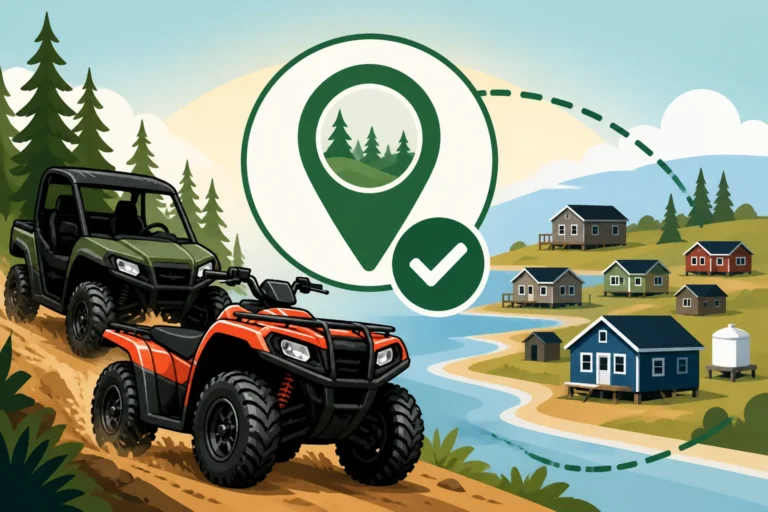
Another situation where the exemption might apply is at a truly remote cabin or hunting camp. Imagine a cabin deep in the bush, accessible only by a long, private road or trail that you or your group exclusively own or lease, with no interaction with public roads or Crown land for general use. If you use your ORV only within the confines of this private property, never venturing onto public access points, the exemption could hold.
However, this is a very high bar to meet. Most "remote" cabins still involve travelling on some form of public access road, even if unmaintained, or crossing Crown land that is publicly accessible. The moment your ORV touches a section of land that is not exclusively yours, the exemption disappears. The crucial test is whether any part of your journey, from arrival to departure, involves operating the ORV on public access points. Many people assume "remote" means "exempt," but the legal definition is much stricter.
Property with Limited Public Access (e.g., Seasonal Roads)
This is a common trap. Some properties are accessed by roads that are not maintained year-round by the municipality, or appear to be private gravel roads. Riders often assume that because the road is rough, seasonal, or seems private, it must therefore be covered by the "own property" exemption. This is usually incorrect.
A road might be unmaintained, seasonal, or gravel, but if it's a dedicated access route for multiple properties and is not legally considered your exclusive private land, it's likely a public road or road allowance in the eyes of the law. This means any ORV operating on it must be registered. You might have the best intentions, thinking you're being considerate by not using a paved road, but the legal status of the road, not its condition, dictates the registration requirement. Always check with your local municipality or LGD (Local Government District) to confirm the status of access roads if you're unsure. Don't rely on assumptions based on the road's appearance.
What to Do If You're Unsure or Need to Expand Your Riding
Given the strict limitations, many riders find themselves in a grey area, or realize their needs might expand beyond strictly private land. It's always better to be safe than sorry.
When to Get Registered Anyway
Even if you think you qualify for the own-property exemption, it's often a smart move to simply register your ORV. The peace of mind alone can be worth it. What if you suddenly need to cross a road to help a neighbour? What if you want to explore a new trail system that was just opened nearby? Having your machine registered gives you the flexibility to adapt to new situations without worrying about breaking the law.
The registration process through MPI is relatively straightforward, and it ensures you meet the basic legal requirements for operating an ORV in Manitoba. It also provides basic third-party liability coverage, which is a critical safety net. Accidents can happen anywhere, even on your own property, and having that base level of coverage can prevent financial disaster. If you're ready to get your machine registered, you can find a good overview in [How to Register an ATV in Manitoba]. The process typically involves a visit to an Autopac agent with your bill of sale and identification.
Documenting Your Property Rights
If you are absolutely certain you meet the exemption criteria, it's a good idea to have your property boundaries clearly documented. This means knowing where your property lines are, having a survey plan, and understanding any easements or rights-of-way that might exist on or near your land. If you have shared access with neighbours, having a formal, written agreement about ORV use can prevent disputes.
For example, if you have an unwritten understanding with a neighbour to cross a small corner of their land to access a more remote part of your property, this oral agreement might not hold up legally if an incident occurs. A formal agreement, perhaps drafted with the help of a legal template service like LawDepot, can clarify permissions and responsibilities. While this doesn't replace registration for public access, it can certainly help manage private land use. Knowing your property boundaries isn't just for ORV registration; it's good practice for any landowner.
Consulting an Expert or Autopac Agent
When in doubt, always seek clarification from official sources. Your local Autopac agent is a fantastic resource for all questions related to ORV registration in Manitoba. They deal with these rules every day and can provide definitive answers based on your specific situation. Don't rely on hearsay or what a friend of a friend told you.
An Autopac agent can look at your property's location, discuss your intended use, and advise you on whether registration is truly necessary or if you fit one of the narrow exemptions. They are also the ones who can help you with [Manitoba Autopac Agents and ORV Registration]. Their expertise can save you a lot of headaches, fines, and potential legal issues down the road. It's much better to ask a question beforehand than to explain to an enforcement officer why you thought you were exempt after being ticketed.
Beyond Registration: Other Laws Still Apply
It's absolutely crucial to remember that even if your ORV qualifies for the own-property registration exemption, it doesn't mean you're exempt from all other rules and regulations. Safety, liability, and common sense still apply, perhaps even more so because you might not have the basic insurance coverage that comes with registration.
Helmet, Age, and Impairment Rules
Even when operating on your own private land, rules regarding helmet use for youth, age restrictions for operators, and strict prohibitions against impaired riding are still critical. While some helmet exemptions exist for specific activities on private land (like farming), for general recreational riding, it's always safest to wear a helmet, especially for younger riders. [Manitoba ATV Helmet Law] and [Manitoba ATV Age Requirements] are designed for safety, and these principles should extend to private property as well, particularly if there are passengers or other people around.
Operating an ORV while impaired by alcohol or drugs is illegal everywhere, including on private land. This is a public safety issue that transcends property lines. Law enforcement can, and will, investigate impaired operation on private property, and the consequences are severe. Do not take chances with impairment, no matter where you are riding.
Liability and Insurance Considerations
This is arguably the biggest concern for unregistered ORVs, even when legally exempt. Basic registration through MPI provides a minimal level of third-party liability insurance. If your unregistered ORV is involved in an accident on your private property that injures a guest or damages their property, you could be personally liable for significant costs. Your standard homeowner's insurance policy may not cover ORV accidents, especially if the machine isn't registered or if it's used in a way that falls outside typical home insurance clauses.
It's highly advisable to speak with your insurance broker to understand what coverage you have and what you might need. You might need to purchase separate, dedicated ORV insurance even if your machine isn't registered, especially if you have visitors who might ride or be near the machine. While [Manitoba Insurance Included With Registration] offers a basic layer, if you're exempt, you don't get that. Exploring [Manitoba ATV Insurance Options] outside of MPI might be a wise decision to protect yourself. You could even use a template from LawDepot to create a liability waiver for anyone riding on your property, adding another layer of protection, though this doesn't replace insurance.
Understanding the Own-Property Exemption: A Summary
To summarize the intricate details of Manitoba's own-property registration exemption, here's a quick comparison of when it generally applies and when it absolutely does not. This table isn't exhaustive, but it highlights the core distinctions.
| Scenario for ORV Use | Does Exemption Apply? | Explanation and Key Considerations |
|---|---|---|
| Riding solely within a private, deeded farm or acreage. | YES | If the ORV never leaves your legally defined property boundaries, including not touching public roads or ditches. |
| Riding on a private road you exclusively own or lease, with no public access points. | YES | Very rare; the road must be 100% private and inaccessible to the general public. |
| Moving a machine on your property that is bisected by a public road, requiring you to cross the road. | NO | Any public road, shoulder, or ditch crossing, no matter how brief, voids the exemption. |
| Riding from your private property onto a designated public ATV trail or Crown land. | NO | Public trails and general Crown land always require a registered ORV. |
| Riding on a neighbour's private property with their permission. | NO | The exemption is for your own property. You need to be registered or your neighbour needs to be. |
| Using an ORV on an unmaintained or seasonal access road that is still a public right-of-way. | NO | The legal status of the road determines public vs. private, not its condition. |
| Transporting an unregistered ORV on a trailer on public roads. | YES | The exemption applies to operation, not transport. The machine can be trailered, but not driven, on public land. |
| Operating an ORV on a private community property (e.g., shared cottage development with communal roads). | NO | Unless you exclusively own all the roads and common areas, it's not "your own property" in this context. |
This article is for general informational purposes only and does not constitute professional advice. Laws, prices and regulations vary by location and change over time. Consult a qualified professional for guidance on your specific situation.