Manitoba Trail Grant Programmes
Manitoba’s trail grant programme matters to riders because maintained routes, safety work and repairs to damaged land all need funding. But the existence of a grant does not mean every club, project or trail qualifies, or that a route will always be open. Here’s what the programme supports, how it relates to registration fees and what riders can check before heading out.
What Manitoba’s trail grant programme supports
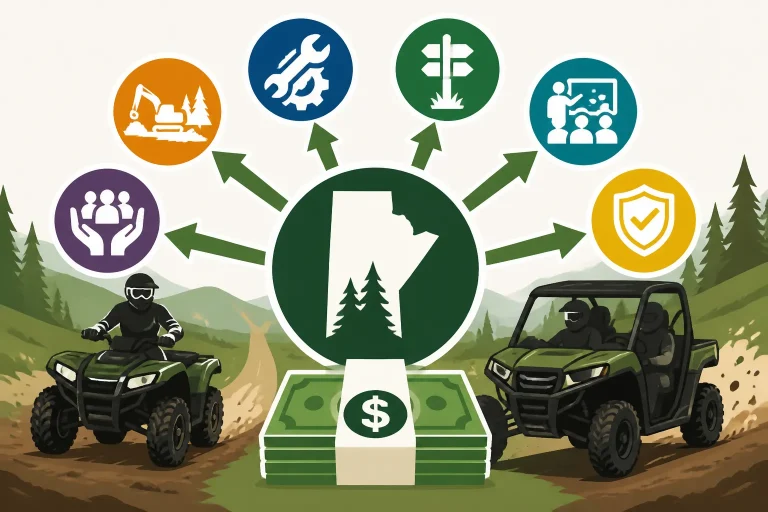
The Manitoba government offers the Off-Road Vehicle Land and Trail Rehabilitation Grant program. According to Manitoba Environment and Climate Change, it is funded through annual off-road vehicle registration fees and supports public trail maintenance, trail development, safety education and rehabilitation of public land affected by off-road vehicle use.
That purpose covers several different kinds of work. Maintaining a public trail might involve addressing wear or damage, while trail development can involve establishing or improving a route. Safety education is a separate purpose from physical trail work, and land rehabilitation focuses on public land impacted by riding. These are the programme’s stated areas of support; they do not, by themselves, establish which project expenses or applicants are eligible.
| Programme purpose | What it can mean for riders | What to verify before assuming a project qualifies |
|---|---|---|
| Public trail maintenance | Work intended to keep a public route in usable condition | Whether the route and proposed work meet current programme rules |
| Trail development | Work to establish or improve public off-road trails | Whether new routes, upgrades or related costs are eligible |
| Safety education | Activities intended to help riders use off-road vehicles more safely | Which education activities and expenses the programme accepts |
| Public land rehabilitation | Repair work on public land affected by off-road vehicle use | How the programme defines eligible land, damage and restoration work |
The word “public” is important. The programme description is about public off-road vehicle trails and public lands, not a general fund for private recreational property or any expense associated with owning a machine. A group considering a project should confirm how the programme defines public access, trail responsibility and eligible work rather than assuming that a popular route is automatically covered.
The grant’s listed purposes are also not a promise of funding for every project. The available facts do not set out application dates, grant amounts, matching requirements, applicant qualifications or the decision process. Those details can affect whether a project can proceed, so an organizer should check the current official programme information before budgeting or committing to work.
For a broader explanation of how trail-related registration funding fits into the province’s system, see Manitoba’s Off-Road Trails Fee Explained and Where Manitoba’s Off-Road Trails Fee Actually Goes. The grant programme is a useful way to understand what the money is intended to support, but it should not be treated as a guarantee that a particular trail receives funding.
How registration funding connects to trail work
According to Manitoba Environment and Climate Change, annual off-road vehicle registration fees fund the Off-Road Vehicle Land and Trail Rehabilitation Grant program. That links the registration system to public trail maintenance, development, safety education and rehabilitation work.
The relationship is worth understanding, but it is not the same as paying for a personal trail pass. Registration is a vehicle requirement, while a grant supports eligible public-purpose work under programme rules. Paying to register a machine does not establish that the rider has access to every trail, that a specific club receives money or that a particular route has been maintained.
The province’s trail system is managed by organizations as well as supported through public funding. According to the Manitoba Government, Snowmobilers of Manitoba Inc. and the All-Terrain Vehicle Association of Manitoba are involved in managing more than 13,000 kilometres of trail. The same government information identifies those organizations as managers of off-road vehicle trail networks. That does not mean every route is open to every type of machine or that every section has the same maintenance arrangements.
For an individual rider, the practical takeaway is to separate four questions:
- Is the machine properly registered? The Manitoba Government requires off-road vehicles to be registered and plated.
- Is the route legally open to this machine? Registration does not grant permission to ride anywhere.
- Who manages the route? A club or trail organization may be a useful point of contact, but confirm the route’s status.
- Is the trail currently passable? Maintenance funding does not rule out closures caused by weather, damage, construction or other hazards.
A trail grant is therefore part of a wider system, rather than a direct service that riders can assume applies to their next outing. The registration and fee relationship is covered in The $25 Trails Fee Added to Every Registration, while Trails Fee Money Spent on Trail Maintenance Grants focuses on the grant connection.
Clubs and local organizations may also have their own activities and expenses that are distinct from a government grant. If you are considering joining a club, Manitoba ATV Clubs Worth Joining and Manitoba Club Affiliation Fees Explained can help clarify the difference between club participation and public programme funding. Do not assume that club membership, vehicle registration and grant eligibility are interchangeable.
Why grant funding does not guarantee a trail is open
A grant can support maintenance or rehabilitation, but access still depends on the rules for the location and the trail’s current condition. In provincial parks, off-road vehicles are strictly limited to designated routes, according to Environment and Climate Change. A trail being visible on a map or known locally does not make it an authorized route.
Duck Mountain Provincial Park is highlighted by Environment and Climate Change as a signature destination for off-road vehicle riders. The Mossberry Trail spans 30 kilometres and accommodates off-road vehicles alongside other activities, according to Environment and Climate Change. The park also has three backcountry campsites situated along remote lakes for multi-day riding, fishing and camping, according to the same agency. These examples show how a riding area can combine routes and other uses, but riders still need to check the route information and access rules for their plans.
Closures are another reason not to treat a funded or established route as automatically available. Environment and Climate Change Manitoba lists closures including the Shell River Trail in Duck Mountain Provincial Park because of road closures on Provincial Road 367, the second loop of Spray Lakes Trail because of a landslide and fallen trees, and Hecla/Grindstone Provincial Park’s Black Wolf Trail because of construction activity. Trail status can change, so check current park notices before hauling a machine.
The same caution applies beyond provincial parks. Funding a public trail project does not settle who has permission to use adjacent land, whether a route crosses a restricted area, or whether temporary conditions make riding unsafe. Riders can use Manitoba ATV Trails: Club Ground and Crown Land to understand why the type of land matters, and Manitoba Trail Conditions Before You Haul for planning around changing access and conditions.
A useful way to think about a grant is that it may help support the trail system, while the rider remains responsible for checking whether a particular trip is allowed and practical. Before setting out, confirm the route, any local restrictions, the trail’s latest condition and whether the machine is permitted there. In provincial parks, use designated routes only.
How riders and project organizers can use the information
If you are a rider, the programme can help explain why registration is connected to public trail work. It is not a substitute for checking the route or carrying out the required safety preparation. According to the Manitoba Government, off-road vehicles require registration and plating, and helmets are required when operating an off-road vehicle. The Manitoba Government also identifies headlights, taillights, mufflers and spark arresters as safety requirements, and seat belts are required on applicable vehicles. These obligations apply independently of whether a trail project has received grant support.
If you are involved in a club, community group or trail project, start with the programme’s stated purposes, then confirm the current application requirements with Manitoba Environment and Climate Change. Ask specifically about applicant eligibility, the meaning of a public trail or public land, eligible activities and costs, application timing, required documentation, and any obligations after a project is approved. Those are practical questions to settle before estimating expenses or promising that a proposed route will be built.
It is also sensible to distinguish work that benefits public access from work that mainly benefits a private property or a single user. The programme description points to public trails and public lands, but the exact boundary between eligible and ineligible work must come from the current programme terms. A project description should explain the public purpose and the intended maintenance, development, safety education or rehabilitation outcome without assuming approval.
For a rider who wants to help without applying for a grant, local clubs can be a starting point for learning about volunteer opportunities, trail notices and route stewardship. Manitoba Trail Volunteer Days may help you find a suitable way to contribute. You can also visit ATVMB to find additional riding areas in Manitoba, as Environment and Climate Change recommends. For route planning, Manitoba ATV Trail Map Downloads and Manitoba Park Trail Conditions Pages can help direct you to maps and park updates.
The simplest approach is to keep funding, access and safety as separate checks. A grant supports specified public purposes; it does not certify every route as open. Registration applies to the vehicle; it does not replace permission or park rules. A trail map helps with planning; it does not guarantee current conditions. Checking each point before a ride is the best way to benefit from trail improvements while respecting the limits that still apply.
Sources
- Manitoba Government — Province of Manitoba | News Releases | Manitoba Government Introduces Off-Road Trails Safety and Maintenance Act (checked November 3, 2026)
- Environment and Climate Change — Parks and Protected Spaces | Environment and Climate Change | Province of Manitoba (checked November 3, 2026)
Disclaimer
This article is for general informational purposes only and does not constitute professional advice. Laws, prices and regulations vary by location and change over time. Consult a qualified professional for guidance on your specific situation.