Manitoba Crown Lease Access Rules
A map may show Crown land, a trail may look well used, and no fence may block the way—but none of those facts automatically gives an ATV or UTV rider permission to cross a Crown lease. The key is to confirm who occupies the leased land, whether your route is authorized, and what other rules apply before unloading or riding in.
Crown land and Crown leases are not the same thing
Crown land is land owned by the provincial government. Some Crown land is open to public access, subject to applicable laws, closures and land-use restrictions. Other areas are leased or otherwise occupied for a particular purpose. A Crown lease can give an occupant rights to use and manage an area, so riders should not treat leased land as unrestricted public riding space.
For an ATV or UTV trip, the practical rule is straightforward: get permission from the leaseholder or other authorized occupier before riding on or across a Crown lease, unless a clearly authorized public route applies. Do not assume that general public access to Crown land includes permission to drive through an occupied lease.
This distinction matters because a route can cross different kinds of land in a short distance. A public road, an established trail, open Crown land and leased land may appear connected on a map, but they do not necessarily share the same access rules. A track visible on a phone or satellite image is evidence that someone has travelled there—not proof that the public may use it.
| What you find | What it means for your ride |
|---|---|
| Crown land with no known lease or access restriction | Check applicable rules, closures and land-use limits; public ownership alone is not a guarantee that every kind of riding is allowed. |
| Crown land identified as leased or occupied | Contact the leaseholder or authorized occupier and get permission before riding across it. |
| A marked, maintained ORV route | Confirm that the route is current, open and authorized through the land you plan to cross. |
| A track on a map or satellite image | Treat it as a clue, not permission. Verify the land status and access. |
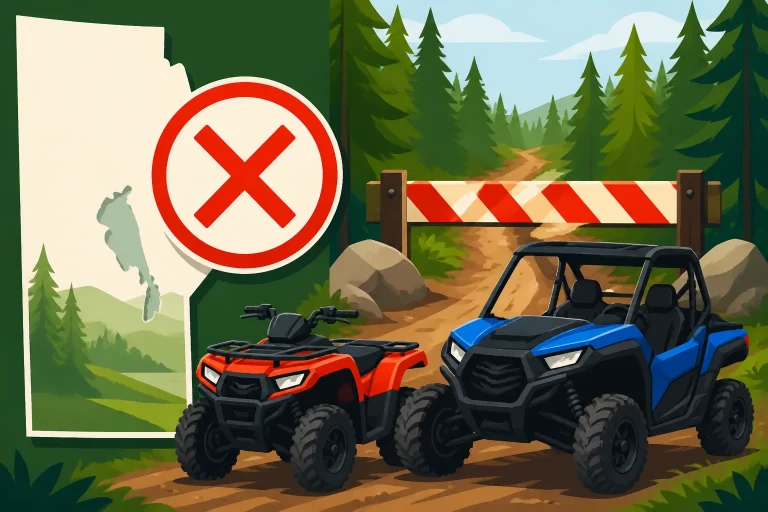
| A gate, fence, sign or blocked trail | Stop and respect the restriction. Do not go around a barrier to continue. |
| Unclear land status or no way to confirm access | Choose another route until permission and access can be verified. |
The details of Crown land access are worth checking separately from riding permissions. Manitoba Crown Land Riding Explained covers the broader distinction between riding on Crown land and having authority to use a particular route. For leased areas, the specific issue is whether the leaseholder or occupier has authorized your access. See also Crown Leases Need the Occupier’s Consent First.
A lease does not necessarily mean every part of an area is fenced, visibly posted or actively used at the time you arrive. Nor does an open-looking trail prove that the leaseholder has allowed public ORV traffic. When in doubt, take the cautious route and ask before entering. A useful overview of the permission question is Consent From a Crown Lease Holder.
How to confirm access before riding
Before planning a route through leased land, identify the area and the person or organization with authority to grant access. Then confirm that your intended activity—not just general entry—is allowed. Permission to walk in, hunt, fish, camp or reach a cabin may not automatically cover ATV or UTV travel.
Identify the route and land status
Start with a current map or local trail information, but use it to frame questions rather than settle them. Write down the trail or road name, nearby landmarks, the section you want to ride and where you plan to enter and leave. If the route crosses multiple parcels, ask about each section. Permission from one leaseholder does not authorize travel across neighbouring leased or private land.
Maps may not show lease boundaries, access agreements or temporary restrictions. A club map may show a route that has changed, been closed, or is open only under particular conditions. Look for recent notices and ask the organization responsible for the route whether it remains open to the public. The broader guide to access questions is Manitoba Crown Land Access Rules.
If you cannot tell whether a route crosses a lease, ask the appropriate provincial land office or local authority for help identifying the responsible contact. Avoid relying on an old map pin, a social media post, or another rider’s statement that “people use this trail.” Someone else’s past access does not establish your permission.
Ask for permission that matches your plan
When you reach the leaseholder or authorized occupier, explain what you want to do clearly. Include:
- The date or date range of the ride.
- The number and type of machines.
- The exact route, entry point and exit point.
- Whether you will stop, park, camp, fish or hunt along the way.
- Whether you are travelling alone or as part of an organized group.
- Any trailer staging or vehicle parking you need.
Ask whether the permission covers every machine and rider in your group, and whether it has conditions. The leaseholder may limit access to a particular route, require you to stay on a road, set a time window, or refuse access because of livestock, crops, work activity, fire risk or other concerns. Treat those limits as part of the permission, not as optional suggestions.
A written confirmation, text or email can help prevent misunderstandings about the route and dates. Written permission may not be a universal legal requirement, but keeping a record is sensible—especially for a group ride or a route with several access points. Save the contact details and any conditions with your trip information.
If permission is denied, unclear or limited to a different activity, do not enter on the assumption that the restriction is unlikely to be enforced. Ask about an alternate route, or plan to ride somewhere else.
Treat barriers and posted instructions seriously
A gate or fence may protect livestock, crops, equipment or a work area. Do not open it unless you have permission and know how the leaseholder wants it handled. If you are authorized to pass through a gate, follow the instructions you were given and leave it in the required position. Never drive around a closed gate or cut across land to bypass a blocked route.
Signs can communicate a closure or a specific access condition, but the absence of a sign is not proof that access is allowed. Likewise, a worn path does not mean that it is open to motorized traffic. If the sign’s meaning is unclear, stop and seek clarification rather than continuing into the area.
Permission is only one part of a legal ride
Getting permission to cross a Crown lease does not replace other requirements. Registration, insurance, operating rules, fire restrictions and local access limits remain separate questions. A landholder can authorize access to land but cannot waive provincial rules or make a closed public route legal to ride.
Registration and operating rules still apply
Confirm that your machine meets Manitoba registration requirements, and carry the required documents while riding. Registration is not permission to use a particular lease or trail; it is a separate obligation. For the general rule that registration is not limited to trail use, see Manitoba Requires Registration in Any Location. For document-carrying details, see Carrying Your Registration Card on Every Ride.
You must also follow the rules that apply to the type of route you are using. Permission to cross a lease does not make a roadway open to an off-road machine, authorize riding in a ditch where it is prohibited, or allow you to use a shoulder outside the applicable exception. Review Manitoba ORV Road Rules Explained before treating a road or roadside as a connector between trails.
Check for temporary closures and sensitive land
Access can change with conditions. A route may be closed because of wildfire danger, fire operations, environmental sensitivity, land work or another temporary concern. Check official notices and local trail information close to the day you ride, not just when you first plan the trip. Manitoba Wildfire Season Rules for Riders and [Manitoba Area Closure Orders] are useful starting points for fire-related restrictions and area closures.
Even where a leaseholder permits access, stay on the agreed route and avoid damaging the land. Wet ground, muskeg, crops, planted areas, shorelines and other sensitive terrain can be particularly vulnerable to vehicle traffic. Do not widen a trail to get around mud or take a shortcut across vegetation. The guidance in Manitoba Sensitive Areas to Avoid can help with route choices beyond the lease-access question.
Private land may adjoin or sit within a broader Crown land area. Permission for a Crown lease does not automatically carry over to neighbouring private land. Check access separately and get permission from the relevant owner or occupier. See Manitoba Private Land Permission.
A trail map is not a land-access agreement
A route shown by a club or on a recreation map is useful for planning, but it should not be treated as a blanket promise that every part of the route remains open. Ask the club or route manager about current conditions, then verify any leased sections with the person who can authorize access. The closer you get to the ride date, the more important it is to check for closures, detours and seasonal changes.
A sensible rule is to separate three questions:
- Is the route legally open to an ATV or UTV?
- Do I have permission to cross every leased or privately occupied section?
- Does my machine and riding plan meet the registration, insurance and operating requirements?
A “yes” to one does not answer the others.
A practical pre-ride check for leased land
Use this sequence when a proposed route may cross a Crown lease:
- Map the full route. Note entry and exit points, connecting trails, roads, parking and any planned stops.
- Check current land and trail information. Look for lease indicators, route notices, closures and detours. Treat map data as a starting point, not final authorization.
- Find the authorized contact. If the leaseholder is not identified, ask the appropriate provincial land office or local authority how to confirm the responsible contact.
- Request permission for your actual activity. State that you plan to ride an ATV or UTV, and provide dates, group size and route details.
- Record the conditions. Keep the contact’s instructions and any written permission available during the trip.
- Recheck before departure. Confirm that no fire restriction, area closure, route change or land-use issue has altered the plan.
- Follow the approved route exactly. Respect gates, signs, speed or timing conditions, and any request to avoid sensitive or working areas.
- Have a backup route. If access is denied or uncertain, turn around or choose a route with verified access.
If a trip involves multiple machines, a club event or riders who do not know the area, share the permission conditions with everyone before setting out. Make sure the group understands where the authorized route begins and ends. A lead rider’s permission does not help if the rest of the group takes a different track.
If the leaseholder cannot be reached, do not treat silence as approval. Plan around the lease or postpone that part of the ride until access is clear. The extra call is usually less trouble than arriving at a gate, disrupting land use or being asked to leave.
Disclaimer
This article is for general informational purposes only and does not constitute professional advice. Laws, prices and regulations vary by location and change over time. Consult a qualified professional for guidance on your specific situation.