Ontario Riders Bringing a Quad Across the Border
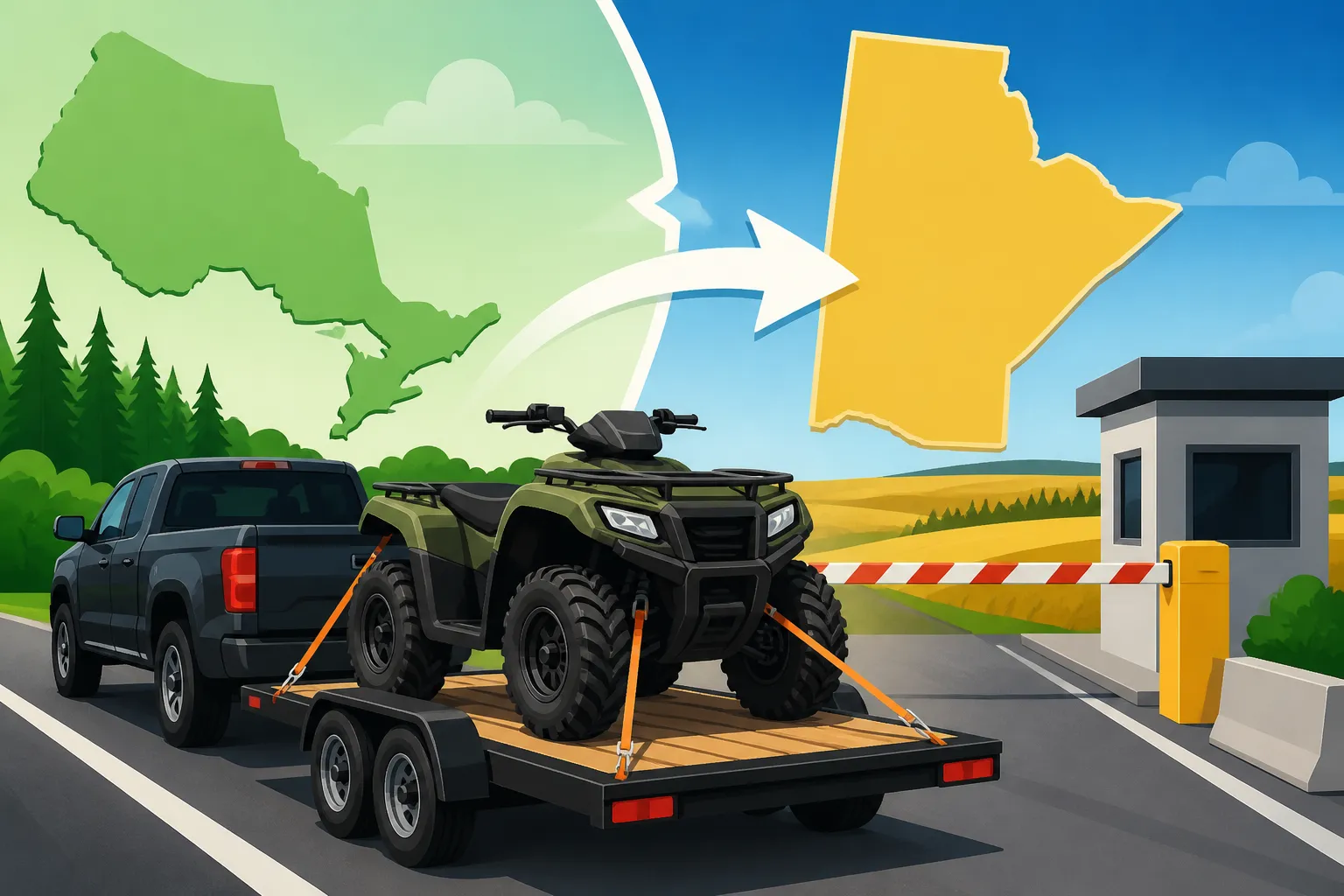
An Ontario rider can bring a quad to Manitoba without automatically registering it there, but a valid Ontario registration does not give permission to ride everywhere. The key is to sort out the machine’s paperwork and insurance, then check Manitoba’s operating rules and the local access conditions for every place you plan to ride.
What to sort out before you leave Ontario
For a temporary visit, a quad that is properly registered in Ontario may qualify for Manitoba’s visitor exemption from provincial registration. The important condition is that the machine’s home-jurisdiction registration is valid and the rider can show proof of it. If the quad is unregistered, its registration has expired, or the ownership paperwork is unclear, do not assume the visitor exemption applies. Check the current requirements with Manitoba Public Insurance before travelling.
This is a registration exemption, not a blanket waiver of every Manitoba requirement. Visitors still have to follow Manitoba’s operating rules, and a valid Ontario permit does not override a local trail closure or a landowner’s decision to deny access. For the distinction between home registration and Manitoba rules, see Manitoba Visitors Registered at Home and Manitoba Visitors and Operating Rules.
Before packing the quad, check that its identification number matches the paperwork and that the person bringing it has permission to use it. If you borrowed the machine, carry the owner’s contact details and written permission. If it has recently changed hands, make sure the sale documents connect the seller, buyer and machine clearly. Manitoba Proof of Ownership on the Trail explains why ownership evidence can matter even when you are only visiting.
A useful pre-trip document set includes:
- The Ontario registration permit and any other proof of registration issued for the machine
- Proof of insurance that applies to the quad and the trip
- Proof of ownership, or written permission from the owner if you are borrowing it
- Contact details for the insurer and the machine’s owner
- Any club, event or park information required for the specific riding area
Keep the documents accessible rather than buried under luggage. A waterproof document pouch can help protect paper records from rain, mud and a wet machine; a plain pouch from a local retailer or Amazon can work. Keep a phone copy as backup, but do not rely on a digital image if you are unsure whether it will be accepted in the situation.
The quad’s registration is separate from the registration or plate requirements for the vehicle and trailer carrying it. Check those requirements for your tow vehicle and trailer before crossing into Manitoba. If you are unsure whether the trailer needs its own plate or paperwork, see Trailers and Their Own Plates in Manitoba.
Registration, insurance and the Manitoba trails fee
A visitor whose quad is validly registered in Ontario generally does not need to buy a Manitoba ORV registration for a temporary visit. Manitoba’s registration surcharge that helps fund trails is associated with Manitoba registration; visitors who qualify for the home-registration exemption generally do not pay that Manitoba fee. The exemption is not the same as a trail pass, and it does not automatically provide access to club trails or other private riding areas. See Why a Visitor Never Pays the Trails Fee for the fee distinction.
| Before riding | What to verify | Why it matters |
|---|---|---|
| Ontario registration | It is current and applies to the machine you are bringing | A visitor exemption depends on valid home registration |
| Insurance | The policy covers the quad in Manitoba and the riding you plan to do | A policy may have territory, use or driver restrictions |
| Ownership | You can show ownership or permission to use the machine | Registration and permission to possess the quad are different issues |
| Riding location | The land or trail is open to ORVs and you have any required permission | Registration does not grant access |
| Local rules | Municipal, park, club and closure rules allow your machine and planned route | Rules and access can differ from one area to another |
Insurance deserves a direct call to your insurer. Ask whether the quad’s policy applies in Manitoba, whether it covers off-road operation, and whether the specific riders are covered. If the quad is financed, rented, borrowed or insured under someone else’s name, ask whether those circumstances affect coverage. Get the answer in a form you can keep with your trip records.
Do not assume that an Ontario policy automatically meets every Manitoba requirement simply because it is valid at home. Manitoba has rules for insurance and visiting machines; read Manitoba Insurance Rules for Visitors and confirm your own policy with the insurer. If you need to understand the province’s basic liability rule, Manitoba’s Liability Coverage Requirement covers that separate issue.
If you plan to use more than one machine, check each one individually. Registration and insurance attach to the relevant machine and policy, not to the group or the truck transporting them. A passenger’s quad, a spare machine or a borrowed unit should not be treated as covered just because another quad in the convoy is registered.
Manitoba rules still apply once you arrive
Visitors are expected to follow Manitoba’s operating rules while riding in the province. Ontario rules do not travel with the quad in place of Manitoba law. This matters for where an ORV can travel, how it may cross a roadway, rider and passenger requirements, helmets, lighting and other operating conditions.
The broad principle is simple: a quad is not allowed on every road, trail or piece of open-looking land. Manitoba generally restricts ORVs from roadways, with limited exceptions and specific conditions for certain movements such as crossings. A route that appears convenient on a map may still be a prohibited roadway or an area where local rules do not permit riding. Review Manitoba Rules for an Out-of-Province Machine and Manitoba ORV Road Rules Explained before planning a road connection.
Do not treat a short road segment as harmless merely because it links two trails. Manitoba has detailed rules about where and how some crossings may occur, and municipal rules can add restrictions or allow specific local routes. If a planned trip depends on using a road, ditch or shoulder, confirm that exact route rather than relying on another rider’s recollection. The separate rules for crossings are covered in Manitoba Rules for Crossing a Highway.
Rider age, licence status and machine design can also affect what is permitted. A child who can operate a quad at home may face different supervision or operating restrictions in Manitoba. Passenger rules depend on the machine’s design and seating, not just on whether the passenger can hold on. A parent or group leader should check the applicable Manitoba requirements for every rider and passenger before setting off.
Equipment requirements matter too. Check that the machine is in safe condition and that required lights and other equipment work, particularly if any part of the ride could continue toward dusk. Carry a helmet that meets the rules and fits the actual rider. Do not assume that a helmet accepted for one rider or activity is automatically appropriate for everyone in the group.
Riders should also plan for restrictions that can change with conditions. An area may be temporarily closed because of wildfire risk, damage, maintenance or another local concern. Check current notices and signs before unloading, and again if you move to a different riding area. A registration exemption does not excuse riding in a closed area.
Choosing a place to ride and checking access
The most important planning step after paperwork is confirming where the quad may legally go. Manitoba includes club-managed trails, provincial park routes, Crown land and private property, but those categories do not all have the same access rules. Public land is not automatically open to motorized riding, and a line on a general map is not proof that an ORV route is authorized.
For a club trail, check the local club’s current information before making the drive. Confirm that the trail is open, that your machine type is allowed, and whether the club or event has an access requirement. Manitoba does not have a general mandatory ATV trail pass for every visitor, but local arrangements and organized events may have their own requirements. Ask the trail operator directly rather than assuming that the province-wide registration surcharge functions as trail access.
Provincial parks require particular care. A park may allow ORVs on designated routes while prohibiting them elsewhere. Park access for a truck or trailer should not be confused with permission to ride the quad throughout the park. Check the park’s current route map and restrictions, and confirm whether any separate permit applies to the vehicle you are bringing into the park.
Crown land also does not mean unrestricted access. Some areas have restrictions, sensitive ground, leases or other conditions. A Crown lease may require the occupier’s consent, and private land requires the landowner’s permission. Cropland, gated rangeland, wetlands and other sensitive areas are not safe to treat as informal trails. For practical access distinctions, see Manitoba Crown Land Access Rules and Manitoba Private Land Permission.
A good pre-ride routine is:
- Choose the specific trail system or riding area rather than planning to “ride somewhere nearby.”
- Check the current map, closure notices and local rules for that location.
- Confirm that the route allows your type of machine and that any required permission is in place.
- Ask the club, park office, landholder or local authority about anything unclear.
- Save the route information and a backup plan in case access changes or the trail is closed.
- Read signs at the staging area and turn back if posted restrictions differ from what you expected.
Local information is especially valuable when a route crosses municipal boundaries or uses a shared corridor. A club volunteer may know whether a trail has been affected by recent weather, while a park office can clarify park-specific restrictions. If the route involves a road or a local community, check with the appropriate municipality or community authority as well.
A practical checklist for the border trip
Before loading, make a quick check of the machine, papers and planned riding area. This helps avoid two common mistakes: arriving with an expired or mismatched registration, and assuming that an otherwise legal visitor machine can ride any accessible-looking route.
- Confirm the Ontario registration is valid and belongs to the quad being transported.
- Check the machine identification number against its paperwork.
- Confirm with the insurer that coverage applies in Manitoba and to the intended off-road use.
- Carry proof of ownership or written authorization if the quad is borrowed.
- Check requirements for the truck and trailer separately.
- Choose a specific riding area and verify access, closures and local rules.
- Confirm any club or event requirements directly with the organizer.
- Carry the documents where they can be reached during the ride.
- Recheck signs and conditions at the trailhead before unloading or setting out.
If your situation is not a straightforward temporary visit—for example, the quad is unregistered, the owner lives in Manitoba, you are moving to the province, or the machine was bought shortly before the trip—ask Manitoba Public Insurance how the registration rules apply. The visitor exemption should not be used as a substitute for sorting out a permanent move or an ownership transfer. For a basic visitor with current Ontario registration, however, the central approach is manageable: keep the home paperwork valid, confirm insurance, and follow Manitoba’s rules and the specific access conditions where you ride.
Disclaimer
This article is for general informational purposes only and does not constitute professional advice. Laws, prices and regulations vary by location and change over time. Consult a qualified professional for guidance on your specific situation.